NOTE: If you want to tell me I\'m full of crap
SEND COMMENTS TO BUDDAIRBUM@COX.NET :
THINKING OUT LOUD
22 July 2022 - Gigantic Change Coming for Thinking Outloud
After something like 15 years of blogging in this space, I\'ve decided I have to face realities and catch up with the times. And my life situation. As of today I\'m starting a new Thinking Out Loud outlet on Substack.com. It will no longer be updated on Airbum.com. The new URL is budddavisson.substack.com. Right now it is free, but somewhere down the pike I\'m going to start charging for part of the new content. I hate to do this, but as with so many others, I\'m running out of time so I have to make as much of it pay for itself as possible.
For the most part, if you don\'t want to subscribe to the paying part of Substack, you\'ll still get some free stuff, but you won\'t have access to much of the new materials or a whole lot of new features I\'m going to work in like audio pilot reports, new written pireps, more and varied Neat Sh*t galleries, etc. To put it in very blunt terms, making a buck is getting harder and harder so I have to keep getting smarter and smarter. The fee for the paid portions will be $5/mo or $50/year. Less than a buck a week.
A good portion of Airbum.com is going to remain as is. But, I\'m going to start removing a few sections and may make some of them, like Pilot Reports, available as part of the Substack.com subscription service. Pilot reports is one of the sections I\'ll be expanding. These changes will start happening, when I get back from Oshkosh, the week after next.
I can\'t begin to explain how this pains me. And I\'m not just saying that for effect. I\'m saying that because Airbum readers are my family and for the past 15 years or so have been with me through lots of both good and bad times. I hope ya\'ll understand. And I hope most of you will follow Thinking Out Loud over to Substack.
THIS REALLY SUCKS!!! bd
4 July 2022 -- Our Political Pissing Contest Will Sink us
The definition of a nearly unsolvable problem is one that stretches to the horizon and you can\'t see the edges that define it. Unfortunately, that is the current state of the Union. Wall-to-wall we have infinite, undefined problems, most being rooted in partisan politics.
This is the Fourth-of-July weekend. Monday is the anniversay of when we signed what has to be one of the gutsiest documents ever signed. It clearly told The Crown to stuff it. With no way to back out, we declared that we\'re free and we\'ll fight to stay free. Further, the King and his crew have to get the hell out of Dodge.
Never mind that we\'re a bunch of sometimes illiterate farm hands with black dirt under our finbernails and have a laughably small, ill-equipped and poorly-trained army. Never mind that the bad guys are the mightiest military nation on Earth. Never mind that a small cadre of mostly-wealthy colonialists put their names on paper and their fortunes and lives on the line betting it all in a drive for freedom.
If Las Vegas odds-makers had been around they wouldn\'t have given the Founding Fathers a snow ball\'s chance in hell of even surviving. Much less winning. But they did. WE did. 246 years later we\'re still reaping the unbelievable benefits of their efforts. However, we\'re in the process of screwing it up in the name of political positioning.
It\'s worth noting that the average stable length of any given civilization in history is 300 years, a few re-invented themselves after 300 years, most didn\'t. Almost all of them failed because of internal divisions and opportunistic approaches to leadership. Our deadline is just around the corner.
It appears as if both parties have lost sight of what the goals of the Founding Fathers were and how clearly they are stated in the Constitution. In point of fact, it is becoming clear that politicians no longer view the Constitution as our guiding document because it is getting in their way. They\'re more concerned with keeping their jobs and building power than serving The Nation.
Part of the difficulties are rooted in a general misunderstanding by the population that thinks we\'re a Democracy that is ruled by majority, rather than a Republic that is govern by the rules laid out in the Constitution. It is an absolutely brilliant, but often ignored, road map for America.
A similar misunderstanding surrounds the purpose and function of the Supreme Court. The Roe vs Wade controversay has made it abundantly clear that the general population sees SCOTUS as being liberal-versus-conservative and decisions are made that way. However, what is actually happening is that what are labeled "Conservative" or "Right Wing" are actually judges who are "Originalists"— They cling to the original purpose of SCOTUS, which, as a totally separate branch of government and independent of any outside control, is to judge challenged laws against the template as laid down by the Constitution. No personal opnion is supposed to be involved. It\'s either in the Constitution or it isn\'t. However, that is open to internal SCOTUS debate to even out the differences in judges\' opinions.
In the latest dust-up, the Roe/Wade thing, Constitutional Amendment X, clearly states that "The powers not delegated to the United States by the Constituion, nor prohibited by it to the sates, are reserved to the states respectively, or to the people." The Constitution says nothing at all about abortions so that subject belongs to the states. For that reason, the Federal government has no dog in that hunt. The People can vote the way they like in their state. This actually gives them more control on a local level.
I won\'t comment on the abortion thing but I will comment on the way in which politics are beginning to destroy the Nation. Both sides have forgotten that their goals should be to preserve and project the nation. Not ignore The People in favor of The Party. I\'m a hard core Independent, So, I don\'t want to appear to favor one side or the other but it\'s really sad to see things like the following Tweet, which was published in the news here in my own Arizona, "Let\'s Mourn with F*ck the Fourth. See you at Reid Park" which the news said was the message from the Pima County Democratic Party.
"F*ck the Fourth"??!! Give me a break! How can anyone on any side of any political argument say something like that? Especially on this weekend.
There is no perfect country on the planet. However, no country spends more time or money trying to iron out its internal wrinkles than the US. No country offers more opportunity or more freedom. God knows our history is rife with unspeakable blunders but most are being addressed as quickly as our national inertia will allow. Tony Blair, England\'s ex-leader summed it up best, when he said, "You can judge the quality of a country by whether people are trying to get into it or out of it." Our legal and illegal incoming immigration should answer that.
Additionally, the two main political parties spend far more time sniping at each other than they do trying to honestly understand or represent the general population. And they spend far too much time catering to radical elements on both extremes. We have a huge number of identity groups that constitute anywhere from 2%-5% of the population that have far more impact on politics than the rest of the country does. The tail is definitely wagging the dog and the eventual effect will be the death of the dog.
The following is a hyper-typical statement. This from a Congressional candidate’s ad that showed up a few days ago. The all-cap words are my edits. This could have come from either side of the aisle.
Trump/BIDEN and his National Republicans/DEMOCRATS are pushing a far-right/LEFT agenda onto the American people that simply does not represent our Democratic/REPUBLICAN values.
Political and opinion divides are to be expected. However, we\'re now drawing lines against family and friends that are often wounds so deep they won\'t heal. This is tragic. A difference of opinion is what progress is built upon. It shouldn\'t kill relationships. Or countries.
Just sayin…bd
19 June -- Golden Years my Ass!
I\'m laughing as I\'m typing this. But, I don\'t know why. It has something to do with the fact that I\'m once again in the process of starting a new life but the world is in the process of falling apart around us. Nice, timing, Budd!
This whole "starting over" thing is getting old. But, not really. There is something to be said for the process of redirecting a life because it\'s like cleaning out a closet that\'s so stuffed, we can\'t wedge one more item into it. The closet has always been that way, so we just ignore it. It\'s like part of the wood work. However, once we get into cleaning mode and attack it, we inevitably stumble across stuff we haven\'t used in years and can\'t identify part of the rest. So, the trash can is full and the closet is empty or close to it. We now have more space than we know what to do with. Redirecting a life often works much the same. Toss out the old and look for the new. Been there, done that, doing it again, learning a lot in the process.
I\'m certain I\'ve talked about it before, but about a month after arriving here in Phoenix, I spent my 50th birthday alone. Part of it was spent sitting in a borrowed car, on an empty piece of Arizona desert in a gray drizzle. My wife had bailed, leaving me with a 13-year-old daughter (which came with no instruction manual), a son in college and every single revenue-producing endeavor I had going had split-Sed into the ground. I was starting from scratch. I had a yellow pad in my lap on which I had printed in big letters, "What Do I Want My Life to Be?" A column of goals was stacked up under the headline with thoughts about how to accomplish those goals under each.
Looking back on what was written on that pad, I have to say I\'m mildly surprised at how well I\'ve done in accomplishing those goals. However, I\'m not surprised that I\'m now looking at a new set of goals but I am surprised that the yellow pad is still in my lap and I\'m still using a pen, not a keyboard. Thinking with a pen in your hand seems to be more natural and organic than typing onto a screen. That\'s undoubtedly a graydog way of thinking.
The original pad-scribbling happened decades ago, 1992 to be exact, and both the world and my life have changed radically since. Most changes have been for the better, most were expected, some totally unexpected, some avoidable, some not.
Every single person reading this can look back and say the same thing about life\'s changes and how everything seems to be accelerating. How many of us can say we\'re still who and where we were 30 years ago? Very few And I don\'t want any of the younger smart asses out there saying "Thirty years ago?! Damn, I was in fourth grade!" And, if there actually are any youngsters out there reading this (that\'s anyone under 40) I don\'t want them thinking that what they\'re doing, or where they\'re doing it, is going to last forever. Or even for ten years.
The world has become based upon change that happens so quickly it can be dizzying. However, now that I think about it, from what I\'m reading in the press, it\'s the youngsters who don\'t expect their careers/jobs/lives to be an uninterrupted continuum. For them, change is their stability.
Some of the new age ways of the digital world can be seen by the changes that have affected Airbum.com. Three years ago, I hired a web company to help me redesign my website. I was doing that to attract advertising revenue. Cutting to the chase, I wasted three years and many thousands of dollars and came up with virtually nothing. That\'s just as well, because, during that same time frame, the newsletter/podcast and You-tube universes made non-commercial websites nearly obsolete as a way of selling anything. So, right now I\'m learning a lot that the youngsters already know but we graydogs are just beginning to recognize.
I\'m going to be talking about this more in the future because I\'m not scheduling ANY flying between the Fourth and when I leave for Oshkosh. Flying eats up a minimum of five hours a day, which is why my work days usually start at 0330 and wrap up at around 2100 hours. During the three weeks leading into OSH, I\'m going to be developing a new digital vehicle that will allow me to better serve a narrower market. Airbum.com will still be alive and slowly improving but it\'s going to give birth to an as-yet-unnamed sibling. Or two. Or three.
What readers of Thinking Out Loud are going to witness are the struggles of an analog graydog trying to understand and penetrate the digital world. It ought to be fun. And more than a little painful. But, then, that\'s what change is all about. If doesn\'t hurt, you aren\'t making any head way. Or something like that. Thanks for your patience. bd
5 June 2022 -- An Orgy of Opinions...Mine!
Throw a dart at the map of our current civilizations, worldwide, and, wherever it lands, that area is screwed up. Almost nothing is right in the world right now and solutions are rare. Opinions, however, are plentiful. So, for whatever it\'s worth, here are a batch of mine.
Energy
Energy is the basis of civilization and right how our push towards electric everything is us making a flying leap onto a boat 20 feet off the dock, rather than putting one foot on the dock and the other in the boat, thus making the transition easily and smoothly. Right now EV technology is so young that what is needed to go all electric isn\'t there. We\'re just not ready to make the entire change. We\'re where England was in the very beginning of the Industrial Revolution in the early 1700s. They were running out of trees for energy and shifted to coal that gave much more power, which lead to steam and increased machinery capabilities, which led to capitalist thinking and the revolution took off. It took nearly a generation for it to all happen. We\'ll eventually be all electric but not until we get better generation systems (fission? Tidal?), better batteries, better charging, etc., etc. It was idiotic to cut off known energy systems (oil/gas) without sufficient alternatives. We have taken the 20 leap off the dock and couldn\'t make it to the boat, so, we\'re floundering around trying to stay afloat.
Climate Change
Going green all at one time has the same drawbacks as the electric thing. Obviously, the climate is changing but, regardless of what we\'re told, no one absolutely knows how much of it we\'re causing or contributing to. However, it only makes sense to look at everything we do and try to make our efforts cleaner. Efficiency should be our goal but don\'t destroy economies as sacrificial offerings at the feet of what has become a pagan idol of greenology. Be sensible about it. Give technology a chance to catch up.
Border
How can ANYONE argue that there isn\'t a disaster on our border? Commonsense says you don\'t let random, uncontrolled millions stream across your border. Let people in the old fashion way. Ellis Island worked and our immigration policies work (although they could be greatly improved). Protect the country by protecting our borders.
Guns
The fight about these includes much more opinion and emotion than logic based on facts. HOWEVER, I can easily see why folks focus on them. If guns didn\'t exist, we wouldn\'t have gun violence. But, they do exist and aren\'t going to disappear or be regulated to the point of complete control. Go back to last week\'s blog. Harden the targets, improve mental awareness programs and make them part of social media.
Transgender/LBGTQ
I have zero problems with any of that. I say let people be people. Some of this is biological and some is personal choice but it\'s all part of being an individual. HOWEVER, I don\'t want it rammed down our throats or see it made part of our educational system. None of that is necessary and pushing it so hard makes it that much more difficult for the concepts to become normalized because the population begins to resent being forced into compliance. A tiny part of the population, estimated to be around 6%, falls into the LBGTQ category, so the tail is wagging the dog.
Diversity Vs Meritocracy
Life should be based on how good someone is at doing what they do. Get the best man/woman/whatever for the job. Color, gender, sexual orientation should have nothing to do with it. JUST GET THE FRIGGING JOB DONE! This applies in every aspect of our civilization.
Military
China is the Cartel on steroids and can\'t be dealt with via normal logic. Ditto N. Korea. Not so much Russia. They talk big but have too much too lose and are closer to being logical than the other two. However, they are all prepping for a fight. We can count on fighting at least one of them in the not-too-distant future so we should be preparing too. Unfortunately, our military is suffering from what I think will prove to be a temporary fad of evoking wokeness in an environment where it doesn\'t belong. Kicking ass and securing our nation should be the goal. Not making individuals feel good about themselves.
Regional Division: Urban Vs Rural, East Vs West
This will never go away. It\'s built into us as a nation. The stronger individualists and risk takers kept pushing into the interior of an unknown continent and that defines the fly-over regions. Those are areas the coasts don\'t understand and don\'t value so I don\'t expect relations to ever get better. But I sure wish they\'d stop looking down their noses at us, our cultures and our traditions.
CRT
Someone tell me why it\'s good to make people see each other via the color of their skin. Teach history as it happened. That\'s needed. Don\'t sugar coat those really bad parts of our history. But, don\'t teach division.
History Revision
See above. Teach history with all its warts and ugliness but teach it in a way that makes it fact and not warped to give a specific point of view. Facts are facts. Report them and let the reader make up their mind about them.
Inflation
The government has to stop pointing fingers at other people and other forces and own up to their mistakes. We can fix mistakes. But, any man or women on the planet who doesn\'t say, "Wow! I really screwed that up. I\'ll do better next time. Let\'s fix it." is bound to be a failure for their entire life. When things go wrong, look at the situation and determine how much of it was our own fault and move on.
Politics
Don\'t ask. I can\'t find a good thing to say about them. The leading of our nation has become a battle ground in which cheating is both ignored and expected and truth has become a casualty. However, if the November elections aren\'t held via ballot boxes that are honest, then our entire country is lost. The central core of trust will be gone.
Media
The media has turned out to be the deciding factor in almost any national arguement. This is not how it should be, but it is what it is, and we have to deal with it. That being said, however, it\'s interesting to see that some of the major outlets are beginning to change their tune a little and are touching subjects they simply hid in the past. For instance, the Hunter Biden thing is coming out from its hiding place under the rug,where it was earlier swept. Whodathunk!?
Alright I\'m done. Wow! Verbal/mental vomiting is dometimes good for you. Gets all the bad crap out of your mental system. I feel great! I hope I made no one sick. bd
29 May 2022 -- Tragedies, Guns and Reality
I really do hate to add to the massive number of words that have been tossed around about the Texas tragedy put I had an interesting experience built around it and wanted to share it.
I\'m not sure how to start this, but first I want ya\'ll to know that this isn\'t meant to be political although I\'m certain that many will see it that way. Hopefully, by posting some quotes, this is going to illustrate some differences in the way people think and will lead into what I think are some commonsense ways to prevent these terrible things from happening. There will be nothing Earth shaking here, so, if you have something important to do, go do it. Don\'t let me slow you down. The Media has literally beaten this thing to death so it\'s unlikely I\'m going to say something you haven\'t heard before.
To put the following quotes in context, I was talking to a friend, a highly intelligent, well-educated friend and laid out what I thought were already recognized ways of preventing these kinds of events from happening. Nothing new in my concepts. Here are some quotes that I\'m not sure I understand but they demonstrate the gulf that exists between the opinions of two people and how quickly conversations like this can go off the rails. There is no right or wrong here. No better or worse. Just differences of opinions.
I proposed typical security measures be enacted at schools. A response was:
You don\'t arm schools. That\'s not who we are.
I said there are 20 million AR-15s out there (this from ABC News) so crazies will always be able to find one.
Look at who has done the school shootings. They aren\'t crazies. They are sad, broke youths.
Why does anyone have to have an assult rifle unless it\'s their job to assault people.
We aren\'t talking about outlaws who buy them!! We\'re talking about losers, people who are sad and lonely.
I mentioned that the big cities have the biggest problems with shootings and was told:
When the stations like Fox News say "issues with Big cities" and Fox LOVES to talk about Chicago, that\'s code for talking about people of color. Racism is wrong. You as a privileged white man don\'t get to say what\'s racist and what isn\'t. You also should have no say in what happens to a woman\'s body
Even if you don\'t want to agree with me, the truth is that you are voting these people into office. You are the cause because the only thing that will change this stuff is our elected officials and policy changes.
In response to me saying that it\'s racist to say a white man can\'t define racism (my friend is white) I was told:
That\'s the most racist thing you have EVER SAID. You don\'t know it, but it is. And I\'m not saying who to vote for. I\'m saying who not to vote for. You are a good person so stop voting for people who don\'t follow fundamental ehtical beliefs. If someone doesn\'t believe in gun control, they think it\'s ok for a child to have a gun.
It drifted into abortions and I pointed out that I was okay up to about three or four months but not for the right-up-to-the-birth canals thing and was told:
Nobody thinks that. That\'s another Fox news/right wing tactic
This even though that\'s being proposed in at least one or two states.
And the capper:
You don\'t like who I vote for based on economic policies, global strategies and whatever falsehood you tell yourself about what it is to be a working man or woman in America. I\'m criticising your choices because they are fundamentally racist and hurt people. The stuff you don\'t like about the Democrats is just about the way in which the country is run. We\'re talking about what\'s ethical and moral. It should be just about being a good person.
Look at the rest of the world where we\'re a joke because of what the Right has done. Morals and ethics. You can tell yourself you have them all you want, but not if you\'re voting for people to try to take fundamental rights away from others. I know the difference between right and wrong. You think you do but you only support them to a point.
Each of these points/quotes could be the central theme for a major debate. But, I didn\'t, and don\'t, want to debate any of them. I\'ll just let them stand and the reader can make his own comments inside the silence of their own head.
Reducing school shootings almost to zero is not brain surgery. There are a bazillion rifles and hand guns out there and, if anyone thinks they are going to eliminate them by laws and policiies, they are kidding themselves. The logistics of dealing with 20,000,000 AR-15s are unmanageable. If the U.S. population is 330,000,000, half is men and 20% of those are kids and we figure about half are between the ages of 18 and 70, then there is approximately one AR for every 3.5 men!!! HOLY CRAP!!! I don\'t care what anyone in DC says and what kinds of onerous laws they pass, even making a dent on the AR population is a HUGE deal. They are out there, we just have to recognize that reality and deal with it.
We also have an unknown, but sizeable, population of crazies, outlaws, and screwed up kids. Combine that with the relatively easy access to firearms of all kinds (and machetes, hatchets, etc.) and there\'s always the possibility of something like Uvalde happening. Also, it\'s a known fact that the terrorists/crazies/ and kids with guns always go for soft targets. Concerts, schools, movies, malls, anywhere there are a lot of people and no security. At the same time, the young shooters who seem to focus on schools (and some of the other targets) invariably broadcast their intentions on social media. The Buffalo shooter and the Uvalde kid, both let the world know what they were about to do. So, the facts say that there are two obvious fixes.
First, harden every school of every size. Do the logical stuff. Locked doors, limited access, trained security people. If a bad guy can\'t get in, it\'s not even necessary to arm teachers. However, it is likely to take a long time to get security measures in place throughout the educational community, so, arming teachers and full time guards in the short term is a good idea. Trained security people is a good idea in the long term because school shootings seem to be following a copy cat model. They come in batches because media can\'t get enough of them, so, after every one, the claim to notoriety dangles out there like a carrot for some distorted individuals.
Also, every kind of social media should be doing public service announcements on a regular basis telling its users to sing out when they see something posted like this. The notification might be a header on the pages, or simply a note that automatically goes out once a day to every one advising them to let authorities know. The notification should have a live link to the media owner who automatically sends it on to the proper authorities.
Hard targets and social media watch dogs. It\'s as simple as that. bd
22 May 2022 -- A Life, Start to Finish
I had a very strange thing happen last week. Okay, so "strange" may not be the right word, but "different" definitely is. The folks at the EAA interviewed me for their Green Dot podcast series. In it, for the first time that I can remember, I recounted my entire life in aviation in one sitting. I\'m not sure how much of it is of interest, but here it is. It\'s about 45 minutes long and I hope this link works:
https://inspire.eaa.org/2022/05/18/eaas-the-green-dot-aviation-journalist-budd-davisson/
bd
8 May 2022 -- I Need a Quick Answer to a Short Question
Originally, I was going to distribute my list of the things that are currently going to crap in the US (as if we need to point those out) but then decided to do something of more importance to me right now: I\'m pondering how to re-direct Airbum in the future and need reader\'s opinions.
The crux of the question is simple: How many would be willing to pay $2/mo for content that isn\'t available to most Airbum readers. I NEED TO HEAR WHAT YOU HAVE TO SAY ABOUT THAT!
Airbum in its present form has been alive since 2000, which, as I\'ve said before, in website time was when dinosaurs were still roaming the Earth. I\'m well along in redoing most of the main pages for the new version of website, but am now faced with a serious decision: I\'ve reached the point in life that I need to come up with another source of revenue and doing it digitally makes the most sense. In other words: I have to figure out how to monetize the silly amount of time Airbum takes. Even Thinking Out Loud takes most of a day.
There are lots of ways folks like me are making some money on the web, most of which don\'t appeal to me. The more successful ones are single-subject blogs/newsletters. This single-subject focus is an important factor. They might address cooking. One focuses on high-dollar watches. Aviation has lots of YouTube, blogs and podcasts aimed at narrow segments of the aviation community with back country flying leading that pack. Personally, I\'m not crazy about the single subject focus and I want to work around it. HOWEVER SINGLE-SUBJECT COVERAGE MAKES SENSE.
All of my life, going back to even before I started flying in high school, aviation, specifically sport aviation, has been a central theme of my life. But, not the only central theme. Any who have followed Thinking Out Loud for any length of time are familiar with all of the fringe stuff I\'m interested in. It\'s obvious that I\'ve raised A.D.D. to a higher art form and made it into a career (of sorts) and definitely into a life style. Life, as I see it, has an unlimited number of interests in which we can indulge ourselves with aviation being just one. For that reason, in some ways I feel as if I\'m leaving a lot of unrelated, interesting stuff laying around the fringes of Airbum while there might be readers who would be interested in it. That kind of material falls under the heading of "Neat Sh*t".
I\'ve thought about pushing Airbum off to the side and developing a Neat Sh*t newsletter in its place that surrounds aviation with a ton of other interests (specialy cars, firearms, special leather work, steel work, archeology, history, paleontology, travel, etc., etc). Some of these interests have shown up in Airbum as blogs that featured big photo galleries. None of those are still listed or available. But they still exist in the archives. But, I don\'t want to leave Airbum behind. It is an intity that I think diserves longevity.
So, what I\'m proposing is segmenting Airbun.com into two departments under one heading: First, a free section that features a some of the material that is already on the website but is seldom seen. Second, a section behind a paywall that includes new, never before seen aviation content paired with Neat Sh*t content. The N/S content is best described as unexpected and mildly dramatic, from new pireps to Airbum merchandise, to archeological discoveries and lots of photo galleries of everything from castles to oddbar motorcycles to model boats that are man-sized models, and whatever blows our skirt.
To cut to the chase, I want to know if ya\'ll would be willing to pay two or three bucks a month for an upgraded version of Airbum.com. That princely sum will be spent on keeping this old country boy fed and bent on generating more new Airbum stuff. Whatdoyahsay! Drop me a note at buddairbum@cox.net. bd
1 May 2022 -- How do you Define Happy?
First, let me admit right up front that I\'m not sure where this blog is going. I recently found a question richocetting around inside my brain that I didn\'t know how to answer and I\'m going to talk it out here. Be patient. The question was, "Am I happy?" Seems like a dumb thought. But is it?
This rather obtuse thought pattern was kicked-off by a comment a friend made at lunch. He said that the stock market had recently made him more money than at any time in the past. I then said, as I often do, that early on, while still a teen, I appeared to make a conscious effort to select two career paths that were guaranteed to not make money; magazine journalism and aviation. He then retorted, "Yeah, but you\'ve been happy." That got me to thinking. Am I happy? As far as that goes, how do you define Happy?
The more I thought about it, the more confused I became. There are lots of ways to define happy. One of the leading ones may be that "happy" is simply the absence of "unhappy." However, I\'m absolutely certan that I\'m no different than the next guy in knowing exactly when I\'m unhappy. There\'s no doubt, when I\'m in that condition. However the more I thought about "unhappy" the more confusion set in because there are so many levels, degrees and types of "unhappy."
Remember what I said? I have no idea where this is going.
When defining "unhappy," do we have to divorce the emotion from the cause? Actually is "unhappy" an emotion at all? I don\'t think so. I think of being an unhappy person as having a continually negative, dark state of mind. That isn\'t an emotion. That\'s a way of being. A mental frown is your default position. That is unlikely to be the result of something that simply arouses an emotion. For instance, something happens that pisses me off. That\'s an emotion that results in an unhappy state of mind, however that\'s a temporary condition. But, does that make me an unhappy person? Of course not. Unless, of course, I stay pissed off. Some folks do, most don\'t. Those who stay pissed off stay unhappy, so I guess you can consider those to be negative, unhappy people. I don\'t stay pissed off. But, does that make me a happy person? There we go again.
My kids tell me I\'m an unhappy, negative person because I\'m always looking at the downsides of any situation. In restaurants I insist on sitting facing the door. I assume the guy at the stop sign is going to pull out infront of me. I assume my engine is going to quit everytime I leave the ground. That definitely does NOT make someone an unhappy person. You can always be prepared for the worse, but still be a happy person. The Boy Scout motto is "Be Prepared." Are they unhappy? Of course not. I was an Eagle at 14. And I was raised in a very rural setting where it was absolutely assumed bad things can happen and we\'re all responsible for ourselves and those we love. But, I can absolutely guarantee that we weren\'t, and aren\'t, negative, unhappy thinkers.
So, what is happy?
Yeah, I know I\'m going in rethorical circles. However, I\'m going to make a declaritive statement and I want you to bear in mind that what I\'m saying is based only on my own experiences with people. That and the fact that I\'ve lived inside this head for a helluva long time. So, this may not apply to all people but I\'m betting it\'s closer to average than you\'d think.
I\'m positive that there are people who wake up bubblingly happy, cruise through the day and go to bed in the same etherial state. However, I don\'t think that\'s typical. I think most folks are basically "up" people but we coast up and down between happy and sorta-unhappy in a relatively unpredictable manner. A good percentage of what pushes us closer to unhappy than happy are events and conditions that aren\'t to our liking. I have continual live-in relative aggravations and it\'s abundantly clear that they don\'t make me happy. However, I\'ve made it a goal to rise above the situation and basically ignore them because there\'s nothing I can do about it. I feel that\'s the key to keeping a more or less happy mindset in life: don\'t let what you can\'t control color your thoughts. But, that\'s not always easy to do. Some days we\'re aces at ignoring BS, other days we find ourselves taking it head-on even though we know the ultimate out come can\'t be changed. That\'s just part of being a human animal. Unfortunately, many let everything in life they don\'t like percolate in their brain until they\'re so unhappy that they\'re depressed. Been there, done that.
Sometime in my mid-forties I realized that, when it came to my mental state, I was my own worse enemy. Again, I doubt that I\'m unique. I\'d let some aggravating or sad thing in my life weevil its way under my mental saddle blanket and I would focus on it until I was totally depressed. For a while, that was a problem. I\'d spend weeks in the dumps. Then, for some unknown reason, I began to recognize the thought pattern where I was letting something push me over the edge into depression. It was a very recognizable mental event that I came to see so clearly that it would set an alarm off in my head and I\'d force myself to think or concentrate on something more upliftings. In fact, that\'s where I recognized the mental benefits of making sparks or sawdust. Other folks probably escape their own thoughts in different ways (books, music, etc.), but the workshop has always been my mental curative drug of choice.
So, apparently I define happy as being successful at keeping unhappy at bay. There! I hope some of this makes sense. I don\'t want anyone unhappy at my happy conclusion. But, it won\'t make me unhappy if you are. bd
24 April 2022 -- Health Stuff We Don\'t Know, But Should
One of the many drawbacks to being a graydog is that we\'re high mileage models and stuff starts to show wear and tear. However, just as we know to change the oil and check the tire pressures on our daily transportation, theoretically we should know some of the same stuff about our bodies. However, we often don\'t take it to heart because we don\'t truly understand what is being said.
Let\'s start off with teeth as I had a recent episode that taught me something I should know, but didn\'t.
Everyone has teeth and, for that reason, we all have our own dental stories and histories. Mine isn\'t that much different, but this week I had to have a "deep cleaning" done because of spaces under my molars, all of which are biforcated (the bone has retreated from the teeth creating openings) and trapping crap in the spaces. During the cleaning process the gal doing it started talking and I started asking questions and, in the process I suddenly realized that there were a lot of things I didn\'t know about my teeth. This even though I\'ve spent almost as much time in dentist chairs as I have in cockpits. I\'d gone through all those sometimes wild/exotic procedures and stuff but it wasn\'t until I had this talk with the hygenist that I realized I should know more about teeth than I do. If I\'d been told some of this stuff earlier, I wouldn\'t have had some of the problems I\'ve had.
Lemme put this in context: My first memorances of dentists was being four or five years old, sitting in the chair and the dentist had his knee on my chest while he was wrestling my front teeth out. My baby teeth had come in with the front two fuzed together as one. I looked like Kukla out of Kukla, Fran and Ollie (if you catch that reference, you\'re older than you think you are). He had to pull them both out at once.
Then, as a toddler, my under-bite was so enormous, they were talking about cutting a section out of my jaw to make my teeth come even close to meshing. As an interim fix, they put me in something that looked like a WW II flying helmet with huge rubber bands pulling my jaw back. I slept in that until I was at least 12 years old. Maybe later. Hmmmmm - might be why I became a pilot. It pretty much worked but my bite still sucks and nothing in back lines up. This week I was told that it was my bite that over-stressed the jawbone and caused the bone to recede opening up the gaps and inviting bacteria in to do its thing.
I\'d known about the gaps under the molars for years. I was told to floss, brush, and, oh-by-the-way, a Waterpik is good. Not once did a dentist add a sentence after "...a Waterpik is good" in which they\'d say "...it works because it gets under and blows all the bacteria gunk out of the gaps." Okay, so that makes great sense and I should have known that, but I\'d never thought "...a Waterpik is good BECAUSE..". If that had been impressed on me earlier by a full explanation, I would have gotten a WaterPik and wouldn\'t have had the gum problems. Simple! But, not if you don\'t know the background facts.
What I\'m saying here is that most of us are blasting through life and hear all the platitudes about health, but too often the reasons behind those platitudes aren\'t spelled out so we don\'t truly understand what they\'re saying. Here are a few of my favorites and, because of relatively minor health issues I\'ve developed over the years, I wish I\'d actually understood what was behind the platitudes and taken them to heart. Of course, when you\'re young none of us take anything worthwhile to heart:
Moderation is Good: I lead off with this one because I\'ve lived by the concept of Everything in Excess, Nothing in Moderation. Everything that follows is actually okay to do, but in moderation. I did it all in excess and I\'m paying for it. Fortunately, I\'ve never consumed alcohol or taken even a single toke of grass. If I had, I\'d probably be living in a cardboard box in an alley somewhere. If I was still alive, that is.
Cheese Burgers Are Not a Food Group: For much of my life, they were a diet staple and they fed my developing Non-alcoholic Fatty Liver Disease. PLEASE NOTE THAT 25% OF THE POPULATION HAS FATTY LIVER BUT DOESN\'T KNOW IT!
Red Meat is Just Fine But...: Again, too much creates fatty livers.
Sugar has its Limits: Sweetner like Splenda does the same thing and I\'d have two in my coffee, three in my oatmeal and another five or six throughout the day: Fatty liver on the way!
Diet Soda can Eat You Up: Dark soda dings kidneys and feeds fatty livers: I\'d drink an eight-pack a day!
Protein, Potassium, etc. is bad for Kidneys: I lived on various types of high protein stuff and my kidneys didn\'t like that. There are tons of stuff in our normal diets which can create Chronic Kidney Disease, CKD, which is an epidemic in the US. ONE IN SEVEN AMONGST US HAVE IT AND IT HAS NO SYMPTOMS UNTIL YOU\'RE TOTALLY SCREWED!
Yeah, I know that this has been a boring subject. But now that the numbness in my tongue from the excavating under my molars has worn off, I figured I\'d wag it a little and see what it had to say. Next week I promise that it\'ll be a more interesting subject. Among other things, I\'m going to explore the concept of "happy." Later! bd
17 April 2022 -- Miracles Really do Happen!
As I said a few weeks ago, the insurance companies have continuously told me in no uncertain words that this time around they definitely wouldn\'t insure me for solo flight. I\'m too damn old. So, I started having Life-After-Flying thoughts. Then, yesterday my insurance agent of nearly 30 years told me the underwriter had agreed to give me full insurance, no restrictions. ZOWIE!!
I can\'t begin to tell anyone how much of a relief that was. Okay, so it\'s only a year, but a year (300+ hours of Pitts landing instruction) is a lot. And it gives me more time to home in on what I\'m going to do, when the axe comes down and I\'m no longer a pilot. It also lets me continue to be me for just that much longer.
First, I have to admit that, if I were given a choice of being able to do my Pitts thing for one year, or fly Cessnas and Cherokees, etc. for the rest of my life. I\'d take the one-year thing. Every single takeoff, every single landing, no matter how bad the student does is a wonderful thing to me. And I learn from every one of them...both the student and the maneuver. The challenge never goes away. The exhileration never diminishes. The sense of accomplishment is difficult to match and you can\'t say that about many things in life.
All of that being said, I\'m not fool enough to think I can keep doing this forever. Then what? I have zero interest in "retiring", no matter how you define it. A beer, a lounge chair, a TV, as a matched set, is not in my future, which is a good damn thing because we couldn\'t retire if we wanted to. Not only do I NOT want to stop working, but the time will never come, when we will have enough long-green to sit on the porch and watch the world go by. Even as I typed that, I felt a little chill at the very thought of finishing a day not having accomplished something concrete. Of not having moved closer to a goal. Last week I mentioned that we have to plan our old age, which most folks have done well. I haven\'t because I flat never thought I\'d reach a point that an insurance company (among others) could judge me as being old. I just never thought I\'d last this long. SURPRISE, BUDD! HERE YOU ARE.
In terms of there even being a life after flying, which again, never occurred to me, I\'m doing my best to prioritize life\'s projects by not only their importance, but also how close they are to be finished. Given the years left to me, I definitely have to get my sh*t together and keep moving ahead no matter how bogged down I can get. This website is one of those projects.
Getting the new Airbum going has been probably the most frustrating, aggravating thing I\'ve done as an adult. It just shouldn\'t be that complicated but I\'ve found too many "experts" aren\'t experts so, after many thousands of dollars and several years, it\'s back in house and very soon, I\'m going to start putting sections of it up and will then improve various departments (Pireps, Photos, etc.) on an on-going basis. The opening page may be changed sometime in the next month or so. Maybe not, but I\'m trying.
Anyway, I thought I\'d share the news that all-is-not-lost on the Pitts flying front. I\'m hoping what I\'m seeing in that is a move among underwriters that is less age-discrimitory and the improved effect is seen industry-wide, but I doubt if that\'s the case. I just think I somehow squeaked through. And I\'ll take it. And I won\'t waste the opportunity.
Onward and upward. See \'ya. bd
10 April 2022 -- Road Thoughts
I normally scramble the words together for Thinking Out Loud early Saturday AM and put it up on the web Sunday. The operative word is "Normally." This one, however, just now fell out of my head on Saturday night after a nine-hour think fest on the road.
Today started out as any normal work day. I dragged myself out of bed (I definitely do not "hop" out of bed) shortly before 0400, did my bathroom, then staggered out to the car and left to do my daily stuff. However, when I returned, 14 hours later, having had a normal length day and sat down at the keyboard, my brain was everything but normal. That\'s because the 14 hours that had elapsed were anything but normal and my brain was over-flowing with bloggable experiences, thoughts and remembrances. That\'s what happens, when nine hours of a day are spent boring holes in the highway at 85 mph with the only company being a country music station and your own thoughts.
Less than an hour ago, I returned from visiting my daughter and three grand daughters while they were spring-breaking in Palm Springs. It\'s only a little over four-hours to Palm Springs from Phoenix (300 miles), so, for a boy brought up in Nebraska, where everyting is 500 miles away, this trip was a super easy out and back visit. The visit with my daughter and the grand kids was incredible, but listening to what my brain was thinking while watching I-10 white stripes and nutzo drivers was also entertaining. And some were actually thought provoking (them being thoughts and all).
For one thing, the concept of funerals, which has bugged me for some time, popped up again. I\'m at the age where I\'m going to start losing some really close friends and relatives, none of which are local. They are all a sizeable airline trip away. So, since there are bound to be a number of them, what do I do, since I can\'t really afford to go to a lot of funerals?
Then I got to thinking about the function of a funeral: It\'s to remember and honor the friend. Which, of course, means nothing to the friend. That\'s when I had a constructive thought: None of my friends or relatives are going to be pissed that I\'m not at their funerals. They won\'t be in a pissable condition. However, I\'m going to be pissed (at myself), if I let them pass and haven\'t taken the time to go visit them and tell them how I feel about them. So, I\'m mentally setting up a short list of folks I want to dedicate the time and money to go see again. A worthwhile thought, if I don\'t say so myself.
In one of my other thoughts, one of my current favorite country songs, has the theme, "What would I be doing if I wasn\'t doing what I\'m doing now?" And everytime I hear it, I ask myself that question. If I wasn\'t doing the airplane/writing and car/gun/whatever building thing, what would I be doing? The country song says that he\'d still be singing his songs but at local bars but not concert stages, but he\'d still be doing it. Would I still be flying if I didn\'t have a booming business indoctrinating innocent pilots in the challenging ways of the Pitts Special? Yes, it would be financially difficult, but, yes, I\'d still be flying and it would be in a Pitts. If I wasn\'t being forced to meet weekly deadlines on magazine articles, would I still be writing? The very existence of this blog, answers that question. I can\'t even begin to explain why I write stuff. I just do. However, I do admit that the only regret in my life (so far) is not being able to establish a career as a fiction writer. I LOVE doing that. Life, however, is not over, so who knows? I might tackle that. How many of you have actually read the two novels I\'ve published? Just curious.
Periodically on the trip, I\'d find that whatever controls the theater of the mind decided to project short remembrance scenarios on my mind\'s eye. I had no control what the scenarios were. They just popped up like random YouTube videos. One had me remembering an instant where I was standing on stage at the fairgrounds auditorium in Amarillo, TX. I had just lost winning a talent contest in front of something approaching 10,000 people (or at least it felt that way. It was a HUGE venue.) and they had us performing in sort of a post-contest concert. The spot lights were so powerful that I felt as if I was standing in black mud because I couldn\'t even see the stage at my feet. I was standing up there like John Wayne challenging the crowd with a 12-string guitar (A D-18 Martin I had converted to 12-string and it was a real hoss!).
Then, I lived out a performer\'s worse nightmare: I managed to drop my thumb pick which disappeared into the gloom at my feet. There I was standing in front of this huge audience and was flat out of business. No possible way I could play! This was quite easily the longest three or four seconds of my life. I quickly asked if any of the other guitar players below me could lend me a thumb pick and my friend, Eric Madsen, who still hangs with me at Oshkosh, instantly handed me one. Over the PA system I said, "Much grass, senior!", which, for some reason, the audience loved and I proceeded to redeem myself. I think.
A whole series of scenarios like that kept popping up, but then the refrain from a song written by two friends popped up and stuck with me: "Today is the first day of the rest of your life. You wake as a child to watch the world begin." That concept, "...first day of the rest of your life", although a common thought, right at that moment, in the early morning dark with white lines and tail lights my only world, for some reason, struck a chord with me. For the entire rest of the trip it resonnated in my mind. For nine hours it keep popping up to remind me that you have to work at life\'s plan every minute of every day. Especially at this stage of life. So, I got serious and did a lot of planning all the way out and back.
I think that many of us reach a stage where mentally we\'re just coasting to the end. We\'re tired of challenging the world and we think our plans and productive stages are behind us. This trip reminded me that thinking like that was destructive and self-fulling. As long as a person\'s health isn\'t dragging them down, there\'s zero reason they can\'t still be productive and live the life they want to live. But, we have to make it happen. It\'s not going to be handed to us. The effort that goes into that planning is the basis upon which the line that I\'ve repeated on these pages many times is built: Don\'t let the old man in (Clint Eastwood, 2020). So, I\'m not. Are you? bd
Lack of Passion Versus Bat Sh*t Driven Interests
March 31 was the 90th anniversay of Henry Ford introducing his one-in-every-garage flathead V-8 to the world. A lot of us celebrated the date. The flathead marked a new era of power to the people. However, when looking around while celebrating, it was obvious that today most folks didn\'t give a crap. So, why is it that some folks have a passion for such things and "normal" folks don\'t? And who decides what\'s "normal" and what isn\'t?
First about Henry\'s flathead V-8: Introduced in the \'32 Ford and produced for the next 21 years, a lot of luminaries sang its praise. Notable was the letter of thanks that Clyde Barrow (and his girl friend Bonnie) sent to Henry for producing such a great getaway car. In many ways it\'s a crude little chunk of cast iron known for overheating because exhaust passages squirm around inside the block. However it puts out a lot of torque for its size. Plus it was cheap and reacted well to modifications. It quickly became the foundation for American dirt track racing and hotrodding until the small block Chevy cast a pall over the automotive enthusiast world. But not all of it. A lot of us graydog holdouts still slave over flatheads.
Most of you reading these words were initially attracted to Thinking Out Loud because you have an interest in sport aviation. However, I know for a fact that every one of you are lateral personalities with many more collateral interests. Maybe motorcycles, firearms, guitars, antique cars/boats/etc., etc. I\'m also just as certain that you\'re interested in far more things than you\'re actually working on. We all have far more interests than we have the time and money we\'d need to indulge ourselves in them.
I\'m also positive that, as a group, we are a relatively small percentage of the population. The mysterious force that fuels our interests and energy isn\'t a common trait. If it were, there would be a lot more pilots and hotrodders and there would be smaller crowds at sporting events (among other things). We don\'t seem to be spectators as much as we are participants. I\'m not saying that one is better than the other, but there is obviously a difference. A big one. Especially, when it comes to mechanical stuff and getting our hands dirty.
I\'m curious why that is? I think for one thing, it has to do with our mental energy and the way that always has us looking for new, often non-sensical ways to spend our time and money. Sport aviation is a classic example. It\'s easy to rationalize owning something like a Bonanza or Cirrus (did I actually say that outloud?!) because it\'s transportation. Now try to rationalize a Cub. Or, God help us, a Pitts. Or \'29 Travelair. Or Mustang! We can all clearly explain why we love airplanes like that. Now let\'s see how many of us can actually rationalize the money, the risk and the general inconvenience of having to keep them alive and well. Can\'t be done. Even a motorcycle can be more easily rationalized than a Pitts.
To verify my concept of people having lateral interests when I\'m doing forums at Oshkosh (I\'m doing six this year, look for them in the forum program), I often play games with the crowd prior to starting the forum. I\'ll ask those who are into hotrods or high performance cars to put their hands up. At least 25-to-30 percent do. What about boats? Same percentage, usually some of the same folks. Firearms. Same number. I can pick almost any subject (I haven\'t tried button collecting yet) and a sizeable percentage of the audience puts their hands up. Of course, they\'re all in that audience because of airplanes. So, we\'re talking about a lot of people with a lot of diverse, sometimes expensive, interests. There are a lot of lateral people in one place. In total, around 500,000 for the week. Impressive, but why?
Short answer...I don\'t have a clue. If you corner ten pilots and ask them why they fly you\'ll get at least eight or ten different replies. They\'ll range from the freedom of the sky, the beauty of both the scenery and the airplanes, on and on. You\'ll also get a number of them who say, "Why do I fly? Because I can. I don\'t need a reason." From every one of them you\'ll be able to sense the passion. Sometimes it\'s a little vieled but more often it\'s floating right on the surface. They don\'t like it. They LOVE it! But most of them don\'t know why. I spend at least two hours a day, every day, rocketing around the pattern and, while I can come up with some logical sounding reasons (the challenge, the desire for perfection, the need to pass along what I\'ve learned over the years), the truth is, I don\'t actually know why I do what I do. Do you?
When I finish writing this, hopefully I\'m going to spend a little time doing the final shaping on a chunk of walnut that came from my teenage chain hoist tree. It is now snuggled around a brand new octagonal 38-55 barrel that\'s screwed into an 1871 Remington rolling block action. This one replicates an 1890\'s target rifle. Why am I doing it? Because I want to. Because I have to. Because I can\'t not do it. Because it scratches an internal, mental itch that nothing else does. In short, I don\'t know.
I\'m betting that the last paragraph could suffice as an explaination for what alot of you reading this are doing. It may not work as an explanation for our significant others but it\'ll work for us. bd
27 March 2022 ... Forced Changes
I hate to admit this, but the older I get, the longer it takes me adjust to changes. Assuming I can adjust at all. However, lately, it seems as if "change" is about all there is and I\'m reminded of the cliche\', "Don\'t move an old dog\'s dish or he may starve to death" which may explain why I\'m mentally hungry.
I say I can\'t adjust to changes but that\'s not entirely true. What I\'m actually feeling is the frustration and irritation change seems to bring with it. Some of my current changes don\'t seem necessary. Most, I have no control over. Others seem to test my ability to see the logic behind them.
Actually, now that I think about it, what bugs me most about my current changes is that they all seem to be happening at one time, as if the fates are ganging up on me. And, when I think about that statement, I should correct that to say that "change" appears to be ganging up on all of us. Because of this, "normal" doesn\'t seem to exist. And don\'t give me the "this is the new normal" crap. A lot of this is being forced on us, both as individuals and as a nation and I resent that.
A short list of recent personal changes that bug the crap out of me:
The Insurance Adventure. Yesterday my insurance agent of nearly 30 years (he\'s a good guy) and I began exchanging e-mails which are the opening salvoes in him trying to renew the insurance on 8PB, my trusty old aerial mount. In so doing I had to tally up my flight times and add them to those I had last year. The total time is 10,505 hours of which 7,351 is Pitts, and 9,743 is tailwheel. Zero accidents, zero insurance claims. Total years flying, 64 years, total years flying Pitts 51 years. All of which I find amazing. However, I have been told all along that they were going to drop me once the two digit number in the box labeled "age" was one they didn\'t like and that\'s what the box reads now. He doesn\'t think they\'ll cover me for solo flight. The whole age versus insurance thing has become a national aviation disaster. The problem is so wide spread that Jack Pelton, EAA President has said he thinks it\'ll come down to an age discrimination class action suit because there is no data that links age to accident rates. I\'ll keep you apprised on what happens.
You\'re Tearing my Hangar Down? Damn! I\'ve been in the same hangar complex, same hangar for 30 years. The FBO that bought the lease told the city they were going to save the hangars. Until they decided they wouldn\'t. They need the area to park more jets and build a jet hangar. 67 little airplanes are being tossed out in the cold AND THERE IS NOT EVEN ONE SINGLE-ENGINE HANGAR AVAILABLE IN THE ENTIRE PHOENIX METRO AREA!! NOT ONE. Lots of folks are having to sell their airplanes. The FBO took pity on me and is letting me have one of their big box hangars. So my $600 rent is now $3,500! I brought in three other Pitts, an RV-9 and a Mooney to split the cost and including taxes and insurance it\'s still going to cost north of $800.
So, for the last week and into next week I\'m moving into the new hangar. You cannot begin to imagine how much crap you accumulate in a hangar over 30 years. Not only is change a pain in the butt, in this case it\'s dirty and nasty, with spiders, termites eating wheel chocks and other stuff I don\'t want to think about.
I Have to Garage the Honda. After getting my 1990 Civic hatchback back from the shop where it was 100% mechanically restored (for almost as much as I paid for it new in 1990) it has become my daily driver. I can\'t leave it out in the driveway because that series of Hondas is the most stolen car in Phoenix. Plus people keep leaving notes in it about wanting to buy it. So, I had to compress everything in the garage/workshop and suddenly nothing fits. Or at least has no room around it to work on it. I don\'t have a solution for that. Oh, well...
Physical Changes Suck! I thought the cushions in the Pitts were taking a set and needed to be replaced because I needed two extras. Then I measured my height at my last physical and I\'ve lost 1.5". The cushions are fine. I\'m not.
Arthritis in my toes, a stick shift and a tailwheel airplane don\'t mix well.
Marlene\'s A-Fib has us worried.
I Want Normal Back. Lemme see. Where do I start? I want our border back. I want to be proud of our country. I want to stop being embarrassed by our Vice President. I want a President that makes sense. I want a government that\'s "by the people, for the people." I want to stop worrying about whether the ballot box is still viable. I want boys to be boys and girls to be girls. I want organizations to stop e-mailing me and telling me that I\'m thinking and doing the wrong thing. I want cancel culture to cancel itself. I want to have cheese burgers again (liver problems!). I don\'t want us to building anything in China. Yada, yada, yada!
Last week, I said I couldn\'t bitch. So, I made up for it this week. bd
20 March 2022 ... I\'d Like to Bitch, But I Can\'t
Right now it is 0452 on a typical Saturday morning. While I\'d love to be looking forward to a day of making sawdust or sparks in the workshop, that\'s not gonna happen. I have to meet a student at 0600, fly two hops, launch a new article, etc., etc. In other words, it\'s a normal work day. Part of me wants to complain. But then, I think of the hapless souls in Ukraine who are experiencing something none of us can imagine. Thinking those thoughts, I\'m suddenly okay with my day.
There is a hugely surreal aspect to what we\'re seeing in Ukraine. While we have seen what seems like endless coverage of combat during our lifetimes, we\'ve actually never seen what we\'re seeing in Ukraine. Nor have past wars been presented to us in our living rooms in the way this one is being presented. The digital age has given us a real-time window into what\'s happening, when it\'s happening. In past conflicts, there would be a delay, sometimes days, before we\'d see what\'s going on. Now, thanks to cell phones, we\'re seeing what residents are seeing and we\'re not dependent on war correspondents to present their view of war as we have been in the past. And what we\'re seeing is just short of being incomprehensible.
Try to put yourself in a Urkranian\'s shoes for a minute or two: First, it\'s easy for us to think of the smaller European nations as being some sort of lesser countries. Maybe second world countries. This is dead wrong! Ukraine is every bit as modern, civilized and productive as the US is. It\'s about the size of Texas but is considered to be the "bread basket" of Europe because it is the largest producer of food stuffs including grain, corn, etc. It\'s also a high tech nation. And, like so many of the other smaller nations, its capabilities are seldom well known by us westerners. For instance, it wasn\'t until the news of world\'s largest aircraft, the AN-225, being destroyed that I realized Antonov, the aircraft manufacture, is in Ukraine. I just assumed it was Russian. Ukraine is also rich in many natural resource, which could easily be part of why it is being invaded.
What the prior paragraph says is that Ukrainian citizens aren\'t a helluva lot different than the average American citizen. Their lives are the same. Their homes and families are the same. Their goals and asperations are the same. So picture yourself in their shoes as they try to survive what we can\'t begin to understand.
One minute you\'re going about your life and the next there are bombs bursting around you. Fire, shrapnel and fragmented buildings rain down upon you. The abstract concept of violent death, which had never before visited your home is suddenly real. Very real. Worse, in many locations, the scenes of maimed, bloody loved ones, of children turned into unrecognizeable masses, which had only been part of history books were instantly part of your daily existence. Realities too awful to be contemplated become unavoidable. So, you try to hunker down and seek shelter only to find that the perpetrator has gone past normal warfare to a stage where non-military, residential areas are now targets. It is now no longer soldiers versus soldiers. It is now weaponry versus average citizens. The targets are no longer those of military value. Simple people like you and me are now the target. That kind of warfare hasn\'t been seen since WW II.
In a matter of days, the systems upon which your life has depended begin to fail. Then disappear altogether. With transportation systems targeted and disrupted, the trucks and trains that deliver the food, the medicine, everything upon which life depends cease to run. In a few days, simply feeding your children, much less yourself, has become a daily challenge. Life as you\'ve known it no longer exists. Survival is the goal. People who may have never even been camping, suddenly find themselve crammed together in tunnels and basements which are completely devoid of the nicities of civilization from bathrooms to water sources. You and yours are dirty, hungry, and terrified. It\'s worth noting that of the estimated 70-85 million people who died during WW II, roughly a third starved to death. That\'s 10% more than were killed in combat
So, you try to run. You and millions others flee as best you can. Neighboring countries open their borders and their doors. Then, there you are, a stranger in a strange land, a homeless person depending on others for the basics of survival: shelter, food, medicine. Every single familiar aspect of your life is gone. Probably forever. Few, if any of us, is mentally and emotionally equipped for living in those kinds of conditions. It is the equivalent of being caught in a major earthquake where the planet itself has turned upon us. Everything we know is gone. That upon which we\'ve based our lives is gone. Hopelessness becomes the reigning thought and emotion.
We can talk about Ukraine, but no matter what we say, it\'s only words. We are incapable of actually knowing what they are feeling or experiencing. So, the best we can do is donate where donating makes sense and lean up on our leaders, as best we can, to help in any way they can without dragging us into yet another war. This is no easy task.
Out of these events has come the image of a people, the Ukrainians, who are awe inspiring in their national spirit and willingness of fight for the country and the life they obviously love. They are to be admired. And emulated. They remind me of an America that used to inhabit this contiinent but is now struggling with its own identity. However, I like to think that were we to be presented with the same challenges, we would also rise to the occassion. I hope I\'m right. And I hope we never have to prove it.
bd
13 March 2022 ... Getting Back Into Life
This is the first Speaking Out Loud for 2022, and as subjects rattled through my brain to talk about, total confusion set in. So much has happened in the four months that I was locked out of Airbum.com, I don\'t know where to start.
Yeah, I know...I should probably make some sort of profound statements about what\'s happening in Ukraine and how screwed up the world is right now, but I, for one, am overwhelmed enough with the more mundane aspects of life that I just don\'t want to talk about it. We\'re getting beatten to death by tons of news coverages and there\'s nothing I can add. However, I\'ll make one statement (just enough to piss a few people off): We brought this on ourselves by giving Putin exactly the big stick he needed to pull this off. We gave him the keys to much of the world\'s energy supply and that, combined with something like 6,000 nukes, means we can\'t back him into a corner. We\'re the ones in a corner.
In doing some subject-searching for Thinking Out Loud, I skimmed back through past blogs and found that the 18 April 2021 episode was titled "The First Week of a Crazy Sort of Normalcy." In it I babbled on how it felt to be back flying and seeing life around me returning to a maskless normal. At the time I wrote that, I hadn\'t done much traveling. Then, this past weekend I did one of my Road Warrior runs to West Hollywood for a granddaughter\'s seventh birthday (more on that later) and I realized how far out of touch I had been with other\'s lives. Although California\'s mask mandate was being partially lifted this week, all retail establishments had mask warning signs on the doors, kids are still masked in classrooms, etc. It was as if I\'d stepped through the looking glass into a chapter I had just been through.
In looking back, I realized that those of us in Arizona and similar states had lived a different type of Pandemic than the rest. There were no state mandates. It was left up to local municipalities and businesses. Phoenix pushed masks but it wasn\'t a big deal at all. We did it, if we felt like it and when we thought it advisable (big crowds, etc.) and I don\'t think the state suffered significantly more than any other. 71% of the state has gotten one shot, 60% two and 23% got the booster. Nationally, the percentages are 74% one shot, 65% two. So, we\'re close. Being gray dogs, the Davisson\'s got all three, but it wasn\'t forced on us. Inasmuch as AZ refused to honor the federal 55 mph speed limit back in the \'70s and sued the federal government over the Brady Law on handgun purchases, I\'m thinking that, if it had been mandated, our vax percentage would have been much lower. Most Zonies don\'t like having anyone, much less the government, tell us what to do.
The bottom line, when looking at states like California, we Zonies have had one additional year of normal life with few, if any restrictions. Then the birthday party drive to CA forced another realization on me: This inflation thing could be a no-sh*t problem.
When I stopped at my usual semi-weird gas stop at Chiriaco Summit (Google it, it\'s unique) just short of Palm Springs, I paid $6.20/gallon for hi-test (it was Marlene\'s Maxima and she insists on hi-test--$90 for 3/4 tank!). The average I saw on I-10 was $4.90 for low-lead and $5.50 for diesel. This has to be killing truckers! My daughter\'s house is right in the middle of West Hollywood and one of the stations on a major intersection was proudly advertising $7.25 for low lead. The surround stations were more reasonable at $5.50-$6.00! Holy...!
And then there was the traffic. I began regularly driving I-10 into LA sometime in the early \'60s and have driven it literally hundreds of times since. The last 90 minutes working your way into the LA basin has never been fun but this time was more tedious than usual. However, on the return trip eastbound, once you\'re out of the LA-Menagerie, traffic would normally spread out and become normal highway traffic. NOT THIS TIME! I-10 has about a 200 mile stretch that is almost dead straight while racing across the desert. It has always been fast, but not action packed. This time the stacked-up city traffic never thinned out. The desert drive was nothing less than a race track with not-quite-bumper-to-bumper traffic. If you were doing 80 mph, traffic would be backed up behind you, almost touching one another, as far back as the eye could see (CA speed limit is 70, AZ is 75). I was running around 85 mph and people were passing me on both sides with at least 15-20 mph advantage. Damn! I\'ve always been a serious, high-speed cross-country driver but doing this at night, after a long day, almost became work. Almost.
My daughter, Jennifer, may be the only movie mogul in Hollywood who is a country music fan and she gave the party a country theme. My orders were to wear denim and boots, big buckle, cowboy hat. She later said she realized that\'s what I always wear so the hat was the only addition to daily attire. I have a number of hats (one an airshow-only special) and wore a 4X Stetson (look it up) that my late brother had given me. She liked it so much, I gave it to her. I have a policy that things should always go to those who appreciate them the most. Especially at this stage of life\'s game.
The welcome kiss that Rosie, the new seven-year-old, gave me made every bit of playing traffic dodge \'em worth it. bd
27 Feb 2022 ... We\'re Back!
You won\'t believe what I\'ve been going through for the past three months, when it comes to being able to update Thinking Out loud. First, I contracted with a company to help me build a new website. Three years and many of thousands of dollars later, they proved themselves to be thieves, not creators. So, I dropped them, took the project back and have been working with Byron, whom I have known since he was a toddler and is now an accomplished code writer, to get the new website up
One challenge was that I had been hosting it on my last Mac Pro. My trusty Mac Pro. Then, in early December, just as we were preparing to move it over to my new Super Mac, it proved to be a thief too, when it committed suicide and took all of my connections to the server with it. After an incredibly frustrating on-again, off-again, process, we came up with a back door to the site that at least gives me temporary access. So, Thinking Out loud breathes once again.
Right now I have to go check-in a new B & B/Student, but it looks as if I\'ve cracked the code so, over the next couple of days, I\'ll get back at it. We have a lot to talk about! bd
28 Nov 21...About 48-Hour Days
I\'ve talked a lot about time, sleep and the problems most of us are having in dealing with a shortage of both. A couple days ago, Thanksgiving night, actually, I had a chance to inadvertently re-visit a time in my youth, when I came up with a way of having 48-hour days.
First, I should admit that it was nothing short of a miracle that I actually graduated from college and that I somehow managed to survive it both mentally and physically. I\'m certain most of us can say the same thing but, in my case, it may be for different reasons. For one thing, I did absolutely zero partying in college. None. So that had nothing to do with my survival risks. In fact, until I typed that last sentence, I hadn\'t actually thought my zero-party experience. I don\'t drink and never did. Ditto for the exploding drug culture at the time (I was in college from 1960-1968 when weed, speed and coke were everywhere you looked). Drugs were a constant part of my existence but I didn\'t take even one toke of grass. Much less the stronger stuff. I was seriously into playing the guitar, flying, rebuilding Cessna 195s, dealing in firearms, guitars (went through 40-50 Martins) and such and, when I felt like it, occasionally going to class.
A degree in Aerospace Engineering was supposed to take five years and I somehow made it. Barely! As an engineer, I was missing most of the pre-requisites to get into the new MBA program, so that made the two-year MBA program into a three-year stint. That\'s right: I was in college for eight frigging years! And I have the diplomas to prove it. That is one of the major miracles of my life!
I was incredibly passionate and dedicated to everything. Everything except college studies. I didn\'t know it at the time, but the wildly complex, diverse, time-consuming ways I was making a dollar here and a dollar there was actually giving me an education upon which I would accidentally base the rest of my life. I was constantly traveling, constantly gigging here and there, constantly taking on new projects and constantly, in the absolute nick of time, weaseling my way through classes.
Here\'s another sudden revelation I\'m having as I\'m typing this: I didn\'t hang out with anyone in the engineering program. Not a single soul. Even stranger, I didn\'t have a single flying friend. Not one! This, even though, when I graduated, I had built my flying time from 80 hours to over 1,500 hours while earning my ratings and then instructing for the University. Every single one of my close friends in college were guitar players. Hmmm! I\'m not sure what that says.
One thing that says is that I had a different way of managing time, than I do today: I packed a lot of different stuff into each day except that for the last four years I was in college, I purposely redefined the concept of"day" and this is what I revisited Thanksgiving night. One of our cats woke me up about mid-night and my brain was instantly ablaze with project-oriented thoughts. I was so awake that I said to-hell-with it, got up and was in the office by 0100. I was revisiting one of the 48-hour days I had purposely scheduled for three times each week for four years. Let me repeat that: I purposely stayed up all night three times a week...that is the survival miracle I was referring to. How did I possibly do that! I found out over Turkey Day. It had to do with keeping the brain so busy, it didn\'t have time to realize it hadn\'t slept.
After the cat episode, I jumped into the work shop to make up some aircraft pieces I needed to photograph for the Shop Talk column I had due for EAA\'s Sport Aviation. So, there I was at 0200, making sparks at the sander, band sawing fish-mouth joints into steel tubing, sanding 5:1 bevels into plywood doublers, etc., etc. It was a normal day but dark outside and the actual day was still yet to come. It felt strangely normal.
I didn\'t even notice that I had had less than two hours of sleep. In fact, I was supposed to fly at 0800 but pushed that off to right after lunch so I could finish the Shop Talk thing. I kept watching myself to see when I was going to start fading, at which point I would have cancelled the flight. But I didn\'t fade. I flew and this hop had another of those rare micro-second episodes that happen about once a year in which a student put the airplane on the pavement at just the wrong angle, so it started to crow hop sideways. A very bad situation! This at 80 mph! However, my brain didn\'t hesitate. I caught it after the first hop, hammered the throttle and away we went.
I was living the dream of having 48-hour days again. I went to bed that night at the normal 1030, not feeling any more tired than usual and, per usual, I was up at 0400 this morning feeling great. Wow! I had gotten so much stuff done that I was thinking,"Gee, maybe I should start staying up all night again!"
So, am I going to stay up all night tonight figuring out The Roadster\'s fuel system problems? I did that night before last! How about tonight? Well...it has been close to 60 years since I regularly pulled an all-nighter and one thing that has changed since then is that I recognize that, regardless of what I tell myself, I\'m not superman. So, the cat stays in the living room and I stay in bed trying hard for my usual six hours. I\'m no longer young, but I\'m a whole lot smarter. I\'m not gonna push it.
Unfortunately, like everyone else in the world, I\'m time critical. How about at least 28-hour days? Can\'t someone make that happen for us? This 24-hour day thing isn\'t working out! bd
21 Nov 21...Rittenhouse, Our House, My House
About Rittenhouse: I\'m not going to add a single new fact, just personal thoughts. Ditto for our house, yours and my national houses, and finally, my house because of changes taking place here.
Rittenhouse
Considering that a white 17-year-old shot three white guys (all with rap sheets), I\'m amazed at how the left quickly labeled the event racist, the kid a racist, and the verdict racist. God knows there are a lot of racists out there doing despicable things but the label is being thrown around so much that it is beginning, if it hasn\'t already, to lose its real meaning.
Bottom line: I\'m not surprised at the verdict. Every inch of video we all saw had him retreating and trying to avoid getting beat up. I\'m certain Wisconsin law is similar to AZ law that says (I\'m paraphrasing)"...if an individual logically feels as if he or she or another is about to experience injury or death, lethal force may be applied." At the same time, the statute says that if someone has threatened you with injury/death but is retreating, you can\'t shoot them. The threat is no longer imminent. I didn\'t see any of those shot in Kenosha retreating. So, if logic is applied, it was self-defense. However, and this is a big HOWEVER, there will be civil suits brought against him by every one related to the shooting victims that will cost him far out of proportion to common sense.
Our House (the Nation)
There is no way this isn\'t going to become a cause of riots, etc. It has become tradition that whenever a faction of the population sees something they don\'t like, they voice their displeasure by burning their local businesses (many of which are minority-owned), challenging authorities and generally bringing discomfort and lawlessness to their home area. In the long run, assuming the rioters/looters are local, and not those out-of-town professional rioters that seem in vogue, after the excitement dies down, they share in the inconvenience because they\'ve messed their own bed.
On the other national front, the AZ Red Head is in a constant state of political agita because of things like the idiotic $2 trillion bill just passed. Otherwise, we\'re fairly cool at the moment. Incidentally, have you noticed that with all of the trillions being tossed around, suddenly a billion dollars feels like pocket change? My biggest bitch about the so-called Infrastructure Bill is that so little of it actually applies to infrastructure. Infrastructure improvements are necessary and would be excellent investments. Most of the social experiments being financed will have little or no long-term return, so are us pissing into the wind.
My House
None of the above has any effect on my house but starting today, major changes are going to take place in part of my world: I\'m spending the weekend and employing my step son as slave labor emptying out the garage/workshop and completely restructuring it. I need more organized work space because I\'m instituting a change in automotive focus: The Banger racecar is going on a back burner while I focus on making The Roadster a usable vehicle.
The old \'29 hotrod has been licensed and streetable for a couple of years, but it has a few small details to be sorted out to make it truly usable. Basically, the always troublesome habit I have of being sucked into new projects has kept The Roadster in a not-quite-ready-for-prime-time limbo for entirely too long. Now, I want to get it so I can use it to run to the airport, when I feel like it. It still needs paint and upholstery, but that won\'t stop me from using it as viable transportation.
At the same time, a couple weeks ago I made a sort-of investment-driven decision (not really). I\'ve been driving the 2000 Nissan Maxima that was Marlene\'s last new car for years but, with only 200,000 miles on it, it is completely worn out. Completely! It needs so much work that it has become a worthless car and anything I put into it would be like burning money. And then there is my 1990 Honda Civic hatchback.
That year and type of Civic has become the Tuners\' \'32 Ford coupe. They drop in 2.4L CR-V engines (a 60% bigger plug-and-play conversion!), add nitrous and enormous sound systems and can blow a Corvette into the weeds. Mine sits in the drive and I finally covered it because people trying to buy it became a nuisance. It bottomed out value-wise at least five years ago and is continually increasing in value. Plus, I like driving it. It\'s a spunky little guy with fat tires and corners like a go-cart. And, it is ungodly utilitarian. I CARRIED THE FRAME FOR THE ROADSTER TO THE POWDER COATER COMPLETELY INSIDE THE CIVIC!!!! It\'ll carry a dozen 8-foot 2 x 4s, with the deck lid closed and the A/C on. So, knowing money spent on that (I already had the body cherried out and painted) won\'t be totally wasted, I put it in a shop that specializes in mechanically rehabbing cars like this. It has 234,000 miles on it but every cylinder is within 10 pounds of new and it burns zero oil. So...
As I keep telling AZRDHD (her license plate), deal with stuff over which we have control and don\'t let stuff we can\'t control intrude on our happiness. I have control over my cars. I\'ll let the rest of the world deal with the national stuff. bd
12 Nov 21...The Killer Amongst Us
Here\'s a story that I thought long and hard about whether to tell it or not. However, given the opioid death epidemic that we\'re experiencing and the amount of Fentanyl that\'s crossing our now-open borders, I thought there was a lesson to be learned here. A very personal one.
It happens so often that it doesn\'t rate even a column-inch on the front page: a parent goes in to get their child up to get ready for school only to find the love of their life laying there lifeless. They aren\'t addicts. They aren\'t hell raisers. They are someone who was handed a pill."Hey, everyone\'s doing it." And it only takes one pill to erase a life. Once that pill is taken, there are no warnings and no cure unless fate is absolutely on your side and the odds, for some unexplainable reason, go in your favor.
First, let me set the stage and explain the setting and the characters in our episode. Marlene is my 70-year-old wife. Bo is my 44-year-old step-son and Emily is his 40-year-old, very long-time girlfriend. They\'re staying with us temporarily. They have drugs in their history, but are now sober and have been for a while. This factors into the following story in both good and bad ways.
It was a Sunday afternoon and everyone was playing in the pool and I was cleaning our storage shed. Marlene\'s back has always been, and always will be, a problem that causes occasional bouts of blinding, unbearable pain. This time it was exaggerated by her having cracked a vertebra trying to move something. She had had a couple of wines, but not enough to be even tipsy. However, the alcohol was in her. This became a factor.
Her pain is often so bad that her eyes won\'t focus and this was one of those times. She was desperate to get some relief from the pain but no normal pain pill helps. Bo had some oxycodone pills left from back when they were taking those and gave her one.
She walked into the bedroom and laid down right on the edge of passing out. Emily has medical training and immediately recognized what was going on. She sat on the edge of the bed and screamed for Bo. Marlene also seemed to know what was going on and asked if she was going to die. Emily told her she wouldn\'t let her. Her breathing stopped and Emily was getting ready to do CPR, when Bo rushed in. He had remembered that they had some left over Narcan (an opioid inhibitor) and syringes somewhere in the trunk of their car. He ran out, tore the trunk apart, found it, raced back and gave her a shot while calling 911. By this time, she was dark blue and hadn\'t been breathing for some time. He then came to the shed and got me.
By the time I got to the bedroom, she was still out and blue. In a couple of minutes, which seemed like an hour, the EMTs showed up and immediately hooked her up with a heart monitor while giving her another Narcan shot. Then another. Then another. She wasn\'t responding as they hoped, so they kept the Narcan coming. I believe the total was eight shots. It was obvious they were working very hard and were very worried.
By this time the ambulance showed up and we had a total of eight or nine EMTs, some in fire department gear, others in medical gear, in our bedroom with a gurney. The scene was beyond being surreal!!! By this time, her eyes were partially open but she wasn\'t actually conscious and she doesn\'t remember any of it.
The whole scene was so overwhelming I couldn\'t sort my feelings out enough to even react to it. I felt absolutely zero emotion. No panic. No fear. No nothing. Maybe a little numb. Somewhere in the back of my mind I don\'t think that I believed what was happening. This was the kind of scene you saw on television or in a movie. Not in your own bedroom. Not in your own life. She\'s not an addict and doesn\'t even take aspirin. Now this!!
The heart monitor was apparently causing them great concern as they hustled her into the ambulance. I tossed Bo in the car and we beat the ambulance to the hospital. By the time we got there, Bo had gotten the message that if Marlene didn\'t make it, he had better start running. And keep running.
They worked on her for 45 minutes before they\'d let us in to see her. The attending doctor (further backed up by our GP later, when he\'d reviewed the report) said she was less than two minutes from being dead. Maybe only a minute. If Bo hadn\'t immediately given her the Narcan, the EMTs couldn\'t have saved her. One damned minute from disaster. The odds had somehow worked in our favor.
It turns out Bo had gotten the oxy pill on the street and it was laced with fentanyl. This would have been another of those one-pill-one-death stories we\'re hearing about kids today. One pill is all it takes, when fentanyl is involved.
For a brief moment, Bo felt as if he had saved the day. I corrected him in no uncertain terms that he had caused the day and was definitely not a hero. If she hadn\'t made it, Bo would have been suicidal, as he\'s very close to her, even though they fight constantly.
The whole episode, beginning-to-end, was four hours with no after effects. These days, I react to it stronger than I did at the time. I\'m choking up as I\'m typing this, which is my usual reaction to the memory. We came so damned close to a real tragedy! So close!
It can\'t be emphasized enough that the abundance of fentanyl has created a situation where every pill, no matter how small, is a potential, immediate, unstoppable overdose. It didn\'t take three minutes for it to take her down and it was nothing short of a miracle that Bo had the Narcan and needle on hand. That was part of the root cause but it turned out to be a saving grace. Even if we had known exactly what the pill was and what the effect would be, when she put it in her mouth, and had called 911 right at that moment, she would have been gone before EMTs could have arrived. Fentanyl is very serious sh*t!
We are now in a situation at the border that is so bad that our normal population can\'t begin to understand how incredibly dangerous it is. There is so much Fentanyl coming across and there are so many bad guys processing it into forms that duplicate known pill manufactures that almost no one is safe.
If it can happen to Marlene and me, it can happen to anyone. Nothing should go in our mouths that isn\'t part of our own prescriptions. Nothing!
And we desperately need to stop it at the source: Close the damn borders and give us back our country. bd
7 Nov 21...The Art of Avoiding Stupidity
Okay, so I admit it: I\'m jammed up like crazy so, to keep from missing another week of Thinking Out Loud, I\'m going to reprint one of the Grassroots columns from the distant past. This time I was addressing how easy it is to grow old while not having learned a damn thing.
Grassroots:
Old and stupid, Young and brilliant
Life is a great teacher, but only if we listen to what it is saying
This is a really terrible thing to say, but every time I get on an airliner, I look into the cockpit hoping to find an abundance of gray hair. I know that\'s an age-elitist thing to say, but I just feel better when I know some one is driving the bus who has been there a long, long time.
Okay, now that I\'ve angered everyone under the age of fifty, I have to freely admit that"gray" doesn\'t guarantee"good" any more than"young" guarantees"bad." Now that I\'m becoming one of the gray guys, I can look around and see that there are just as many stupid people and questionable pilots in my peer group now as there were when I was a heck of a lot younger. And I find that curious.
Flying, just like life, is essentially a skill that, as the years and hours go by, is embellished and polished by that gossamer thing called"experience". The process is so subtle that, without even trying, we get better at what we do. We\'ve had more things happen to us, so, theoretically, we know more."Experience" is the result of a life\'s journey that normally has a bunch of twists and turns in it that are continually testing us and giving us lots of opportunity to learn from our mistakes. In fact, it\'s a common saying that a man (or woman) is the sum total of their mistakes. I, however, have to disagree with that. Or at least add a caveat or two.
During our journey from newby pilot to gray beard, every hour we\'re in the air is an opportunity to learn something and often, that"something" is the result of us doing something wrong. We made a mistake, maybe an almost invisible one, like being continually off altitude, but we know it\'s not right and that mistake is an opportunity to better ourselves.
However, a flying career can easily be like many lives: it can be spent in the middle of the envelope with nothing happening that overly stretches the skills. No divorces, no engines sputtering to a halt, no home invasions, no inflight fires, no bankruptcies, no record setting cross countries or tremendous business successes. Does this mean that a bland, middle-of-the-road life/flying career means that individual is going to grow older but no wiser? Possibly, but not necessarily.
The reason I don\'t agree that a man\'s experience and knowledge is based entirely upon his mistakes and the road he has traveled is that the smart money doesn\'t have to make all the mistakes to gain the knowledge. Those people who become really good pilots or have successful lives while in their early thirties, haven\'t lived long enough to make all the mistakes or have all the experiences. So why are they so smart and so good so young? Partially, it\'s because they discovered a very basic fact of learning early on: first, you work your butt off to get better. Second, you realize that you don\'t have to make all the mistakes or have all the experiences yourself. The key to multiplying your learning is being observant and learning from the lives of others, both good and bad.
As we paddle through life\'s pond, everyone around us is learning to fly and learning to live exactly the same way we are. But their journeys are never identical to ours. They are experiencing different bumps and learning new lessons many of which are visible to those around them. We don\'t need to bumble into a thunderstorm and have the experience, if we listen closely to those who have been there. Just keeping our heads up and our eyes and ears open to what\'s going on around us means we\'ll expand our experience by piggy-backing on the experiences of others.
The exact opposite are those people who go through life with their eyes narrowly focused on the gravel in front of them, never noticing what, or whom, they are passing along the way. When someone travels through life with their nose on the center line, their experience is only their own and is limited by the curbs that define their path. When someone doesn\'t peek over the fence to find out what others are doing or experiencing, then there is no way they can expand outside themselves and their own little world.
When someone spends their life flying in the middle of the envelope while making no effort to venture off on the side roads and/or borrow from the experiences of others, they stand a very real chance of living a version of the movie Groundhog Day: it\'s the same day, the same flight hour, the same mile, over and over. That\'s not experience. That\'s turning the crank and watching life go by without ever really taking advantage of it.
Is the foregoing the wrong way to live life? Who knows? Certainly not me! I\'m not good at coming up with profound conclusions. Further, even though I\'m continually tuned into others and often find myself running off into the ditch while trying something new, I know lots of folks who think I\'m living a staid, conservative, centerline existence. This is because they\'re the hair-on-fire types and are so far from the middle of the envelop, I\'m not even sure they\'re still in it. The concept of middle-of-the-envelop living is open to definition: everyone is going to see it differently.
I do believe in one absolute: if we don\'t make an overt effort to broaden our experience and observe the world around us, we stand a chance of coming to the end no better off than we started. We begin the trip young and inexperienced, both as people and as pilots. That\'s unavoidable. However, there is no excuse for ending our trip in the same condition. Don\'t kid yourself, it\'s really easy to wind up old and stupid! bd
17 Oct 2021 ...Life Without Sport Aviation? \'Never Happen!
This morning, as I was sucking down oatmeal and two cups of coffee, I was watching Fox news talking heads going on about the channel\'s 25th anniversary. They made it very clear that being involved with Fox had changed their lives, which I suspect is true for any network that gives newbies a break. That caused me to think about the roots of my own career/life travels, which aren\'t that much different than the travels of most reading this. There is a vague parallel to the reporters\' thoughts about breaks that got them going.
I hate to admit it, but the dates on my driver\'s license say that even though I\'m daily rocketing around in a little red, bi-winged thunderstorm, right now I\'m knocking on old-age\'s door. Just the fact I\'ve been to Oshkosh and Rockford 53 times, says something. Among other things, as I look back at my life since the early ‘60\'s, I can\'t remotely imagine where I\'d be if Paul Poberezny and his friends hadn\'t started the EAA. They didn\'t invent sport aviation. That was already sprouting up all around the country. However, by giving it a home and organizing it, they laid the ground work for hundreds and thousands of us to live a life many of us had only dreamed of. Our personal passion was given a place where it could incubate and become a life style.
I want every one reading this to imagine life without sport aviation. Okay, so some of us are more homebuilt driven than others. Some of us are antiquers. A few are racers or acrobats. A few of you, like me, are all of the above. However, the bottom line is that sport airplanes, both little ones and not-so-little, old and new have been a passion since we were gluing balsa to our fingers in an upstairs bedroom. The EAA was a major cog in the works of life that took us from bedroom workshops and into the air. What none of us bargained for, as we were taking our first, faltering steps into a three-dimensional world, was the overall effect of the people we would meet. Or the growth that sport aviation would experience through the EAA.
My personal story is laced with fortunate happenstances that, although their specifics might be unique to me, are undoubtedly paralleled in the lives of everyone reading this. Dozens of seemingly minor events served to cement the concept of sport aviation into my thinking, personality and future. As I said earlier, for almost all of us, sport aviation has become a life style, not an interest. Nor even a passion. It is something bigger than that.
I was hitch hiking to the Rockford EAA fly-in from college in 1967 and the second car to pick me up was Leeon Davis, whom I knew because we were based on the same airport in Norman, OK. That lead to a week in which I flew 15 hours of rides in his DA-2A at the fly-in; My first homebuilt flights. The bug bit deeply and the infection never left me.
While at Rockford on that trip, I was standing behind the left wing of a P-40 on my tip toes trying to see into the cockpit. The gentleman flying the airplane, who was standing in front of it, looked back over the wing and said,"Go ahead. Climb in. Just don\'t touch anything."
Can you imagine that today? Dozens of other similar "happenings" kept me moving forward.
That gentleman was Paul Poberezny and those few minutes in that cockpit literally set my imagination on fire. The flames have yet to die down and helped fuel what was to become a career (of sorts). Also, although I didn\'t know it at the time, that moment set a course that would have me interfacing with Paul and the EAA on an almost constant basis for my entire life. Sport aviation, the EAA, my life for the next six decades (rounded off), has been essentially one endless, amalgamated flow. Can any of us say anything different? Through marriages and divorces, births and deaths, there was always the EAA and little airplanes
It was through the pages of Sport Aviation that so many of us discovered airplanes that we might never have known existed if it wasn\'t for the efforts of Jack and Golda Cox. As the on-going spirits of Sport Aviation the magazine, every month they exposed the expanding aviation nation to wonderous things that individual builders, restorers, aviators and personalities were doing.
In my case, although I was already intimately familiar with the Pitts Special, courtesy of U-control models by Berkeley (Built dozens. Destroyed the same number), Sport Aviation kept me abreast of the breed. However, it wasn\'t until 1968 that I knocked on Curtis Pitts\' shop door and my life changed forever. He and his airplanes had more effect on me during my adult life than my parents did. I\'m now celebrating 50 years of Pitts ownership and instructing. Who\'d a thunk?
The proudest thing I can say about my life is that I can honestly say that both Curtis Pitts and Betty Skelton called me"friend."
I know for a fact that right now readers are keying comments into their computers disagreeing with my comments about the EAA. They\'re saying it\'s too big. Too commercial. Too this and too that. Yes, it has had some bad times through the years plus, with size comes change. However, I feel as if it has fallen back into the right groove and the life which Pope Paul had envisioned for those of us who are among the faithful, hasn\'t changed enough to even measure.
Basically, I\'m not a joiner. In fact, I\'m told I\'m something of a loner. However, I\'m firm in the belief that I, for one, would have had an entirely different, less full-filled life were it not for the organization that offered so many of us a place to live out our dreams. I don\'t know how I can say thanks in terms that are as strong as what I feel."Thanks" will just have to do it. So, thanks, Paul, et al. We all owe you a big one. bd
9 Oct 2021 ...Fun and Games in Little Red Airplanes
It is very, very seldom I talk pure airplane talk in Thinking Out Loud. Not sure why. I just don\'t. However, I had a little episode today worth mentioning for the entertainment value involved, if nothing else.
The student was in the front seat and we had just made the fourth or fifth bang-and-go of that hour. I call these"bang and goes" because that\'s what they are. The student flies it into the flare and the instant the airplane touches down, I slam the throttle forward and we\'re up and away. I don\'t want it to roll two feet on the runway. My purpose behind doing this for about three hours with every student is to concentrate on them fine-tuning the stick and rudder skills required to make a square, no-drift touch down every time. We\'ll work on the landings after we get the approaches squared away. The Pitts has an undeserved reputation for ground handling and much of that reputation comes from people flying uncoordinated approaches leading to a drifting or crooked touch down. We hit the pavement at 70 mph, so, if your center of gravity isn\'t moving right down the centerline, the airplane is naturally going to head for the bushes. It\'s the pilot\'s fault, not the airplane\'s.
Anyway, we were only a few seconds into the climb-out on one of those and the voice in the tower very curtly and loudly said,"Eight Papa Bravo, Turn Right NOW!" The voice belonged to my favorite controller who, a few years ago, saved my life by a similarly curt demand (more on that in a minute). We were far lower than usually asked to turn, maybe 250 feet, but I knew better than to hesitate so, maintaining the full-power climb, I yanked it into a hard right turn.
As the airplane was turning, I quickly looked down the runway to my left and found myself staring into the cockpit of a flight school 172. WE WERE HEAD-ON AND I DIDN\'T KNOW HE WAS THERE! For some unexplained reason, the Cessna was landing the wrong direction on a runway that had at least three airplanes in the pattern landing the other direction. Somehow the instructor had gotten confused by the difference between Runway 21 (which was the active) and Runway 3 (which he decided to use).
The controller\'s response was classic,"I didn\'t expect that!" He was busy choreographing the dances taking place on the proper end of the runway and didn\'t see this Cessna until it was over the runway in the process of landing and I was well into my takeoff climb. I\'m totally blind for about a 30-degree arc straight ahead and that\'s in level flight. In climb, I\'m like a ‘70\'s Buick with the hood up. I don\' see nuthin\'!
The controller said exactly the right thing, in the right tone of voice, at the right time and saved my bacon. Or at least kept from dirtying a Cessna instructor\'s underwear, when I climbed over him head-on with maybe 100 feet clearance. I was going uphill fast and, if the Cessna idiot had any sense he would have pushed, if it looked too close. Of course, if he had any sense, he wouldn\'t have been in that position to begin with.
This is the second time this same controller had barked at me and the last time, I guaran-damn-tee you, he saved me from totaling an airplane and probably serious injury or that other bad thing that often follows bad injuries.
The last time I was close in on very short final at probably 300 feet. In a Pitts that means you\'re power off, falling fast (1,500-1,800 fpm) and can see the runway only because I\'m flying to it on an angle. Fly it straight in and you don\'t know the runway is even there until it suddenly shows up on both sides of the nose.
I was in the front seat, student in the back and he was flying. The controller barked"GEESE ON FINAL!!"
I instantly took the airplane and added a little power to stop the rate of descent. I barked back"RIGHT OR LEFT?"
"LEFT!"
As I looked left, I suddenly realized I was maybe 15 feet, no more, crossing over the tightest formation of Canadian honkers I\'d ever seen. They were tucked in so tight that their wings were almost over lapping. Thinking I was past them, I looked right and realized that what I had seen was the leading edge of a long formation that was strung out 45 degrees to the runway, so I was diagonalling them. I turned left to get away from them, then turned back right to realign with the runway. I then, in a very professional voice, over tower frequency said,"Damn! That was close!!"
By coincidence, a friend was running up at the end of the runway and had a grandstand seat for the whole thing. He was certain I was going to plow into them.
At that point in time, I\'m certain I already held the record for killing geese with a Pitts Special. I had taken four through the prop and two into the top left wing during a takeoff while I was still in NJ. 25-pound birds can really mess up a little airplane. If I had been 15 feet lower on the most recent goose adventure, I\'m positive the impacts would have destroyed the leading edges of the wings and the airplane would have been totally dynamic with all of its aerodynamics gone. It would have fallen out of the air like a goose hit with a full load of no. 2 shot from a 12 gauge. The totally lifeless carcass would have fallen onto the runway possibly killing me and my student or at lease giving us very serious injuries. The controller\'s quick actions had saved me.
After the incident this morning, over the tower frequency, I told him,"If this keeps up, I\'m going to have to name you in my will!" We both laughed.
To be honest about it, this last one was actually pretty damn funny and my student will verify that throughout the rest of that hour, he would periodically hear me laughing over the intercom. It was such an improbable, zany thing to happen I thought it was hysterical. And still do. I\'m laughing as I\'m typing
Anyway, that\'s my airplane stories for the day. ‘Sure takes your mind off of politics for a while. That\'s a good thing!
bd
26 Sept 2021... Home Covid Testing and the 8-hour Myth
This\'ll be a quick one but I wanted to go public about private Covid testing and my personal problems with 8 hours of sleep. So, half of this one is useful, the other half, not so much.
First, home Covid testing: I laid in a smallish supply of CVS 15-minute Covid test kits to be used on our B & B guests who may not be vaccinated. I hadn\'t intended on using one of them myself but yesterday I developed a cough, which I often do and is usually the result of my allergies. This time, however, I had the sensation that I might have some congestion in my lungs. My paranoia alarm went off and I decided to take one of the tests for two reasons: First, I wanted to see if I might be infected and second, I wanted to see how the tests worked.
The tests come with a bunch of instructions that are overly complicated. If you get one of them, ignore the entire first three pages where they talk about the concepts and processes. We don\'t need any of that. Cut right to the 1,2,3,4,5 steps in using the test, which are very simple. I wasted more time reading those first pages than it took to administer the test. Basically, you put 6 drops of their reagent in a hole on a card, swab your nose with the supplied swab, push it in another hole until it touches the first hole. You fold the card and wait 15 minutes to see what the indicator windows show. The kit comes with two complete tests to be taken 36 hours apart in case you feel like you should. I didn\'t. it was the final step, reading the indicators, where the test went to hell for me. But this problem won\'t bother you unless you share a common malady with me...colorblindness.
I was just a little pissed as I took the test, not because I was infected, it clearly said I wasn\'t, but because the instruction language and the test windows use words like"pink/purple lines","blue lines". It\'ll be a cold day in hell before I can tell what color pink/purple is. I can barely see blue, but, when it\'s mixed in with the other colors, it ceases to exist.
Basically, the actual colors aren\'t important because, if you have a single line in the top window, you\'re negative. If you have a line in the top window AND the bottom window, you\'re screwed. HOWEVER, the instructions caution you that if the top line is blue and not pink/purple, the test is invalid because something happened to void it. WHAT THE HELL!? I CAN\'T TELL THAT!!
The cure to this color confusion is to make sure you have a wife who isn\'t colorblind (only one out of 200 women are color blind, one out of 12 men, 8%, are). So, this is just me bitching.
My second thought for the day come from the fact that I\'ve been running pretty hard for the last month or two, mostly because of the traffic at the airport: I want to be sitting at the end of the runway with my student, when the tower opens, which is 0600 to beat the traffic. To do that, I have to be out of the house at 0520. To do that and get any writing done, I have to be out of the sack no later than 0320 and I shoot for 0300. Then, the night before last I decided to make up for my sleep deprivation by sleeping late the next morning because my airplane was sick and I couldn\'t fly. So, when my body clock went off at 0300, I told it to go back to sleep. Which really didn\'t work very well. I had crashed at 9 pm, long before I usually do, so, when I was in the process of fighting to stay in bed, my brain was calculating when I would have 8 hours logged in the sack, the supposedly sacrosanct recommended sleep period. That would be 0500. So, that\'s when I got up. It felt mid-morning to me.
Normally my body clock is wired for six hours of sleep, which seems to work fine for me. Zero problems. This time, however when I stood up with eight hours behind me, rather than feeling invigorated, I felt as if I was playing the lead in a segment of The Walking Dead! I felt like absolute crap! Or worse. It was half way through the day before my brain came even close to being back on-line. Then, in an incredible bit of coincidence, as I was skimming through all my stuff from my news feed an article popped up on sleep patterns and aging.
It was a long article, mostly stuff we all know, but the bottom line was that there is no guaranteed set standard. Everyone\'s body has its own set of sleep rules and we\'re smart to determine those rules and follow them. So, that\'s what I\'m doing. This is becoming easier because the sun is coming up later and later, so I can\'t take off at 0600 anyway. Still, it\'s amazing how much work you can get done, when you\'re sitting in the office and the rest of the world is still in bed. However, in recognizing that I\'m not as young as I used to be, I\'ll adjust my get-up time to 0330. That should be a fair compromise, don\'t you think? bd
19 Sept 2021... To Vax or Not to Vax: That is a Question??
There are two very different populations striving to co-exist within our borders, and I\'m not talking legal and illegal or right versus left. What I\'m referring to is those who don\'t like to be told what to do and those who don\'t seem to notice it, when mandates are being laid down.
First, so no one gets the wrong idea, our household has been vaccinated and as soon as the dust settles, if it looks as boosters are needed, we\'ll get those too. However, the reason we\'re doing it is because our personal analysis of the situation, aligns with our doctor\'s views to say that vaxing is a good thing. We\'re not doing it because political or social pressure is pushing us in that direction. I consider myself a fairly clear thinker with a decent education and an engineer\'s mind that always looks at the facts on both sides of a situation before picking a direction and getting vaxxed is, for us the right thing to do. Others have the right to feel differently.
That having been said, I can see why some people are blinded by their distrust of the government. Even more so, I totally understand those who get their back up and tell the authorities to piss-off, when someone points a stern finger at them, as the Administration is now doing, and says they have to do something. When facing a you-have-to-do-it governmental order, even if they were on the fence over a decision, many will dig their heels in and resist. That\'s actually a traditional American response to pressure from on high. And that\'s what we\'re seeing in, not all, but far too many cases of those who refuse to get vaxed. American\'s don\'t like mandates, even when they might agree with the end goal.
Incidentally, it\'s amazing how quickly new words work their way into the American Conversation and are accepted by the population. While typing this, my spelling software pointed out"vax" as a non-word but vax and all its derivatives (vaxing, vaxed, etc.) are now universally recognized.
A federal mandate to get vaxed is coming close to being a major dividing factor between segments of the population. And it\'s not right versus left, although the characteristics of the right versus left do include the Left\'s willingness to go along with big government while the Right resists it. However, it\'s interesting that there\'s a strong anti-vax segment contained within the traditionally conservative community which creates one of those rare moments when you have Right versus Right.
What is really tragic about the whole vaxing issue is how it got so politicized. The instant it sounded as if the government was going to mandate it, which occurred well in advance of the FDA/CDC\'s decision on the efficacy of boosters the whole anti-vax thing careened out of control (more new words: how often did we use"efficacy" or"pandemic" in casual conversation in the past?).
On top of that, this another of those issues where social-media and the Internet causes more confusion than anything else. This is because you can take any position you want on any subject and easily find what appear to be valid sources on the Internet that bolster any position. Lots and lots of strongly voiced pros and cons about vaccinations are readily available. So, it comes down to the individual researching and making up their minds. Plus, there are many people with conditions which cause most authorities to agree that they shouldn\'t be vaccinated. The mandates don\'t appear to recognize those exceptions which makes them even harder to swallow.
Personally, I feel more comfortable around folks who I know are vaccinated than those that aren\'t. Marlene and I are both in the category that is labeled as"vulnerable", another way of saying"old". We know our vaxes pretty much protect us, but we also know a break-through infection (another never-before-heard phrase) could hit us pretty hard. So, our B & B guests take Covid tests, when they come in the door if not vaccinated. And they wear a mask, when not in the cockpit.
Oh, crap! I just now realized that we have laid down our own mandates. Oh, well, at least we aren\'t instituting them for political purposes. They are just our basic worry-wart personalities coming through. ‘Can\'t hurt. bd
11 Sept 2021 -Rememering 9/12!
No, I didn\'t get the date wrong. I meant 9/12, not 9/11. At 0400 this morning, as I was getting saturated by 9/11 memorials, I, like so many others, am remembering the day-after as much as the day-of. That\'s a better memory and one I cherish.
It is impossible to think back on the vivid memories we all have of The Day and not see it, and the following days, in some sort of mental mirror. In that mirror, the reflections in our memories clearly show America as we like to remember it: One for all, all for one. It was flat out amazing how unified the country became in support of NYC. New York became America\'s City and you\'d see everything from tractors in the field to Rolls-Royces on boulevards flying American flags in support. We were in a kick-ass mood because"they" had attacked"us" and we didn\'t like it. As Toby Keith put it, even peace-nicks wanted to,"...put a boot in your ass, it\'s the American way." However, and this is a BIG however, we can\'t look in that mirror today without seeing past our memories to our current realities and mourn the differences. The differences are both sad and terrifying.
For years, I\'ve said that another 9/11 would bring the country together again, but, increasingly, I\'m not convinced that is true.
Certainly, one of the difficulties in looking back is the constant realization of what\'s happening around us today. The last two weeks have painted a vivid picture of America and it doesn\'t jive with the images we have of America post 9/11. Not to mention the fact that the very people that brought down the Towers just chased us out of Afghanistan with our tail between our legs. Do I think we should have gotten out? Yes, but maybe not entirely. However, there is absolutely zero reason why we had to essentially end so many lives by leaving people behind and make international fools of ourselves in the process. Few can argue that the last two weeks have been the most embarrassing, demoralizing, inhumane period in American history. At least I can\'t think of one that was worse. And it continues to coast downhill.
The 20 years since 9/11, when we were all glued to our TV sets watching the biggest disaster since Pearl Harbor happen in real time, has seen several major factors change in the warp and woof of the American fabric.
An entire generation has come of age since 9/11. They have absolutely no personal memories of the event or the patriotic aftermath. They only know what they are told. By the time they reached their teens, the social/political/cultural make-up of the country had changed and the 9/11 unifying effects had withered to less than nothing. Part of that was because the very heroes we all held in our hearts, the first-responders including cops, firemen, etc. are now openly disrespected. There are increasing segments of the population that would applaud seeing another 9/11 blow delivered to the country they have come to, if not hate, at least have no love for.
We\'re even seeing forces that say it\'s not woke to say Islamic extremists killed nearly 3000 people on 9/11 and totally redirected much of America\'s future. The currently fashionable title of Xenophobic is applied to those who attach Islam to the Towers coming down. The word means a dislike for people from other countries. It seems as if it is now better to be a pedophile than xenophobic. That\'s hard to believe, but it is part of our current culture.
Demographics are also working against unifying forces that once sponsored old school patriotism. For instance, our southern border continues to let millions stream across it to join the millions of the undocumented already here. Not one of those are going to have even a modicum of understanding of what makes America what it is. 9/11 means nothing to them. Why should it? Plus, it only makes sense that they\'ll line up behind essentially non-patriotic political forces that put food in their bellies and roofs over their heads. In their shoes, and knowing what they know, we\'d probably do the same thing.
Making matters a lot worse, some of those in government openly deride the Constitution and the country it is supposed to guide. For instance, in the Capital, where the original copies of the Declaration of Independence and Bill of Rights are on display there are now foot notes in the descriptions that warn readers of mental triggers that may be contained in the verbiage! What the hell!? And we hear increasing stories of our educational systems preaching much of the same types of things.
The effect of parents not liking the country or not buying into respect for the flag or those who have served it, is that they are raising another generation that sees the country the same way they do. The total breakdown of a country is guaranteed once a generation of parents starts preaching dislike of it. Once that generational alteration starts, there is no way to reverse it.
9/11/2021 may well be the last anniversary during which a major part of the population remembers our past and our country with reverence, pride and patriotism. Sad! bd
5 Sept 2021 ... They are Hiding in the Weeds!
It\'s happening already: Afghanistan is increasingly not the lead news story. That\'s inevitable! The trend of letting yesterday\'s news fade in our memories is happening and we shouldn\'t let it. And then there\'s Jasper!
It\'s obvious that some parts of the political spectrum are depending on our tendency to forget to pull them out of the polling quicksand our incredibly poor handling of our departure has generated. All of this while so many Americans and Allies are still trapped behind enemy lines. Most of those stranded are being hunted by the most sub-human forces we\'ve ever encountered. As a population we absolutely cannot forget those left behind or we are complicit in abandoning them. That\'s not who we are. Further, there\'s another problem that\'s going to haunt us forever.
Internationally, the US has always been a fort in hostile territory with the enemy hiding in the weeds around us just waiting for an opportunity to attack. And opportunity is exactly what we\'ve given them. Afghanistan is again a terrorist territory but this time it is armed better than all but a few of our Allies.
One of the long-term effects of The Afghanistan Debacle is likely to be a series of major international brush fires to erupt too many of which may be inside our borders. Our enemies are licking their chops trying to decide which way to go first. Right now, they are disorganized because they\'ve been successful far beyond their wildest dreams and aren\'t sure what to do with their incredible windfall. Once they get themselves together AND other groups like Al Qaeda and ISIS establish bases under their auspices, you can bet they\'re coming after us.
To make matters a lot worse, we have now, beyond a shadow of a doubt, proven ourselves to be vulnerable. More than anything else, we\'ve proven that we\'ve lost our ability to coerce anyone to do anything through intimidation. In the past, we\'ve threatened them with dire circumstances and we\'ve backed that up with action. That\'s no longer the case. There is now no price to be paid for nipping at this giant\'s heels. Plus, we\'ve given the traditional protections we\'ve always depended upon away.
We\'ve always been protected by our oceans. And our borders. In a digital world, those oceans no longer exist and the concepts of attack have changed. And our borders have evaporated. Plus, it\'s obvious that through the unvetted, uncontrolled rush of humanity onboard the US-bound C-17s, we\'re undoubtedly in the process of importing terrorists and giving them a new home.
Still, we can\'t forget those left behind or they are lost. And, in abandoning them, we will have lost something of ourselves.
And then there is Jasper.
To many, the name Jasper doesn\'t mean much. To the Fox News community, it is, in one word, simply America\'s Dog. For most of the last decade, he was news anchor Dana Perino\'s ever-present companion. He became a TV icon in his own right. We came to know him. And love him. That\'s why this morning, when an early Sunday morning newscast chronicled his passing, I\'m positive I wasn\'t the only one totally choked up. He was only eight. Cancer!
Dog lovers are a tight-knit community in which the loss of one is a loss to all of us. We totally identify with the death of everyone\'s dog. I\'m sensing that the majority of those reading these words are in that category. We\'re more than sensitive to the unreal grief that is always a part of losing one of our closest friends.
It\'s a cliché that dogs become part of the family. However, cliches become cliches because they always contain an obvious element of truth. When we\'ve lost a dog, I can honestly say that nothing in my life, other than losing my brother at 41 years of age, has hurt that much. I routinely go for a month during which I break down at least once during the day. It has been said that the reason dogs are given such short lives is because if they were longer, the grief would be fatal. And I believe that. That having been said, however, as long as I\'m breathing, I\'ll never be without a dog. The joy is worth the pain.
We all identify with what Dana is going through and why someone is substituting for her on the two shows she does each day. I\'m positive she wouldn\'t be able to face the audience, which she knows is/was in love with Jasper, and maintain her composure. I don\'t envy her. I truly feel for her. I hope she realizes what a wonderfully positive factor Jasper became in so many lives besides her own. Singer Chris Stapleton has a line in his song about losing a dog, Maggie\'s Song, that speaks an absolute truth:
I had a revelation
As the tractor dug a hole
I can tell you right now
That a dog has a soul
Every dog owner reading this agrees with that. bd
27 AUG 2021... Afghanstan 3.0: This Can\'t be Happening!
It\'s Friday afternoon and Alexi is singing Chris Stapleton songs in the kitchen next to the office. The TV in the living room is chronicling the count down in Afghanistan. And I can hear Marlene sobbing. She\'s been watching the news.
Almost unable to talk, she came in to show me Facebook images of one of the young Marines who died in Afghanistan yesterday. A beautiful, happy young man. And I choked up too. I tried to rationalize it as just another young man lost to the ravages of war. That\'s bad enough. It always is. However, that isn\'t what this death was. This was a terrorist taking advantage of incredibly bad, stupid decisions being made by people who shouldn\'t be trusted to make decisions like this. It was a glaring, heart shredding example of what happens when politicians start making military decisions. Especially politicians that see everything through a political, rather than a tactical, prism, which is basically all of them. They have no right to be in this game. This wasn\'t to be a combat situation. It was to be a reduction in force. A nice way of saying a retreat. A safe way of saving people.
The US-Dunkirk 2021 supposedly terminates in four days, on Tuesday, and that knowledge points out one of the drawbacks of having your office at home, as I do. Your surroundings, the TV, social media, won\'t let us get away from thoughts of what\'s happening on the other side of the world. And in the US.
Mothers, fathers, loved ones, siblings wait behind closed doors on both sides of the world, fearful for different reasons.
Somewhere in the US, there\'s a knock on the door and answering it finds a member of the clergy and an officer waiting to say a nightmare has come to rest. One of theirs has died. The entire family and tons of friends are now part of the martyrdom of the gold star.
In hundreds of places, thousands actually, spread throughout Afghanistan, mothers, fathers, siblings also dread the knock on the door. For them they know the time is coming when they will be discovered. And dragged away. Or savagely beaten on their own doorstep. Or bullets will tear into their bodies. Or blades will cross their necks. They will be the tangible examples of what the phrase"Left behind" can mean in a world where unimaginable cruelty is the norm.
I can\'t imagine the fear. The smothering feeling of being alone. Of being ignored. Or forgotten. I can\'t begin to understand the full feeling of their hopelessness, of knowing there is no way out. There are no roads that lead to safety. None. And the knowledge that no one will be coming to help has taken over their psyche.
The disbelief of what is happening to them must make it impossible to think of anything else. I know that because even those of us who are safe within our own homes can think of nothing else.
We try to carry on our lives. Try to work. I try to create informative, enjoyable aeronautical thoughts on a computer screen, but nothing wants to come. It all seems so meaningless.
"Left behind" is simply not a phrase that America has ever included in its vocabulary. Or at least it hasn\'t in the past. Today, there are no determined voices saying"No matter what it takes, we\'re coming for you. We will get you out." The official voices equivocate,"There are less than 1,500 Americans left". They make it sound as if that\'s a number that\'s so low it is an accomplishment. But it\'s not. Each number is a person.
Some of those numbers are targeted because they are Americans. Many more are slated for much more severe consequences simply because they helped Americans. They have no one to take their side in any conflict. Essentially, they are dead. And it\'s our fault.
How did we get to this place? What has happened to our America? What has happened to the America the world has always trusted and depended up on?
As we\'re watching the count down, we\'re all holding our breath. The next time I put some words on this page, we\'ll be a day or two past the deadline. Right now, I see no possible way this thing can end that isn\'t terrifyingly awful. Never in my life have I wished so hard that I\'m wrong.
I know: I haven\'t said a single thing here that hundreds of other voices haven\'t said first and usually better. I\'m sorry. I just had to vent. bd
21 AUG 2021... Afghanstan 2.0: The Disaster Continues
This has been one of the most surrealistic weeks I can remember. It\'s right up there with the weeks after Kennedy was assassinated and the Trade Centers came down. The sights and sounds that dominate newscasts on every station, regardless of political leaning, are unbelievable.
This is going to be a very short Thinking Out Loud because I can\'t add anything worthwhile to what most newscasters and opinion talking heads are saying. All I can do is vent. We\'re all shell shocked at the obviously bad planning that has resulted in an equally shocking, nearly-impossible to cure situation. Right from the git-go, we didn\'t just shoot ourselves in the foot, we actually blew both feet off rendering ourselves totally impotent as a fighting force and as a nation. Un-frigging-real!
You don\'t have to be wearing four-stars to know there are certain things you absolutely must do when engaging with an enemy while evacuating your citizenry and friendlies that are still in country.
1. Maintain the existing, hopefully over-powering, fighting force on-site to support the evacuation. It\'s citizens first, troops last.
2. Use that force to create avenues for evacuation of civilians.
3. Do not reduce the force until all operations are concluded.
4. Maintain a solid base of operations that is well equipped and well defended
5. Do not, under any circumstances arm the enemy with abandoned armament and support equipment.
6. Begin processing any necessary evacuee paperwork months in advance, or ignore it, if that\'s impossible.
7. Above all, do all planning far, far in advance and assume the evacuation process is going to take two to three times longer than anticipated.
How many of the above were done? Not a single damn one of them!
What kind of idiot pulls its entire fighting force out while the civilians they are there to protect are still home and have no idea they are about to be abandoned? And, if you are going to cut and run, how much effort does it take to drop a grenade into every abandoned vehicle, airplane and computer system? Not only did every weapon, armor, communication and intelligence system we had built into the Afghan army fall into enemy hands, so did our biggest base and everything it included. All of it in pristine, ready-to-be-used-against-us condition. HOW DUMB IS THAT?!
Enough! I have nothing more to add. Just more bitching. Tune into any news station and be sure to place what is being reported from the field against what the Administration\'s lackies are saying. It\'s as if the Administration is living in a different universe. The facts, as reported from Kabul, and the pronouncements from DC don\'t come close to matching.
I\'m afraid this thing is going to get worse, possibly much worse, before it gets better. In my lifetime, I\'ve never seen a bigger, more unsolvable situation and we brought it entirely on ourselves and the world through our incredibly inept management of it. God help those caught in the middle. bd
16 AUG 2021... Afghanstan and Us: Do the Right Thing
When I rolled out of the sack this morning at 0430, I was intent on finishing a blog I had started yesterday, Sunday. Then, as per my usual custom, sat down to watch the news while sucking down my oatmeal and coffee. The news! I actually had tears running down my cheeks as I watched the Afghanistan debacle. The original blog will have to wait.
I couldn\'t believe what I was seeing and what 20 years of our blood and treasure has come to. I couldn\'t stop thinking of the unbelievable panic and despair all of those people running around the airport must feel. They are trapped like animals. They have been reduced to the Jews during WW II who know they are being herded down a chute towards torture and probable death. The feeling of being abandoned by the US must be palpable. The anger they feel must be on the same level as their fear. How could we??
We knew we were going to have to get out of Afghanistan at some point. As a country, we absolutely don\'t need another 20-year war. Nor can we be the world\'s police force. Nations have to learn to stand on their own two feet and fight their own battles. I understand that. However, all of us, every single US citizen, knew in our hearts that the Afghan government and army didn\'t stand a chance against an enemy as determined and as inhumane as the Taliban. So, our exit had to be carefully choreographed. We saw what happened in Saigon and we were guaranteed that wouldn\'t happen again. But, it has! Our leaders have failed the entire world in not orchestrating our pull out better. We didn\'t keep our word and I feel so badly about that.
There is no possible way we\'re going to get all of the Afghans out who worked so closely with us in fighting a common enemy. In fact, once we\'re done with the chaotic evacuation of US personnel, there\'s the high probability that we are going to cut and run. That would fit the way this Administration seems to think: If you wait to face a crisis long enough, it will abate and the media will avoid making us look like the idiots are until the public furor has abated.
Damn, damn, damn it! We owe those who helped us a monstrous debt that we can repay only by whisking them out of harm\'s way, a situation we created, getting them to the States and helping them begin new lives. They shouldn\'t be subjected to the horrible treatment both they, and we, know is coming to them via the Taliban simply because they were pro-US. We\'re perfectly willing to let tens of thousands of aliens flood across our border who have done zero to help the US and seek only to suck what they can get out of us. In truth, we owe them nothing yet they want everything. And we\'re giving it to them because that\'s the kind of people we are. We\'re so empathetic we\'re going to"good guy" ourselves right out of business. But, that\'s not the way it is with the Afghans. We owe them!
I don\'t see a cure to the situation but I\'d love to see us uncork our military and engage in a little overkill to at least try to rescue those we\'ve put in such a bad situation.
- Get every single military big transport on the way to Kabul, the first few of which would be carrying airline support equipment and transportation coordinators inbound and refugees out bound. Forget about pleasant seating. Get the people on board and out of danger. Use the airliners available for the same thing.
- At the same time, blanket the area with an announcement that we\'re going to arm the crap out of the area around the airport, making it into a fiercely armed fort and, if you aren\'t planning on leaving and don\'t want to die, you\'re going to vacate the surrounding area. Period!
- At the same time and immediately, before the Taliban has a chance to see it coming, get every B-52 we can and everything capable of laying down bombs inbound to flatten every ex-US base in an effort at destroying all of the military equipment we\'ve left behind. We don\'t want to be arming the Taliban. This has to be done quickly and completely.
Will the Administration do any of the above? Not if what we\'ve seen out of them so far is any indication of their willingness and readiness for immediate action.
Forget feeling embarrassed by our actions! Embarrassment means nothing. That\'s us feeling bad for ourselves. What we should feel is guilt. And we should act on that and act on it right now. Every hour is critical. Do it, dammit!!
This thing is moving so fast that, by the time you read this, everything I\'ve said above may well be moot points. Maybe, however, today, Monday, the Administration will get their head out of that dark, moist place they store their heads and do what should be done.
7 AUG 2021... Are You a Workaholic? And Should You Really Care?
This is NOT the blog I started out to write, but I ran across something in my files that will make this one of the more unusual Thinking Out Louds you\'ll ever read. It concerns a quiz that determines whether you\'re a workaholic or not. I\'m betting most who read this will"fail" the quiz.
The following came out of WebMD, is by Cathryn Conroy and seems to say that the concept of being a workaholic is seen, in some circles, as being a really bad thing. However, I contend that there are a number of definitions of"Workaholic", and some of its versions are very positive. The final paragraph of this session of Thinking Out Loud, sums it up for me and so many others that I know. Still, this makes for interesting reading.
I\'ll publicly take the quiz (which I fail miserably) and will make comments on the way. The following are WebMD\'s questions:
Quiz: How to Tell If You\'re a Workaholic
Smack on the heels of a national survey that indicates fully 52 percent of us are unhappy at work and find the only good thing about our jobs is NOT being there, comes this quiz from the Workaholics Anonymous 12-StepProgram. Answer "yes" to just three (or more) questions and you need to stand up and introduce yourself as a workaholic...or at least recognize that you\'re on your way to becoming one. Take this quiz to find out if you\'re a conscientious or compulsive employee. It may change your whole outlook on work.
1.
Do you get more excited about work than about family or anything else? HELL NO!
2.
Are there times when you can charge through your work and other times when you can\'t get
anything done? OF COURSE! THAT\'S PART OF BEING HUMAN.
3.
Do you take work with you to bed? On weekends? On vacation? ABSOLUTELY! IT\'S MY GO-TO, WHEN LIFE SLOWS DOWN. HOWEVER, MOST DON\'T SEE WHAT I DO AS WORK AND I DON\'T EITHER.
4.
Is work the activity you like to do best and talk about most? MY WORK IS THE KIND OF THING EVERYONE LIKES TO TALK ABOUT.
5.
Do you work more than 40 hours a week? I DON\'T KNOW HOW ANYONE CAN GET WORTHWHILE WORK DONE IN 40 HOURS. I RUN FULL BLAST FOR 75-85 HOURS A WEEK, BUT MOST OF IT IS STUFF I\'D BE DOING ANYWAY.
6.
Do you turn your hobbies into money-making ventures? OF COURSE! READ THE ABOVE ANSWER.
7.
Do you take complete responsibility for the outcome of your work efforts? ABSOLUTELY! WHO DOESN\'T?
8.
Have your family or friends given up expecting you on time? YOU HAVE TO BE KIDDING! I RUN MY LIFE TO THE SECOND AND I\'M NEVER, I REPEAT, NEVER LATE.
9.
Do you underestimate how long a project will take, and then rush to complete it? HAHAHAHAHA! DOESN\'T EVERYONE?
10.
Do you believe it\'s okay to work long hours if you love what you are doing? YOU\'RE SH*TTING ME, RIGHT?
11.
Do you get impatient with people who have other priorities besides work? NO! I DON\'T JUDGE PEOPLE.
12.
Are you afraid that if you don\'t work hard, you will lose your job or be a failure? IF YOU DON\'T WORK HARD, YOU DESERVE TO LOSE YOUR JOB AND/OR BE A FAILURE.
13.
Is the future a constant worry for you, even when things are going well? GIMME A BREAK! WHO COMES UP WITH SUCH STUPID QUESTIONS? OF COURSE, I WORRY ABOUT OUR FUTURE!
14.
Do you do things energetically and competitively, including play? YES, I DO THINGS ENERGETICALLY BUT I\'M ONLY COMPETING AGAINST MYSELF. NOT AGAINST OTHERS.
15.
Do you get irritated when people ask you to stop doing your work to do something else? DEPENDS ON WHAT I\'M DOING AND WHETHER WHAT THEY WANT TO DO INTERESTS ME.
16.
Have your long hours hurt your family or other relationships? NO. MY LONG HOURS ARE WHEN OTHER PEOPLE ARE EITHER NOT UP YET OR HAVE GONE TO BED.
17.
Do you think about your work while driving, before falling asleep, or when others are talking? NOT WHEN OTHERS ARE TALKING BUT ALWAYS IN OTHER SITUATIONS.
18.
Do you work or read during meals? NEVER!
19.
Do you believe that more money will solve the other problems in your life? ANOTHER DUMB QUESTION! MORE MONEY WOULD CERTAINLY HELP IRON OUT SOME OF LIFE\'S WRINKLES.
The article concludes by saying,"Workaholics can ‘cure\' themselves by learning to separate their sense of self-worth from work. Workaholics need to take a look at the fact that their life is not balanced, and learn how to make time for relaxation, education, culture, friends, and family that are neglected because of their work habits," Dr, Filewich told WebMD.
Personally, I think the good doctor is full of crap because he doesn\'t understand life as described by the following quote from philosopher L. P. Jacks. It is the best description I\'ve ever run into that describes life, as it should be. To sum it up, if I were to hit the lottery tomorrow, there is not one damn thing that I\'m doing that I\'d stop doing. What I\'m doing isn\'t my job, it is simply my life. Jacks says it best:
A master in the art of living draws no sharp distinction between his work and his play; his labor and his leisure; his mind and his body; his education and his recreation. He hardly knows which is which. He simply pursues his vision of excellence through whatever he is doing, and leaves others to determine whether he is working or playing. To himself, he always appears to be doing both.
And, that, sports fans, hits the nail right on the head! bd
3 AUG 2021...Oshkosh Recap
It\'s Monday afternoon and I made it home from Valhalla North about 24 hours ago. At least what\'s left of my body made it home. A goodly portion of my mind is still wrapped around struts and wires, spinners and prop blades and most important, the warm, never-ending, and always hysterical, insult-fest that is ongoing between close friends.
The psychological intertwining of the Internet and Oshkosh does some pretty cool things, when it comes to friendships. I run with the same six or eight guys every year on the grounds and the fact that we hadn\'t actually seen each other for two years had no effect on anything. In fact, it was as if we were finishing stories we had started two years ago. That\'s largely because the Internet never let us actually separate from one another. The entire group is talkingat least three or four times a week. So, Oshkosh is never actually over for us and I\'ll bet it\'s the same for innumerable other groups on the grounds.
As I was hoping, the outside world mentally drifted into the distance for the entire week. I doubt if politics came up more than twice. When we\'re out in the real world, that\'s about all that\'s discussed. This time, whether on a forum stage or not, I found myself talking about wheel landings or describing the way a clean airplane like a Siai-Marchetti doesn\'t lose energy when charging uphill into a loop. Lots of talking about weld puddles, and gas versus MIG versus TIG welding. Phrases like"Rockwell hardness on the C scale", which are seldom said except at Oshkosh, came tumbling out of my mouth. I found myself fixated on a stranger\'s words as he talked about the sensation of settling down into a hot LZ and feeling and hearing AK rounds ripping through his chopper. Memories of all kind were very much in evidence. The world\'s happenings, not so much.
Covid masks were seldom seen but were sometimes discussed. As a group, pilots are a pretty independent bunch so Type A personalities flowed to the horizon. You knew they had their opinions and steel backbones but, how that translated into"do or don\'t" for vaccines I couldn\'t get a handle on. I guess that in a couple weeks we\'ll know. I\'m hoping it wasn\'t a super-spreader.
There was for me an overt feeling of"bigness" overlaying the entire event. The grounds had been hugely expanded and every square inch of the grass was covered with airplanes. The number of airplanes were not to be believed. And you no longer count Van\'s RVs by numbers. You count them by the acre.
A couple of odd observations: Like so many folks I depend on my phone to tell me how much exercise I\'m getting by recording how many steps I\'ve taken. If you believe my phone, I was averaging about 5,000 steps a day or right at two miles. This even though I almost never got out of my golf cart. I was glued to it. The steps count was the phone\'s way of telling me that the grass, most of which had been plowed fields back in the day, was beating the crap out of me. And my kidneys. And L-3 and L-4. However, it was better than walking.
When it came time to come home, I found myself neck deep in transportation drama courtesy of Southwest Airlines. I paid an amazing $1100 for flights that were direct Phoenix to Milwaukee and back. Three hours each way. When I got my boarding pass for the return trip 24 hours ahead of time, the 1215 departure had been moved up to 0945 and I was an hour and a half away from Milwaukee. Hmmm! An early morning launch was called for. Then I looked closely at the boarding pass: My three-hour direct flight home was now eight hours and fifteen minutes! You have to be kidding me! I learned later, they were routing me through Fort Lauderdale. I\'m pretty good at geography and I was fairly certain that Fort Lauderdale wasn\'t really on the way to Phoenix. DAMN! $1,100 dollars and I have an eight-hour leg?! Gimme a break! Plus, if I had decided to pick up my boarding pass at the airport, rather than the day before, I would have missed the flight entirely because they were thinking 0945 and I had 1215 in my head.
When I hit the road the next morning at 0430, I was mentally prepared for a terribly long day. This after spending a week getting beaten to death by a Cushman golf cart for 11-13 hours a day, nine forums and a bunch of meetings. It was fun, but I was dead on my butt.
I\'m the last guy on the planet to complain about hardly anything. I generally just gut it out. However, as I tossed my bag up on the airline\'s scale and waited for my hard copy boarding pass from the young lady, I explained what I had paid for and what I was actually getting. I didn\'t say that for any reason but, as soon as I did, the ticket agent started doing some searching for me. Routing me through Fort Lauderdale didn\'t sound kosher to her either.
She came up with a couple of bad alternatives then said,"Oh, wait. We have one that\'s loading right now and will connect through Las Vegas. But I don\'t know if you have time to get to C23. It\'s the last gate out on the airport. They\'re closing the doors in 12 minutes."
I blurted,"I\'ll take it!" Even I could hear the desperation in my voice.
I grabbed the pass and took off in as much of a sprint as a thoroughly-trashed gray dog could muster. Unfortunately, I had forgotten about security! Shoes, computer, belt, cowboy hat, denim jacket, wallet all in different trays. Would I make it? As I passed the hands-in-the-air X-ray, they stopped me to wand my ankles for some reason. Come on, come on, let me go!!! I wadded all my stuff, including my belt, wallet, etc. up in my jacket and took off in a slow, painful-looking trot. Might have been a lope. Not sure. I\'m definitely not the athletic type and it definitely showed.
When I got to the gate, they were already loading the B group and that\'s\' when I realized she had given me an A Group pass, so I went right to the head of the line. Bless her heart! I was so relieved I was thinking about giving her my first born...oh, wait...he\'s 49 so that probably wouldn\'t work.
Anyway, I made it to Vegas, miraculously the departure gate was right next to the arrival gate so it was no sweat from that point on. My eight-hour flight was cut almost in half. I\'ve never had an arrival-hug from my redhead and an enthusiastic licking of my nose from my little furry redhead feel so good. bd
PS...Southwest owes me one! A big one! I wonder if they read my blog?
PPS - By some miracle, my bag not only made it but was one of the first ten on the carousel. That put a perfect end on an imperfect day.
17 JULY 2021...Oshkosh Count Down
Today is Saturday. Next Saturday I catch an 0550 flight and my Main Week of the Year begins: I\'m escaping from the real world by spending a week at Oshkosh-the-event in Oshkosh-the-town. So, Thinking Out Loud will miss two weeks. Sorry!
This year will be my 53rd time headed for Av Mecca North!!! The first four were in Rockford before it was moved to Oshkosh in 1970. I missed \'92 during a fit of mis-placed loyalty to a job that I left shortly thereafter and EAA didn\'t have it last year. ‘Something about a pandemic or something getting in the way. During the entire five decades, I don\'t think I\'ve missed a single day of the event. Also, since 1969 I\'ve never gone when I wasn\'t working there. Either I was on assignment for a magazine or, beginning in \'92, I\'ve been working with the EAA generating articles from the chaos that is The Event. Plus, I\'m always hustling from place to place doing forums and such. This year I have nine to do covering subjects from Welding for the Beginner to Landing a Pitts and Loving it! That makes me really easy to find: Search my name on the EAA\'s Oshkosh forum roster and stop by a forum and become one of the hecklers.
Oshkosh, as it\'s known to we graydogs, and AirVenture, as it\'s known by the EAA itself and the general public, isn\'t easy to describe to those who haven\'t been. It\'s like describing the Grand Canyon. You can look at hundreds of pictures and watch dozens of videos of The Canyon, but it\'s not until you\'re actually standing on the rim that you know the true definition of the word"immense." I don\'t care how many times we go, it\'s awe inspiring! And downright frightening for those of us with severe acrophobia.
Oshkosh is very much the same. One big difference, however, is that The Canyon hits you right between the eyes the instant you walk up to the rim because one view point covers most of it. The expanse hits your brain all at one time. That\'s not that way at Oshkosh unless you fly in because, initially, you can only see what\'s visually available from ground level. It isn\'t until you start walking, or better yet, tour the grounds on the tractor drawn trams that you realize how big it is. It goes and goes and goes. The main runway is 8,000 feet. That\'s a mile and a half of airplanes parked about a half mile wide. But, that\'s just the one runway. The other runway is 6,000 ft long, has airplanes parked 30 or 40 deep on both sides. Approximately one out of every ten airplanes in the US is parked on Oshkosh or the two satellite airports at Fond du Loc or Appleton at one time. That\'s your basic sh*t load of airplanes! This includes thousands of homebuilts, warbirds, vintage and antique and Van\'s RVs. There are so many Vans designs on the field that they are measured by the acre, not by numbers.
Then there\'s the massive number of exhibitors in an equally massive number of huge exhibit buildings, an equal number of outdoor exhibitors, the nightly programs at Theater in the Woods and on and on. The experience is mind numbing. And totally exhausting! Like I said impossible to imagine without actually being there.
All that having been said about the airplanes, for most of us steady attendees it\'s not the airplanes that make the experience but the people. Every one reading this has dozens and dozens of Internet friends that we\'ve never actually laid eyes on. But many of us do see each other once a year at Oshkosh. Little by little, a group of eight or ten guys that I digitally talk to on a daily basis has evolved out of, or possibly into, the little posse that hangs together at OSH. I\'m not sure what came first for us: Friends at Oshkosh or Friends that began to gather at Oshkosh. Either or. Makes no difference.
This year I know that unavoidable events are keeping two of the long-time stalwarts away, one of which is my close guitar playing buddy from the ‘60s, Eric. He\'s forgiven. However, I also know a couple of new guys are going to be inserted into the group.
One of the best things to come out of the week, and it affects everyone, is that for that entire time we put the rest of the world on hold. We\'ve stepped off the kalidescope ride that life has become and, for that one week, can pretty much ignore it. Invariably we finish the week physically spent but mentally rehabilitated and ready to take on the world again. I know that everything I do on a daily basis suddenly becomes easier and moves faster after I return. That is, however, after I spend a day or two wading through the several thousand e-mails that have piled up. I cherry pick the important ones each night at OSH and ignore the rest. I won\'t let that part of my world intrude at OSH.
I\'ve said it before and I\'ll say it again: In the segment of society in which I live my life, many of us view OSH as our version of New Year. We date stuff as having happened before and after OSH. Our year starts and our year ends that week. Last year, we didn\'t have that beginning and end so we were cast adrift. God knows we need, and deserve, The Oshkosh Week.
So, the week after this, if you aren\'t there, let me know and I\'ll try to relax a little for you. bd
4 JULY 2021...245 Years Later: A Look Back
I was watching some man-in-the-street interviews yesterday that asked people of all ages why we celebrate the 4th of July. Far too many answers were disturbingly ignorant. It\'s time we look back at the moment of our birth as a nation.
To be honest, until Pete Hegseth on FOX and Friends Sunday read the opening paragraphs of the Declaration of Independence, I\'d forgotten how clearly it spelled out the foundations for what we see as freedom. And I was surprised to see how apropos they are to our national situation today. I was even more surprised to find that part of my mind found itself applying the principles to both sides of the political aisle, not just the side I, as a hard core Independent, clearly lean towards. Read this and see what you think. This is a transcription of the Declaration as it was written. It says a lot about us and our national attitudes.
In Congress, July 4, 1776
The unanimous Declaration of the thirteen united States of America.
When in the Course of human events, it becomes necessary for one people to dissolve the political bands which have connected them with another, and to assume among the powers of the earth, the separate and equal station to which the Laws of Nature and of Nature\'s God entitle them, a decent respect to the opinions of mankind requires that they should declare the causes which impel them to the separation.
We hold these truths to be self-evident, that all men are created equal, that they are endowed by their Creator with certain unalienable Rights, that among these are Life, Liberty and the pursuit of Happiness....That to secure these rights, Governments are instituted among Men, deriving their just powers from the consent of the governed, ...That whenever any Form of Government becomes destructive of these ends, it is the Right of the People to alter or to abolish it, and to institute new Government, laying its foundation on such principles and organizing its powers in such form, as to them shall seem most likely to affect their Safety and Happiness. Prudence, indeed, will dictate that Governments long established should not be changed for light and transient causes; and accordingly all experience hath shewn, that mankind are more disposed to suffer, while evils are sufferable, than to right themselves by abolishing the forms to which they are accustomed. But when a long train of abuses and usurpations, pursuing invariably the same Object evinces a design to reduce them under absolute Despotism, it is their right, it is their duty, to throw off such Government, and to provide new Guards for their future security. Such has been the patient sufferance of these Colonies; and such is now the necessity which constrains them to alter their former Systems of Government. The history of the present King of Great Britain is a history of repeated injuries and usurpations, all having in direct object the establishment of an absolute Tyranny over these States. To prove this, let Facts be submitted to a candid world.
Incidentally, amidst all the current furor over"woke" philosophies, diversity, my-group-is-better-than-your-group and what is obviously a serious political divisiveness, I don\'t believe for a second that it represents a universal change in America. As much as it appears that Dems hate Republicans and vice versa, I don\'t think the rank and file feel that way. Just as it has been Russia/China versus the US for decades and we all know that\'s just the governments talking, not the populations, that\'s how I see our current political situation. I\'m convinced that if we were to take The Media, social and otherwise, out of the mix, the obvious animosity would probably still exist, but not at the panic levels it does now. It feeds off of news coverage and Twitter/Facebook, etc. I think that the much-publicized dislike for America, The Flag and the other party is a flashy, newsworthy veneer floating on top of a still-solid America that still appreciates its freedom and the values it was founded upon. The America we see on our TVs and news feeds isn\'t actually America.
To show how smart our founders were, let\'s take the Declaration apart and see how various aspects still apply today but may need re-enforcing, not changing.
We hold these truths to be self-evident, that all men are created equal, that they are endowed by their Creator with certain unalienable Rights, that among these are Life, Liberty and the pursuit of Happiness....That\'s pretty powerful stuff and clearly states our goals as a Nation. Some of which we\'re still working on.
Governments are instituted among Men, deriving their just powers from the consent of the governed, ...That absolutely says it all. WE are the government, NOT the politicians.
That whenever any Form of Government becomes destructive of these ends, it is the Right of the People to alter or to abolish it, and to institute new Government...And that\'s why the ballot box has to be examined and proven still viable. If not, other forms to"... institute new Government" may, down the road a piece, prove necessary.
Prudence, indeed, will dictate that Governments long established should not be changed for light and transient causes...This is where we are today. We\'re fighting over nit noids. We don\'t want to throw the baby out with the bath water. We just need to clean government up a bit, not trash the whole thing.
and accordingly all experience hath shewn, that mankind are more disposed to suffer, while evils are sufferable, than to right themselves by abolishing the forms to which they are accustomed ... Inevitably, we wait too long to take care of some of our internal national ills, slavery being an example of that. Ditto dislikes for other nationalities and/or races. But, given enough time, we set things right. We have a way to go but we\'re working on it.
But when a long train of abuses and usurpations, pursuing invariably the same Object evinces a design to reduce them under absolute Despotism, it is their right, it is their duty, to throw off such Government, and to provide new Guards for their future security... So, we knew from the beginning that we can put up with crap from our leaders for only so long before we need to do something about it. More reason for the ballot box to be verified to stillbe viable. That should be our single most important national goal.
The bottom line to the Fourth of July is that we remember what our founders saw as the need for our Independence and what for m that independence would take.
If you feel like re-reading the original Constitution here\'s a link. It\'s worth the read.
https://www.archives.gov/founding-docs/constitution-transcript
20 June 2021- Sleep and Other Oddities
This is definitely TMI, too much information, but I know of no other way to accurately introduce the following subjects: Every morning, as part of logging time on the porcelain pony, I\'m scanning through the news on my phone and sometimes some interesting stuff pops up that is worth passing along. Ignore where I sourced the info. You\'ll enjoy the reading more.
The subject that popped up a couple days ago was a huge study that said that certain characteristics of our sleep determine our mental health and happiness. Well...duh! I\'m betting that a big percentage of those reading this see sleep as a challenge; either getting enough or working it into your schedule. Too often sleep is far from being just plopping down, passing out and awaking to chirping birds, a perfect sun and morning coffee. Modern life has, for many of us, really raised hell with our sleep patterns.
I\'m certain I\'ve talked about it before, but decades ago I read an intense study that explained why some people are morning people and others are night owls: We each have two energy, cognitive peaks a day a couple hours a part. Mine are at 4:30 PM and 10:30 PM, so I\'m predisposed to being a night hawk. I\'d work until midnight and be out of the sack around 0700. I found myself most creative late in the day but more analytic early in the morning.
Then, I moved to AZ where I had responsibilities for a work force that hit the floor at 0530, so I wanted to be there at 0515. That forced me into changing my sleep patterns to an 0430 wake-up and a 1030 bed time. Now, post-Pandemic pressures force me out of the sack at 0300-0330 and I try to get to bed by 10 pm, but seldom do. I seem to have adjusted nicely, which is surprising to me. Then I read the following thing about how our body clock can dictate our mental attitude. I\'m watching that closely to see how true it is but once the second cup has kicked in around 0400 I seem to be as chipper as I\'m going to get. Of course, I\'m waking up to make my first Pitts takeoff at 0530 so it\'s hard not to be chipper. Still, it\'s something to consider.
Scientists discover one sleep habit is most likely to result in happiness
Read in Inverse: https://apple.news/A4is9n9b-S-GjYCYb4wi4Hg
Then there\'s the thing about the nature of friendship. This one I absolutely believe. Absolutely!!!
Why friends are the key to our health and survival
Sure, lovers and children are great. But friends are more than ever the heart of happiness, of family and of love itself. Read in Aeon: https://apple.news/AT2y59BqDSUS1P9FgRSFPig
Keeping myself hydrated is a major problem at this point in the aging process, so I drink a lot of water, which means I\'m up far more often than I wished in the middle of the night peeing. I\'m betting a lot of the readers are the same. What we don\'t know is that we\'re costing the US lots of money. Which I have a hard time believing.
Peeing at night could cost the United States\' economy billions
In March, a team of scientists at the RAND corporation estimated that shuffling to the bathroom at least twice each night could be costing the United States economy billions of dollars. Those pee breaks, the report suggests, are responsible for $44.4 billion in lost profits each year. Read in Inverse: https://apple.news/AOGLnS9heSP-jj6t1BOfmmA
Reading the news, it\'s often mentioned that an increasing number of young adult children are living with their parents. I\'m not sure what that says about our country. I\'d like to see the curve going back at least one generation. Or more. Growing up where, and how, I did, I don\'t think I knew anyone from my high school class who lived with their parents after leaving college. And those who didn\'t go to college, moved into their own places a year or so after graduation unless they were working on the family farm. Many of those still got a place in our little town while working on the farm. Again, not sure what that says about us. https://digg.com/2020/young-adults-living-with-parents-percentage
This one is totally out of left field: it says that one basic skill Neanderthals lacked and Homo Sapiens had is what caused us Homos to flourish and Neanderthals to disappear and become mythical cavemen cast in insurance commercials.
This Gene May Have Developed the Modern Human
https://www.sciencetimes.com/articles/30819/20210422/neanderthals-went-lack-important-skill-homo-sapiens.htm
Okay, that\'s it. Enough bathroom philosophizing for the day. Incidentally, it\'s father\'s day, so you guys out there with off spring, congratulations for surviving this long! bd
14 June 2021- Small Town Thoughts...Again
These days I find myself listening to a lot of country music and I\'m becoming more aware of the pictures that the lyrics often paint of life in a small town. That, in turn, has caused me to realize that, as measured by the rest of the world, I really am from a small town. Only, at the time I didn\'t realize it was a small town. It was just MY town.
According to Wiki, when I graduated in 1960 the population of Seward, Nebraska was 4,208. This is larger than I expected, but, courtesy of song lyrics, I guess it actually was quite small. Further, it was, and still is a"water tower town", which country songs seem to venerate. Today, it has ballooned to over 7,000 and it feels positively huge. However, in the big scheme of things, it\'s still a tiny town.
I don\'t have a clue as to what percentage of folks in the US come from smallish towns, but I\'m betting the percentage is getting smaller by the day. So, excuse me, if I pontificate on a subject a few readers may not relate to. Others, however, will totally get it.
To put a few things in perspective, Seward Country, Nebraska is the first county west of the capital city of Lincoln and is 578 square miles so it is roughly 24 miles square. It is composed of a combination of rolling hills and table-flat farm lands with several major (for the area) rivers and creeks ("cricks" in Nebraska-speak) coming together where the town itself is located. Most of the downtown area sits on a huge, wide, flat hill that overlooks the confluence of the rivers. Incidentally, all Seward County license plates start with the number 16. You can tell which cars in Nebraska are from which counties because the first number on their license plates were assigned in 1922. They were based on where a given county ranked in the hierarchy of the number of licensed vehicles in the state. Omaha is number one. Lincoln number two. Seward was 16th in the state, hence the license plates. I never actually knew that. Thank you, Wiki!
I started thinking about my old hometown as I was driving to the airport for the umpteenth time this week. Since I started flying again in early March, I\'ve been commuting to the airport (nine miles) in the pre-dawn light on a daily basis. My students and I (most are bunking with us) try to be there at 0515 so we can get in the air and beat the build-up of traffic in the pattern. As the sun creeps over the mountains to the East and the sun warms the line of Cessnas, they all appear to awaken and flutter into the air at the same time creating the illusion that I\'m flying through a cloud of hatching Cicadas. So, I try to beat them to it.
During one of the recent commutes, while listening to my country station, it dawned on me that not once in my adult life had I lived anywhere but in a major metropolitan area. Here in Phoenix, I\'m adrift in the ocean of suburbs that flow out from the relatively small central city area. Unfortunately, PHX is five million people and growing. Fortunately, only a couple dozen of the locals are on the road at 0515 between me and the airport.
On the run to the airport the day before Memorial Day, Seward, Nebraska was heavy on my mind. As it will be again come July 4th. As a youth, both days were periods during which the town came together to recognize what the days meant to us. In my younger days, Memorial Day found me as part of the crowd gathered around a flag, listening to noted speakers, in the middle of the smallish cemetery north of town. The local National Guard unit, which now has a museum in town, would fire its salute and I\'d be scrambling through the grass seeking out the empty 30-06 brass casings (blanks). In high school, as a trumpet player in the band, I\'d be playing taps for the proceedings, with a fellow band member in the distance echoing the familiar notes. Flags were everywhere you looked in town. Thank God, the same is still true today. National pride is very much alive in the Midwest.
July 4th is an amazing period for small towns, but especially for Seward. In the past, I\'ve talked about the huge celebration the Fourth has become in my old hometown and I\'m going to be visiting it this year, but only in my heart and soul. Unfortunately, physically I\'m going to be stuck down here. However, I\'ve made up my mind that next year I\'m going to be traveling north. It has been entirely too long and I sorely miss my roots.
I\'m certain that no matter the size of the town/city a person grows up in, the size is exactly what that person needed as a youth. A kid from Brooklyn or Van Nuys is likely to have the same feelings for where he/she grew up as I have for Seward. For most of us, it\'ll be a warm, soft place in our memories that will forever be"home."
As I\'m now looking back on a life that has been lived in the extremes of American culture (Midwest, East Coast, West Coast, now Southwest) I have to say that, as an adult, being a small-town kid has given me a perspective on life that has always been a serious positive. Never a negative. The skills that are physical, mental, social and cultural, were baked into me amidst the cornfields and small businesses have helped me in ways that I\'m still discovering. The concepts of self-reliance and personal responsibility were givens. The feelings for the flag and the country were part of the surroundings. The respect for your neighbor and the unconscious offering of a helping hand was, and is, just"there." Probably the most important thing I\'ve been given is the pride in knowing that there is nothing small about being a small-town kid.
Side notes on the Class of 1960: There were 66 in my graduating class. Without doing even a small amount of investigation, the few I\'ve followed in later life include a federal judge whom Warren Buffet chose to do his last nuptials, a lawyer, a doctor, a federal agent (DEA among other things), a national known ethnic musician (polka), at least one recognized artist, an Ivy League professor, a successful real estate investor. That\'s eight out of 66 and I\'m sure there are others with similar accomplishment. Like I said, nothing is small about a small town. bd
5 June 2021 - They Never Leave Us
This morning Marlene shook me awake. She said I was crying, sobbing actually, in my sleep. I was having a bad dream. Or, as I reflected back on it, maybe it was a good one.
As with most dreams, this one was disjointed and hard to remember, but I was staying in a hotel and was in some sort of panic because I couldn\'t get my car out of the garage. On one side it was blocked in by a \'29 roadster hotrod, that looked exactly like mine and the other was blocked by a highly modified 1950 Ford business coupe that was a duplicate of the one I took to college. I was running back and forth between the garage and the main hotel lobby trying to find someone to help.
At the end of the dream, I was standing in the lobby frantically punching numbers into my phone and someone walked past me to lean against the opposite wall. I ignored him. Then, I flicked my eyes up and focused on him as he did the same and our eyes met. Recognition flashed through both us and we rushed forward and wrapped ourselves around each other, both sobbing. It was my brother, Gary, who had left us at the age of 41 from a massive heart attack. It was at that point Marlene shook me back into the real world. At that moment, I re-ran the morning of November 2nd, 1985.
It was 2:30 in the morning, when the phone rang. At first, I didn\'t realize it was the phone. Then, as I picked it up, I rotated up to sit on the edge of the bed. The voice on the other end was my brother-in-law. In a very measured voice he said,"Budd...Gary has died." His words made no sense to me and I had him repeat them. Then I repeated them back out loud and my wife (first wife), said,"Gary who?" and I blurted out"Gary! Our Gary!" She was shocked and started crying.
I didn\'t know what to do or what I felt. In fact, after several minutes of me being shell shocked, my wife said,"Say, something. Do something!" I said,"I will. Later."
A week later, I reacted to that phone call and wrote a Grassroots column about it. After Marlene shook me awake, I wandered out to the office and scrolled down through the Grassroots menu in the very website you\'re now reading to reread what I had written while the wounds of Gary\'s passing were still fresh. And raw. It has been 36 years since I got that phone call and I jotted down those words and they are as true today as they were then.
When you lose someone, they are never actually gone. They just hide within us to resurface, when we need them most. And 100% of the time, we learn something from their passing. And in this case, we learn from the times they come back to visit. Love never dies.
MY WORDS AND THOUGHTS FROM 36 YEARS AGO:
GRASSROOTS
Kid Brother
Good-by is a little too final
by Budd Davisson
Saturday mornings and I don\'t usually get together so early. The late fall sun was barely out of the sack when I twitched my wrist and felt the cool, fat air above shove me away from the runway. It was a fantastic time to be alive. The cockpit of the Pitts fit like it always did. Like an old shoe. A comfortable feeling. I was going aloft with a dear old, somewhat raucous, friend. I was home, but at that moment I didn\'t know exactly how much a home it was.
When it came, I really wasn\'t prepared for it. Going through 2000 feet, as I climbed away from the pattern, I felt it well up inside of me and suddenly I was sobbing. Not just misty eyed or crying, but I was racked with the deepest, most gut-wrenching sobs I\'ve known as an adult. Maybe ever. I was alone for the first time in a week and I was suddenly faced with the true knowledge that my brother was gone. I wasn\'t wrapping my arms around my mother trying to comfort her. I wasn\'t holding his wife Betsy, feeling our tears run together. I was alone. In my entire life I had never felt so alone.
It had been exactly one week since that awful call had come in the middle of the night. It wasn\'t supposed to happen to my family. The stories about men dying in their prime, at 41 years old, were about other people Not Gary. Not tall, good looking, so damned sensitive, Gary. It just wasn\'t supposed to happen. But it did. And there, at 2000 feet, I knew the set had been broken. I would never again know that feeling of walking into a room as The Davisson Kids. We were a pair. Now I was alone.
Somehow through the numbness of the week I managed to grieve the only way I knew how, with my arms around another loved one who hurt as much as I did. What I didn\'t know was that I was grieving not for Gary and not for me, but for those he had left behind. For Betsy. For his three step-kids. For the literally hundreds and hundreds of people he had touched in his life, every one of whom knew they had met someone special.
Through our entire adult life, it was almost embarrassing the way he could get inside somebody\'s head in a matter of seconds. If you met Gary for five minutes, you knew Gary. And what\'s more, try as you might to hide, he knew you. I guess that\'s why he became a shrink, a PhD in cowboy boots and Levis who practiced the art and theory of love and made it work for other people. Especially kids. Most especially kids.
I pushed my way through the week. It was a blur of airplanes: Newark/O\'Hare/Omaha, Omaha/Dallas/Phoenix, Phoenix/Denver/Lincoln. Then, finally, Lincoln/O\'Hare/Home. Home! The trip was punctuated with tidal waves of hugs and tears. With kind words and kinder caresses. It was one hell of a long, hard week.
And then I was home and it was an absolutely beautiful Indian summer day, It was a day made for Pitts Specials and one I wasn\'t going to waste.
As I was taxiing out, I had forgotten my first impulse of the week before. Seven days earlier the phone rang in the dark and I answered. The shock and disbelief took their toll and, without thinking, I started to put on Levi\'s and my leather jacket and head for the airport. But, I didn\'t. As the sun came up, the press of having to be someplace else in a hurry and the dense ground fog combined to make me forget why I was walking around the house in a flight jacket. I forgot a lot of things that morning.
Then, a week later, as I pressed my head against the side of the canopy and let the pain exit my body anyway it wanted, I remembered where I was headed that morning. I had wanted to be alone. I wanted to be where it was just me and nobody else. Where I could let go of my emotional control and wouldn\'t be embarrassed at the consequences. Still, I was surprised, and relieved at the strength of the sobs, the profusion of tears. And the sound of my own cries over the Lycoming. Oh God, how I hurt! He was gone and, at that moment, climbing through the early morning sun over Andover. New Jersey, I let myself believe that fact for the first time. And I didn\'t like it.
I\'ve never been a true romantic about aviation. I\'ve heard a million people say they get up in an airplane and all their troubles disappear. I\'ve never really felt that way. When I\'m flying, it\'s an experiment, a challenge, to see if I can fly better than I did the last time. In a way it\'s a competition in which I\'m the only contestant Flying is a long way from being work for me, but it\'s not necessarily a mystical experience either. Not usually anyway.
That one flight made me realize that I didn\'t have a clue as to how important flying was to me. Gary, in his always subtle way, had made me reach inside to see how the pieces really fit together. For the first time, I was seeing how the emotions actually dovetailed without the sugar coating of logic or rationality. I was seeing that flight was much more important to me than I had ever known. Damned, I wished he\'d picked an easier method of analysis!
One of the real tragedies of my life is that I really didn\'t get to know my brother until we were in our late thirties. Being less than two years younger than me, it shouldn\'t have been that way. Brothers being what they sometimes are, however, we were so different it took half a lifetime to grow together. And the tragedy is I didn\'t have time to learn from him nearly what I could and should have.
He taught me two very serious and useful things in his passing; The first is that, in the final analysis, when all the hugs and rituals are over, you grieve alone. That\'s the grieving which really counts.
The second thing I learned from Gary that day is I now know where I have to go to be alone. I now know how to visit those private places which exist only within my own mind.
Gary and I were never big on good-byes. We\'d hug and mumble ". . . see ya later." Never good-bye. It was too final then, and it\'s too final now. I don\'t know how many more flights it\'s going to take to work that one out, but at least I know where to start. bd
30 May 2021 - Memorial Memories
I was in the process of sitting down to rattle off something for Thinking Out Loud, when something landed on my desk that summed up Memorial Day better than anything I could cobble together. It\'s simple and to the point: A lot of American\'s have lost their lives so we could have ours.
THE WALL TALKS
A little history built around the statistics off the Vietnam Memorial Wall. The same statistics exist for the American Armed forces going back to 1776. These are typical. Not atypical.
There are 58,267 names now listed on that polished black wall, including those added in 2010.
The names are arranged in the order in which they were taken from us by date and within each date the names are alphabetized. It is hard to believe it is 57 years since the first casualty.
The first known casualty was Richard B. Fitzgibbon, of North Weymouth, Mass. Listed by the U.S. Department of Defense as having been killed on June 8, 1956. His name is listed on the Wall with that of his son, Marine Corps Lance Cpl. Richard B. Fitzgibbon III, who was killed on Sept. 7, 1965.
There are three sets of fathers and sons on the Wall.
39,996 on the Wall were just 22 or younger.
8,283 were just 19 years old.
The largest age group, 33,103 were 18 years old.
12 soldiers on the Wall were 17 years old.
5 soldiers on the Wall were 16 years old.
One soldier, PFC Dan Bullock was 15 years old.
997 soldiers were killed on their first day in Vietnam ..
1,448 soldiers were killed on their last day in Vietnam ..
31 sets of brothers are on the Wall.
Thirty one sets of parents lost two of their sons.
54 soldiers attended Thomas Edison High School in Philadelphia . I wonder why so many from one school.
8 Women are on the Wall, Nursing the wounded.
244 soldiers were awarded the Medal of Honor during the Vietnam War; 153 of them are on the Wall.
Beallsville, Ohio with a population of 475 lost 6 of her sons.
West Virginia had the highest casualty rate per capita in the nation. There are 711 West Virginians on the Wall.
The Marines of Morenci - They led some of the scrappiest high school football and basketball teams that the little Arizona copper town of Morenci (pop. 5,058) had ever known and cheered. They enjoyed roaring beer busts. In quieter moments, they rode horses along the Coronado Trail, stalked deer in the Apache National Forest . And in the patriotic camaraderie typical of Morenci\'s mining families, the nine graduates of Morenci High enlisted as a group in the Marine Corps. Their service began on Independence Day, 1966. Only 3 returned home.
The Buddies of Midvale - LeRoy Tafoya, Jimmy Martinez, Tom Gonzales were all boyhood friends and lived on three consecutive streets in Midvale, Utah on Fifth, Sixth and Seventh avenues. They lived only a few yards apart. They played ball at the adjacent sandlot ball field. And they all went to Vietnam . In a span of 16 dark days in late 1967, all three would be killed. LeRoy was killed on Wednesday, Nov. 22, the fourth anniversary of John F. Kennedy\'s assassination. Jimmy died less than 24 hours later on Thanksgiving Day. Tom was shot dead assaulting the enemy on Dec. 7, Pearl Harbor Remembrance Day.
The most casualty deaths for a single day was on January 31, 1968 ~ 245 deaths.
The most casualty deaths for a single month was May 1968 - 2,415 casualties were incurred.
For most Americans who read this they will only see the numbers that the Vietnam War created. To those of us who survived the war, and to the families of those who did not, we see the faces, we feel the pain that these numbers created. We are, until we too pass away, haunted with these numbers, because they were our friends, fathers, husbands, wives, sons and daughters. There are no noble wars, just noble warriors.
Please pass this on to those who served during this time, and those who DO Care.
7 May 2021 - Post-Pandemic Changes
I don\'t even know where to start on this one because, as we come out of lockdown, it seems as if everything everywhere is changing. Some for the good. Some not so much. Some we\'ve talked about. Some we haven\'t.
What follows first is a tale that is being repeated across the nation and has nothing to do with politics. It has to do with an age discrimination protocol that threatens the very soul of aviation.
Today I had a heart-to-heart with my aviation insurance agent about how insurance companies\' changing view of age is in the process of becoming an aviation catastrophe. Although even the top dog at AVEMCO Insurance has said that there is zero data that says age is playing a role in accidents, those of us over 65-70 are in the process of being removed from aviation via the insurance route. Next time around for me, my insurance company has said it is going to drop me because the number that is typed in the box labeled"age" is one they don\'t like. Hey, I don\'t like it any more than they do. However, as I told my agent, I\'m absolutely willing to go toe-to-toe with any insurance executive and let him try to prove that my age is a detriment of any kind. Better yet, let that executive try to follow me around for a day and see how long it is before his tongue is hanging out. Or let\'s get into a debate over any subject of his choosing and let\'s see if his cognitive abilities are super superior to this gray dog\'s. Just because the number in the age box is one they don\'t like, that absolutely does not describe every single one of us who has the same number. Some will be ancient beyond their years and will clearly show their age. Others will be a long way from fitting the profile the insurance folks are attaching to that age. In some cases, a very long way.
Okay, that was the bad news of the insurance thing. There was some good news. Sort of. Basically, I ignore my flight time. It\'s kept track in my airplane logs and my yearly insurance applications. This time, however, even though the Pandemic stole a year and surgery the year before soaked up a couple of months, when I added the airplane\'s recorded time to the prior insurance totals, I found that I had reached a couple of worthwhile plateaus: In the"Time in Make and Model" column (Pitts Special) the number was 7,080 hours. So, I officially have 7,000 hours in Pitts Specials. Then, when the same number is added to the"Total Flight Time", the number is 10,050 hours! For a lot of pilots, like airline jockeys, 10K means nothing. However, I think it\'s cool! Also, in my case, the vast majority of the time is giving flight instruction, so it\'s a bazillion one-hour hops with very little cross country. Also, about 8,500 hours and most of the Pitts time is comprised of approximately six or seven landings an hour. Do the math!
Thinking back over that much flying, it takes very little to trip off memories that I\'ll never outgrow. I, like everyone else, clearly remember my first solo takeoff. Mine was in 1959 in a Piper Tri-pacer that was brand new and smelled like it. I can still feel my hand wrapped around the cylindrical throttle of my first Mustang, absolutely enthralled with the ensuing cacophony of sound that was flowing over me. The image through the Bearcat\'s windshield of the runway streaking past, then, abruptly disappearing as the world rapidly fell behind often repeats itself in the theater of my mind. The awesome feeling of four negative Gs slowly bleeding off as I settled back into the seat on the top of my first outside loop. The smell of the jungle as I stepped out of the Evangel 4500 deep in Brazil occasionally wafts through my imaginary nostrils. It was sobering knowing that we were on the edge of the world. Civilization was many hundreds of miles away. Further, the tiny, breach clouted natives coming out of the edges of the miniscule runway were real and not a photo in Nat Geo. And on, and on, and on. It\'s been a great aero-life, and I\'m not about to stop now. I\'m going to beat this insurance thing, one way or another.
On another post Pandemic (I\'m capitalizing it because it has become a proper noun in the language of the shared experience) front are the incredible changes in retail purchasing. I absolutely don\'t know how brick and mortar retail stores can compete with the Internet. This became very clear this week, when my trusty, battery powered Milwaukee 3/8" drill finally gave up the ghost and died. This after something over 25 years of being beaten to death by God knows how many major projects. This happened at about 0645 in the morning. I walked in the office and, after doing a little research on corded drills (I\'m past the battery, portability thing), ordered what was lauded as the best of the breed, an 8 amp Dewalt through Amazon. FIVE HOURS LATER IT WAS DELIVERED!!!! Five frigging hours!!! We have a couple of Amazon warehouses in town, so this probably isn\'t typical in other parts of the country, but it certainly makes it difficult to wait until the stores are open and then saddle up to start looking at drills. One click shopping and it\'s on the way. ‘Hard to believe.
One way or the other, every soul on the planet is in the process of learning to live a new life. Will the small business folks who lost it all try again? Will those who lost loved ones regain their balance quickly or will the scars be too deep? Will the super-big tech companies who gained total control of our communication and much of our lives while we were all suffering be challenged and brought into a semblance of balance? Will our political pendulum swing too far and start back in the near future?
The questions ahead of us are numerous and challenging. However, the truth is that it is all going to be livable because the aero-faithful will once again be converging on Oshkosh in July. Knowing that makes the rest of the challenges both bearable and beatable. See...I\'m not hard to please! bd
24 April 2021 - A Long ago Beginning
This is another those weeks when there are no spaces between the gotta-get-done parts of life and the wanna-get-done parts. In an effort to get my back log of students cleaned up, I\'m overbooked and under-rested, but very much in the groove. So, I\'m once again re-running one of my long-ago Grassroots columns (Plane and Pilot, 2000) in this space. I\'m hoping many can identify with the following.
Grassroots:
In the Beginning
The signs had been everywhere but that morning in the motel room I knew we had crossed a major threshold.
Early sun was pouring through the windows, as bright and clean as the high altitude of Prescott, AZ could make it. I was putting off the inevitable lurch out of bed for my 0700 hop as long as possible. The Pitts and a student would be waiting.
As I lay there, floating in that delicious semi-conscious state between sleep and wakefulness, I caught The Redhead staring at me. She arched her eyebrows seductively.
"And what is that look supposed to mean?" I was certain I knew the answer.
But, I didn\'t. I wasn\'t even close.
She smiled, "It means I remember Jim Clevenger saying he had enough extra steel tubing to start building the fuselage for our Desert Hawk."
I started laughing and pulled her close. Talk about words a man dreams of hearing! My redhead had popped out of sleep with visions of round-motored airplanes dancing in her head. I had died and gone to aerial heaven!
Too much information, you\'re saying? Maybe so, but I had to share the incident to remind us all how much effect the first few hours of flight instruction can have on a person. Learning to fly often changes a person\'s outlook on life and it\'s always for the better.
The day before, The Redhead had taken her first 2.5 hours of serious dual instruction. What I was seeing that morning was the result of her first now-you-are-a-real-student instruction. The effect was immediate. And intense. And, I think we will find in the long run, it\'s super beneficial.
What I was seeing in my lady was typical. The first steps through aviation\'s door almost always have major effects on a person\'s mind. Especially those who have been around aviation, but never a functioning part of it.
When they step through the portal and become a functioning part of aviation, so much of the conversation that, in the past, had flowed invisibly past begins to take form. A totally foreign language before, individual words now have meaning. Entire phrases paint pictures. And raise questions. Lots and lots of questions. In my lady\'s case, we\'ll now be driving down the street and out of nowhere she\'ll say something like, "...now let me get this straight, the trim tab\'s that little thing on the elevator and it..."
It would be easy to say she was riding the first flush of excitement at discovering a new experience. It would be even easier to say she was doing this to make me happy because aviation is such a part of my life, but neither is correct. I didn\'t introduce her to aviation. She\'s been around aircraft her entire adult life. However, life has a way of squashing dreams like learning to fly. It\'s a common affliction. Kids, household, making a living and so many other things are custom made for sucking the life out of dreams.
Then we stumbled into the situation in Prescott and everything dovetailed. I was going to be up there several weekends a month instructing in the Pitts and she could learn to fly at the same time. I had forgotten how strong the impact of learning to fly can be on people. It has done wonderful things for her. And us.
Learning to fly is an extremely intense psychological experience and it affects different people in different ways. But it\'s always positive. In most cases, it is the one experience in which a person can clearly see that it is "their" experience and belongs to no one else. The cockpit excludes anyone else. The emotions and fears must be dealt with on a one-to-one basis. No one can do it for them.
Certainly, the thing most folks don\'t expect is the way in which the experience rekindles their interest in life in general. For most folks, it is as if a veil has been lifted from everything around them and they see everything more clearly. And have more confidence. It\'s not unusual for a person to suddenly find it\'s possible to take control of heretofore uncontrollable aspects of their lives, once they\'ve started flying. It uncorks psychological reserves that may have remained hidden for a lifetime unless the people had to come face to face with themselves in the act of learning to fly.
The excitement and freshness I\'m seeing in The Redhead is what I see in others, as well as myself, when I get a new rating. Or strap the Pitts on after an absence. Or when I discover a new facet of aviation like flying the Sherpa in the bush. That experience alone has made me feel like a born-again student for over a year.
The very act of flying must release some flavor of endorphin into our brain, which gives us the same mental high runners supposedly feel. And we have to continually recharge that experience by putting ourselves back into the student role. Back into that exciting front edge of a new experience.
In watching a new student, like my lady, climbing those first rungs of the ladder, I find myself rediscovering flight. I\'m seeing it fresh and new and tasting some of her excitement myself. I only wish I could reach out to the rest of the world and drag them in to experience the therapeutic value of aviation. It has so much more to offer the troubled mind, the bored soul, the un-focused emotion than outsiders could possibly imagine.
Like so many before her, The Redhead (AKA Marlene) is just now discovering a part of herself she never really knew existed. And, I\'m just discovering The Redhead. bd
18 April 2021 - The First Week of a Crazy Sort of Normalcy
We just finished the first full week of returning to our pre-pandemic life. And I\'d forgotten how crazy life had been before it got positively Covid-bizarre. It was, and is, both harder and better than I remembered. Some observations follow.
Actually, I\'d bet any amount of money that those reading this who have been vaccinated and are experiencing a return to a more or less normal life are feeling much the same things we are. Ours might be a little different because of the flying and B & B, but any one of us who are gingerly peeking out of the pandemic tunnel are experiencing the same sudden light shining on us: Hey, there actually IS a life out there!
The Davisson household returned to normalcy in a purposely graduated sort of way: I spent all of March flying local students because social distancing and masks would work. But we reopened the B & B a week ago and had our first couple living with us in addition to them flying. I flew the out-of-state B & B student twice a day and stuffed a local student between those hops.
At the same time, I officially announced that I was no longer going to fly on Sundays. This was a drastic effort to shorten my work weeks and give me some time in the shop. After making that change, at the end of the week I added up the hours I had been on the job and it turns out that I\'m now working a 78-82 hour week and it feels shorter. Hmmmm...!
The Redhead and I had both forgotten how much we enjoy our B & B guests. Invariably, after they check in and we have some short conversations with them, we say to each other,"Damn! Once again, we have really outstanding guests! How do we keep getting so lucky?!" It is amazing how they are ALWAYS interesting, funny, high-verbal guests with fascinating backgrounds that almost instantly become really great friends.
These two were from Montana and he flew for the Navy (A-4s) for a time, left to become a Park Ranger but joined the Air National Guard and flew F-106s and F-16s in aggressor roles until retiring from that recently. Not only did he have a ton of stories to tell, but he and my hangar mate (ex-USAF, Vietnam F-100s, etc) bonded instantly. Even better, a hangar neighbor, also from Montana, and he had an amazing number of communal friends. Having the couple around was a load of fun. He had never flown anything like the Pitts, which really lit his fire, so a good time was had by all.
We\'ve been doing the B & B thing for close to 20 years, which means we always have a revolving cast of characters that usually show up on Sunday and leave the following Saturday. As I\'m typing this, at 0600 Sunday morning, our last B & B\'rs left two hours ago and the next ones check in later this afternoon. We\'re booked solid until July 6th, when the City shuts down the airport to rebuild the runway. They say 45 days but I\'m expecting two months, plus. So, I\'m now booking September and October guests. So, for the next nearly three months we\'ll be welcoming a wide variety of people from all over the country (and some overseas) into our lives.
Until we open the front door, we don\'t have a clue what kind of folks we\'re going to be splitting our house and our animals with. History, however, tells us that because they\'re here to fly an unusual kind of airplane that has an unusual reputation that they themselves are going to be some flavor of"unusual". Your average pilot has no interest in Pitts Specials or tailwheel airplanes. In fact, they often look at the Pitts as an indication that the pilot may well be a Hells Angel gone to seed. Or they are some other type who is on the edge of social norms due to a form of mental aberration that makes them think that flying upside down and pulling Gs is a good thing. Yes, we probably do have a mental aberration of some sort but we\'re damn proud of it! So, on that score, before we open the front door, we at least know something about whomever is standing on the other side. We assume they are going to be interesting people and so far, we\'ve never been wrong.
Anyway, it\'s good to be on the other wide of the pandemic curve and back in the saddle. Unfortunately, those who are still locked down will never know how badly we feel for them. However, buck up, folks. Normalcy is just over the horizon. bd
4 April 2021 - Experience Vs Teaching
I made a really interesting, and fairly obvious, discovery this week. I proved that just because you have a lot of experience in something doesn\'t mean you actually know how to do it well enough to teach it. It\'s just another of life\'s truths.
Let me say that again: You may know how to do something really well, but, it\'s not until you try to teach it that you realize all that experience has made your skills instinctual and not necessarily intellectual. This means you may not be good at explaining them. As I re-read that last sentence, I realized that\'s not entirely true either. It\'s a complicated subject.
What brought this into focus is a curious family situation in which I found myself teaching someone to do something...welding and working steel...that I\'ve been doing for as long as I\'ve been able to stand up. My 43-year-old step son is out of work and had an opportunity for a job interview that would require him to know how to MIG weld and repair ornamental and security steel work on rental properties. He had never done either and asked me for help, which I was glad to do. Welding and steel work is my thing and MIG welding is incredibly easy learn, at least when doing the kind of work that would be expected of him.
I gave him the basics and, between that and You-Tube videos, he quickly got to where he could at least lay down a bead that wasn\'t embarrassing. He went for the interview and was given an assignment to do a specific project and return it to the potential employer. I have no idea where they got the idea (probably You-Tube), but it was, in my eyes, an excellent way to evaluate a person\'s ability to repair or fabricate, a residential railing or security door. He was to construct a cube that was twelve inches square and made of 2" x 2" x 1/16" square tubing. Not a terribly complicated job but it would definitely show the employer how well he could work steel and how well he could weld. No big deal! Or so I thought.
He sat down, starting cutting with my favorite steel working tool, an angle head grinder with cut-off disks and I walked off. When I returned, he had cut the ends that were to be joined in a manner that had never even crossed my mind. Instead of making butt welds or mitering the corners, he had cut 2" off of each end but left one wall of that cubic cut intact so the resulting joint had metal around the edges but an empty square in the middle of it. It would join the tubes in an externally clean manner but was structurally weak and required about ten times as much work for each joint as a simple miter would take.
When I mentioned mitering the corners, I had to explain how you could just lay one piece on top the other, draw a line, then draw a line from the end of the tube to the other end of that line and he\'d have a 45-degree cut line. Or, failing that, simply use the 45 degree, sliding guide on the combination square I had loaned him. Neither possibility had occurred to him. Why did I automatically think to miter the corners? Because I\'d made those same joints probably ten thousand times in my life. So, it was a no brainer.
I walked away again, leaving him to make his cuts.
Next time I show up, he has made the cuts and welded three pieces together into a"U" shape utilizing miters but one corner was entirely out of square because he was completely welding each corner, as he went, so the weld shrinkage was pulling corners out of square. All he needed was to tack weld the corners, not finish welding, as he went, making sure each was square and not finish welding any joint until the entire cube was tack welded together.
He started welding the joints, but fortunately I came back before he\'d gotten very far and had to explain how to control warpage. Do this by spreading the finish welds around the tack welded unit so, as the welds shrink on one side, you\'re welding on the other so the shrinkage cancels each other out, rather than pulling the cube way out of square.
It was in the process of teaching him all of this that I realized that, although I teach people how to fly and how to gas weld, and am hyper-focused on the nuances of both, I\'d never taught MIG welding or how to control the warpage and beads on structures like this. I do it on teaching gas welding all the time, but not on this. I hadn\'t realized how many of the steel-working skills are automatic thoughts. These details range from clamping tubing to the bench or in a vice before cutting, or tack welding identical pieces to each other so they are all trimmed to length at the same time, down to sanding the burrs off the ends before aligning for a weld so the burrs don\'t throw off the measurements. I had to stress that to hold dimensions when cutting, you have to make the decision to either leave the line, center it in the cutting wheel kerf or barely take the line. I even had to point out that, when you draw a line with a straight edge, the resulting line is a small distance away from the straight edge and it\'s necessary to compensate for that for the lines to be exactly placed. Precision is the build-up of tiny details like that. However, after you\'ve done the same kinds of procedures for a lifetime you don\'t realize you\'re doing it until you try to show someone else how to do it. It\'s only then that we see how necessary it is that all of the tiny nuances that experience has tucked away in the corners of our thought processes be passed along.
At this point, we still don\'t know if he got the job. However, whatever he learned from building that cube, I learned twice as much. In teaching it, I came away much smarter than I went in. That\'s always a side benefit of teaching anything. bd
27 Mar 2021 - A Long-ago Tale of Fly-in Friends
It\'s 5:31 Saturday morning and I\'m late getting out the door for a full morning (four Pitts hops) and I\'m hoping to get back shortly after noon for an afternoon of Banger Blacksmithing. I was flipping through some old files, just now, and ran across one of my old Grassroots columns from 2002 and, as we\'re all gearing up for post-Pandemic fly-ins, it seemed apropos. It is, however, a little sad seeing how many friends have since passed. So, here it is.
Grassroots:
Plane and Pilot, May 2002
Fly-in Friends
With some friends it\'s quality, not quantity that counts
There\'s a blank page staring back at me. Images of the first day at a fly-in are hiding behind it. This time it\'s Sun ‘n Fun 2002, but there have been other fly-ins. Hundreds of them. And after each one, a blank page stares at me expecting me to fill it. And each time, it somehow gets filled. Just as this one will. But I don\'t yet know how.
As I sit here, free-associating and remembering, I think back to the people of the day. There were Mike and Margaret Wilson. He\'s 82, flew P-38\'s during The War, and flies a PT-22 today like it\'s a super-slow magic carpet that wafts him over any horizon and any distance. Following not far behind, and often passing him, is Margaret, almost his age, in her fire-breathing TransAm. When they aren\'t doing that, they are logging 20,000 miles a year on their matched Harleys (hers is chopped so she can touch the ground). Everyone I know wants to be Mike and Margaret when they grow up. No forget that...neither of the Wilsons has grown up, so we just want to be them, when we\'re the same age. (Editor\'s note from 2021: they were two of my favorite people!)
Curtis Pitts, he who has made our lives so special with his little biplanes, asked Tom Poberezny, who was driving him, to stop, while he got out to said hi. I gave him a hug. How could I not? So many would like to do the same, so my hug was from all of us to the man who has given us so much. We miss you Curtis!
K. T. dropped her head over my shoulder and gave me a little nuzzle while The Redhead and I were having lunch. We were delighted to see her. She and Syd were there with the B-25 and we made a date for dinner. There is so much about their lives I want to know. Among other things, they were part of Mel Fisher\'s crew that found and salvaged the Spanish treasure ship, Atocha, and its millions in gold. But they have found gold in so many other ways. They are treasured friends.
Someone was asking about Yak 55Ms, when I glanced up and saw Patty striding through the crowd towards me. Her smile was as wide as the ramp and as bright as the polished Mustang behind her. We were glad to see one another and she swapped hugs with The Redhead (Patty calls her Marlooney) and me. Some people make you glad they are friends with nothing more than a smile and the sure knowledge that they are always there.
Carl popped up unannounced and we were so glad to see him that the electricity was instantaneous. The words were short. The time even shorter. Why don\'t we see him more often? Gotta remedy that.
Then was Jim. We\'ve been close friends for thirty years (Note from 2021; Now it\'s nearly 50 years) but it seems like only thirty days. Or a couple of millenniums. At least a lifetime. Swirls of air show smoke obscured the horizon while we sat under the Grumman Avenger he had flown in and ironed out airplane building problems, cursed airport security and generally BS\'d. We laughed. We picked on each other. It was an easy exchange in which we melded together as we always do. Nothing particularly important happened, other than the fact that we were at home with one another. That was important enough.
Fly-ins are people places, but, of the thousands milling around, you know only a few of them. They are like grains of sand on a huge beach, but somehow, year after year, you keep running into them. You\'ll be walking along and someone hails you down. Hey, what\'s new? How\'s the project coming? Flying much? How\'re the kids? You smile, you\'re glad to see them. And you go on your way, knowing you probably won\'t see them again until next year, although fortune may smile and you\'ll bump into them at the next fly-in. You never know, but you look forward to it.
All of us know people whom we see only at fly-ins. A few of them, in our case, the Patty/Jim/Curtis category, are friends of the heart, and we work hard to hook up with them outside of the air show circuit. Sometimes we do, but not nearly often enough. The rest of the faces we search the crowd for might be labeled Fly-in Friends. They occupy a special corner of our hearts and minds and, even though time spent with them during the year can be measured in minutes, we see them as more than mere acquaintances. They are an erratic constant in our lives and hitting Oshkosh/Sun ‘n Fun/Watsonville/Etc. without seeing them makes those events seem a little smaller.
In all of these cases, our conversations are continuations of one we started last year. Or the year before. A few of those conversations have been in process since before the EAA Convention moved to Oshkosh in 1970. Added, up they probably total less than an hour in length. Still, I\'m certain that both of us see our relationship as a strong one.
As I look back over the first day of this fly-in, I realize it has been a full one. And a good one. We touched base with many points in our friendship circle so we feel as if the day has been well invested. Fly-in friends make it that kind of a day.
PS
There were some airplanes there too.
15 Mar 2021 - Hat Symbology
Am I the only one who feels that we\'re being judged for things we\'ve never been judged for before? For instance, we\'re now being classed by the way we wear our hats. However, even I see some sort of symbology in that.
Let\'s take the lowly baseball hat as an example of hat-discrimination. Ignoring the concept of wearing a baseball hat backwards (I\'m not sure what that says), and ignoring what\'s emblazoned on the hat, let\'s just take a look at the way the bill of said hat is shaped.
Both sides of the political aisle can be seen wearing baseball hats. No matter the politics nor the geographical location, every level of our culture and our society wears them. However, there seems to be a multi-level divide in how the bill should be curved. The curve of the bill seems to communicate something of the person\'s possible cultural affiliation, their attitude and even their age.
There are two basic bill shapes: curved (with tightly-curved being a sub-set of curved), and absolutely flat. What do each say about the wearer? If anything.
Incidentally, I haven\'t the foggiest why a hat bill is called a bill? Maybe because of the similarity to a duck bill? That\'s not one of life\'s facts that I\'m going kill any neurons thinking about.
Also, in case you haven\'t noticed, this is not a subject of Earth-shaking importance. ‘Just thought I\'d ruminate on it.
Absolutely Flat Bills. Wearing the hat with a stone-flat bill is, to me anyway, a new phenomenon. I\'d never seen anyone, anywhere wearing a hat like that, but now they\'re all over the place. However, you never see them at rodeos, NASCAR races, honky-tonks, hotrod meets, shooting ranges, country music festivals, etc. Culturally, the right side of the aisle seems to want nothing to do with flat hat bills. Besides that, it appears that it\'s universally understood that an adult looks pretty damn silly wearing a hat with a flat brim. Have you ever seen a gray dog wearing a flat-brim hat? No!! However, increasingly, they seem to be the proper social attire for the young. But, we all know how silly those folks are!
Tightly Curved Bill: There are a couple of variations of the curved hat bill. They include mildly curved bills and curved-tighter-than-hell bills. Here\'s a given: anyone can wear the normally curved bill and look fine, although some of us shouldn\'t be wearing hats at all (I look like Mr. Potato Head in one but I wear them when flying anyway). However, the only folks who can get away with the super-tightly-scrunched bills have to have a physical look that matches the tight bill. You to be slim, with longer than normal hair and it helps if you have a couple days growth and are leading a horse behind you or getting out of a truck that has more rust than paint. You can\'t be wearing silk shirts or pegged pants. And definitely not shorts. Denim is the obvious match to the hat.
Normal Curved Bill: You\'ll see the normally curved bill showing up everywhere in society and in every culture. However, of late, we\'re seeing a drift away from cowboy hats to worn baseball hats amongst country singers. This is okay as long as they are advertising John Deere, Colt or Ruger. Or even C. F. Martin or Gibson. However, a Titleist, Ping or Mercedes hat looks wildly out of place on a country stage. It may even be illegal!
|
|
This is how a baseball hat is supposed to look! |

|
|
This is just WRONG!
|
And now for cowboy hats: One way of finding me at a fly-in is to look for the well-worn Stetson. I live in cowboy hats, when outside. Part of this is because I\'m a small-town, country boy. Also, I wear them for the same reason cowboys do: At fly-ins we need the shade. However, in the last five years or so, even cowboy hats are going through a style change that I don\'t quite understand, but it is neither cultural nor political. However, cowboy hats definitely belong to a specifical part of the political/cultural American spectrum. Politics doesn\'t have much to do with them. For instance, when was the last time you saw Senate Majority Leader Chuck Schumer in a 4X (that\'s high quality) Stetson? Think about that image. That\'s actually pretty damn funny! Better yet, picture long time Congressman Jerry Nadler (5\'3") in a hat like Charlie Daniels\'. That\'s hysterical!
The change in cowboy hats I\'m referring to is that there\'s an emerging change in the way the brim is being shaped at the front. Increasingly, we\'re seeing a shift away from the brim roll tightening as it comes to the front forming a sort of point, as opposed to a squarish shape in front. Truth is, is if you Google"Old Cowboy Pictures" and look at 1800s cowpunchers you\'ll find that the true cowboys had no specific style to their hats. They were of the"form fits function" variety. So, the brims often had very little curve front to back but often had just a little rim around the brim, maybe to keep rain water more controllable.
When most of us think"cowboy hat", we are visualizing hat brims that tighten toward the front. We think of them that way because it\'s a shape favored by Hollywood. Those of us who have hats that show sweat stains from many decades of wear, seem to favor that shape because we came of age watching Westerns. Truth is, although I have three or four actual Stetsons, I\'m most often seen in a hat that was custom made for me (at half the price of a real Stetson) by an exhibitor at a gun show who specialized in making hats that are apropos to the shape of the face under it. I have chubby cheeks so mine is a chubby-cheek hat that tones down the Mr. Potato Head effect. That having been said, I should mention that this week Hasbro announced that Mr. Potato Head has suffered gender elimination. He\'s no longer a mister. Bummer!
I tend to associate the squarish brim cowboy hat with a younger generation, many of whom are actually working the land. So, they can get away with any shape they want. However, I see hats like those worn by country singers like Tim McGraw, that are actually hard-formed out of some sort of plastic and cost close to $1000, as costume hats. They are not of the cowboy variety.

|
|
Hollywood Hats, but I love \'em !!
|
|
|
The new look in working guy hats. I can live with it.
|
The Flag. The saddest trend in wearable symbology is the way that wearing the flag, either on a shoulder patch, as a tie or on a hat, evokes a negative thought pattern in some folks. Especially those on the left side of the aisle. Who ever thought that wearing the flag would be a problem? It denotes patriotism, which, itself somehow has a negative connotation in some quarters. Who\'d a thunk?

|
|
A hat with a terrific message
|
The times, they are a changin\'! Sometimes I can tolerate change. Sometimes I can\'t. However, I\'m willing to develop a little flexibility, but not when it comes to the flag. Enuff said? bd
7 Mar 2021 - On Rejoining the Work Force
This is being written at 0430 Sunday, March 7th, the day before I officially re-enter the work force by re-opening our little flight school. Like so many others, I\'ll be changing mental gears to re-engage with the rest of the world and I have interesting, sometimes conflicting, thoughts about it. I\'m not sure how typical they are, but I thought I\'d share them.
As I said last week, the pandemic and the associated shutdowns constituted a form a stay-cation for us. For exactly 50 years, which is the time that has elapsed since I had my only W-2 type of job (and that one had me on the road 100% of the time), my businesses have ALWAYS been home based. So, being shut down wasn\'t actually being shut down. Fortunately, during the shutdown, magazine editors were hard pressed for content, so my writing output was greatly increased. I did a ton of feature articles during the shutdown. A ton! So, I wasn\'t sitting around doing nothing. However, I had the extreme luxury of free time because I wasn\'t flying.
To fly one hour of Pitts dual-given takes two hours and fifteen minutes minimum because of the pre and postflight briefings, ground school, transit time, fitting cushions to saddle up, etc. I do that a minimum of twice a day which means that five hours a day, seven days a week, are consumed by flight instruction. That\'s a 35-hour chunk on top of the 40-50 hours sucked up by the magazine business. So, beginning this week, I\'m back to the 70-80 hour work weeks that have been the norm for my entire adult life. I\'m not sure I\'m ready for this. And I have a few negative feelings about it. However, it\'ll be a huge relief to add the B & B income back to our revenue stream.
Oddly enough, the flight instruction, like the writing, doesn\'t kick out enough revenue to even come close to paying the bills. However, I can\'t NOT flight instruct! When the airplane was being rebuilt in 2006, it was down for 93 days and I was getting pretty antsy by the time it was ready to go. I was partway through the first test flight when a thought crossed my mind,"It wasn\'t the flying I\'ve been missing, but the instructing!" That sort of surprised me, but then, again, it didn\'t.
I guess some people are just hardwired to be teachers. If they weren\'t, we wouldn\'t have teachers in our schools (most of them anyway), because there are a lot of aspects to that role that are a long way from being enjoyable. However, the dedicated teacher will tell you that they do it because they want to. Not because they have to. They look forward to it. In so many ways it is their identity. That\'s exactly the way I see my flight instructing. I can\'t imagine not living that role on a daily basis.
Also, to be honest about it, inasmuch as the Pitts has the reputation of being the hardest airplane in the world to land and that\'s what I specialize in, I glory in meeting the challenge. Also, I\'m fairly convinced that the little red airplane, combined with my having to meet so many editorial deadlines, has gone a long way towards keeping my thinking apparatus working. Both are challenges. Both are centered on problem solving, some of which requires instantaneous action on my part. I\'m tempted to say that keeps me young, but, unfortunately, I don\'t think anything can actually do that. However, I\'m certain the challenges are at least slowing down the natural aging process. At least, when I\'m on short final wondering whether this is going to be the one that bites me in the butt, that\'s what I keep telling myself.
Even though I\'m looking forward to sliding down into the cockpit with a student tomorrow, which I know is the one place where I\'m supposed to be, I\'m going to miss a few pandemic positives. I\'m going to miss watching the news with Marlene over lunch. Even though both of our work days are spent in the house, usually on computers, we only see each other, as we breeze past in the hall racing to meet our next commitment. So, thanks to Covid, we\'re reconnected. I\'m going to miss the feeling on Friday nights of knowing that the next day is going to be spent entirely in the shop making sparks as the Banger car forges ahead. I\'m going to miss the comfortable feeling of knowing, when I sit down at the keyboard, that I\'ll have the day to do the article and do it right. Starting tomorrow, I\'ll be constantly comparing the words on the screen to what the clock in the upper right hand of the screen says. And I\'ll know that almost every weekend will be a combination of writing and flying. That\'s hardly a bad combination, but my workshop projects will suffer. Not a good feeling considering that the age-clock that every graydog has ticking in his head is continually getting louder.
The good news is that the nation still exists and is coming out of hibernation. Some parts of it are more awake than others, but the people are stirring. Plus, just FYI, even though the Redhead and I have our vaccinations, we\'re going to continue to distance and wear masks as the B & B reopens. Why not? It can\'t hurt.
So, look out world, we\'re back! bd
27 Feb 2021 - A Banger Report
And now for news on a much less complicated, of no importance, doesn\'t need a vaccine front: A couple of readers have asked how The Banger car project is going, so this is going to be a short progress report. If you\'re not into nuts and bolts, hit delete and I\'ll see you next week. I understand.
As I\'ve mentioned, the Pandemic, for our household at least, was a form of stay-cation and, for the most part pretty enjoyable. We don\'t make have an eating-out habit and, in truth, don\'t have much of a social life. Our B & B guests fill that role, but that stopped in March of last year. It will start up again this year on April 4, when our first B & B guests of 2021 arrive. So, not splitting our house with someone else and me not leaving for the airport early every morning, let us concentrate that was going on within the four walls of ourselves. That included The Banger race car project.
I don\'t remember where I was the last time I talked about the car, but it has made major moves forward courtesy of the pandemic lockdown. I built the frame from scratch and I mean by scratch: The entire thing was made of flat 10-gauge cold roll steel (.134) not rectangular tubing, like you would a hotrod frame. I was trying replicate the way it would have been done around 1932-34, which is the supposed period of the car I started with.
I purchased the car thinking I\'d be able to use most of what was there, but, it didn\'t take long to realize it was not only a non-running car but just about everything about it was not worth trying to restore. It was at least two and probably three cars, that someone had tried to cobble together to race, but they never came close: Nothing was joined in such a way that it could have been driven. The rear radius rods and suspension, for instance, besides being laughably crude, were dimensioned all wrong: The radius rods were pivoted a full six inches behind the front U-joint so things would have broken the first time it hit a bump. Plus, most of the welding couldn\'t have been more poorly done. Everything about the engine and transmission mounting was bogus and I didn\'t know whether the engine itself, a 1930-31 Model A , was worth trying to save either. So, inasmuch as this was going to be the only old race car project I\'d ever do and I planned on driving it on the street, I had a 1930 Model A race engine (still a flathead, not an overhead conversion) built. I adapted that to a 1939 3-speed Ford transmission, which would give me sychromesh gears in 2nd and 3rd. A stock Model A trans has no synchro anywhere.
The car\'s saving grace was that the cowl and tail aluminum had great lines and were definitely worth saving, if given a lot of welding and massaging. I thought I could save the nose too, but it turned out to be horribly cracked everywhere and wildly out of line. Also, I loved the wheels which are actually 1930 Model A 19" centered laced to 16" Ford V-8 rims. Very rusty but period looking and would clean up. The steering box also was worth saving.
I finished the frame, got the engine, suspension and transmission mounted and totally rebuilt the steel framework that framed the cockpit and mounted the firewall. There were many yards of cutting and welding to make that framework square and presentable. I made up new steel angles (actually split 1/16" wall rectangular tubing so they\'d have square corners) for mounting the aluminum body work to the frame.
So, a month or so ago I had a car that looked more or less like a car but needed stuff I couldn\'t do. I can\'t do the aluminum work but I have a friend here in town who is an aluminum wizard and can make aluminum do anything wanted of it. The car just returned from a couple weeks at his place where he hammered out a new nose, , repaired and mounted the cowling and tail and hooked up the steering arm to the front end I had put together. Now it not only looks like a car, but IS a car.
An alignment issue popped up while he was doing that and after it came home I had to strip everything off the frame to check it for square again thinking that might be the problem. But, it\'s not. The diagonals are less than 1/16" different. However, I found that the center bolt in the rear spring was nearly 3/8" off center (!) so the differential was off to one side and, with the old Ford torque tube, where the differential is always rigidly mounted 90 degrees to the drive shaft and won\'t correct alignments, it changed the wheel base from the left to the right. So, right now I\'m fabricating another rear crossmember that will compensate for that.
When the new rear crossmember is in, the car will need all of its systems fabricated and installed, (brakes, electrical, fuel, radiator, etc.), but that\'s duck soup compared to all the designing, measuring, welding, etc.that\'s been going on for the last year or so. Plus, everything about the car is right out in the open so working on that kind of stuff is embarrassingly easy compared to the same thing on The Roadster, where everything was crammed together and impossible to get at. Even when it\'s totally assembled, the Banger is like working on a naked car.
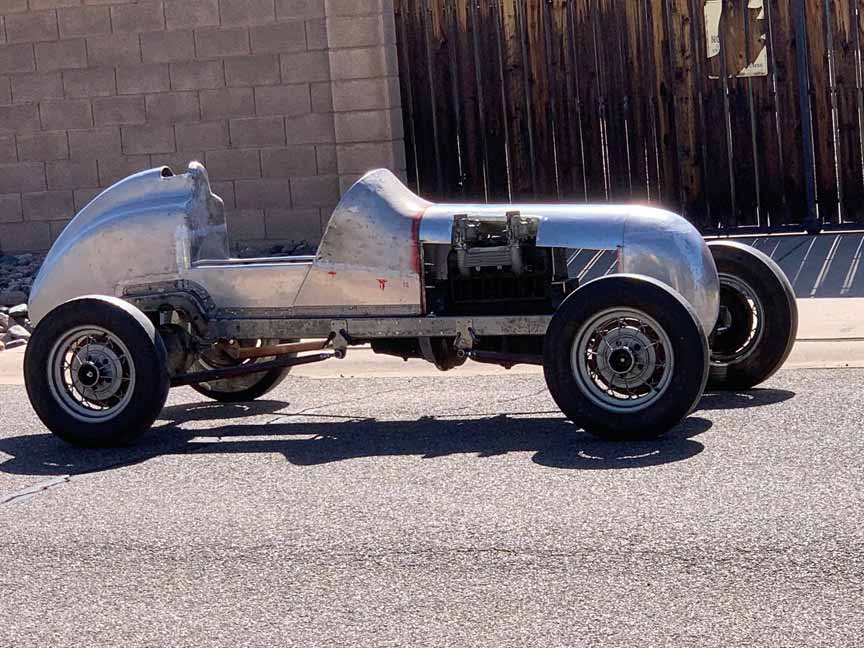
I was hoping to have it finished by my birthday next year, which is 1 March, but I don\'t know if I\'ll make it. I get my second Covid shot March 3 and will go back to flying March 8, which means I\'ll be back to 80-hour work weeks and no weekends. So, work on the Banger will slow down.
I\'m probably one of the very few who, in some ways, has negative feeling about seeing lockdowns and pandemic restrictions coming to an end. Now, I actually have to go back to work. Oh, well, I knew that sooner or later I was going to have leave Disneyland. bd
19 Feb 2021 - Perseverance and Hozro
Right up front I want to say how incredibly impressed I am with the human race this week: There we were watching a manmade object land on Mars. It\'s just another of the science-fiction-come-true things we\'re become accustom to.
The Perseverance landing had an emotion edge to it because we were in the control room sharing the tension and the excitement with those who made it happen. It\'s like we were all sharing a miracle we had helped create. I got choked up just watching.
However, the most amazing bit of science fiction to come to life was last year when I watched two of Space X\'s boosters back down to landings at the same time in perfect unison. Ming the Merciless had arrived! Only the gray dogs among you will get that reference.
On a different tact, but sharing a little of the spiritual/emotional stuff was something that came out of an e-mail I received a couple days ago. The writer was trying to locate a Grassroots column I had written years ago and could I forward it to him. Another absolute miracle happened when I was able to find the original draft of it. I had written it in 2002!!! In reading it, I felt as if it was something worth sharing. So, here it is.
Grassroots 2002
Hozro
Hozro: now there\'s a word you don\'t run across every day. It\'s an interesting word, because in two syllables it sums up something that would make many of us much happier if we worked towards it. Hozro is the Navajo word, which, if I understand it correctly, denotes a concept in which you strive for balance within yourself, with the natural world around you and with the spirituality which that world contains.
I mention this because, as I look around my own life and those of my friends, I\'m becoming increasingly conscious of some sort of thematic thread that ties the many aspects of their lives together. Yes, we\'re almost all aviators. But, more than simply being aviators, we are serious aviators and our interest is more than an interest. It\'s not something we do. It\'s who we are.
I remember hearing The Redhead on the phone a few years back, when it looked as if selling the Pitts would be a smart financial move. She was talking to a friend, and said,"...and I told him no way! The Pitts is part of the man I fell in love with and he\'ll never be without it. Not, if I have anything to do about it." Early on, she had gained an appreciation for how things fit together in my life and what part the little red airplane plays in it.
Aviation, however, is really only a small part of the harmony I\'m seeing in those around me because there\'s something there that indicates an Anglo form of Hozro, of an effort to seek a balance. Each of the people I\'m close to have many different interests which go in many different directions and it would be easy to say the only common trait between them is aviation. But, that\'s wrong. There is something much less tangible there that indicates a subliminal understanding that to maintain a balance there\'s more to life than flying.
Most of us Anglos have a difficult time understanding the way cultures like the Navajos\' look at life. They definitely do not see themselves as one entity, their environment as another and their spirtual beliefs as yet another. They see them all as parts of a whole. Their religious beliefs and their identity as a people spring from the land and everything blends together with no borders between spirituality, life and the world. Their religion, if you want to call it that, is simply the way they live their lives.
In a way, that\'s what I see in those people around me who have attained their own form of hozro. The people whom I see as being truly satisfied with their lives have all developed a delicate balance between their passions, what they do and who they are. These people radiate a quiet confidence that has nothing to do with how much they earn, what they say, how they dress or what they fly. In fact, we run across those kinds of personalities so seldom, they often stick out because, in a world full of high profiles, they don\'t feel driven to establish a profile at all, and that\'s unusual. They are just there, quietly doing what they do and enjoying their lives.
I said aviation wasn\'t the unifying trait between these people and it\'s not. If there\'s a unifying trait it is their passionate interest in, and an urge to understand, just about everything they come in contact with. They have a total appreciation for their lives and they know they can\'t focus on just one thing and be the person they want to be. If they did, the balance wouldn\'t be there. Even if aviation is their central interest, they know there are many other factors which must be included in their lives or there would be no balance. It would be a good life, but not a balanced one. And, when a life is unbalanced, an almost imperceptible anxiety often lurks within and reminds us things aren\'t quite right.
I\'d like to say I\'ve attained a state of Hozro , but, I haven\'t. Few Anglos do. Still, the most important thing about not being in total harmony with your world is realizing that\'s the case and refusing to accept it. Those of us who constantly seek a balance eventually reach it. Those who don\'t feel it\'s necessary, however, don\'t stand a chance. bd
7 Feb 2021 - Insecurity as a Way of Life
As a rule, I don\'t get depressed or anywhere close to it. And I don\'t get up-tight. I can let lots of stuff roll off my back. Sometimes it\'s stuff I should probably react to more than I do. Oh, wait...I may have just told a couple of lies.
First, most of my friends and students have said I\'m very laid back but in a very intense sort of way. I\'m not sure how to interpret that, but it\'s a common evaluation. I think it has to do with the fact that, although I\'m hyper passionate about the stuff I do, it\'s sort of a quiet but very strong passion. It\'s not an evangelistic form in which I\'m on a soap box pushing it on others. The sole exception might be how I feel about perfecting flying skills.
All that having been said, I want to describe a surprising, but, fortunately, short term, episode that happened last weekend that showed me a forgotten side of myself. I\'m sharing this only because I\'m certain some of the readers here are moving into the same phase of life and are having the same thoughts. Not one thing I\'m going to mention is unique to me.
I haven\'t flown a student since last March because of Covid, but I\'m supposed to get my first vaccine shot this week and, hopefully, I\'m going to get the needle jockeys to do Marlene at the same time. Then I can start flying the more than 30 folks on my Pitts waiting list. In support of that, I\'ve made it a habit to fly at least twice a month to make sure neither the airplane nor I develop any rust. One of those hops was early last Sunday.
It had been a decent hop during which I made five landings. all of which were above average for me, so I should have been in a good mood. However, as I was driving home, I had a series of disturbing thoughts invade my mood.
The plan for the day was that, when I got home I was going to concentrate on the final shaping of the butt stock for one of my rolling block single-shot rifle projects, of which I have five in process. This in addition to four muzzle-loading rifles, two Mausers bolt actions (one a 1000-yard target, iron sighted target piece) and one Martini range rifle. As I drove, my brain was skipping from rolling block to rolling block trying to decide which one to jump on as soon as I got home. As I mentally monitored the selection process my brain was going through, a really sad, totally disruptive and totally unexpected thought popped up and overwhelmed the thoughts in progress: As plain as day, my brain said,"There is no possible way you can finished all of the rifles you\'re working on in the time you have left. None! You won\'t live that long. You\'ll be lucky to finish The Banger car and The Roadster."
It was as if some outside force was using my brain to make a logical observation that I had obviously been keeping from myself.
DAMN!!!! That was a really upsetting thought. In a nano second, I was in a funk. At that moment, I suddenly realized, why my father, who died at 91, was on Prozac for the last decade or so of his life: When"The End" is close enough that it is no longer a theoretical concept and is staring you in the face, it\'s hard not to develop a"Why try?" attitude. Nothing has any worth because the time is so short. Who gives a crap!?
By the time I got home, I was a total waste of space. I wandered into the front room, slumped into a chair, and just sat there. My brain was awash in negative thoughts. I hadn\'t seen that side of me in over 30 years, when my first marriage and much of my life had split-S\'d into the ground. What the hell?! I don\'t get depressed. Who/what had invaded me?
My hand automatically flipped the TV on and the images of the guys on Iron Resurrection constructing a new frame to put under a heavily modified \'55 Chevy popped up. Sparks were streaming out of angle-head grinders with cutoff wheels. MIG welders were making the so-identifiable bacon-frying sounds. Bits of unrelated steel were being combined to create something very unique and cool.
There was something very calming and affirming about the process I was watching. In about ten minutes I was very conscious of my negative thought patterns fading. The sure knowledge that I was never going to get everything finished was mutating into something else. The negativism was slowly being replaced by a plan of action. The plan in hand, my attitude changed from one of defeat to one of facing a challenge: Time is short, so I can\'t waste any of it. That was hardly a new thought. Out of that came a new set of Rules of Engagement in terms of finishing projects.
The Banger Car and The Roadster would be top priority, in that order. However, short periods of time, an hour or so, would be interspersed between automotive endeavors and aimed at the rifles. Without any conscious thought, those were also prioritized. The new butt stock for the 38-55 was number one as it was already fitted, had the butt plate attached and was half way through final shaping. The pecking order of the other rifle projects fell in behind that one.
Negative thoughts and funks are hard to avoid. I fight ‘em like everyone else, but I\'ve found that if I start wrestling them as soon as they arrive, they don\'t turn into real depression. In my experience, depression is often the culmination of us creating, and then feeding on, our own negative thoughts. The way I beat them back is to step into the shop and start making sawdust or sparks.
By the time the Resurrection Iron guys (the Martin Brothers) had the Chevy together at the end of the show, I had wrestled my negative thoughts to the ground and hustled out to the shop with a goal in mind: I\'ll work as hard as I can, as fast as I can, for as long as I can and, when I hear them closing the oven door at the crematorium, I\'ll know the race is over and I can stop pushing.
BTW...Never finish all of your projects. We always need something to look forward to. bd
30 JAN 2021 - Night Owls vs Morning Folk vs the World
This week I was in a conversation with a friend about work habits and sleep patterns and it reminded me of something that semi-revolutionized my work habits. I didn\'t invent it, but I certainly live by it and others may benefit from hearing about it.
First, however: Now that we\'re into the new administrative regime and we see which direction it\'s going, I\'m going to try not to talk about politics. There\'s enough of that on the web and the news and frankly I don\'t think any of it is helping our mental health. However, I am going to put a You-Tube link at the end of this treatise that I think every 2nd Amendment supporter should watch.
About work habits: Years ago, I stumbled across an article in a medical journal that was talking about what makes some folks"morning people" while others are"night owls". What it explained sounds like bio-rhythm theory but it\'s not. It said that most people have two energy peaks during the day that may be two to four hours apart. We have no control over when they occur, how strong they are or anything else. They are simply baked into our DNA, and when they occur is what determines whether you\'re a morning or a night person.
Like a lot of folks, without understanding them, I\'ve always been very aware of those peaks and for most of my life I\'ve scheduled my days around them. They are at 4:30 pm and 10:30 pm so, like it or not, I was a night owl, continually working until midnight or 0100 and not getting up until 0700-0730. Those were, and still are, my most creative hours and when I do most of my drafting of articles, etc. My first wife was a morning person there was constant conflict in that area.
Then, in \'92, I moved to AZ.
When I came out here, I was instantly put in charge of running a 75-man operation (manufacturing and mail order sales) that started at 0530. If I\'m running something, I want to be there before the crew arrives and be the last one out the door at night. So, I arrived at 0515, forcing myself out of the sack at 0430 or so. This was six days a week for nine very intense months and it reset, or at least revised, my body clock. However, my most creative hours were still late in the afternoon and evening.
I should also mention that my body clock has always been cast in concrete and lets me have six to six and a half hours of sleep. Period! I never use alarm clocks. I just wake up. I know that at my age, I\'m supposed to get eight hours, but you\'d have to drug me to make me sleep that long. I don\'t do that on purpose. It just happens.
During the period, when I first got here and my body clock was being reset, I became very aware of a difference in the way my brain worked early morning versus early evening. I wrote better and easier in the late afternoon/evening, but I was much better at editing and doing any kind of detailed analysis, engineering, planning, etc. in the early morning. I also start drinking a half dozen cups of coffee a day. When I left that company, I had to cut back on the coffee and retrain that part of my system because it was so dependent on the caffeine that I\'d have a slump after lunch and my body begged for more caffeine. Now I\'m doing two cups in the early morning and that\'s it for the day.
So, now I run my days based on what I learned during that period and have kept my body clock set to what it became during that time: Up 0430-0500, depending on what my body feels like doing, but I try hard to give myself a six and a half window to sleep. And I do all of my detailed, left-brain stuff in the morning and my more creative, free-thinking, right-brain stuff in the late afternoon/evening. I do the editing of what I\'ve written the morning of the day after it\'s written.
I\'m positive that most folks reading this are aware of their morning/evening differences without thinking about it. Hopefully, the foregoing explains those differences and ya\'ll will find it helpful.
Here\'s the link I mentioned. It\'s a pretty damn unbelievable bill, H.R. 127. Google it and you\'ll find the text in a lot of places. Supposedly, it\'s not likely to pass, but it definitely shows what\'s being attempted and where the government\'s head is at! https://youtu.be/BNtiFDQTTNM
24 JAN 2021 - We\'ll Survive!
I\'m sitting here, four days after the inauguration, trying to organize my thoughts but am finding I can\'t. They are going in too many directions. However, the central one goes back to the last line of the Thinking Out Loud I did two weeks ago."View all of that outside crap as distant entertainment and ‘Let that Sh*t go!\'
Surprisingly, I\'m neither upset nor full of dread. It\'s a classic case of"it is what it is." I do see the character of half of the population being assaulted from many sides. They\'re calling us all sorts of names and proposing all sorts of penalties and restrictions. But, you know what? I can\'t, and you can\'t, immediately do a damn thing about it. Denigrating half of the population has become the norm and we\'d better get used to it. If we don\'t let it roll off our backs, we\'ll be a nation of ulcers.
Right now, we have to hope that those who we sent to Washington do what they were sent there to do. They have some major chores ahead of them but the most important may be, as I\'ve said before, verifying the election process. Personally, I think that, given what has happened in DC in the first four days of the new era, I\'m fairly certain many of the announced policies will have the effect of eventually changing many voters\' minds so the mid-terms should help right the ship. That, however, assumes the electoral process works as it should. If it works, the mid-term elections will solve a lot of our perceived problems. Or at least prevent them from getting worse.going to have to live with. Among them, much higher taxes, a border that might as well not be there, a government size that will grow in leaps and bounds and a ton of regulations and policies that will slow the economy, cause businesses to go overseas (again), etc. Again, that train has left the station. There\'s no way to
Although the mid-terms may help, until then, there are some things we\'re just prevent it so it shouldn\'t raise our blood pressure. However, the important stuff...our home, family and friends...are the things over which we have some control and affect us directly. Those we need to worry about. The rest we have to continue to monitor, but we can\'t let them consume us. Nothing is less effective than a warrior who has let his/her emotions overcome their logic and tactical awareness (Davisson, 2021).
While this is all going on, like so many of my peers, I\'m battling increasing personal pressure from insurance companies about my age and my flying. This is becoming a nationwide problem that I\'ll get into in a later blog as soon as some of the facts become clearer and I see what the road ahead entails. However, believe me, this has the makings of a disaster for a large segment of the flying public.
If there is any good news out there, it is that the vaccines are starting to roll out. Marlene and I start ours in mid-Feb and I think I\'ll have the flight school and B & B in full operation by the end of March. That\'ll make it exactly a year since I\'ve flown a student. Who\'d a thunk?! Right now, I have over 30 students on the waiting list, so I\'ll go back to not having weekends or easy week days, but that\'s not a bad thing.
Another piece of personal good news, is that my 1930s race car that I\'m putting on the street, The Banger (so-called because it\'s powered by a 1930 Model A Ford four-banger flathead), is presently in the aluminum hospital. We have one of those rare craftsmen in town who can make aluminum sheet do anything he wants it to do, so he\'s doing the body repairs and upgrading. He\'s also doing a little machine work (chopping drive shaft, rebuilding steering box, etc.). So, when it comes back to me in a couple of weeks the project becomes one of fabricating and installing systems (brakes, electrical, fuel, etc.), which is super simple compared to building the frame, the gas tank, etc. because, being an open wheel race car, all of those systems are right out where you can see them.
Circling back to the political stuff: The world has not, nor will it, come to an end. Although there are going to be some dire changes that make many of us unhappy, we will survive (I think). Just know that the American spirit that has taken us through pandemics, wars and political upheavals in the past is still healthy enough to see us through again. So, hang in there! bd
16 JAN 2021 - Thoughts From the Fog of War We\'re Living in
What a week! However, we\'ve had a lot of those. What the hell is going on?! For nearly a year, every Saturday, we\'d be thinking that we\'ve just seen the week of all weeks but, they just seem to keep coming. What follows are thoughts from the fog of war ingulfing us.
I started writing this a week, ago, Jan 9, but life got in the way and I\'m just now, Jan 16, finishing it. That\'s another amazing week gone by. This is a helluva way to start to start a new year!
First, the topic of the month: the DC invasion. Regardless of how you spin it, Trump was wrong to fire up the crowd. However, from a transcript of the speech it would appear that what transpired went well past what he expected to happen. And investigations appear to be saying that the early reports about what happened may not be correct. However, telling something like 45,000 people to march down to the Capital and make their displeasure known was almost guaranteed to backfire. I think the phrase"unintended consequences" fits here.
As part of the invasion aftermath, a major truth has surfaced via the actions of the tech companies that is, in my mind, more important than the event itself: I\'m talking about the clear understanding of the degree of control a very small number of tech company presidents have over the nation...they control the information flow so they control the country. Social media Has absolute control of what the country sees and thinks. They dwarf network or cable news in terms of information flow and their control of it. Today, social media is more than social. It is an armor-coated intertwining of politics and culture and that doesn\'t bode well for our future.
This week we\'ve heard vague mentions of monopolies and restraint of trade, but, what we should have been hearing is huge outcries and officials pledging to look into tech company collusion. I\'m saying this even though I feel that corporations are too often targets of unwarranted anger. However, in this case, I don\'t think enough anger (and fear) is being demonstrated by the public or the media. But, then, we\'re transitioning into an entirely new time that has a different way of seeing the world and we have little or no control over it. I\'m not sure I can adequately adjust to that.
Normally, right here I\'d inject something about the way a population controls its government is via the ballot box. However, for the first time in our history, much of the population is doubting the ballot box. This is not healthy for us. It is not even remotely the America we know and love.
The same thing could be said about the whole logic of impeaching an executive who only has a little over a week in office left (now just four days). Congressional vitriol of this level aimed at destroying a single individual has never been seen before. This is also not healthy. However, the most threatening aspect of it is the precedent it sets. By taking such a dramatic action with neither an investigation nor giving the accused a chance to defend himself and zooming through the entire procedure in a single day has set the stage for the same thing to happen should the other party be in control. It has made implementing snap decisions on a national level into a norm. This is not only scary but drives the wedge between the two factions even deeper. I started voting in 1960, 60 years ago, and I\'ve never seen the country even close to being so divided. It is sad in the extreme.
What the most recent facts to come out of the investigations into the capital invasion pointed out to me is several things. First, I\'m amazed and appreciative of the way in which the FBI has found and prosecuted those responsible for the invasion of the Capital itself. Second, it points out how many crazies are taking advantage of the situation, not to enforce their beliefs or to make a point, but simply to destroy and generally engage in anachronistic, anti-government behavior. As I sit here right now, four days from the inauguration, that statement about the past couple of weeks is what worries me the most. There is a crazy element out there that belongs to neither side and is raising hell just because they can.
Actually, I\'m more than simply worried about the crazy element. I\'m terrified that they\'re going to do something dangerous and stupid during the inauguration that will give the left even more ammunition against the right. Or vice versa. Both sides have their share of crazies.
Regardless of who does what, anything that goes wrong is going to widen a divide that already looks as if it is too wide to bridge. The last sentence is exactly what the ANTIFA mindset is trying to accomplish. They want to divide us and destroy America. We can\'t let that happen. If the anarchists win, both sides have lost.
I\'m hoping that next Saturday I can reflect on a week in which a smooth/peaceful transition of power happened with no drama. As a nation, we desperately need a boring week. bd
1 JAN 2021 - So, How is the New Year Going so Far?
As I\'m sitting here, the first day of the new year is just now drawing to a close. How is your year going so far? Is 2021 living up to your expectations? So far, 18 hours into the new year, my version of 2021 is actually pretty good. I wonder if I can keep it that way?
Official local sunrise was 0732. My watch said it was 0734 when my left hand started forward and the bark of an unmuffled IO-360 Lycoming proceeded to wake up the neighbors. The tower had verified that the OAT was 38 degrees. In Zonie-speak that translates as"damn cold" with the alternative translation being"Fat air! It\'s going to be a kick-butt flight." And it was. My little red mind-blower blasted through pattern altitude long before we reached the end of the runway. It was glorious and at that moment I decided that 2021 was going to be whatever I would make it to be. I wasn\'t going to let things I couldn\'t control alter my mood or my mindset and I\'ll minimize what they do to my life. To quote the title of a cute little book by Monica Sweeney (Castle Point Books) that someone had given the AZ Red Head, I\'m going to ‘Let That Sh*t go!" I wasn\'t going to let national external happenings infect my personal life.
It could be said that 2021 has an easy act to follow: 2020 didn\'t make anyone happy. It is so hard to remember that the past year actually saw some monumental things happen, many of which are fading in our memory. It\'s hard to remember, for instance that, while Covid lurked in the background and had yet to grab any headlines, that the President was being impeached. That\'s a landmark event, that seems like it happened in another lifetime because we\'re now remembering the developing phases of Covid as a way of remembering time.
The word"pandemic", which was previously seldom heard in normal conversation, is now in common usage. However, hidden within the textbook definition of"pandemic" is the phrase"...prevalent over the entire country or the world." Looking at it that way, it could be said that we actually had three or four pandemics all happening at the same time because worldwide things were going to hell in a handbasket.
Underlying the life threatening, soul-sucking aspects of Covid 19 was a pandemic, or maybe an epidemic, of politicization. Everything having to do with everything was infected with politics. Every aspect of what remained of our lives was viewed through a right or left prism, which fractured our views in such a way that no matter how something turned out, it left a bad taste in your mouth.
An additional infection that\'s the result of politicization was the pandemic level of distrust that has altered the way in which we look at just about every form of authority. It\'s difficult to name anything that a majority of the country doesn\'t distrust. This begins with the media (including the purveyors of social media, the mega companies) and works up through our various levels of government. A lot of previously sacrosanct bodies, from the church to the Boy Scouts to the NRA, whatever, now exist under an umbrella of distrust. There is nothing at the national level in which we have total, or even partial, faith. For instance, who on God\'s green Earth ever thought there\'d be a debate about whether we needed law enforcement or not! Damn! Maybe Shakespeare had it wired, when he said \'Now is the winter of our discontent\', the first line of Richard III, 1594. The second line of the play is \'To be made a glorious summer by the son of York\', referring to a politician or whatever who was going to save the day.
Given our current situation, is there anyone on either side of the aisle who honestly believes someone is going to gallop in and right our ship? Nope, we\'re still pretty much adrift in a perfect storm of wildly divergent views of the direction our country should take in the future. This is pretty damn hard to believe, given that for most of our lives whether the words were coming down from a pulpit, a DC chamber or our local Boy Scout troop leader, right or left, they all pointed in the same general direction: The goals were a happy, healthy population and a country with a solid belief in the worth of its people and the concrete guidance of our Constitution. That\'s no longer true. Now everyone in power at any level seems to have an agenda that is focused more on power for the party or the corporation than the good of the people.
Basically, I guess what I\'m saying (I think) is that in 2021 we can no longer depend on any official body to look out for our wellbeing. To a certain extent I feel as I imagine the Pilgrims felt when they stepped off the Mayflower and realized they truly were strangers in a strange land and they were on their own. They had to develop a beachhead and what happened from that point on was totally dependent on their own resourcefulness and determination. To a certain extent that\'s how I\'m feeling right now; Semi-alone and focused on my life-partner, my family and my friends. I\'m going to first, ignore the wolves at the door and, at the same time, develop the mental and financial firepower to stop whatever wolf comes through that door dead in its tracks.
When the air is fat and something like a Pitts Special is speaking to you, although you\'re barely touching it, there is a feeling of oneness, a solidarity that\'s difficult to describe. For whatever reason, that\'s how I\'m feeling about the life that lays ahead. Regardless of what happens in Georgia in a couple of days, which will be monumental in terms of what happens in DC, the truth is that it still comes down to our own personal beachhead and those with whom we\'ve chosen to surround ourselves in defense of our own lives. We have little or no control over anything past that. So, we can\'t let those outside factors color our lives or our thoughts. View all of that outside crap as distant entertainment and"Let that Sh*t Go!" bd
25 Dec 2020 - Welcome to the Humbug Zone
It\'s Christmas day. More correctly, as I start typing this it is exactly 0356 Christmas morning. No, I\'m not up waiting for Santa. I\'m up because I woke up at 0330 and couldn\'t shut my brain off. A mind is a terrible thing to waste. So, here I am.
Christmas 2020 might as well have been cancelled. At least in our household, which hopefully doesn\'t reflect what\'s happening in many others. The pandemic, the politics, the pressures of making a living and an overall feeling of...I don\'t know how to describe it...maybe,"nothingness" has just sucked the air out of the season. For the first time ever, we don\'t have a tree and didn\'t even make the effort to put up our exterior Christmas lights (note, that I don\'t say Xmas, even I think it should be called what it is). This is indicative of our general lack of cheer and energy because our neighborhood is afire with decorations and blow-up Santas, elves and things that look like a cross between the Michelin Man and cupie dolls. Even when we\'re not in humbug mode and have our lights up, they are nothing but those laser projectors that shoot moving, multicolored dots all over the cacti and front of the house. They are the lazy man\'s way of decorating. So, when we don\'t even do that, which makes us the dark spot on the street, that shows how low our seasonal energy is.
For whatever reason, me sitting here in the dark typing conjures up the image of one of my better Christmas mornings when I was about eight years old. I had sneaked out to the tree before anyone got up and retrieved one of my presents. It was a mechanized, die-cast, wonderfully detailed WW I artillery piece. About eight inches long, it had a working breech system that, when opened, accepted the cast lead artillery shells that were made in two pieces: slug and casing. The casing contained a spring and a hook-shaped part of that spring protruded through the slug and locked it in place. After locking the breech closed, when I moved a lever on the breech, it unlocked the slug and fired it half way across the room. I had a flash light in bed with me and my covers over me like a tent while I played with my new toy. I was in heaven!
That artillery piece and all its accessories, including the loading plate for the"cartridges" sits on the shelf to my right, as I type.
To a certain extent, that memory saddens me. I hate to see Christmas reduced to being just another day, and in many lives, that\'s what has happened. The first step is always when your kids are no longer kids. Kids are the magic that makes the day. The second step is when the family splinters as everyone begins their own lives and scatter. Then, if a divorce is involved, that divides that family, further fracturing the life forces that make Christmas day a family affair. And then the pandemic came along. The Chinese Christmas Curse flattened the lead-up to the day and pretty much sucked the life out of it. However, I have a suggestion that, at least in our household, may help. Let\'s not cancel Christmas. Let\'s just postpone it.
So, as of today, Christmas 2020 for the Clan Davisson, is being moved to July 4th, 2021. This year\'s stand-out Christmas gift, one that will keep on giving, is the arrival of the vaccines. I\'m hoping that by mid-summer a semblance of life, which includes the wonderfulness of the Oshkosh Fly-in, will return us to something close to normal. So, during today, Christmas 2020, I\'m going to root around in the storage shed out back, find our Christmas wreaths and laser lights, and put them where I can find them in July.
I\'m not kidding one damn bit. Come July, we might be the only house on the block with Christmas lights and more than our usual one American flag, but at least a little of the right kind of spirit will have returned to our household. If any of you reading this agree, let\'s start a national Christmas-in-July movement. You can sign up by hanging your Christmas lights in July (however, I hate those blow up things) as a sign that the pandemic cocoon has opened and the long-overdue butterfly of the American spirit is once again aloft. Screw politics! Screw China! Hooray America! Hooray family! We may not be there yet, but we\'re on the way and let\'s make July our returning-to-life celebration. We owe it to ourselves.
God help us, if China\'s gift to humanity is still standing on our chest in July! bd
20 Dec 2020 - A Tooth, a Life Span and Ugly Decisions
Life, beginning-to-end is a series of decisions, many of which involve the age-old question"How much does it cost and how long will it take to pay it off?" The time-versus-cost ratio is always in the back of our minds. Usually money is the deciding factor. But, not always.
There comes a time in life, and I\'m betting many of you reading this are coming into that period, when time becomes a bigger factor than cost. When most of us financed our first car in our 20\'s and saw that we\'d be paying on it for three to five years, we just shrugged our shoulders and soldiered on. When our first house mortgage was for 30 years, we totally ignored the time it would take to pay it off and focused on what it was going to cost a month. We live most of our lives making those kinds of decisions: The cost per month far out-weighs any time concerns. Then, that thought pattern begins to change. I had a rather startling example of that recently.
Inasmuch as Covid shut down my little flight school and, more important, the B &B where Marlene routinely makes more money/day than I do flying, our cash flow took a pretty good hit. This is on top of bailing from Flight Journal last year. However, the writing income has expanded because editors are starved for material. So, we\'re keeping our heads above water. On the good side, progress on the Banger car has accelerated rapidly because not flying means I have weekends. Fortunately, the Banger hasn\'t affected our cash flow at all because I had it totally covered by having sold some assets including my artillery piece (sniff, sniff) and some guns combined with money I had squirreled away in the past. Then, last week I went in for a $150 teeth cleaning and came out with a future bill of over $5,000. That also won\'t affect our cash flow but knocks the crap out of the Banger project. However, I can figure the Banger stuff out. What is difficult is comparing the total cost of putting in a new post and tooth against the length of time it\'ll be used.
Again, I\'m betting a lot of you reading this can identify with what I\'m about to explain via a little tooth-history. BTW...I\'ve written literally hundreds, maybe thousands, of articles on historical airplanes, guns, cars, etc but this will be the first historical treatise on a tooth. Hang in there, I\'ll be making a point.
The tooth in question, which is technically known as Number Three (third from the back, top right) and is the first one in front of the molars. Prior to the latest dental drama, it had been capped at least twice. Around $1,500/each. We\'ll average that at a total of $2,500.
Then in a matter of a few months This one tooth needed
- A root canal through the cap to protect the tooth next to it - $1,700
- A tooth cleaning revealed decay. New cap: $1,700
- Two weeks ago, X-rays said that tooth had to come out and a post installed, $5,400
So, the grand total spent on that one tooth, which is going to disappear is $11,300 during its life!!! HOLY CRAP!!!
The $5,400 for this current excavation project has to come out of the Banger account, so I\'m lucky I have the money to pay it.
In one year I will have spent $8,900 on one frigging tooth! I figure I\'ll only be using that tooth for another ten or twelve years so my cost of hanging onto that one tooth for the rest of my life is approx. $900/year, $75/month which isn\'t tax deductible so I have to make right at $100/month pre-tax to afford that one tooth. Damn!
This is where the time thing comes into play. Am I willing to pay $100/month for the rest of my life to have that tooth working for me? Inasmuch as chewing right now without it is a real pain in the butt I would say, yeah, I\'m willing to do that. But I don\'t like to let time become part of my decision making process. I\'ve never done that before. Now, I have to.
It used to be that saying"...for the rest of my life" really didn\'t mean that much. However, now it does because evaluating time is based on a logarithmic scale in which the value of time increases exponentially as we watch it disappear. The less we have, the more we value it. Or at least we should. Sadly, many don\'t.
I know entirely too many people my age who sleep late and spend their days in a lounge chair in front of the TV with a six pack at hand. Retirement is slowly and insidiously killing them. However, those who are in my circle of close friends aren\'t part of that group. They\'re out there kickin\' butt and takin\' names doing stuff about which they are passionate. They have a driving interest and, when I look at those guys and then I look at a few of my in-laws that are part of the easy-chair/TV gang, even though they\'re the same age, there is no comparison in their attitudes or looks. The easy-chair gang looks old and acts old. Those who are engaged in life and are still living it seem to belong in an entirely different, younger age group. The big difference is motivation and interests.
The concept of motivation and interests has always mystified me. I have no idea why some people are fired up about being alive and others just sit there letting it pass them by as if it means nothing. In truth most have always been that way. Beginning at birth, they have basically been in storage waiting for Ma Nature to haul them away. My friends, on the other hand, are having a helluva good time fighting time and making it pay for itself. Why? I don\'t know. I\'ve found it\'s impossible to motivate most people but you can\'t slow those down who are naturally motivated. It seems to be baked into their DNA. It would appear that people are either motivated or they\'re not.
I wish there was a way that motivation could be processed into a pill and swallowed. If that were possible, a massive number of people may not live longer, but they\'d certainly live better.
So, the question I\'ll leave you with is"Threat of violence and/or money can promote external motivation, but how do you get people to motivate themselves? bd
11 Dec 2020 - Remembering the Day the World Changed
I wrote this last week, but screwed up my computer and couldn\'t post it.
Today, Dec 6th, 2020 is the 79th anniversary of the day before the whole world changed. It was a sunny, normal weekend in Hawaii and the rest of the US was just living life. The next day, via radio, our parents and grandparents learned that the world, as they knew it, was gone and a new one was in the process of taking its place, even as they listened.
I\'m not certain how the majority of the US looks at that day or the history it represents. As far as that goes, I\'m not sure how most of the under-50 crowd look at history, in general. Especially something approaching 80 years old. My generation, that which is characterized as Bomb Babies, born right after WW II, is the last generation that might have had parents who had personal remembrances of a time, we can only imagine. Putting it in context, for me (Technically, I\'m not a bomb baby...born in \'42. Dad jumped the gun.), growing up in the 1950s (I\'m the class of 1960), Pearl Harbor, the Battle of the Bulge, fuel rations and such were just part of normal conversation amongst adults. That said, however, the times during which I heard an adult talk about their experiences in combat were few and far between. Just like today, we seldom hear a Vietnam combat vet talk about their experiences. The combat-experience is something that is usually shared only with those who had been there and can understand. The rest of us can\'t.
To a certain extent, I can understand why today\'s youth has no apparent interest in something that happened 80 years ago. When I was 16 years old, 80 years earlier would have been 1878 and the Indian Wars were peaking and, sadly, would draw to a close over the next decade. The West was well into the process of being settled. As a teenager, even though I was heavy into hotrods, guns and guitars, I had a lot of interest in that period. I\'m not sure why, but I can almost guarantee you that I was the only one in my class of 66 souls who cared about it.
That having been said, I do have to say that my old hometown, Seward, Nebraska seems to have a more obvious pride in its past than many towns of its size. There are monuments memorializing the dead of every war going back to the Civil War, visually, the town square and the surrounding shopping area have changed little since 1910-1920 and they\'re proud of that. Plus, they have a county museum and the National Guard Armory features a small museum and a Sherman and a Patton tank out front. Part of this historical pride may be because for a town of its size (7,000 now, 3000, when I graduated), it is far more financially fortunate than most of its peer group. Going back to shortly after WW I, it has had a strong industrial manufacturing base that seems to keep getting stronger. So, it has the tax revenues and can afford the pride that shows in almost every square block of the town. Plus, the people, in general, seem to value their history more than many do.
To my generation, Dec 7th still means something because it was a life altering event in the lives of our folks. Every person of the post-war generation who is reading this remembers hearing their parents telling them how it felt to be sitting around the radio listening to news reports of the attack and then FDR declaring war for all to hear. Their tales were an integral part of our upbringing. I remember one of my friend\'s father, showing me a piece of shrapnel that had been dug out of his hip, the result of his Stuart tank taking an anti-tank round. To this day, I can picture that thumb-sized, jagged piece of steel laying in the palm of his hand. Threads of his uniform were still jammed in the crevices. One of my best friend\'s brother brought back a Japanese helmet with a bullet hole in the front, blood stains inside. Another friend\'s father was a Seabee in the Pacific and had a knife he\'d made out of a Zero\'s prop blade, the handle being stacks of Plexiglas wafers cut from the plane\'s canopy. He also had a loaded feeder strip of 7.7mm cartridges for a Nambu machine gun. Pearl Harbor and WW II was still a living memory for my generation, but those memories lose their meaning as additional generations are added to the que.
I know that next year, on the 80th Anniversary, there will be lots of flag waving, parades and speeches. Old movies will be replayed. There will even be a few stooped, old warriors who try to remind us of the reality of the day. I\'m going to be paying particular attention to see if we can pull any youngsters\' noses away from their cell phones and game boxes long enough to appreciate what\'s going on around them.
Oh well: They may not remember or appreciate. But, you and I will. bd
PS
Another reason I\'ll remember the date is that it\'s my son\'s birthday. He was late for his own birth, so he was induced. The doctor gave us a three-day window as to which date we\'d want for his birthday and I picked the 7th. That way it\'s hard for me to forget it.
29 NOV 2020 - Where Did the Actual Cell Phones Go?
Would I be doing the world a disserve by being so un-American as to not mention Trump, Biden or Covid in this blog? Yes, I\'m going to bitch about something but, believe or not, the aforementioned triumvirate of frustration aren\'t part of it.
Here\'s a flat statement, and remember, its coming from a guy whose life has somehow become wrapped around his iPhone: Smart phones are absolutely wizard-like in their capabilities and have, in my life at least, become as depended upon as my computer. However, as smart as they may be, they are actually pretty marginal telephones. In fact, in some ways they are flat-out lousy.
I\'ve had the above thought for a couple of years now, but on Turkey Day, something happened that clarified the situation enough to write about the foregoing observation/opinion. One of my stepsons and I were talking about the problems with The Redhead\'s Samsong phone, the primary one being that it\'s not an Apple so neither I, nor either of her grown sons, know enough about it to help her. Then I remembered that I still had my last iPhone (I\'ve kept all of my phones and periodically charge them up...don\'t ask why...I don\'t know). That phone was an 8 and was a really good phone but had some sort of problem, so I went up to an Xs. Then I had a brainstorm about The Redhead\'s phone! We get the 8 fixed and give it to her.
So, I dug through my desk drawers and excavated the 8, however, in the process, my old Motorola Razr flip phone surfaced along with my first iPhone, which was a 6. It had been a while since I had seen either and was immediately struck by the difference in size. By comparison to my Xs, which is the smaller of the iPhone line, they were tiny. Then I picked up the Razr and realized what a perfect telephone it was. It had all the features you want on a phone.
To answer it, you just flip it open. To hang up, you just close it. To dial often-used numbers, you just remember how many clicks represents a given number and you\'re connected. 1 was home, 2 was The Redhead, 3 was ATIS, etc. At no time did I need to look at the phone, which was so convenient. Especially while driving. Of course, texting was in its infancy, so texting was a real exercise in dexterity and patience.
To make a call on my fantastically-capable, hot dog Apple Xs, first I have to wake it up, so I tap the screen. Then I have to swipe up to get to the App screen. Then I have to tap the Phone app. Then I have to go to Favorites. Then scroll down and tap on the requested number (Home is the first one, The Redhead, the second). This is a damn dangerous thing to be doing while driving and it is far too long and drawn out to use even sitting in the office.
And then there\'s the question of size: Okay, so having a little bigger screen is necessary, if you\'re dealing with photos and such. It\'s not necessary as a phone but it\'s a Godsend when doing anything requiring graphics. However, how big is big enough? I think we\'ve gone past the point of diminishing returns. An illustrative story:
A few years back I began having to work really hard to get into my airplane and I came to accept it as being an unavoidable part of aging. Climbing into either cockpit requires swinging my right leg high to clear the cockpit side so I can step over and drop down into the seat. However, I was having problems with my right hip getting my leg high enough and was having to grab my pants leg and pull the leg up to get it to clear. This went on for six months until I took a phone call while standing by the airplane and dropped the phone into my jacket pocket rather than back into my right hip pocket where it usually lives. When I got into the airplane, it was as if I was a teenager again. Zero problem getting my leg to swing over the cockpit side. I hadn\'t realized that the extra inch in the iPhone 8\'s height over the 6 was getting in the way and was making me act like an old man while trying to board. In terms of functionality, I lost about fifteen years with that discovery and now my phone goes flying clipped to my left shoulder harness.
When we were playing with all of my old phones this week, I also realized how perfectly sized the 6 was. It wasn\'t so small as to be difficult to see or use, but it fit both a pocket and a hand almost perfectly. The camera, however, was okay, but just okay. I have to admit that the camera on the Xs is fantastic and I use it constantly for photos that accompany my articles in magazines. In a lot of situations, it\'s better than my Canons. I\'m also using it for doing podcasts and videos for the new website.
Like I said, the current crop of smart phones are incredible devices, but they\'re computers and entertainment devices first and the fact that they are also telephones is just a fortunate accident. Would I want to carry the old Razr and give up the whiz-bang stuff? No way!
Right now I just wish the Smart Phone people would spend just a little more time improving the Phone part of Smart Phone and stop trying so hard to make them smarter. bd
22 NOV 2020 - Of Flames, Choices and Risk Management
The past week was interesting. The coming one is going to be even more interesting because a lot of us are going to be forced to make what are hard choices for some, easy choices for others, depending entirely on your definition and ways of handling risk.
What brought this up was a conversation I had yesterday with one of my stepsons. The Redhead and I had already made the decision and announcement that we weren\'t going to attend the Thanksgiving dinner hosted by one of their friends where we would get the rare opportunity to socialize with his recent bride aœnd him. There would be about 25 people expected and we just didn\'t feel as if it was a Covid-safe environment for we gray dogs. Then, I heard they were flying her mother in from Florida for the event.
To say that The Redhead and I are being cautious is a gross understatement. Except for the occasional run for food and"serious essentials" that are necessary for our (actually my) wellbeing (essentials such as nuts, bolts, steel, etc), we are, for all intents and purposes, quarantined/locked down/hunkered down/etc. Arizona, like so many other states is setting records for cases and our death rate is steadily climbing. This is Ma Nature telling us that she\'s still in control and we\'d better get our act together. And it bothered me that our stepson\'s mother-in-law was being flown in. So, I did something I NEVER do: I stuck my nose into something that is none or my business and, in a text, voiced my concerns to my stepson. She has to be somewhere in the category they now call"vulnerable", which is a kind way of saying"older". I just didn\'t think it was worth the risk. A hard decision for all concern.
To my stepson\'s credit, he called and we had a warm, heartfelt discussion about their decision. Woven into that discussion was my personal way of looking at"risk" and how it relates to my decisions about my Covid behavior.
As I pointed out to him, risk management in my life is more obvious than in lots of others\' lives. Even though I seldom voice it, I\'m very aware that what I\'m doing on a daily basis, both in the workshop and more so at the airport involves an element of risk. Especially when instructing people who have less than zero ability to handle my little red flying machine (Pitts Special) and giving them control of it. A part of that procedure includes me having to let them make mistakes, give them time to correct those mistakes, while, at the same time, giving me time to save our bacon. For the pilots in the audience, this is NOT like you saw while learning to fly in a Cessna/Piper, etc. Everything in this airplane, especially in landing mode, happens at lightning speed. To the uninitiated it is one blinding flash of activity followed by another blinding flash of activity. The difference between right and catastrophically-wrong happens in nano seconds and you\'re stone-ass blind for about a 60 degree arc dead ahead. That said, it\'s amazing how everyone, after four to five hours starts to catch up More or less. However, there\'s a reason we call the first three hours of flight instruction"The deer-in-the-headlights flights".
Okay, so, I\'m operating in a high-risk environment, but there\'s not a moment, when I\'m in that airplane, that I\'m not expecting and preparing for the worse. I\'m managing the risk. At the same time, it would be easy to look at my flying operations as some sort of hair-on-fire way of approaching aviation. Some would also brand me as being a hair-on-fire pilot, when just the opposite is true. As Pitts pilots go (a genre unique unto itself), I\'m incredibly conservative. For instance, I\'ve never rolled an airplane on takeoff. When I\'m doing akro, generally teaching it, I\'m much higher than I need to be because altitude is my insurance. I don\'t go cross country in a Pitts in anything but the best weather. I\'m never down to less than 45 minutes of gas, which means I\'m flying legs just a little over an hour in length. The basis of this conservative way of looking at aviation is exactly the same way I look at life\'s decisions: I always look at the consequences of being wrong. If making the decision includes a risk of being wrong that has unacceptable consequences, maybe we shouldn\'t make that decision."Yeah, we probably have enough gas." If wrong, that\'s an unacceptable consequence. If bringing someone into a higher than normal threat environment to be with family, strangers, and a dead bird, and the theoretical consequences (Covid) are high enough, maybe the bird\'s funeral ceremony should be via Zoom. However, we\'re all adults and make our own decisions.
In my opinion, whenever possible, every decision should have an upside for the decision maker. Analyze the downside of decisions carefully.
And now for the flames I mentioned in the title and an unintended example of workshop risk: This is one of those moments, when I wish I had surveillance cameras in the shop to record the sequence of events.
I spend a lot of time cutting steel with an angle-head grinder with a cut-off wheel. And I mean A LOT of time. Yesterday, I was cutting across a ½" piece of 1018 that was 3" wide. So, lots and lots of sparks were involved; a steady, very heavy, continual stream. This is nothing new. That stream of sparks can be very hot, so I try to stand to the side so I don\'t scorch another T-shirt or burn a hole in an apron. Did I say it\'s hot?
This time I was dutifully standing to the side. However, I didn\'t realize that the light weight, long sleeve shirt I was wearing unbuttoned with a T-shirt under it was dangling directly in the line of sparks. Usually cloth, in that situation will send off signals as it starts to smolder before breaking into flames. You can smell it. This time it gave zero warning.
By the time I knew what was happening, I had serious flames racing up my shirt between my arm that was holding the grinder and my chest and was setting the sleeve on fire. These were real flames as if I was wearing a frigging bonfire!! This is where I would like to see a video of what happened next.
Looking back at it, I clearly remember a sequence of three thoughts that flashed through my mind, all three seemingly resolved at one time. 1. I\'m wearing gloves, can I beat the flames out while wearing the shirt. No, it\'ll burn me, if I squash them. 2. I have to get out of the shirt. So, I dropped the still running grinder, which shut off because it has a suicide switch on it and started ripping the shirt off. 3. While doing that, I decided I couldn\'t let that by-now flaming shirt hit the floor or it would set something else on fire, so, while stripping the shirt off, I bolted for the open rear garage door. By that time I got there, I had it off and threw the flaming wad into the gravel and the event was over. Total elapsed time had to be under four seconds! ‘Sure wish I had that video. It\'s interesting to look back and see how the human brain works.
A few minutes before writing the above I ordered a leather welding apron to be worn, when grinding, not welding. I can\'t afford to lose any more shirts or singe any more hair. bd
14 NOV 2020 - So, What Did You Do During the Pandemic?
Covid has pretty well screwed up every aspect of everyone\'s lives. So much so that worrying about it and hiding from it has become a new normal. However, Thumper says we\'ll see a vaccine soon. And I believe him. Then what?
First, I\'m amazed at how even the vaccine has become political. Pfizer isn\'t an unknown quantity to the population. Ditto for most of the other companies working on their own vaccine versions. And the FDA isn\'t going to pass something onto the population that might have a glitch. Them, I almost trust. Almost. Still, something like half of the population says they aren\'t going to take it because they don\'t trust the administration. What the hell does the administration have to do with it? It\'s the FDA and the drug companies that are making and approving it. Trump or Biden, it makes no difference. It\'ll be proven. So, the second it\'s available and plebians like me finally work our way to the front of the line, I\'m going to get it. If playing the age-card will buy me a position farther up the line, I\'ll gladly play it. I want to get back to work flying and I\'m not going to re-open my little flight school until I feel safe. This is one time being a gray dog may work to my advantage and I\'m going to utilize it to the fullest.
The current situation is that even though we all have Covid surges surrounding us, we know there\'s an end in sight. Still, we can\'t let our guards down. Because of the surge, we cancelled attending a family Thanksgiving dinner. It\'s not worth the risk. Now, Turkey Day at the Davisson household will just be me, the AZ Redhead, two cats, a little red dog and a dead bird. I think I\'ll like this one. As with all things in life, it starts with our immediate family and works its way out.
As a year, 2020 is one for each of our personal record books. I\'m also certain we each see it from a different perspective with the memories colored by how it affected us personally. Or what happened while hunkering down under the Covid umbrella.
Until March of this year, nearly every year for the past 25 or more I\'ve flown at least 300 hours. As I\'m typing this, I put exactly 74.5 hours in my log book this year, all in the first quarter. I\'ve had to struggle just to get an hour or so a month in since March to keep both the airplane and me from rusting. I\'ve been so used to losing at least five hours a day to flying seven days a week, that it wasn\'t until I stopped doing that that I realized I was so used to 13-14 hour work days that cutting back to 10 hours a day was like being on vacation.
Because of the radical change in my daily routines, I\'ve gotten a HUGE amount done on The Banger race car. All the running gear is done and in, power train is pretty much finalized and mounted. Next month it\'s going down to my aluminum wizard, Don Marks, who is going to iron out the cowling and mount all of the original as well as new aluminum to the frame. When it comes back to me, I\'ll be installing systems, which on something as crude as a 1930\'s dirt track car, are all pretty rudimentary. It will, however, be one of the first cars of its generation to actually have turn signals and lights. It\'s going on the street, remember?
Also, since I wasn\'t flying much, I tackled some long-standing medical issues I\'ve been dancing around with the FAA for years. Both of these conditions are worth a little bit of discussion because I\'m absolutely positive that some who are reading this have the same conditions, but don\'t know it unless they routinely see their doctor. They are very common.
CKD, Chronic Kidney Disease, is a very gradual decrease in the filtering action of your kidneys that often comes with age. In simple terms, it\'s long term renal failure and we\'ve been tracking mine for going on 30 years. It has never been bad but anything less than normal is a factor with the FAA. This, even though it has zero effect on a person\'s ability to perform. It\'s generally indicated in blood tests as a filtration ratio (GFR), which tells you at what percentage your kidneys are functioning. According to www.kidney.org, it causes more deaths than breast or prostate cancer and is THE under-recognized public health crisis (their words not mine). It affects one out of seven adults (!) and approximately 90% of those with CKD don\'t even know they have it because there are no symptoms until it gets really bad. At that point, you\'re screwed! It can be slowed, but not eliminated. It is slowed entirely by diet. In my case, it\'s not even close to being life threatening or debilitating. What it has done is make me be more critical of what I eat. I\'m required to lower salt, potassium, and phosphorus intake and limit protein. I say again, there are no symptoms, so make sure you get tested for your GFR filtration ratio.
This year I was diagnosed with Non-Alcoholic Fatty Liver Disease. This is also extremely common and, according to the experts, affects 25% of the population, also with no noticeable symptoms until it\'s really bad. The reason mine is tagged as"non-alcoholic" is because the usual cause is drinking too much because alcohol converts to sugar in the body and too much sugar is the primary cause of the disease, along with obesity (which I don\'t have) and diabetes (which I also don\'t have). I don\'t, and never have, consumed alcohol in any form so it\'s Non-Alcoholic. This is reversible at the levels I have it via diet. This is something I\'m certain I caused myself by having entirely too much artificial sweetener (Splenda), which the body recognizes as sugar, in my diet.
The first line in all of the on-line sites that address either of these conditions is"lose weight". So, since my pandemic high several months ago, I have dropped 32 pounds!!!! Losing the weight was easy because, between the two diets, almost everything on the planet is eliminated. For instance, I can have spaghetti/pasta and white bread on the CKD diet, but can\'t touch either on the liver diet. This is true pretty much right down the line. So, I eat a lot of apples, egg whites, small amount of chicken and turkey. As a side benefit, my blood pressure which averaged 128/80 is now routinely 110/70!!!
The FAA bought off on all of the above with no problem, but I decided to go with Basic Med anyway. It was much less complicated.
So, what did I do during the shutdowns besides writing my brains out? I did a lot of grinding, welding and apple slicing. The net result is that I\'m in better shape and farther along than when this whole thing began. And that\'s a good thing!
Now, if I can just start flying students again, life will be REALLY good. bd
7 NOV 2020 - SURPRISE...CAUGHT IN MID WORD!!
As this is being written the election statistics haven\'t changed for four days. The conspiracies and law-suits are assaulting us in banzai waves, and, more than anything else, my distrust and sadness are being overwhelmed by election fatigue. When is enough actually enough?
Not a single word that follows is going to add any information of value to that which we\'re all being bombarded with. At the same time, however, since the post-election drama is literally engulfing us, I don\'t know how I can opine on anything without at least mentioning it. At the same time, I have to emphasis that life is going on. And will continue to go on regardless of the results.
As it happens, psychologically I\'m already living in the new, Biden, era. That\'s the pessimist in me that always protects me from disappointment. Expect the worse and it\'s never a surprise. My psychosis is tempered by the fact that it appears there won\'t be a super majority. And moderates made themselves heard in the House, which hopefully signals that they aren\'t having it with the whole socialist, Green New Deal stuff.
HA! AS I WAS TYPING THE LAST PARAGRAPH, I RECEIVED A TEXT THAT SAYS PA HAS GONE TO BIDEN SO HE IS NOW OFFICIALLY THE PRESIDENT ELECT. Good thing my pessimism has me protected!
This is setting the stage for some unprecedented and highly interesting periods in our history. First up is the roughly three last months that Trump will still be in office. God knows what that is going to look like. However, I\'m glad my name isn\'t Hunter Biden.
My hope is that Trump shows more grace than anger over this. At the same time, there have to be some rigorous investigations mounted aimed at purifying the election process so it is uniform across the country and more difficult to infiltrate. There\'s not a doubt in my mind that, if we can get into the systems, we\'ll find some fraud. It\'s always there but we don\'t know how much. To protect future elections and maintain the nation\'s trust in them, we need to find out what actually happened during this one.
Judging from the fact that the predicted Blue Wave wasn\'t even a ripple and we actually gained seats in the House, I\'m hoping that shows that the electorate isn\'t buying into the whole left-wing thing. Further, I\'m hoping that Sanders and his crew will try to push Biden further to the left and the electorate objects to it enough that, when the mid-terms come, we\'ll retake the House.
And then there\'s 2024. A couple of days ago we were already hearing rumblings about Trump for 2024. In fact, I\'m betting that before the weekend is out, T-shirts and hats with that on them will be for sale. I didn\'t realize it, but twice before, Presidents have been defeated, sat out a term, then ran again and won. That would make Thumper 78, which is what Biden is now. This makes it all the more important that the process by which he leaves office paints him in a pleasant way. This is especially important since he is now the supreme leader of his party, whether he wants to be or not.
I\'m also betting he begins looking into starting his own Television network.
Enough! The shoe has finally dropped. We know what we\'re dealing with, so we can now start living our lives. So, let\'s do. bd
31 Oct 2020 - Predictions
I debated with myself whether to wait and write this one after the election is over or not. That\'s three days from now, so I thought, what the hell, I\'d make a few predictions. A year or two ago, I promised my kids I wouldn\'t talk about politics because mine and theirs are polar opposites, but this is going to be short and I won\'t touch on the politics of the situation. Only the philosophies of those involved.
First of all, the chances of us actually knowing who won this thing on Wednesday morning are next to zero. Less than zero! The delayed input of mailed in ballots is going to drag this thing out for weeks or months. I\'m betting that even if one of the competitors has a stunning land slide victory, and it\'s obvious he has 350 electoral votes or so, which makes it mathematically impossible to win, the other side is still going to contest it heavily. If dragged out to Jan 20, the House will have to make the decision and Pelosi will be POTUS for a period of time. Think on that for a while!! I\'m sorry! Was that a political comment? What I don\'t know is whether that decision is made by the House as it existed before the election or the one that takes over after the election.
There is also zero doubt as to what\'s going to happen if Trump wins. We\'re going to see violence in the streets like we\'ve never seen. This is so obvious that lots of cities, including DC, are already boarding up stores and have riot plans in place just in case. It\'s going to be serious, folks!
If Biden wins, the real winners will be the liquor industry. Repubs will bitch and moan and lots of suds and hard stuff will be sucked down. Then, they\'ll shrug their shoulders and go on with life. They won\'t be happy, but they\'ll do their best to live life under the radically new rules they know are coming. I guarantee there will be no windows broken.
Oh, wait, on that last sentence about no windows being broken: I may be wrong. There are atypical parts of the population (which are disavowed by both sides) that look for any reason whatsoever to hit the streets and raise hell. So, in celebration of their win, they may set some fires and break some windows.
As to the one big prediction...who is going to win...I don\'t have a clue. It is so tight in so many states and the winning margin in those states was almost microscopic in 2016, I feel as if the entire country is up for grabs. All we can do is hide and watch.
I\'ll be glad when this damn thing is over and we can return to TV coverage that is NOT real-time coverage of someone\'s rally. That is getting REALLY old!
Come Thursday or Friday, when the realities of Tuesday are a little more concrete, I may be back on the Thinking Out Loud soap box. I\'ll have to just wait and see. bd
26 Oct 2020 - Birds of a Feather Live Longer!
This morning Nat Geo had an article on their newsfeed that I found super interesting in the way that it could affect us as a species and as a nation: They talked about Moai, a Japanese version of Birds of a Feather and a concept of living that too many are without.
I\'m putting the link to the article at the end of this missive so I don\'t lose you too early. The article basically covers research that has been done into why the population of a few areas scattered around the world experience longer than normal longevity and health. One of those is the island of Okinawa, the scene of some of the most brutal fighting in WW II, so it has seen a lot more than the average amount of stress. Still, their population has a far higher number of folks who live healthy, happy lives into their 90s and 100s than most countries. Much of the research yielded things we all know is important so it\'s not surprising: diet and genetics are on the top of the list. No big news there. However, they found that much of the population has divided itself into associations, almost clubs, in which friends with common interests band together which unintentionally yields communal emotional support in their later years. They call this concept Moai. This makes a lot of sense. It especially makes sense, when I look around and realize that a version of this concept is what makes parts of our own population more likely to make it through life\'s stresses, like the pandemic, better than others.
First, let me toss a caveat out there: My personal exposure to the normal world is very limited. So, any wide-ranging comments I make about changing someone\'s life may or may not be grounded in fact. They are grounded only in the facts as I see them in the small segment of society in which I\'m involved. I\'m saying that because everyone I know is into some sort of special interest and, to a person, they\'re passionate about it. I\'m positive I don\'t know a single person whose idea of fun is habitually hanging out at bars. This because they\'re all too busy doing"something." For all I know, the entire world behaves exactly the same as those I know, but I doubt it. If they did, bars couldn\'t keep their doors open.
If the pandemic has done nothing else, it has isolated people with themselves and brought just how capable each individual is at entertaining themselves into focus. Or better yet, how good they are at making spare time pay for itself. For most, their primary companion is the person they see in the mirror in the morning and those they are isolated with, usually family. However, of course, as long as you have a computer and a circle of friends you don\'t need to be truly isolated.
About that circle of friends.
Hidden within the prior paragraph is what I see as a determining factor as to how well people fair when locked down: Do they have a passionate interest, does their environment allow them to indulge in that interest, and do they have a circle of like-minded friends they can communicate with via Internet so they aren\'t actually alone?
Living in an apartment and being a fabricator of"stuff", as I am, can be frustrating. I had a couple of years living in a two-bedroom apartment by myself after moving out here and I wound up putting a heavy work bench in one bedroom and crafting the best Mannlicher stocked (claro walnut) Mauser (.308), I\'ve done to date. I cut the stock from a board and couldn\'t use many power tools because of the neighbors. Just handsaws, chisels, rasps and sand paper. Lots of sand paper! I had the passion and made it work for me. It really kept my spirits up. Now that I have a decent workshop and no neighbors, I hardly noticed the lock-down. Plus, I\'m in constant contact with about ten guys who are doing some of the same stuff I am, so human-like contact is always there.
To sum up my theory which ties into the article: People who are passionate about a special interest and habitually associate with others with the same interest live longer. Or, at the very least, live happier during the time they live. Those without an interest, run the risk of filling their time with mind numbing TV, alcohol or comfort food, which recent statics seem to bear out. Right there is a bumper sticker in the making,"Hobbies Help You Live Longer."
Here\'s the article link. https://apple.news/AVolCNzS8TDKv78oYpTTiQQ
Are you watching The Right Stuff on Disney+ Channel?
It\'s a REALLY well done eight-part dramatic series on the Mercury Seven astronauts. Yes, my daughter, as executive producer, helped create and ran the production, but even so, I\'d still highly recommend it. It is really well done! Each new episode is loaded onto Disney+ channel on Fridays. They\'re now through episode four and those are all available now.
20 Oct 2020 - He\'s Baaack!
I just looked at the date above and realized that I actually started writing this exactly two month ago. Exactly! Like everyone else on the planet, I\'m finding someone else living inside my head making believe it\'s me, but isn\'t. I\'m more than a little discombobulated!
This is going to be a rambling mess of random thoughts and pronouncements because I\'m just not in the mood to beat my brain into submission and make it do something logical. Although I do seem to be getting better. What about you? The world is definitely a full bubble off of plumb. The concept of Normal just ain\'t what it used to be.
We are in the eye of a perfect storm in terms of stuff going wrong. The population is suffering. Some more than others. However, as much as I bitch, I know for a fact that I am one of the fortunate few. I don\'t have kids in the house, I have a ton of room, rather than being an apartment or condo and I have my version of a stairway to heaven...a reasonably well-equipped workshop. Better yet, I have tons of magazine stuff to work to do. And then there\'s the new website, which is finally moving ahead. So, to the guys/gals who have dropped me a line to make sure that I\'m okay. I\'m more than okay. Just a little bit scattered in my thinking is all.
As I sit here watching the world outside of my property lines going crazy, I\'d like to make some logical comments, but, truth is: I don\'t even know where to start. There are, however, two current metrics that say as much about the mental state of the Nation as any of the high-brow statistics quoted by the"experts": Ammo sales and toilet paper. The AZ redhead came back from Costco yesterday and announced that they were again out of TP. It\'s de ja vu all over again! They were fine for months. Now they\'re not. As soon as Covid wiggled around and raised its ugly head again, like the reptile that it is, people again decided to make pooping into a national crisis. That is an oh-my-God-we\'re-heading-down-the-tubes-and-may-be-locked-down-again way of Covid-driven thinking.
Relax folks! I know this thing can be dangerous as hell but, again, regardless of what the experts say, if we stick with the basics, wear a mask, distance, wash our hands, we\'re going to come out the other side okay. Yeah, I know masks are controversial, but I say, what-the-hell, they can\'t hurt, so wear ‘em. Also, I think bars are probably responsible for a lot of the problems we have in getting this thing beat back into a corner for two reasons: The first is the obvious lack of distancing and second is that alcohol inevitably leads to a give-a-sh*t-attitude and we\'ll conduct ourselves in a less than Covid-safe manner. Incidentally, I think I\'ve said it here before, but, if I were to have a tombstone (I won\'t), my epitaph would be"I\'ve never seen a situation where the addition of the FAA or alcohol made it better."
That\'s metric No. one. Metric No. two is the obvious deterioration of the population\'s feeling of safety as revealed in the fact that ammo is basically gone. I don\'t mean sort of gone. I mean it\'s nearly impossible to find. Even the oddball calibers I work with like .44 Special and 38-55 would put me in scavenger-hunt mode to find it, but I load it so don\'t go looking for it. This is strictly caused by the same thought pattern that makes toilet paper hard to find: hoarding! Listen, folks, we can only poop just so many times. Do we actually need 200 rolls of toilet paper? And none of us needs 2,000 rounds of 9mm (or 30-30, .308, 32 ACP, yada, yada) to protect ourselves and our families.
When it comes to safety, I\'m a very much in favor of having the means to defend yourself, but let\'s be realistic: Unless you habitually walk through the bad parts of town at mid-night, the chances of you being accosted are right up there with getting hit by lightning. So, avoid danger zones and don\'t golf in a lightning storm. Yes, if you want to, go through concealed carry training and carry when in crowds or other possible terrorist targets. That\'s about the only time I carry. However, you don\'t need 2,000 rounds to do that.
The average firearms encounter is generally over in three to five rounds. So, I like to have at least ten rounds onboard because I assume the first five rounds will be adrenaline-rounds: I\'ll be so ampted up I\'m not going to be very effective. The last five, I\'ll have my head together. So, get a Glock 19, which has 15 rounds. I\'m not actually a Glock guy, but that\'s what I carry because, as long as you have the ammo in the magazine pointy end forward, it\'ll work every time. And it doesn\'t have a safety to worry about. Just point it and pull.
A box of 9mm is 50 rounds. That\'s three Glock mags. So, you buy two boxes and shoot up one learning the weapon. Unless you plan on spending a lot of time at the range, you sure as hell don\'t need 1,000 rounds. Calm down! And, if you\'re worried about Antifa coming to your neighborhood, don\'t get an AR-15, which is going to put rounds into the houses around you. Get a Mossberg 590 12 gauge and load it with no.2 or 3 shot. Not 00 buckshot. 00 also travels too far. #2 or #3 buckshot will more than discourage an intruder and the 590, which is as reliable as a hammer, carries nine rounds. Get a speed loader for it if you want more rounds, which you are VERY unlikely to need.
So, calm down folks. We\'ll make our way through this. However, if Trump wins, don\'t be surprised if the weeks and months after the election see us wading through more street violence. So, stay out of those neighborhoods. If you live in one, pick up some more fire extinguishers and an extra box of 12 gauge. For less lethal choices Google"Bean bag ammo."
And, on that happy note, hopefully we\'ll talk again next week, rather than next month. bd
14 August 2020 - Mud, Memories and Hydroplanes
I don\'t know about you, but I\'m bone-tired of the first word of every news report being either"Trump" or"Covid". That\'s why today I\'m doing something I never do: I\'m revisiting a subject I\'ve covered before: A chapter in the history of growing up when life was supposedly simpler (I\'m not sure it ever was). At least we made it seem that way.
What kicked this thought pattern off was www.bringatrailer.com . This is a daily auction site that I visit first thing every morning. Normally, it features exotic/vintage cars and bikes of wildly divergent, but always expensive, types but actually features almost everything including boats. This morning a museum was selling a 1960 Dawes, kit-built, two-point hydroplane with a Mercury short shaft motor. The instant the photo popped up on the screen, an endless series of memories stampeded through my brain. In each, one of those little beasts played an active role in the lives of a bunch of 1950s Nebraskan teenagers. The years bracketed 1960 and the memories blur together as a warm sequence of muddy water escapes and a creaking old shack and dock. It was a marvelous time during which fate took a holiday and spared us all what should have been a litany of serious injuries.
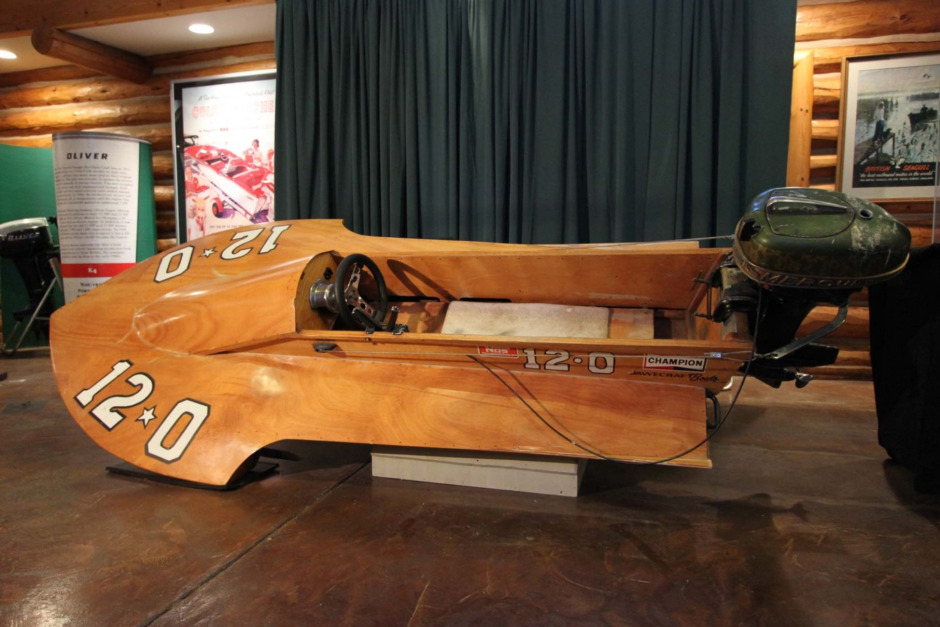
|
|
This little plywood bullet is about ten feet long, if that, and goes like the hammers of hell. It\'s a little scary but so much fun you can\'t stand it!! |
First, we\'re talking about a pond here. Not a lake. A pond. A lake is an actual measurable body of water. Here, we\'re talking about maybe 80-100 yards of water. Probably much less. It was basically a wet spot in the middle of corn fields. And one end was barely wide enough turn a boat with a skier while the other was far too narrow. Worse yet, it had a definite"L" shape with the too-narrow-to-turn part at the base of the L. However, in that part of the country, if its wet, you strap on skis and go for it. Especially, when you\'re too young to know better.
Before we started using it, someone got creative with a bulldozer. They let the pond dry out and cut through the corner of the"L" creating a very narrow channel that allowed the boat and skier to make a wider radius turn that was completed through that channel. A skier who swung even slightly wide wound up impaled in the bank at the edge of a corn field. When we started using a single"banana peel" ski, which has no skeg fin so it slides sideways in a turn, every one of us ate mud at that point a lot more than once.
Thanks to my friend\'s dad, we had a whole flotilla of boats, the main one being an old wooden Thompson that was maybe 18 feet. However, the two we used the most in testing our mortality were the hydroplane and a craft I don\'t even know what to call or how to describe. I\'ll try.
Picture this: You take a bunch of aluminum irrigation tubing about 12 feet long ranging from about six inches in diameter down to maybe three inches. You lay that tubing side-by-side, the bigger tubes in the middle. Then you arch the tubes up in a shallow"U" with the smaller tubes on the upper sides. These are all artfully welded together. It\'s like a dished raft except the tubing at the front has been cut so it can be bent upwards to form a prow. At the back, the tubing goes straight back and is capped. There is no transom except for a little area in the middle where a foot-square panel sticks up and an outboard motor is mounted. A perfectly smooth and extremely slick aluminum bench spanned the top of the"U" with basically no gunwhales on the ends. Remember this point.
Now picture this: You\'ve got a fairly high horsepower motor on the back of what is an aluminum version of an inflatable pool raft and you\'re pushing it at speeds that aren\'t even remotely safe. Actually, at that age,"safe" speed doesn\'t exist. Only"more" speed exists. It was one of the dumbest, most unpredictable water craft ever created so it was ready-made for us. When it got up to speed, which was almost immediately, nothing was touching the water but the center tube. When you turned, even slightly, it instantly rolled on its side and planed on the outermost tubes. If you didn\'t have a death grip on the seat, you went right over the edge, none of us giving any thought to the possibility of the prop running over us in the turn.
We had all sorts of"trick" moves on that stupid thing. If you got two guys on the front, with their legs hanging down in the water, you could force the bow to run under water with nothing but the back five or six feet of the"boat" above water. One of our favorites (did this in the Thompson too) was to get going as fast as we could and jump over the side to land flat on our backs with our feet up trying to skip like a flat rock. Mostly what we got were mud enemas. But we were having fun!
You kneeled, didn\'t sit, in the hydro plane and the second you nailed the throttle it would jump up on the step and be absolutely hauling a**! It was way in the hell too fast for such a small stretch of water and, looking back at it, it was actually damn dangerous. But not to us. When you were trying to turn into the channel, it would skip sideways and I can\'t count the number of times I wound up sliding sideways into the trees. Same with everyone else. Never once thought we\'d get hurt. And we seldom did but not for a lack in trying.
Hot sun, lots of laughing, boys, girls, the occasional .22. If you didn\'t count the dangerous stuff, nothing was going on we couldn\'t tell our folks. No beer. No messing around. Nothing but high-jinks as only kids could have them back in the day. But things were about to change. We were the classes of 1960 and 61 and, without knowing it, we were standing in the doorway of a future we would have had trouble believing at the time.
We were blithefully ignoring the contrails overhead of the B-47s going into Lincoln AFB 25 miles down highway 34 or the B-52s marking their paths to SAC HQ at Offutt, 80 miles to the East. At least some of them carrying nukes. I\'m fairly certain not one of us had even seen a joint, a smoking joint, not a drinking joint. Our blessed naivete was teetering on the edge of cold war calamity and we didn\'t have a clue what would be swirling around us in a few years. If anyone had told me that in a few years I\'d be getting a little buzzed while playing on stage in clubs because of all the grass the audience was smoking, I would have laughed. If they had told me we\'d have friends go overseas but never come back I\'d have been incredulous. Not one of us could have found Vietnam on a map.
The small town we lived in was slow coming into the turbulent ‘60s. And just a few miles of gravel road from there, at our hyper active little mudhole, the outside world and the future definitely didn\'t exist. It was a momentary, peaceful hole in time.
I now wish I had bid on that little hydroplane. It would have looked good floating in my pool. I could have lounged in it in the dark and made believe I was 16 again. Sometimes, I wish I drank so moments like that would actually flow over me. But, I don\'t. So, I\'m stuck with reality. As we all are. bd
18 July 2020 - Tools, Temps and Digital Visuals
This has been a fairly eventful week in our household. A little mechanical death. Some overheated moments of mechanical pleasure. And a little digital visual disappointment.
Here\'s an amazing fact we tend to forget: between the pandemic, the politics and the riots, each of us is still living our lives. Regardless of how the media makes it sound as if our world is coming to an end by noon tomorrow (depending on your point of view, that won\'t actually happen until Nov 3), we are still alive and kickin\'. While learning to deal with the earthshaking events around us, we\'re also surviving our own personal mini-crises. And I\'ve had a few.
Death of some Old Friends...Sort of
I\'ll cut right to the painful chase: my 4" angle head grinder died last night! A Makita, he had given me something like 15 years of hard work and, in the process, became one of the most indispensable tools in my shop. To me it\'s a handheld milling machine, band saw, rust-removing wonder that I use so much that I could do dental work with it. But, he\'s gone to that great tool room in the sky. I hope he wouldn\'t feel bad knowing that I hit Home Depot at 0730 this morning and replaced him. I can\'t go a weekend without an angle head grinder.
He was preceded in death by my Black & Decker, 10" radial arm saw. Old B/D had been with me for something like 40 years. Maybe longer. Then, mid-cut, sparks and smoke started leaping out of the motor housing. He was all done! I took the motor apart as best I could but he was cooked. No way to resuscitate him. That said, I couldn\'t bring myself to consign him to the junk pick-up last month, which was a good thing. Since then, the gigantic, and complex looking, old ¾ hp motor on my 6 x 48 sander got terribly sick and stopped working. No smoke or sparks and I found an armature hospital that has him working perfectly. So, maybe there\'s hope for B/D\'s motor too.
Records Set
Night before last, I used the last of an 11-pound roll of .023 MIG welding wire! That\'s one hell of a lot of wire and The Banger racer car remanufacturing project has eaten most of it. It also gobbled up about half a roll of .030 wire. You\'d think I\'d know how to weld after all of that, but I don\'t.
In another of life\'s arenas, I stepped on our bathroom scale this morning and found that courtesy of the pandemic and my total lack of self-control, I now weigh the most I\'ve ever weighed in my life: 215 pounds! 12 pounds I can blame on the pandemic. And the aforementioned lack of self-control. I started my diet and exercise routine about ten minutes later. Let\'s see if I can stick to it. This is two pounds heavier than I was when I had my last big-gut epiphany and lost 35 pounds. My weight-loss secret is what I call the Don\'t-Put-Crap-in-Your-Mouth Diet. Hard to do when sitting at a computer, 50 feet from the refrigerator while trapped indoors.
I may be trapped, but I\'m still getting stuff done. Because I grounded my flying school back in March, I discovered something I\'ve been told is actually pretty common, but it has been 25 years or more since I experienced it. It\'s called a"weekend." WOW! What a concept! It means I can, and have, put eight hours a day on weekends into the shop banging on The Banger.
Inasmuch as the last couple of weeks it has been between 108 and 112 in the shop, I\'ve also discovered the thing in our backyard called a swimming pool, which I NEVER use. But, have recently. After three or four hours at 110 degrees while welding or something, I walk out the back door of the shop, taking off my clothes as I go. At the pile of towels, I hang a right and fall into the pool. Five to seven minutes later, I\'m back in the shop. We\'re still trying to figure out how to clean off the ring I leave around the pool, every time I do that.
BD Webinar Inbound: Next Friday, July 24, 11:30 PST/1:30 CST
The EAA has talked me into doing a webinar titled"Mastering the Tailwheel", which is a forum I\'ve done at Oshkosh for more than 30 years. However, I\'ve never done a Webinar. This means I can\'t see the audience and they have to ask me questions through the moderator. This\'ll be tough because I feed off the audience, while doing forums, which keeps my energy up.This is going to be very educational for me. I want to branch out and do some You-Tube work so this\'ll let me see if I can work in that kind of environment where I don\'t have someone to bounce off of.
The downside to this is that we did a dry run and I got to see myself on the screen: Damn I\'m old! I\'m not sure I want people to know that. Oh, well... bd
5 July 2020 - Random Thoughts on the Fourth
As I watched Trump in front of Mount Rushmore I found myself loaded down with contradictory thoughts. Some good. Some not so good. Many were surprising.
I can add nothing new or enlightening to what the Media has said. However, I thought I\'d mentioned a few things that went through my mind both during and after the speech.
By far the most important effect on me was one of overwhelming thankfulness for the luck of being born in America. No matter what her failings and the chinks in her armor, she\'s still the shining light of the world and I\'m immensely proud of her. UK Prime Minister, Tony Blair, said it best, when he said,"The way you judge a country is whether people are trying to get into it or out of it."
No country is perfect. Especially the US and I started thinking about our transgressions and areas of conflicts. Many of these have been brought to the fore by protesters using founding fathers\' wrong doings as reasons for toppling national statues and removing them from our memory.
First, after giving it some thought, I can see, but not agree with, their points of view: He owned slaves so must have been a racist, so he\'s gone. He oversaw relocation of Native Americans, so, he\'s gone. And so forth and so on. Every imperfection is grounds for erasing an individual from our history. I think this is a mistake. We shouldn\'t be erasing history just because, when judged against today\'s standards, an individual isn\'t perfect. They are icons because they were perfect for the time. Judging them by today\'s standards is Monday morning quarter backing on a grand scale.
In the course of having those thoughts, I found myself looking back over our history and realized that there has probably never been a decade, or possibly even a year, that wasn\'t marked by history-making short falls and screw-ups, when judged by modern standards. Given our record in some areas, we seem to have succeeded in spite of ourselves. We should remember those episodes just so we know how we got to where we are now and then vow not to repeat those mistakes. It\'s a real cliché, but clichés are clichés because of the truth they contain. The one that fits here is,"He who forgets his past is bound to repeat it." Let\'s not hide it or, as ISIS and some current day violent protesters (not the peaceful ones) do, destroy our history just because it doesn\'t fit a modern narrative. Learn from it.
Here are a few random historical factoids and observations that popped up while I was researching our past. Some are surprising:
There is no doubt that slavery is a heart-wrenching blot on American\'s history, but we tend to look at it from a purely American perspective. Slavery is actually a blot on the world\'s history, America included.
According to the writings of Henry Louis Gates, the noted African American historian and author, in total approximately 12 million individuals were caught up in the trans-Atlantic slave trade. Many were sold into slavery by their own, or neighboring, tribes. Tragically, two million died in route!! Of the total, 388,000 (4%) came to North America with the rest being enslaved in the Caribbean and South America. Brazil was the biggest importer. So, the US isn\'t unique in having that moral scar on their history. The US Is, however, unique in that the North sacrificed approximately 360,000 of its young men (620,000 both sides) to maintain the Union by stopping secession and put an end to slavery.
BTY - According to Wiki, 170 countries throughout the world still don\'t have statutes that specifically criminalize all forms of slavery.
Right behind slavery as a national shame, or possibly at the same level, is our treatment of our indigenous people, both past and present. We forget how unusual our history is in that area and the way in which"Civilization" was well underway in the East in the 1800s while the West\'s civilization was still in question.
The first"World\'s Fair" to be held in America was the International Centennial Exhibition in Philadelphia in 1876 which show cased the industrialization that was part of America\'s incredible achievements. While the Exhibition was underway, the Battle of the Little Big Horn, where Custer got his egotistical ass handed to him by the Lakotas and Cheyenne, took place.
The World\'s Fair in Chicago kicked off in 1893, which was lit by Edison\'s light bulbs and, among other things, the Ferris Wheel, Wrigleys Chewing Gum, Budweiser beer, the automatic dishwasher and the hamburger debuted. Barely two years before and 900 miles to the west, the US Cavalry massacred several hundred Lakotas, men, women and children at Wounded Knee in South Dakota. A sad chapter! Just one of many.
Civilization has been a long time coming to America and I\'m not sure we\'ve achieved it yet.
A bunch of gender-related issues popped up, while I was digging around, that I\'d either forgotten or flat didn\'t know. Some are pretty damn amazing.
Prior to 1880, the age for consensual sex varied from state to state but it always fell in the seven (you read that right, seven) to 12 years of age range.
African Americans got the vote in 1870. Women, however, didn\'t get it until 1920
1923 -- the Equal Rights Amendment give women equal rights under the Constitution. That gave them equal rights in owning property, employment, etc., however it wasn\'t fully ratified until 1972 and even then, three states didn\'t sign on to it. SCOTUS said it was then legal.
1938...Fair Labor Standards act said employment couldn\'t be limited by sex.
1947...women were qualified for jury duty, but they were given a choice whether they\'d serve or not.
1963...Equal Pay Act...equal pay for equal work. Reportedly, that still isn\'t being enforced.
1965...SCOTUS said there was no doctor prescription required for using contraception.
1971- SCOTUS said no private employers can refuse to hire women just because they have pre-school age kids.
1973...SCOTUS said help wanted ads couldn\'t designate gender to be hired.
1973...SCOTUS, Roe vs Wade gives the right for abortion.
1974...Housing discrimination based on sex was eliminated.
1974...Prior to this law a woman couldn\'t get a credit card without her husband\'s permission!
1977...Harvard finally allowed women to enroll. Yale and Princeton let them enroll in 1969.
1978...Pregnancy cannot be a determining factor in hiring.
1987...SCOTUS, it\'s okay to hire on sex or race, if an imbalance exists within the company.
2013...Ban on women in combat roles is dropped
I skipped a whole bunch, but it surprised me that some of what we assume to be women\'s inalienable rights were so late in coming. A lot of these changes had women marching in the streets. So, peaceable protests actually are an American tradition, as guaranteed in the Constitution.
It\'s really too bad that recent events are giving the right to protest a bad name. bd
29 June 2020 - On Being a Cop
Clearly since I wrote my last blog three weeks ago, which focused on the difference between protesting and rioting/looting, things have gotten more intense and have lost focus. Now, one of the biggest questions in my mind is why any young, intelligent person would want to be a cop?
First, let me explain why I\'m so late getting this blog up: To put it simply, it\'s because everything has been changing so quickly that I have been overwhelmed by the incredible increase in unchecked lawlessness with"unchecked" being the operative word. Also, things have devolved to the point that no matter what words you use, they\'re going to piss someone, somewhere, off. I feel as if we\'re walking through a vocabulary minefield where the definitions are changing daily and that makes writing difficult.
And then there are those who have no definite meanings to their words. These are not the actual protesters. This group is either angry over everything or are raising hell for the sheer fun of raising hell. Statues are a case in point: When they are tearing down statues ranging from Columbus and Washington to Lincoln to Grant to Hans Christian Heg, an avowed abolitionist who died in the Civil War, you know you can\'t have a civil conversation with those involved because a good percentage don\'t actually know why they\'re doing what they\'re doing. The protesters have a focus, a subject and a cause and have every right to be out there. You can have a valid argument with them. The rioters and those causing damage don\'t have a specific goal and can\'t carry on a coherent conversation about anything. The exception is Antifa and their ilk: They have a very different and clearly announced focus: the overthrow of the government. They don\'t want to talk.
Mixed in with this mess are the local police. I have no idea why they don\'t just say"screw it" in mass and disappear. Name a job where, besides having the possibility of being shot dead every single day, your shift may have local citizens throwing water on you, or lobbing bricks and frozen water bottles at your head. Name another job where you have to stand there and have someone stand nose to nose with you, calling you every foul name in the book purposely trying to antagonize you into loosing your cool. Name another job where you\'ll go on a service call only to find it\'s a set up for an ambush.
Then name a job where you\'re just trying to accomplish your mission and the managers of the company you work for, the City, not only don\'t support you, but actually put restrictions on you that stop you from doing what the citizens expect from you. Then they say you\'re not needed and they\'re going to cut your pay and eventually phase out your job. There\'s not a helluva lot of incentive to show up for a job like that.
It\'s difficult for normal folks like us to stand on the sidelines and hear city governments say they\'ve going to do away with their police force. Or drastically cut their funding. That is so incredibly naïve it\'s hard to believe anyone would actually say that out loud in public. Much less mayors and city councils. These kinds of comments display a complete ignorance of the nature of the human species. Since before civilization came out of the caves, there has always been a warped element that is a different kind of human. It is bred into them that preying on the rest of society is central to their own survival. To that segment of society, criminality is a job. It\'s what they get up in the morning to do. They have to be laughing their butts off hearing city governments talking about doing away with the police. The anarchists, which are proliferating like crazy and are forming themselves in to an insurgent-type of force, are cheering the anti-police factions on. Politics are making their over-throw of the government easier.
Yes, law enforcement reform is absolutely necessary. There are always a few bad apples in every barrel and the regulations have to be there to both guide the force and define processes for drumming the bad apples out. So, Congress has to get their act together and come up with a bipartisan level of reform that makes sense. However, it appears that the concept of bipartisanship is seemingly impossible to apply these days.
The concepts that are going to absolutely destroy this country are political correctness, politics in general, and a lack of understanding that lawlessness feeds on success. If law and order doesn\'t prevail, we\'ll be the wild west all over again in every major city.
So, with all of this as a backdrop, why would any 20-something that\'s looking for a worthwhile career consider law enforcement? When cities like Minneapolis and New York see their streets become war zones, they\'ll realize the thin-blue line that has protected them all along is actually necessary and they will try to rectify the situation. By that time, however, their experienced LEOs will be gone and the new talent won\'t be available to them. I\'d like to think those politicians will get voted out of office, but so what? That won\'t harm them. It\'s the people who will suffer and the politicians will just drift to another high paying job. They always do.
Normally, I would say we have a solution: The ballot box. However, with the media leading the electorate by its nose, I\'m not sure that\'s still true. We might have a really rough patch ahead, folks, so, keep your mags loaded and protection close at hand.
31 May 2020...Rioting vs Protesting
Referencing last week\'s Blog: It didn\'t take long for"Civil Disobedience" to take on an entirely different definition this week, did it? However, as the week worn on, there was a clarification of the definitions: We are clearly seeing the difference between protesting and rioting.
I want to make this one as short and clear as I can. First, there\'s not a person in the country, whether he\'s politically right, left or in the middle who doesn\'t support the basic concept of protesting. It\'s written into the constitution. What is not written into the constitution is the wanton destruction of property, both personally and publicly owned. What we have seen this week is a noble protest against the actions of an obviously out of control officer being high-jacked by a combination of anarchists (ANTIFA), bad actors just capitalizing on a situation for personal gain and entertainment, with possible involvement by a criminal element. Here in AZ, we\'re thinking the cartels are also taking advantage of the situation, but I haven\'t seen proof of that.
What we have to recognize is that every kind of population has a small number of individuals who basically bear more resemblance to animals than humans. They are our criminal and socially unbalanced elements and they will take any opportunity to strike out against the rest of society, but only if they think they can do it with no consequences attached to their actions. Riots give them this cover and I think this characterizes much of Antifa\'s membership. Some bad actors may be acting out of anger at perceived inequities of the system, some of which can be understood. However, from watching the videos, all we\'re seeing is individuals acting out of some sort of animalistic urge to destroy. This is not protesting and with all the coverage of it, I\'m hoping America is clearly seeing the difference between protesting and rioting: One has its place and serves a purpose. The other is neither.
A quick photograph of what points out different views of this is, as I was typing this, Marlene called me into see something on TV where celebrities are raising funds for rioters who were arrested. I know none of the details, but that makes little or no sense.
It\'s also worth noting, and I\'m certain this is true nationwide, that, as our local protests gained population, loads of whites started trashing stores including a HUGE mall and especially their Apple store. Is this Antifa\'s contribution to the local situation? This calls for some careful research.
It\'s also worth noting that one of our jewelry stores quickly put together a little security force of their own. They stood around inside the store where they could clearly be seen through the windows carrying ARs and handguns. The looters skipped past them to the store next door. Remember what I said about their actions and consequences. They\'ll never take credit for their actions nor will they take any chances. They have no particular convictions so have no courage to back-up their actions.
I could be wrong, but I don\'t see this whole thing as a long-term threat, however, cities like Minneapolis will be a long time recovering. A number of low-income areas have lost their primary retail and grocery stores and, considering the threats associated with the area, companies may be a long time returning, if at all.
What I do see emerging out of this is a serious re-thinking of the use of police in these situations by some cities. Many suffered far more than they would have, had they responded to the rioters in kind sooner. I also see a spike in security companies renting out quick-response combat teams to large targets such as gigantic malls. As soon as a target goes from being passive to having a risk attached to it, most of these groups will avoid it and go for easier pickings.
I\'m certain that everything I\'ve written here will be made obsolete by events over the next few days. This, however, is how I see it today. Who knows about tomorrow? bd
PS
Notes from after the weekend. You don\'t have to watch many of the videos of people rushing out of broken windows and doors, their arms loaded with loot to know that George Floyd is no longer part of this episode in history. Then, when you see young people cruising the street and attacking single individuals, knocking them out and bloodying them up it\'s easy to see that this has all divolved to pure anarchy and hoodlumism. It is attracting the most extreme and violent elements of our society because they feel they can do what they want because there is almost no chance they\'ll be caught. The cities hae become their playground. This kind of violence knows no logic and the authorities are going to have to get seriously tough to keep it from spreading.
PPS
Did anyone notice the incredible launching of our first privately owned and operated space launch? It got lost in the shuffle. To me, the most incredible part is the technology of them landing the boosters vertically on barges. That looked like CGI. It\'s like trying to balance a pencil, point down, on your finger tip while running down the road. The complexities to be overcome are mind numbing and SpaceX did it! Nice going Elon!!
26 May 2020 - Civil Disobedience: an American Tradition
It\'s really interested looking around America today. We have protests everywhere you look that are populated by basically normal people, not radicals, all of which are talking about freedom and financial survival. Is this what our colonial revolt looked like in 1773?
Think about it: The Revolutionary War, which could easily be renamed, The Freedom Fight, started off with regular people getting fed up with The Crown levying taxes and the population getting nothing for them. So, in 1773, they turned Boston harbor into iced tea. Distaste for the Crown\'s dictatorial approach to governing continued to grow. Then, in 1775, the Crown decided the colonials were becoming too uppity so they marched to Concord to confiscate their arms. The skirmishes at Concord and Lexington, rightfully known as"The shots heard ‘round the world" were the result. At that point, the fight for freedom from The Crown was inevitable and a nation was suddenly in the process of being borne.
When looking back at our Colonial History, the protests we\'re seeing in so many places in the US seem a little familiar don\'t they? What\'s interesting, however, is that the protests aren\'t aimed at the federal government. Amazingly enough, you see few signs being carried by protestors with"TRUMP" in the opening line. The protests are almost exclusively aimed at governors who, under the concept of states\' rights have been recognized as being the final arbiters of how their state shall open up. In effect, they have become the final authority on how freedom shall return to the people. And some appear to have gotten power hungry and approached the process in a mindless, dictatorial fashion: Do it MY way or suffer the consequences. And"their" people don\'t like it. They are forgetting who put them in the position to govern in the first place.
The single most glaring error in the way they are approaching the opening up of local businesses is they are ignoring the fact that their people and their economy is approaching a tragic go/no-go point. This, however, appears to mean little or nothing to them but means everything to the population of their states. Another few weeks and their fiefdom, as they apparently see their state, won\'t be able to recover. The business operators are close to being in panic mode and some governors don\'t seem to care.
The news is full of stories about gyms, restaurants, beauty salons, etc, all of which have gone overboard to guarantee social distancing and mask wearing. The owners understand the risks involved and are trying to lower them as much as they can, but they are desperate to survive. Customers recognize the risk as well. They are desperate to be free. However, when an entrepreneur opens, when the rules say they shouldn\'t, some have gotten their licenses pulled, the locks on their doors changed, thrown in jail. Yes, they broke the rules but the response has been over-kill. It feels as if some governors are taking such actions as personal assaults on their authority."Oh, yeah. They think I\'m kidding? Watch this!" And the hammer comes down. They are, in too many cases, showing zero compassion towards those involved. The voters who put them in office.
In most cases, the local authorities have difficult decisions to make. The law is the law. For the most part, we all agree on that. I just think some of them are going about it the wrong way while showing little or no empathy. They are prosecuting good people, not criminals, all of whom have their backs against the wall and going to work is the only way out.
All that having been said, it\'s absolutely driving me nuts to see people crowding together at beaches, board walks and bars with not a mask in sight and zero consideration being given to distancing. Many Memorial Day crowds acted as if they don\'t think this thing is real. I don\'t think anyone is going to be surprised to see major out breaks erupt. In fact, I think some folks consider getting sick as nothing more than the price of freedom.
BTW- if you haven\'t seen it, here\'s a link to a review of the 1969 Pandemic and how it was handled. It\'s interesting reading. Too bad we don\'t have infection follow-up data on the crowd at Woodstock that year. Talk about ignoring self distancing! https://nypost.com/2020/05/16/why-life-went-on-as-normal-during-the-killer-pandemic-of-1969/
18 May 20 - Random Thoughts: And Life Goes On
This is going to come as a shock to some people, but we WILL survive Covid 19. The big question is whether we\'ll survive the shutdowns and the advice of so many"experts". More important, will we remember that other things are equally as important.
Five-Year-Olds Scare me!
I had an incredibly new experience this week and felt an emotion I hadn\'t felt but a few times in my life. I\'m not a natural at a single thing that I do in life. Nothing. But, I\'m really good at correcting mistakes/editing, which applies to everything in my life. Do it, then fix it. The only thing that seems to come naturally, is public speaking. Wind me up, put me on stage, tell me the subject as I\'m walking to the mike and I can bumble my way through it with a minimum of embarrassing gaffs. That said, this week I had to get involved in a presentation situation that had me nervous as hell for the entire week leading up to it: I had to do a digital Zoom presentation to my granddaughter, Rosie\'s, Kindergarten class about airplanes.
Five-year-olds! Damn! Talk about being outside my comfort zone! It was also my first experience with digital communication where I couldn\'t see the audience. You\'ll never know how nervous I was before hand. Do you know how hard it is to talk for 10 minutes about aviation without using one piece of jargon (on which all of av-speak is based) or swearing at some level? However, I didn\'t get a single e-mail from parents that I had traumatized or embarrassed their kids. I\'m surprised.
Friday Night Emergencies
I almost dread Friday night showing up because that\'s when every single frigging emergency that we have happens. For instance, about every 18 months our main sewer line gets plugged up and we have to call Rotorooter. However, it ALWAYS happens at 10pm Friday and ALWAYS, when we have a house guest and I have to tell them they can\'t flush the toilets.
The air conditioning is in cahoots with the sewer line because it conks out between the sewer episodes. Remember, we\'re in Phoenix. AC is not a luxury. Again, it always dies on Friday night when we have visitors. Never any other time.
Every single time Marlene falls and breaks a bone (Wrist, shoulder blade, last month a rib, the month before a vertebrae) it\'s Friday night late and we spend the night in the ER.
Last night it was our beloved Nikki, the puppy that refuses to grow up and absolutely owns our hearts. Usually bouncing around like she\'s on speed (or acid...does that date me?), we suddenly realized she was laying on the living room floor like a doorstop with her tongue hanging out. In a heartbeat, we were emergency mode and racing to the 24-hour animal hospital. And it was 10pm! And it was Friday. We left the vet\'s parking lot for home at exactly mid-night.
Nikki stayed overnight and finally, at 2 AM, they told Marlene to stop calling them. They couldn\'t get anything done between calls. And I couldn\'t get any sleep between calls. So, I\'m dragging a** today from lack of sleep.
They let us pick her up at 0930. Had"food bloat", which appears to be caused by cat litter and her less than whimsical habit of playing with cat poop. Not eating it. Just playing with it.
Car manufacturers as data source
This morning I heard a really interesting bit of tech/data news: The car companies are going to be back in business this week and each of the line workers will be wearing a bracelet that talks to other worker-bracelets letting them know when they are closer than six feet. That\'s really cool, but what is outstanding is that there are some production line situations where social distancing just can\'t be held. The bracelet information about distancing is also being fed to a computer and they are going combine that information with follow-ups on the workers involved and quantify the correlation between distance and those who get sick. That, I think, is going to answer a lot of questions about Covid 19.
Proving a Point with Data
There aren\'t a lot of good points to come out of the pandemic but one is that the entire population is becoming aware of data and the importance of it. In addition, they are being beat over the head with conclusions drawm from that data. Normally data makes sense out of situations, but not always. And this is one of the classic cases where the more data we have, the more confused we get. This is because a good percentage of the data isn\'t totally understood. For instance, an increase in cases isn\'t necessarily caused by more people getting sick. For the most part, it\'s because more people are being tested so, the number of cases climb.
As in so many other situations that are data driven, it\'s also easy to stand back and watch"dueling experts." They\'ll take the same data and use it to prove different conclusions. Or you can take different sides of any of the arguments and easily find data that supports that side.
Eventually, this is all going to sort itself out, but right now there\'s too much emerging information as we learn more about the bug. It\'s too bad that both politics and commercialism is attached to the cure and that may be the most serious pandemic of all.
Thousands of Pigs but no Butchers
I was talking to my sister who still has a business in our little home town in Nebraska and she says local pork producers have run into a real bottle neck (Nebraska is the 6th largest pork producer in the US and the 2nd largest beef producer). With the major processing plants shut down or barely running farmers had no one to buy their pig inventory so they were offering them to locals for $100 each but had no takers. Why? Because there are no longer any local butchers to process them for purchasers. The skill has simply disappeared. The age-window during which a pig is viable for market is quite narrow so they had to kill them all and bury them. Damn! No one knows how to butcher a hog!? I can probably still hog dress a deer and I\'ll bet there\'s a You-Tube video on butchering So, I can learn that. Maybe in my old age, I\'ll become a butcher. Oh, wait...too late. I\'m already at that age.
9 May 20 - This Damn Thing is Getting Serious!!
You know the world is definitely going to hell, when the EAA cancels Oshkosh (That\'s AirVenture to you young\'uns,). There has been a lot of talk about what they were going to do and that shoe finally dropped earlier in the week. Now those of us who have made it the seminal annual event have to deal with a new reality: Life without Oshkosh!
First, before January, if you had asked me if I\'d ever write that last line, I would have answered"No, frigging way!" Oshkosh is and always will be. Until, of course, it isn\'t. And that\'s where we are right now.
Actually, this doesn\'t come as a total surprise to me. As stay-at-home orders cascaded down on us and we started to see body counts of a thousand a day or more, Oshkosh timing became more and more critical. Sure, it\'s two months off, but that\'s not nearly enough time for the pandemic to subside and for them to prepare. Actually, there were two things happening at the same time: First, it takes the EAA nearly two months to get things ready to go and the work force during those two months is almost entirely volunteers. An entire army of volunteers descends on Oshkosh and become working residents. Hundreds of them. The first hurtle was how many would be willing to be part of a work crew, given the situation.
The second hurtle had a similar decision point: The aviation population is, if not freaked out, at least they are very wary of crowds. At least the intelligent ones who are taking this thing seriously are. Even if the government were to wave a magic wand and suddenly there were no new cases and no deaths to report, the population would still be spooked about large gatherings. So, the EAA management had to ask themselves,"What if we put on a fly-in and no one comes?" Oshkosh is a major revenue spike for the organization, but it costs a helluva lot of money to put the little shindig on. The cost/benefit ratio was beginning to look bad.
More important than all the above is the humanitarian side of this thing. The EAA membership may be focused on airplanes but the organization itself is focused on its membership. This whole aviation fraternity thing is based on people functioning with people. It\'s more of an enormous family dynamic than anything else. EAA HQ had to decide whether they were going to take chances with people\'s lives and they made the correct decision. If there\'s a chance the event is going to cause a spike in cases and deaths, shut it down.
I\'m glad they did what they did. Otherwise I was going to have to show up in a full hazmat suit with a forced-air painting hood. Plus, any one above 61 is, by government decree,"elderly" and at higher risk. And I\'m a few years (decades almost) past 61 so I\'m technically"elderly". Bastards! Still, I\'m taking this thing seriously enough that I\'m willing to play the age card and accept whatever protection they\'re offering.
This having been said about people avoiding large gatherings, one of the silliest things I\'ve seen so far is people protesting the lock down in crowds packed so tightly that they are breathing each other\'s breath. WTF?? I\'m hoping that when some of those protestors become infected that they\'ll own up to their own mistakes.
This thing is passed from person to person, person to doorknob to person, person to five-dollar bill to person, etc. However, for the most part, we could be making mud pies out of Covid19 with our bare hands and, as long as we thoroughly wash/disinfect our hands before we touch our faces, we\'ll be okay. Everyone on the planet knows all of this. Too many just don\'t do it.
There are so many bad things going on over which we have little control that this week has seemed as if we\'re doing a dress rehearsal for the end of days. Things, we didn\'t need on top of the pandemic, like murder hornets and gypsy moths, are far more likely to kill us all by disrupting the natural food chain and those are difficult to control. A virus isn\'t. We know how this works and, give us time, and we\'ll know enough about it to at least limit its effects.
The biggest drawback to them cancelling OSH is that the majority of us airplane gray dogs date our year from that week. Not January one. We date things as being either before or after Oshkosh. It\'ll take us a while to reset our thinking. But, we\'ll make it work. bd
PS
One thought has definitely been re-enforced during the last weeks: I don\' t know how retailers can possibly stay in business. People who had never ordered on line now have dozens of empty Amazon boxes laying around their recycle bins. This morning I ordered a half dozen cut-off disks for my angle head grinder. They showed up around two o\'clock!!! In the middle of a pandemic I\'m still getting my hardware. McMaster-Carr is doing the same thing. One click shopping with no shipping costs. I ordered four 7/16" bolts and they showed up the next morning with no shipping charge. Even Aircraft Spruce shipped some tubing to me that I had ordered Sunday night and it arrived Wednesday. It\'s no longer worth it to climb in the car and drive over to pick something up. Buying patterns were already changing but this has been a tsunami of change. Brick and mortar retailers are going to take it in the shorts. ...and the times, they are a changing.
26 April 20 - Confessions of a Newbee Germaphobe
Alright, this is it! I\'m tired of thinking, living, watching and generally being immersed in Covide19 everything. Right now, if you scan through your e-mails and The Media (of any kind) there will only be three subjects being covered Covid19, Trump and Covid19-combined-with-Trump. Enough already!
I made a quick foray out last night to get a couple of Subs so Marlene wouldn\'t have to cook. She\'s on the first week of recovering from a broken rib (not cracked, actually broken) and anyone who has ever damaged a rib will tell you it\'s one of the most painful minor injuries you can have (I\'ve done it twice). Every movement is an exercise in pain. And God help you if you sneeze or cough. Anyway, this was probably only my third or fourth journey out into the new world which has been re-sculptured by Covid19 and I ran head-on into a new me. It was a me I didn\'t really recognize and I was having a little trouble coping with me. And the world around me.
First, I put my mask and gloves on and went into the Subway only to find the two teenagers running the show who were about to make my sandwich weren\'t wearing masks and were lollygagging around behind the counter in a way that made me very uncomfortable. I asked why they weren\'t wearing masts and they said,"Because we don\'t have any. They haven\'t arrived yet."
Aaarrrggh!
Then, even though the pleasant young man started to don gloves to make my sandwich my brain went into a spasm of okay-he\'s-wearing-gloves-while-actually-making-the-sandwich-but-what-has he-breathed-on-who handled-the-bread-how-often-have-they-disenfected-the-food-trays. On went the uncontrolled mental rant. Then I heard what I was rattling around inside my brain coming out of my mouth,"Nah, forget it. I don\'t want to take a chance."
Ha! I surprised myself! I usually sluff that kind of thing off.
I went out the front door, mask and gloves still in place, hung a left and walked into a local grocery chain, Bashas. I was going to buy sandwiches from their meat/deli counter. It was too late for the butchers so I had to take a couple of the pre-made, in a plastic container, sandwiches. My mind took off again: who-handled-the-plastic-containers? Was that me over-thinking things?
Off to checkout and the check-out lady wasn\'t wearing a mask or gloves although they did have a Plexiglas screen dividing us (even my steel supply yard has those now). My oh-sh*t paranoia meter pegged. As I ran my card into the reader, I was acutely aware of pushing buttons half of the universe had pushed and sneezed on. I was mentally repulsed and very aware that I had handled my card and my wallet after pushing the final key. Then she dropped my purchase in a plastic bag and all my brain could see were herds of bugs (most were black, a few purple and one very aggressive yellow one) running all over the plastic, just waiting for me to pick up the bag. By this time, I was beginning to doubt even my sandwiches. Who had butchered the pig? Had they breathed on the ham while making the sandwich?
I had never seen this me before!
Back at the car, I took the gloves off before opening the door but then realized I had touched both my wallet and card with the gloves that were probably totally coated with germs. So, I ripped a Lysol wipe out of the ever-present box in the other seat, got out, wiped the door handle, my wallet, my credit card, my hands, the steering wheel, the start button, the shift lever, etc., etc. I think I wiped the rearview mirror because I had looked at it. Well...you never know.
While all of this was going on, a part of me was hovering about five feet above me, like a ghost observing the goings-on, and I heard my own voice coming from the apparition saying"Gheez, Budd! Is that really you? Have you gone nuts?"
At that point I realized I had become a germaphobe.
This was an entirely new concept for me. And was probably being too paranoid. However, the operative word in that sentence is"probably." I\'m knee deep in the demographic that is considered hyper-vulnerable to Covid19. With too many miles behind me and mild hypertension, I\'m the poster child (hardly a child) for possible bad things happening should I catch the bug. So, we\'re sheltering in place and are definitely not looking forward to the state opening up.
Will we, as a nation, eventually come out of our social burrow and into the sunlight? Yes. Probably. But, I\'m not sure when. The decisions being made by us and the federal, state and local governments are uniquely critical. None of these kinds of decisions have ever been made before. I don\'t envy the decision makers. If they go too far, people will die. If they don\'t go far enough, the economy dies and higher death rates will be the result there too, but for different reasons. Damned if they do, damned...etc. However, it\'s up to us, as individuals, to still socially distance and wear masks.
The most damning aspect of this entire experience, which I\'m certain the majority of us will survive, is the way in which a civilization-wide tragedy has become politized. The political hate and divisiveness have further divided an already-divided country at a time, when both sides should be pulling together. At the same time, most of that division, but definitely not all, exists primarily inside political ivory towers. And the media. Especially inside the DC beltway. Outside, in the real world, it is heartening to see how we\'re trying to support one another and we\'re united in giving thanks to those doing battle for us, from truck drivers and first responders to the janitors keeping our hospitals and grocery stores clean. The People are still The People, which is a very American way of thinking. At ground level, political views don\'t seem to matter. This is as it should be.
We\'re going to come out of this period greatly changed, but we WILL come out of it and we\'re going to be smarter and more determined to right our ship than ever before. Our politicians had better show that they\'ve learned from this because the populous has definitely seen politicians for what they are. The sweaty-unwashed-masses, you and me, regardless of political persuasion, have clearly seen where governments, and more often specifically, politicians, have forgotten who put them in office and whom they are supposed to be working for. Especially their actions in delaying critical funds for troubled businesses for political gain.
The old cliché,"What doesn\'t kill you makes you stronger," applies here. Unfortunately, we\'ve lost too many friends and loved ones in the process and I hope we\'ve learned what we need to learn. Time will tell.
November is going to be very interesting and will say a lot about who learned what during this trying time. bd
16 April 20 - Road Kill: a Different Kind of Blog
This is a highly unusual Thinking Out Loud. What follows (it\'s a long read) is the first few chapters of a book I pitched to publishers something like 18 years ago. Most publisher\'s reps are female and based in New York City and they rejected it out of hand as being too implausible. The concept of the country falling apart because the truckers weren\'t running was, to them, too silly to contemplate. Looking around right now, I wonder if they\'ve changed their minds. And I apologize for there being no indents. They disappeared, when I took it into HTML format.
Road Kill
By
Budd Davisson
Prologue
"Mr. President?" The presidential advisor had delivered difficult news from nuclear stand-offs to assassinations, but he really didn\'t want to be the messenger this time,"I have some bad news about the state dinner tonight for President Umbabi."
President Thomas McAlvery Buchanan looked up from his desk, his round, featureless face a question mark,"Now, what?"
"Sir, the cook says the planned menu of fillet mignon can\'t be served."
"Why the hell not?" Buchanan snapped. Buchanan, being from Mississippi, didn\'t consider it food if it hadn\'t once been alive and covered with hair.
"Sir, the truckers strike has prevented deliveries to our normal suppliers so there are no fillets available anywhere in town."
"Goddammit, do I have to do all the thinking around here?" the most powerful man in the world roared."Do T-bones then. How obvious is that?"
"Sorry, sir, no T-bones either."
Buchanan, wrinkled his brow and put his face down into folded hands as if saying a prayer. This trucker strike was becoming a pain in the butt, but he\'d be damned if he\'d give in to those sonsabitches. Quietly, from behind his hands he said,"Okay, then, what exactly does the chef say he can serve?"
"Spaghetti."
Buchanan looked up with big eyes,"Spaghetti? You have to be kidding! With meatballs?"
"No, sir, just spaghetti."
Chapter One
"Ladies and gentlemen, this is the Captain speaking. We\'re about twenty minutes out from landing and we have a highly unusual situation developing at Kennedy. Don\'t be alarmed, as it shouldn\'t affect our landing or safety at all, but I thought you should know about it in advance."
Molly Slattery looked over at her husband, Jack, and squeezed his arm.
"As you know," the pilot continued,"the trucking strike has gone on for over a month now and it appears the lack of deliveries to supermarkets and grocery stores has spread to the point that people are leaving their posts to care for their families and we just got word that includes air traffic controllers as well."
A slow mumbling amongst the passengers could be heard over the engines.
The pilot hesitated, cleared his throat and continued,"The airport is officially closed and there is no formal air traffic control. However, we\'re talking to all the other aircraft inbound to JFK and we\'ll just follow each other in. It is, however, going to be crowded because weather has diverted traffic from other cities to Kennedy. The local New York weather is perfect, however, so there should be no problem."
"No problem, my ass," Jack Slattery hissed as he imagined what was going on in the cockpit. A pilot himself for over thirty years, he had his own thoughts on the matter."I\'ll bet there\'s not a pilot inbound to Kennedy who can remember the last time they made a landing without having radar covering their butts. This ought to be a lot of fun."
He didn\'t try to hide the sarcasm.
Molly knew the signs: Jack was just getting up a head of steam. She\'d do her best to calm him down, but the trucker\'s strike and the way President Buchanan was handling it was one of his soapbox subjects.
Dammit," Jack Slattery said."I knew we should have left earlier. As soon as I saw how badly that jerk Buchanan was screwing up, we should have packed up and left England right then." He was fuming."I don\'t know what the hell Buchanan thought was going to happen. It\'s been damn near six weeks and grocery stores can\'t last nearly that long. Same thing with gas stations. We should have learned our lessons with the gas shortages. Or Katrina. Let a population think they\'re about to run out of something and everyone starts hoarding. Then, guess what? They do run out of everything. Then it\'s every man for himself."
Molly, put a finger to her lips making Jack aware that people were looking at him. He didn\'t care and was on a roll,"Don\'t kid yourself, this is happening everywhere in the country. Everywhere! Things started to go to hell a couple of weeks ago. And, what did Buchanan do? He just sat there acting like God. Now, not even the truckers are eating. Damn! We should have headed for home right then."
Molly knew what was bothering him."Jack, Debbie will be just fine. She\'s a level headed kid and can take care of herself."
Jack wasn\'t convinced,"Yeah, but we should never have left her alone. I absolutely guarantee you that we\'re one step away from gangs cruising neighborhoods looking for food. And she\'s stuck at the house. At least I hope that\'s where she is. I don\'t..." he was interrupted as the captain continued delivering more bad news.
"We\'ve been in contact with aircraft that have landed ahead of us and they advise us that all of the boarding bridges are full so we\'ll have to deplane you on the ramp and will probably have to use the emergency slides. Again, this will be no problem and our flight attendants will assist you and give you instructions on how to use the slides. We apologize for this inconvenience, but we\'ll do our best to help in every way we can."
Jack Slattery had dealt with serious adversity from his days as a young Marine to his rough and tumble life as a commercial building contractor in the New York metropolitan area and he was thinking far past the words being said by the captain.
"Babe," he said, moving closer to Molly so others in first class couldn\'t hear him,"I think there\'s a real shit storm going on and we\'d better be prepared for it. Take a look down there."
As Slattery was speaking, the airplane was in a bank giving them a clear view of a river with a number of big bridges spanning it. Traffic filled every lane of highway as far as their eyes could see.
Jack said,"That\'s the Triboro Bridge and it doesn\'t look as if anything is moving. The tunnels have to be a disaster. This is just great! It\'s so clear we can damn near see our place," he indicated the far horizon on the other side of the unmistakable outline of New York City,"but you can bet we\'re going to have a helluva time getting there."
Even as Jack and Molly Slattery stared out across New York at their home in far western New Jersey, Bo Black, a twenty-nine-year-old youth with the build, complexion and demeanor of a short Mike Tyson was sitting in the back of a Department of Corrections van handcuffed to the seat. He couldn\'t help but grin as a bulky guard yelled into the radio.
"Dispatch! Dispach! Is that you, Jackson? What the hell do you mean; the station is leaving?
A tinny voice came out of the speaker,"Yeah, Things are going to hell in a hand basket around here. Maloney got word that a gang was moving down his street in Secaucus cleaning the food out of every house as they go. He wanted to roll a couple of black and whites to stop it, but the Captain said they didn\'t have the manpower, so Maloney told him to stuff it and left. Most of the other guys are gone too. Heading back to their places. Hey, man! We\'re supposed to be protecting the people but just who in the hell is protecting us? I\'ll talk to you. I\'m splitting. Later."
"Jackson! Jackson, what the hell am I supposed to do with this load of jail birds?" his answer was random static.
"Dammit!" He dropped heavily into the driver\'s seat, a bewildered look on his face.
Bo Black was enjoying the display immensely. The van was sitting on a side street in Hoboken where the driver had stopped after being forced off the Jersey Turnpike because of a near riot at a traffic jam. It was pretty obvious that getting to the prison was going to be nearly impossible. Even Black, himself a product of the inner city and used to a high level of localized chaos, was amazed at how quickly the area was unraveling. It seemed as if every block had its own little battle in progress.
The guard abruptly picked up a clipboard fastened to the dash of the big van. He scanned down it, his lips moving as he read. Satisfied, he reached into a lock box and came out with a ring of keys.
He was shaking his head in disbelief as he moved down the aisle unlocking handcuffs and leg chains as he went. The nametag on his khaki uniform shirt said,"Datillo." He was talking in a near-shout as he worked.
"Alright, you dirt bags, this is your lucky damn day! The frigging world is going down the toilet and I don\'t want to be nurse-maiding you assholes while one of your homies is out there burglarizing my place or hassling my family, so I\'m outta here. For two œ cents I\'ve leave you all chained up in here, but I\'m such a nice frigging guy, I\'m not going to do that. I\'ve checked all your sheets and none of you are rapists, murderers or really bad guys, so you\'re on your own."
As Officer Datillo finished speaking, the key clicked in Bo Black\'s cuffs. He was free! He\'d been on his way to serve two years for armed robbery and now he was free, courtesy of stubborn truckers who wanted to overturn regulations he neither knew nor cared about.
Bo Black stood on the curb watching Officer Datillo drive away in the van with New Jersey government license plates. He had to swerve to miss a slow-motion fistfight between two elderly white women. A broken grocery bag was at their feet. Black looked around at a part of Hoboken he knew well and rubbed his wrists where the cuffs had been. Life was suddenly very good, even though his old neighborhood was beginning to like a combat zone complete with a couple of burning cars.
As Black watched the van disappear, he saw something very symbolic in it: the law had just decided to abandon their jobs and return home to tend to family business. Bo Black grinned his signature toothy grin. This was a career opportunity of massive proportions and he wasn\'t going to let it pass without engaging his natural bend towards entrepreneurialism. People had to eat. People had to travel. New Jersey had just become a commodities-based economy with the only two commodities that counted being food and gasoline. Yes sir, with the law at home guarding their own gates, there were some real opportunities here.
Bo Black had a plan. Get his guys together, get a few guns and get going. Corner the food and gasoline market and he would be czar of New Jersey. He grinned again. This was going to work!
As if endorsing Black\'s concept, a Hispanic woman came screaming out of the brownstone directly behind him. She was driving a middle-aged white male in a well-pressed business suit down the steps while beating him with a broom."You sonuvabitch, that\'s my bottle of milk and I don\'t give no damn how much dinero you got. We can\'t eat money. It\'s mine! I catch you in my building again and my man gonna cut you good!"
Chapter Two
"I don\'t like this one damn bit," Jack Slattery said under his breath. He had his nose glued to one of the airliner\'s windows."Look down there. I can actually see mobs of people around the stores. It looks like wall-to-wall riots and...oh, shit!"
A moving shadow cut quickly across the ground beneath them and Slattery snapped his head up. A United Airlines 757 was barely 100 yards away slowly converging on them.
"I don\'t believe this!" Slattery blurted. Molly leaned over his lap and looked out. Jack said,"I think he\'s trying for the same runway we\'re going for! Oh, man! This isn\'t going to work!" Then, the other airplane stopped moving toward them and held position. He was flying a very tight formation with Slattery\'s airliner, which let Sam know the pilot had them in sight although he couldn\'t guess why the pilot insisted on flying so close.
Slattery\'s Boeing 767 was grumbling along, gear and flaps down on final approach to runway 17 Right at Kennedy International. Slattery could imagine the runway dead ahead, but could see none of it. He wasn\'t looking anyway. He couldn\'t take his eyes off the airliner that seemed glued to their wing tip. Even as he watched, a quick puff of dark smoke came from the left engine.
"Damn! One engine just flamed out. He\'s running out of fuel," Slattery blurted."That\'s why he\'s so close. He\'s planning on landing right behind us. He must have been diverted from someplace else. I hope he has...oh, oh, there goes the other one. Oh, my God! It looks as if he\'s trying for the taxiway."
Its source of propulsion gone, the giant airliner began sliding back and Slattery had to lean forward to see, unable to take his eyes off it. The airplane sank lower and Jack knew he was in serious trouble...they weren\'t yet over the airport boundary and there was nothing below but buildings and the occasional boulevard. And airliners on final approach don\'t glide.
Out of the corner of his eye, he caught the paved end of the taxiway just ahead. But it was too late. Just before crossing the muli-lane highway bordering the airport, one of the aircraft\'s landing gear hit a light stanchion and the airliner slewed sharply right. The pilot corrected with a left bank but he was out of airspeed, altitude and luck all at the same time: the down wing tip caught the edge of the raised earthen berm at the airport boundary. The last Slattery saw of the airplane it was a cart wheeling mass of flame that catapulted wreckage up onto the taxiway.
"They didn\'t make it," Slattery quietly breathed, as he slammed back in his seat and stared straight forward."They didn\'t make it! Dammit!" He immediately wondered how many other desperate pilots were out there staring at fuel warning lights.
"Sir, just cross your arms in front of you and jump feet first, the slide will catch you."
Standing in the open door looking down, Slattery only half heard the shaken flight attendant. He was having trouble processing what he saw. The massive JFK terminal was over a quarter mile away and the usually empty ramp between was a hodgepodge of aircraft parked at odd angles, like giant insects trying to build a nest. Noisy groups of people were milling around not knowing what to do, and the occasional airport vehicle could be seen in the distance drawing a beeline for an exit somewhere.
Before jumping, he looked across the confusion and mentally marked the route he and Molly would have to take to make it to the parking lot where he hoped his truck was still parked. The situation was much worse than he had imagined.
Standing at the bottom of the slide, Slattery caught Molly\'s arm, as she slithered to a stop and jerked her to her feet before a portly old lady squashed her.
"Let\'s go. We have to get out of this mob before it gets really ugly," he said.
Even as Jack spoke, an overly tan, middle aged man with too many gold chains, too much chest hair and too much attitude was screaming at one of the flight attendants,"Hey, lady, I don\'t give a damned about your problem, here. I want my goddamn bags! I wear thousand-dollar shirts, ya know, and you don\'t think I\'m going to leave my stuff in the belly of your goddamn airplane do you?"
As Jack pulled Molly through the disorganized crowd, she had to shout to be heard,"Jack, what about our baggage"
"Forget it," Jack yelled back,"When people realize they\'re stranded in the middle of an airport, it\'s really going to get crazy out here. I hope to hell someone disarmed the ramp side security door locks, or we\'re not even going to be able to get off the ramp. What an incredible mess!"
The mobs were everywhere on the ramp and Jack was acutely aware of palpable panic floating in the air. People were just beginning to understand the desperate nature of their dilemma. Airports are not designed to have large numbers of people on the ramp. In fact, post-911 airports are specifically designed to keep people off the ramp and away from the airplanes, which creates a weird sort of reversal...once people are inside a fence that was designed to keep them out, there\'s no logical way to escape because every door and gate is locked.
As Slattery dragged Molly through the frantic crowd, he was trying to apply what he knew about airport security and the way buildings are built to getting past the terminal to the parking lots. It was as if everything he\'d done in his life, from the Marines to construction had led up to surviving in this situation.
Everywhere he looked panicked mobs were beating on locked doors at the elevated ends of jetways and ground level personnel doors. They were crammed against one another as if thinking that by shoving the people ahead against the doors they could somehow gain entry. But it wasn\'t working.
Jack\'s eyes scanned the lower levels and spied a way in.
"Molly," he pointed to where some equipment was backed up to a wall where there were no people,"there\'s a baggage loading dock. Let\'s go."
Molly immediately saw what he was thinking and changed direction. A British national, when she and Jack met several years earlier, she\'d been working for British intelligence as a field agent, so she was also used to handling unusual situations and had received training most women couldn\'t even imagine. They were a good match. Without Jack saying a word, she hopped easily up on a belt loader, clambered over some baggage and crawled through the heavy plastic drapery that kept the weather outside from following baggage through the small portal. Her small, but athletic, frame fit easily. Jack was close behind, but at six feet and one-hundred-ninety pounds, he didn\'t slide through as easily.
"Oh, this is charming!" Molly said, as she smoothed her short-cropped auburn hair. Jack dropped off the conveyor belt beside her in a darkish room that was a mess of baggage, conveyors and baggage carts. Although the murmur of the crowds could be heard through the walls, a gloomy silence lay thick around them."What now, Mr. Slattery? You know it\'s going to be pandemonium as soon as we get into the terminal."
Jack stood for a moment looking around. Thinking. She was right. They needed a plan. They couldn\'t just go barging out there and get swept away by the crush of people that undoubtedly filled the terminal. There had to be a hundred airliners clustered on the ramp in addition to those already on boarding gates, so the problem of people getting out of the airport was reaching critical mass. He tried to picture what was happening on the other side of the terminal wall and what it would take to make it to the parking lot.
"Okay, here\'s the plan," he said."Let\'s do the baggage thing and follow the conveyor. That will put us on the lower baggage claim area. That\'ll be away from most of the crowds. I hope. When we hit the terminal floor, we can count on every door and stairwell being packed to the point they are dangerous. Once we\'re out of the terminal, I think we\'ll be okay. So, let\'s make our own door."
As Jack was talking, he was walking slowly amongst the loaded baggage carts. He was looking for something. Molly didn\'t even try to guess what."Aha!" Jack said."This\'ll do the trick." Hefting a baggage cart tow bar in his hands, he said,"Yeah, this\'ll do it. Let\'s go."
As the Slatterys crawled through the small baggage conveyor door into the baggage claim area and dusted themselves off, not one person in the frantic mob even noticed them. Nor did they question why Jack Slattery was dragging a heavy steel tow bar behind him to the center of the concourse. They were all too intent on forcing their way into the impenetrable mass of humanity that was trying to wedge itself through the hopelessly jammed revolving doors. Between the doors, huge windows offered an unobstructed view of people outside running one way or the other on the sidewalk.
"You ready?" Jack asked Molly, who was standing directly behind him holding the other end of the tow bar. She nodded."Then, let\'s do it!" he said.
In unison, the pair lunged toward one of the glass walls of the terminal. Jack guided the tow bar into the exact center of a panel, which was designed to survive decades of careless skycaps and passengers but not the onslaught of a tow bar. Jack stopped abruptly and let the tow bar do its job. The results were spectacular.
The tow bar pulverized the lower four feet of glass, causing the glass above to collapse and cascade down, the wide sheets shattering like ice, as they hit the floor. Just that quickly, they had a way out and took advantage of it. Now all they had to do was hope their truck was still there and prepare for becoming part of the lemming rush to nowhere they had seen from the air.
As they dashed down the sidewalk toward the distant parking lots, Jack was thinking about the nightmare of trying to get through New York City and said,"This is going to be a very long day."
Molly wrinkled her freckled, pug nose and answered,"What do you mean ‘going to be?\'"
A note from 2020 to Airbum readers: I haven\'t written the rest of this book, but it\'s all outlined.
Briefly, Jack lives on a farm in the west side of NJ, which has been converted into an actual island by the surrounding states. In an effort to protect themselves from the onslaught of paniced NJ and NY citizens trying to get across the rivers that surround the entire state of NJ (except the northern 30 miles or so), the states have blockaded or blown all the bridges. No one can get out of NJ. It instantly degrades to science fiction grade, dog-eat-dog anarchy.
From where they are in JFK, Jack doesn\'t even try to get through NYC to NJ. He hot wires a motor cycle in the parking lot and cross countries his way east, rather than west to a friend\'s potato farm that has a grass runway on it. He hot wires a Cub and puddle jumps his way back home only to find his daughter is gone and left a note, she\'s gone to friends\' house in the middle of the state, which has turned into a dangerous, urban battlefield. In the meantime, Bo Black gets his thugs together, steal a ton of arms from a Nat Guard armory and occupy every Costco, Home Depot and major food storage facility in the northern half of the state.
It becomes a war zone with ex-Marine Jack Slattery and his rural friends on one side and Bo Black and his urban troops on the other. This carries on for an extended period of time because, once the country descended to this level of anarchy, getting the truckers running and up to speed is much more complicated than it sounds. The producers have to start producing to have something to carry in trucks and the outlets have to reorganize and get back up to speed to sell/distribute their goods. NJ and NYC, which are combat jungles by this time, are the last to be taken care of simply because the military, with its manpower depleted by understandable desertions, has to get the rest of the country on its feet before they can jump into a commitment the size of the NY/NJ metropolitan area.
And so it goes.
29 Mar 20 - Personal Responsibility in the Covid Age: Kids can Kill us
I was determined not to talk about CV19 this time around but couldn\'t do it. This thing has so totally enveloped our lives, that it\'s hard to think about anything else. And this time I\'m thinking about personal responsibility and how young people don\'t seem to have it. This is hurting us all.
There was an interesting map put together by a tech company that showed the travel patterns of cell phones that had been in Florida during Spring Break. It clearly showed that a few weeks after the kids returned home that there were Covid spikes where ever bunches of them went. Youth is a wonderful thing, however, for the time being, they have to try to not yield to the traits that make youth what it is or we\'re all going to pay for it.
One of the central themes to being young is that we think of ourselves as being invincible. And we think the old folks, those over 30 or so, exaggerate everything. The"Don\'t trust anyone over thirty" thought pattern wasn\'t invented in the ‘60\'s. It\'s always been with us but ebbs and flows and appears to have something to do with how different generations have experienced life while young.
The vast majority of those pictured frolicking on the beaches or strolling drunkenly down the streets during Mardi Gras were in the 18 to 25-year old bracket. I think back to several interviews of those in Florida and them voicing the attitude that they don\'t care about the Virus. Even if they catch it, it won\'t be a big deal. The concept of them being carriers and bring it home to their parents, grandparents, and friends never occurs to them. That\'s part of being young. It\'s also part of never actually lived through a major event that affects a population.
It\'s hard to believe, but 9/11 is just short of 20 years ago. So, if we say that a person has to be 15 years old before an event actually becomes a burning memory for them, that means that anyone below the age of 35, doesn\'t have the same memory the rest of us do. There hasn\'t been a heart-stopping national event since then. So, there\'s an entire generation that doesn\'t know the feeling of time coming to a stop for a long period of time. Of instantly remembering where they were and what they were doing, when it happened.
There isn\'t a person reading this that doesn\'t clearly remember watching the towers come down and how it seemed absolutely unbelievable. As if we were watching a sci-fi movie. We remember how, when the realization that we were under attack, settled into our brains, we came together as a nation. Same thing for when we first heard Kennedy was killed. Those are moments are frozen in time. Our parents all tell similar tales of listening to the news on the radio of Pearl Harbor being under attack and FDR\'s speech the next day that, in so many words, said the world had forever changed.
Those kids who are staring into a camera and proclaiming their freedom by totally ignoring the whole Cornoavirus thing aren\'t about to give up their partying for anything. They do so out of an overwhelming amount of self-importance and a total lack of understanding of the severe possibilities this pandemic embodies. There appears to be a disconnect that is partially grounded in their not even knowing what\'s going on in the world, nor do a percentage of them care.
I\'m betting that some of this has changed since spring breaks ended. Part of the change may be because I hope they caught a tremendous amount of crap when they returned home and, in the time since, they can\'t ignore colleges shutting down, states demanding they shelter in place, and their favorite bars being closed. Plus, a percentage of them may be hospitalized, as we speak.
But there is still a segment of society that still doesn\'t think this thing is real, so they party on. And they foster the spread of the demon.
Certainly, one of the scenes that drives the reality of the situation home is that of refrigerated trucks backed up to hospital loading docks. You know those trucks can\'t be neatly lined with gurneys or cots that are desperately needed elsewhere. You know body bags are just stacked in there as gently as they can because they have no other choice. The morgues and coroners have to be as overwhelmed as all other systems are.
The millennials are just now entering into the real world, courtesy of a bug none of us had ever heard of. Let\'s hope they are getting the message. If they aren\'t and they persist in rebelling against the always-ignored standards of society, this thing is going to last longer than it should. And some of them and those they love and know are going to pay the so-called ultimate price.
BTW...Where were their parents during spring break?
Incidentally, I\'m going to be pissed, if I lose someone I love because of some drunk kid. bd
22 Mar 20 - Surviving The Great Toilet Paper Panic of 2020 and Other Ridiculous Stuff
The engineer in me kicked in this morning during my morning ride on the porcelain pony. I actually counted the number of sheets I used and came up with some worthwhile conclusions. Potty-thinking is sometimes productive.
Much of what follows definitely falls under the heading of TMI (Too Much Information). Proceed at your own risk.
As part of my early morning research, I found that I use five sheets per pass and there\'s generally two passes (told you...TMI). That\'s 10 sheets a day. Shortly after that bit of fact-finding research, I wandered into our TP storage area (also known as the back bedroom) to evaluate the TP rolls, most of which have been in the house for a couple of years. It turns out that there is a variation between the brands with from 221-300 sheets per roll. Why 221, rather than 220, I haven\'t the foggiest. That was Charmin. So, at 10 sheets per day that means each roll should last 20-30 Budd-days. Looking around the bedroom, in which The Redhead had increased our supply by only a few packs (there are 12 rolls per pack), I\'d guess we have enough for a minimum of two to three years for two people at normal poop rates. 300 sheets per roll is a month per roll or a year per pack. So, why are we seeing people coming out of Costco with five or six packs? What do they know that we don\'t? On the other hand, they may have five kids and a puppy. Nikki, our pup, decimated two months of TP in 24 hours making the room look like a TP blizzard had hit.
Just for the record, I have a certain amount of prepper in me. I\'m certain that\'s left over from my teenage years in the ‘50s, when I was prepping for the Russians to invade Nebraska. Not likely but, I was ready for it. And this was long before the movie Red Dawn was produced. At 14-15 years old I had my own bug-out foot locker ready to toss into dad\'s pick-up and head out to the acreage we owned, and I still own, out in the country a few miles. I\'m wondering if lots of others brought up in the same paranoid environment carried that trait with them into adulthood.
The result of the above is that, as long as we\'ve been in this house, 22 years, I\'ve continually preached how the veneer of civilization is incredibly thin and, at a low level, have prepared for it being challenged. We\'re getting a small taste of that right now through our social distancing and shelter-in-place experiences: We interrupted the natural flow of commerce by keeping people out of the workplace and that effect is going to be felt for years.
As this is being written, hoarding is the problem not supplies: when people panic and overbuy"just because", without giving any serious thought as to how much is actually needed, you wind up with temporarily empty shelves. For that reason, some thought has to be given to the fact that, when the shelves are emptied, they have to be refilled and that brings us to the most important cog in civilization: Truckers.
The shelf-filling apparatus assumes two things: First, it assumes that the people who produce the products can keep producing. This has to be difficult because shelter-in-place dictums, sickness and fear of The Virus all work against that. Second, if they can produce the stuff to fill the shelves, it\'s assumed that the trucks will be running to move the product to the shelves needing to be filled. The truckers are the blood vessels that carry the blood from the heart to the extremities where the blood allows the muscles to do their jobs. Interrupt the flow of blood and everything else screeches to a halt.
This thing we call"civilization" is dependent on a complex interweaving of functioning parts, none of which will work if the truckers aren\'t doing their thing. At the same time, truckers have to be the least appreciated and sometimes most looked down upon segments of society. At the very least, they are terribly taken for granted. And don\'t give me the crap that they\'ll soon be taken out of the cycle by autonomous trucks. I spend lots of hours sandwiched between trucks in the middle of the night going to and from LA and even on straight highway sections, too many odd situations arise to let AI try to figure out a solution. Mixing autonomous multi-ton vehicles with un-predictable civilian traffic at 80 mph is a real"recipe for disaster". Yeah, I know that\'s a cliché but clichés exist because of the truth they contain. And the concept of autonomous big rigs mixed in with high speed traffic, especially in an urban environment like LA, is almost impossible to envision. It\'ll work, when they get their own highways, but not as highways exist today.
BTW-I\'m predicting that the two-week shutdown is going to be extended to at least four weeks or maybe six. As painful as that is, we can\'t let up the pressure until the virus is convincingly forced into retreat. It\'s going to take what it takes and anything less is going to see us going back into the escalation mode we\'re in right now.
When the shelter-in-place thing is extended, the supply situation will probably tighten. However, by that time, hopefully, all of those with hoarding instincts are going to have filled their back bedrooms to the point that even they know they have enough. There is, however, an unknown tipping point: If the economy remains shut down too long, what started as a cancer in business is going to metastasize and our economy and our finances are going to get really bad, really fast.
Is this the bug that\'s going to kill our species? I\'m certain it\'s not but it\'ll lead to working remote being much more acceptable than it is now. On top of everything else, it\'s going to be really interesting to see what political effect it has in November. No one can predict that one.
Remember the supposedly Chinese curse"May you live in interesting times"? That\'s exactly what we\'re living right now. The next year will prove conclusively whether we\'re as smart as we think we are and I\'m betting we actually are that smart. We\'re Americans, remember? Surviving bad situations is our thing. bd
14 Mar 20 - The Virus: Toilet Paper and Other Random Thoughts
At 0530 this morning, as I picked up the remote for my half hour daily dose of Fox and Friends, the thought suddenly flicked through my mind,"Damn, who touched these buttons last?" Then I remembered: No one else is in the house. Marlene and I touched them last. That\'s how complete The Virus has altered our daily thinking. And I\'m already tired of it. But we\'d better get used to it.
It\'s unbelievable how quickly things changed. Only seven weeks ago we had a student/B & B guest who had a really severe, hacking cough. He traveled extensively for his business and we just figured another guy with a cold. Two weeks later, I commented to Marlene how my ever-present allergy-based cough had gotten much worse and seemed to have shifted to my chest from my sinuses, which was odd. I commented that it was a dry cough not unlike the time I had pneumonia years ago. We didn\'t yet know enough about The Virus to even be alarmed. Did I have The Virus? We don\'t know because I did what I usually do in that situation: I just rode it out. No big deal. If that had happened in the last couple of weeks, I would have had my doctor in the loop and been self-quarantined. And, being one of the over-60 targets, at the very least, I would have been nervous.
Marlene didn\'t get the cough, so obviously I didn\'t have The Virus. Or did I? We\'ll never know, but this kind of possibility has certainly altered the entire world\'s way of thinking.
We\'ve entered a time where FDR\'s famous quote that all we have to fear is fear itself rings very true. Today, what we have to fear is unnecessary hoarding. Empty shelves scare the hell out of people.
Random Thought Number one:
When was the last time you gave any thought to how many of the little sheets of toilet paper you use per poop? Since TP is on the verge of becoming a blackmarket, over-priced item, we\'re all downsizing our TP usage. Here\'s a hint for any ladies reading this: Marlene has shifted to paper napkins when she pees and, since they can\'t be flushed down, puts them in a paper bag. Napkins are still plentiful. Not a store in town has toilet paper. How crazy is that?
In just the last few days the length of toilet paper lines has become a more important source of conversation than politics. Poop concerns always outweigh political ones. This is as it should be.
Number two:
It\'s a myth that most toilet paper comes from China. 90% is US produced (Google tells us that). Still, it has become common knowledge that 95% of our antibiotics and medicines depend wholly, or at least partially, on China. And there have been rumblings from over there that they may jack up the prices or embargo us. In a rare flash of international insight, politicians are heard saying, HOW THE HELL DID WE GET SO DEPENDENT ON A COUNTRY WHO IS BASICALLY OUR ENEMY? Yes, even politicians can have moments of commonsense clarity.
Probably the best thing that will come out of this pandemic is the realization that we need to give serious consideration to bringing some of those cheap-labor jobs back into our own borders, even if it\'s not financially advantageous. Inasmuch as even Apple has come to a halt because of component supply problems they have to be thinking of the same thing.
Number three:
The overall damage to the economy is going to be so big it\'ll be nearly impossible to project. Think about it: every single thing, from movies to sporting events to every kind to music festivals will be cancelled. Businesses based on those kinds of events are already crashing as their business evaporates. That\'s billions of dollars! However, it comes right down to things as basic as our local burger joints. In actuality, the country has become paranoid about stepping out of our own front doors. On-line is going to be our savior but will even farther crush local businesses.
BTW: As part of Virus Paranoia, the Davisson household religiously disinfects every package that\'s delivered.
A useful fact: A recognized DIY disinfectant is a combination of alcohol and aloe oil. 2/3rds cup of alcohol (at least 90% alcohol...that\'s important) and a 1/3 cup of Aloe oil as a form of moisturizer.
Random, unimportant Observation:
I just saw an ad for a menopausal medication and the spokesperson endorsing it was Mary Lou Retton! That really made me feel old!
Canned goods evaluation:
This is probably already understood by everyone reading this, but the expiration date on canned good is just a suggestion to retain top quality. It has little to do with how long they\'re actually okay to eat. I did extensive study on this and most of them can go 5-7 years or more past those dates and still be good. The way you should judge them is to avoid cans that have any bulging or dents and, when you open them air should be sucked in (they are in a vacuum) not pushed out. And, if it smells wrong, don\'t eat it.
Hopefully, we won\'t be talking about this same subject next week, but I bet we will. Regardless, it\'s important to follow all the handwashing, personal behavior type rules that we\'re being inundated with. The coverage on this might be overblown, but what if it isn\'t? Let\'s all err on the side of safety. bd
8 Mar 20 - Re-Visiting theVirus
This past weekend, we made a very difficult decision: we decided to forego driving to LA to see my 10-year-old granddaughter, Alice, in the lead in Fiddler on the Roof. At the same time we were to attend another granddaughter\'s, Rosie, 5th birthday and to meet our new granddaughter, Tessa for the first time. I wish I had read what follows before we cancelled.
First, we\'re as spooked as anyone about this thing. Partially because they say only the feeble and"elderly" are at risk. I was fine with that until I found they defined"elderly" as anyone over 60! Bastards! I was 60 once. For about 15 minutes, it seemed.
However, as everything I\'ve read is distilled, several relevant facts seem to be confirmed over and over. It is not airborne so we pick it up by our hands and transfer to our system through our mouths, nose or eyes. They all say wash our hands often. Stay out of big groups. You know all the rest. However, the root cause is basically letting our hands get dirty. So, now we have sanitizer within reach everywhere we go and during everything we do. EVERYTHING we might touch is suspect so we either don\'t touch it or remind ourselves to sanitize our hands before we touch ourselves. Simple as that.
Read the below and you\'ll feel better.
This is reprinted from American Thinker and it makes sense.
An infectious disease doctor has a message about the real epidemic out there
By Andrea Widburg
You know that someone has struck a nerve when his Facebook post about coronavirus has well over 632,000 shares. That\'s the case with a post that Abdu Sharkawy, an infectious diseases specialist, wrote about coronavirus. His is the modern version of Franklin Roosevelt\'s famous warning to Americans on the occasion of his First Inaugural Address, that"the only thing we have to fear is fear itself."
Sharkaway works for the University Health Network, which is affiliated with the University of Toronto Faculty of Medicine. It is also the largest health research organization in North America. An infectious disease specialist at this organization must be presumed to have a better knowledge about coronavirus than talking heads on the news or the writers at the New York Times and Washington Post.
Whatever you\'ve been thinking about coronavirus, this post will give you some rare clarity on the issue:
I\'m a doctor and an Infectious Diseases Specialist. I\'ve been at this for more than 20 years seeing sick patients on a daily basis. I have worked in inner city hospitals and in the poorest slums of Africa. HIV-AIDS, Hepatitis,TB, SARS, Measles, Shingles, Whooping cough, Diphtheria...there is little I haven\'t been exposed to in my profession. And with notable exception of SARS, very little has left me feeling vulnerable, overwhelmed or downright scared.
I am not scared of Covid-19. I am concerned about the implications of a novel infectious agent that has spread the world over and continues to find new footholds in different soil. I am rightly concerned for the welfare of those who are elderly, in frail health or disenfranchised who stand to suffer mostly, and disproportionately, at the hands of this new scourge. But I am not scared of Covid-19.
What I am scared about is the loss of reason and wave of fear that has induced the masses of society into a spellbinding spiral of panic, stockpiling obscene quantities of anything that could fill a bomb shelter adequately in a post-apocalyptic world. I am scared of the N95 masks that are stolen from hospitals and urgent care clinics where they are actually needed for front line healthcare providers and instead are being donned in airports, malls, and coffee lounges, perpetuating even more fear and suspicion of others. I am scared that our hospitals will be overwhelmed with anyone who thinks they " probably don\'t have it but may as well get checked out no matter what because you just never know..." and those with heart failure, emphysema, pneumonia and strokes will pay the price for overfilled ER waiting rooms with only so many doctors and nurses to assess.
I am scared that travel restrictions will become so far reaching that weddings will be canceled, graduations missed and family reunions will not materialize. And well, even that big party called the Olympic Games...that could be kyboshed too. Can you even imagine?
I\'m scared those same epidemic fears will limit trade, harm partnerships in multiple sectors, business and otherwise and ultimately culminate in a global recession.
But mostly, I\'m scared about what message we are telling our kids when faced with a threat. Instead of reason, rationality, openmindedness and altruism, we are telling them to panic, be fearful, suspicious, reactionary and self-interested.
Covid-19 is nowhere near over. It will be coming to a city, a hospital, a friend, even a family member near you at some point. Expect it. Stop waiting to be surprised further. The fact is the virus itself will not likely do much harm when it arrives. But our own behaviors and "fight for yourself above all else" attitude could prove disastrous.
I implore you all. Temper fear with reason, panic with patience and uncertainty with education. We have an opportunity to learn a great deal about health hygiene and limiting the spread of innumerable transmissible diseases in our society. Let\'s meet this challenge together in the best spirit of compassion for others, patience, and above all, an unfailing effort to seek truth, facts and knowledge as opposed to conjecture, speculation and catastrophizing.
Facts not fear. Clean hands. Open hearts.
Our children will thank us for it.
Also, remember that, while panic can be a useful short-term incentive (although it often leads to bad decisions), it\'s not a sustainable long-term emotion. Marie Vassiltchikov\'s Berlin Diaries, 1940-1945 tells about her time working in Nazi Germany and helping groups within Germany that were fighting Hitler. One of the points she makes as she writes in real-time about the paranoia of the Third Reich and the terror from Allied bombings is that people adjust. What induces panic in the beginning eventually becomes tolerable, no matter how awful it is.
If Sharkawy is correct about coronavirus and the mainstream media is wrong, it won\'t be the end of the world and we\'ll learn to live with it.
End of quote: There, I feel better already. bd
9 Feb 2020 ... High School: Where It all Begins
The other day I was involved in a three-way e-mail conversation with friends I\'ve made during my adult life about our high school experiences. Out of it came a sort of self-examination by all of us of what and who we were in high school and what and who we are today. Out of that, an obvious fact surfaced.
As each of the other two guys talked, I couldn\'t help but look around my office at all the crap hanging on the walls and piled on various desks, all of it speaking to long-held interests. At the same time, I was reading what the others said about their high school days. I was putting that against what I knew of them today and what they said about who they were back then. In all three cases, what we were then, we pretty much are today. I couldn\'t judge the intimate details of their lives, but I could of my own, and a visual search of my surroundings had me asking,"What have I done since I left high school that wasn\'t based on what/who I was during those four years?" The answer is nothing. Absolutely nothing! I couldn\'t clearly identify a single thing in my life that didn\'t have very firm roots in my high school days. Is that normal? I think it is, but can\'t confirm that.
I wish I had instant feedback from everyone reading this to see how common this is. I\'m betting it is very common but probably not universal.
I\'m am absolutely certain that there are lots of folks out there who will say that they\'re now doctors or whatever, which they definitely were not in high school. But, if they look back at those four years, especially the last two, can they honestly say that the interest wasn\'t there? Will they say that right after their senior year, they decided they\'d go into medicine, or engineering, or social work in some sort of sudden epiphany with no pre-thought. I think most of us already had a feeling of who we were and had a generalized feeling what we\'d like to be by the time we graduated.
At the same time, there were those who came out of high school with little or no idea of who they were. As any of us look around at our high school classmates and compare them with how we saw them in high school versus how we see them today, it is highly unusual that there is a surprising difference. Those whom we saw as well-defined personalities or characters in high school have been just that well defined in their adult life. Those who were vague in their interests or were not sure who they were and what they wanted have lived lives that are usually just as vague and undefined.
Neither of these approaches to life is better or worse than the other. There is no good or bad. It\'s just that there is an observable difference.
In my own case, I can look at my life, as characterized by the literally tons of knick knacks surrounding me as I type and see that virtually all of it was in my life in high school. A good percentage of it goes back into junior high, the 12 to 14-year-old period. That period is where I think most folks begin to experience the passions and interests that set the course for their lives. That period of my own life may be a little unique because my parents, their attitudes and their life style gave me unlimited opportunities that probably weren\'t available to others. The result was that casual interests could be actively pursued.
My passion for firearms was aided and abetted by a seemingly endless supply of WW II Mausers and Japanese Arisakas that floated through the family store. They were five and three dollar guns respectively and I butchered far more than my share. Sad, but the way it was in the ‘50s.
The roadster, which has been my constant companion, although often in mind only, was a rusty farm field artifact that came by way of my dad\'s radio show. However, the times and the area had a never-ending supply of Model A Fords. $25 was the going price.
Control-line flying models and plastic Mustangs and Messerschmitts filled my basement work bench alongside the rifles.
Teen Age Book club (TAB) at school, a national organization that visited the school once a month, sold paperback books for twenty-five cents apiece and each month saw five to ten of them with my name on them.
By 11-12 years of age I was paid $11.76/month for assembling (folding and heavy-duty stapling) the cardboard shipping containers for the baby chicks dad shipped all over the country. That was just short of an hour and a half of flight time at an airport outside of Lincoln that is long gone. The folk\'s rule was I could do whatever I wanted, within reason, as long as I could figure out how to finance it. The net-net was that the chick boxes and hot rod work, gave me my pilot\'s license the summer I graduated.
So, look around at the period since you were in high school and see what you\'ve added that didn\'t start back in the day. When I look back at the last 60 years, I have to admit that I haven\'t done squat to advance myself. ‘Guess that means that since today is the first day in the rest of my life, I should start something new. First, however, I need to do some work on the roadster. The future can wait. BD
3 Feb 2020 ... Random Super Bowl Thoughts
As this is being typed it is early on Super Bowl Sunday. I know that virtually every TV in the nation is tuned to the hyper activities surrounding it. But, not all. I won\'t be watching and, as I found out, neither are a bunch of others. Does that make us less manly (as if that makes a difference)?
Just make sure what I\'m about to say is not just another blogger seeking to build his public image by going against the public grain, I ran a little poll. I sent the following out to the group of guys who I hang out with at Oshkosh and on line. We\'re all airplane, car, firearms, nuts and bolts guys. All are conservative, all middle age and up, well above average in intellect, and all with more than a little dirt under their fingernails. I asked them,"I\'m doing a little research on the popularity of football for my blog. How many of you will watch the Super Bowl today and who won\'t?".
I received answers such as,
"Nope. I don\'t watch sports unless nitro is the main ingredient."
And
" ...that old quote men use so they don\'t sound like outsiders to the meatheads, "Yeah, College ball is much better," is bullshit. No different and don\'t care about either."
And
"I won\'t watch it. My 13-yr-old daughter might but my 18-yr-old son probably doesn\'t even know it\'s happening today."
And
"Oh, is that today?"
Of the twenty or so folks I who responded, only two were going to watch. What does that mean? If anything?
Personally, I won\'t watch. The level of my interest in sports, and football in particular, can be judged by the fact that I was born and raised in Nebraska (a Corn Husker) but graduated from their arch rival, Oklahoma U. (a galvanized Sooner). I just don\'t care. This even though my family are all football fanatics. It\'s part of the Corn Husker DNA. And, yes, I have to get a visa from the Nebraska governor to visit my sister.
As it turns out, the fact that I\'m severely sports-challenged isn\'t all that unique among a certain group of guys. They all share similar interests, starting with airplanes, but as individuals they are wildly individualistic and prone to following their passions. But, sports isn\'t one of them. Nothing wrong with sports. It\'s just not one of this group\'s hot buttons.
These guys do, however share one uniting characteristic. They are, without exception"doers." They do things. From building cars, airplanes, guns, motorcycles, guitars, etc. to diving into almost anything that piques their interest with gusto. I guess what I\'m saying is that they are big on participating but not big on spectating.
I do, however, have to admit that I part from this group in several minor ways. This to the extent that I fully expect this group, and guys in general, to consider taking a vote to void my"man card." This because I don\'t drink and can\'t stand beer. And don\'t like bacon. Not sure why. Just don\'t. I\'ve been told that makes me un-American, or something. And it casts doubt on whether I\'m actually a pilot. Oh, well!
PS
I do have to admit to watching the half time show. Jennifer Lopez and Shakira demonstrated how much punishment lower lumbar vertebrae can take while butt-swiveling, or whatever it\'s call. And J. Lo makes being 50 years old look really good! However, at 43, Shakira wasn\'t far behind.
26 Jan 2020 ... Chromatic Prejudice
Why are many of our most critical decisions based on red being bad and green being good? From traffic signals to aircraft operations everything is based on those two colors, which is clearly prejudicial against a certain minority. I am now giving voice to that minority as one of its born-to members.
I am color blind. That makes me part of that minority that includes one out of twelve men and one out of two hundred women. We are an unacknowledged minority, yet we are constantly being discriminated against. Okay, so"discriminated" may be a little strong. However, if we want to be over sensitive about it and fall in line with other minorities, we can claim discrimination. But, only for the purposes of a silly blog.
Given today\'s political environment, where everything is an"ism" it could be said that both parties are guilty of colorism. So, I\'m hereby claiming that the government, and society, in general, recognize this downtrodden group. And do something to help us.
As part of that effort, I\'m organizing a walk on Washington to bring attention to our plight. I\'m hoping to point out that even the Green New Deal is obvious colorism (besides being totally stupid and impossible). There, again, a color backs us into a corner. I\'ve received overwhelming response to my announcement of a massive CVD (color vision deficiency) March for Freedom. Current projections say attendance is likely to exceed 23 to 27 individuals and the DC PD is already developing security protocols.
All silliness aside, it\'s a fact that 8% of the world\'s population of men is, to one degree or another, color blind. It is passed down from mothers to their sons and may range from simple red/green difficulties to folks like me who are around 60% color blind. My late brother was worse. Very few people are colorblind to the point that the world is shades of gray. The rest of us just can\'t tell some colors from the others. To put that in context, to me and the vast majority of color-challenged men, a really lush lawn or golf course is the same color as a stop sign or a fire truck. Stop signs fade into the foliage behind them for us. Think of that the next time you pull up to a four-way stop: 8% of the drivers coming the other way may not see the stop sign. Or a stop light.
A familiar example is the FAA\'s colorblind book that contains about ten circles of colored dots that are supposed to portray a number: I don\'t see a single one. Folks with mild red/green color deficiency can see some of the numbers. Not me.
This gives rise to a number of tales of my personal trauma that are designed specifically to generate a wave of sympathy for me. However, a Go-Fund-Me-Page is not warranted. Unless you insist in which case the money will go to my favorite charity: Me!
I remember the exact moment it was discovered that I was color blind. I can clearly picture myself standing in front of my first-grade class doing a painting of a boat. I had made the water purple and the insuring conflagration between me and Mrs. Dowding had them calling my mother to come to school to help calm me down.
When I got my pilot\'s license my medical had restrictions on it because of CVD: I couldn\'t fly at night or by color control. I had taken three tests to get the restrictions removed with a waiver but they were invalidated because of various technical flaws in the testing equipment. Frustrated, in one of my life\'s truly outstanding acts of adolescent bravery/stupidity/audaciousness, I discovered that the director of the FAA\'s medical division lived in the same town where I was going to college in Oklahoma AND I CALLED HIM AT HOME!!! Looking back at that, all I can say is, DAMN!
He was unbelievably nice about it and suggested that he and I fly together and he\'d conduct a test. I was instructing for Oklahoma U., so I got one of their Cherokees and we went up. I identified runway, threshold and taxiway lights and when the beacon was green or white and he wrote out the waiver. Ten years later I need a first-class waiver, dropped him a note and he sent it out by return mail.
After the above, all the time I was in college, if the FAA was going some sort of color study and they needed subjects, he\'d call me and I\'d be part of it. In one of those I discovered an important fact: they had a display that looked like a line of small hockey pucks in a horizontal line. Each represented one of the several hundred hues in the color spectrum. There I discovered I could see each of the primary colored pucks, but as soon as I went one way or the other colors got confused. So, a pure green, for instance, I could see, but one puck over I\'d confuse it for red. Ditto on the red pucks. Green/tan/brown, the same. All colors involving any blue, etc., etc.. Each of those groups merge.
When driving in Hollywood, where the stop lights are horizontal and line up with the street lights at night, the AZ Redhead has to call them out for me.
I can\'t begin to read wiring that is color coded or resistors, etc. Ditto the muzzle energy charts of one of my favorite websites, Ballistics By the Inch.
However, most colorblind folks are more sensitive to other factors. For instance, the instant someone finds out you\'re colorblind, they invariably grab something, hold it up and blurt"What color is this?" That happened in a friend\'s house whose father was a high-end lawyer and had a huge wall full of sets of books, each set a different color. He asked how many sets were there and I quickly counted and gave him the right answer. He asked me how I could do that and I answered,"All of the titles are at different levels." I\'m hyper sensitive to, lines, gaps, etc on airplanes but may not even notice what color it is.
BTW - CVD cost me a Navy scholarship. A major regret.
So, yeah, like so many other folks, I am chromatically-challenged but I\'m making it okay. Still...why use red and green for so much important stuff? That\'s just a little cruel. bd
12 Jan 2020 ... A New Year and a New Human Adventure
As I\'m writing this, my daughter, Jennifer, is barreling through Memphis. Virginia Beach, VA is in her rear view, West Hollywood over her far horizon. She has her whole family onboard, which just got bigger.
Crammed into the seats behind her and her mother, who is riding shotgun for the 5,500-mile circular journey, she has her two daughters and a new, life-long adventure named Tessa March Davisson. She is three days old and heading for a new place she\'ll call home for the rest of her life. Jen adopted her at birth and, in so doing, altered not only the little bundle\'s life, but her own life as well. And that of Tessa\'s sisters, Alice (10) and Rosie (4). In fact, when a new child is added to any family, by whatever method, the changes ripple out and affect everyone in the family circle.
It is unknown what Tessa\'s life would have been if she and Jennifer hadn\'t crossed paths. However, it\'s not hard to guess that her new life is likely to be radically different from that which fate already had in store for her.

|
|
Tessa March Davisson three hours into her new life. |
For one thing, Jennifer is not your average mother. For her, motherhood is not something that happens by chance. It is something she seeks out. Something she makes happen. Two of her three children (she\'s a single mother, BTW) are adopted, which is another way of saying that she is passionate about playing the role of mother. I\'ve often heard her say that she was born to be a mother, which considering her life style, is a little surprising. The concept of a a working mother is far from unusual. However, beginning with her first child, she built a nursery and a playroom into her office complex, where she employs something like 15 people. She doesn\'t want to raise her kids via remote control. She wants them to be part of her life and vice versa. The border between work and family is non-existent.
Alice (10) was six weeks old, when she went on set for a movie Jen was producing in Canada for four months. She\'s been on movie sets all over the country including Puerto Rico and Europe. She has spent endless highway hours with Mom because Mom has a phobia about airplanes. Last year, she, Rosie and Mom took the train to NYC, the Queen Elizabeth II to London and a train to Budapest where they attended an"English School" for half the school year while Jen produced another movie. Where does a kid get that kind of experiences?
The kids go where Jennifer goes and in a few weeks that means that Tessa will become the company mascot as she spends more time in the office. The tight group of creative movie people Jennifer has attracted to her will form a relationship with her that will make her feel as if she is part of a huge family. Just as Alice and Rosie have. She won\'t think it unusual that she sees pictures of one of Mom\'s friends on a huge billboard over Sunset Blvd. She will think that young kids in every family crowd around the TV on Oscar night to see if Mom is seen in the audience or one of those people they know well walks off the stage, golden statue in hand.
Tess is taking a long ride to where she will start the even longer ride we call"life" and it\'s going to be unique. And fun.
BTW: The name"Tessa" came from Alice and"March" was the name of the sisters in Little Women, which they watched together while waiting for the as yet unnamed individual to make her entrance. Jen says they are her little women.
In a matter of days Tessa will learn that her life will be all about family. And she\'ll love it.bd
23 Dec 19 ... America, "The Car" and Christmas
This is being written on the Sunday before Christmas and I\'ve had ample opportunity to observe a few American traits that might be unique to us. Not sure.
First, and this is the one I think might be unique to us: America is a nation on wheels. Our life styles and, to a certain extent, our culture is formed by the automobile. I didn\'t invent that thought but this Friday and Saturday I was again made very aware of it: During one 24-hour period, I spent 14 hours in a car going to and from West Hollywood, CA on the Friday before Christmas. That would appear to have been an obviously bad decision as it put me going into LA during the afternoon on what is probably the worst traffic day of the year. However, there was no decision to be made: One of my granddaughters, Alice (9), was going to be in a play at five o\'clock that afternoon and that wasn\'t going to happen without me being there.
On the way in, I witnessed, and was part of, one of the most mentally destructive experiences mankind continually subjects itself to: LA traffic. The last 100 miles of the 383-mile one-way trip could be Dante\'s definition of a descent into hell. It is always bad and frustrating but this time, it was horrible and absolutely the worst traffic I\'d ever seen in my more than 50 years of driving into the LA basin. That was the bad news. The good news was that I was inbound not outbound.
My side of the huge interstate (I-10 that runs from the Pacific to the Atlantic) was moderate to heavy crazy. The outbound was flat out, 100% crazy. I saw miles of stationary, bumper to bumper traffic on the other side and finally thought to note my position so I could measure how long it was. What I measured was over 30 miles of essentially parked traffic and there was probably another ten miles I didn\'t measure. It was a perfect storm of LA traffic: Friday afternoon commuter traffic, just before Christmas, and a few very minor spots of construction. DAMN! I was going to be on that side the next day! DAMN! That scene totally altered my plans for the next morning.
I hadn\'t told anyone I was coming to this play so my granddaughters, Alice and Rosie, were suitably surprised and loving in their responses. That made the trip totally worth it. Then I put my exit plan into motion.
The next morning my feet hit the floor at 0241 (digital alarm clocks make everything wonderfully exact). By 0310 I was on I-10 headed east and was amazed at the mount of traffic. It wasn\'t overpowering and was blasting along as only LA traffic could blast. However, at that time of the morning I had expected to own the freeway, but most definitely didn\'t. A lot of folks apparently had the same exit plan I had developed. And they were all in a hell of a hurry. I was very aware that neither my brain nor my eyes were fully awake yet so I had to work to keep up with traffic. The speed limit was supposed to be 70 mph, but that apparently was some sort of whimsical suggestion because I was doing 80 and was holding up traffic. A lot of it. All of it with some serious places to be.
Although it was dead dark, the highway lighting and hundreds of headlights made it easy to discern the character of my fellow travelers. Close to half of the traffic was SUVs and virtually every vehicle of any kind was carrying stuff they couldn\'t get inside strapped on the outside. I\'m talking about regular cars with stuff tied to the roof AND THE TRUNK LID. A lot of the SUVs had bumper-hitch racks that would normally have held bicycles but now had God knows what wrapped in blue Home Depot tarps and yellow nylon rope. And they were all going like the hammers of hell.
At one point, my rearview mirror became a fascinating display of motoring madness. I first saw this particular set of headlights nearly a half mile behind me. They separated themselves from the hundreds of other headlights because they were constantly changing lanes. Constantly! Sometimes, going as many as three lanes in a change, threading themselves through the rest of traffic and rapidly getting bigger. Very rapidly!
Suddenly, there he/she was crossing from right to left immediately behind me. I was doing 80-85 with the rest of the traffic but he blew past me like I had the parking brake on. If he was doing less than 100, I\'d be amazed. As he got slightly in front of me, he cut through the relatively narrow gap between me and the car ahead and I could clearly see that he had a Christmas tree lashed to the roof of his nearly new SUV. A Christmas tree at 100 mph! Even worse, the pointy end of the tree was facing forward and the slip stream was trying open the branches! He disappeared from sight, constantly weaving back and forth, so quickly it was hard to believe.
This was Saturday morning so very few of the hundreds and hundreds of headlights that I could see in front and behind were lighting the way for someone going to work. Plus, we were leaving the population center, not going into it. These were almost all people getting the hell out of Dodge for the holidays. And it was 0330 in the morning! Thankfully I hadn\'t given in to the urge to sleep"...just another half hour."
At that point of time, I was seeing a tiny microcosm of what was happening everywhere in every corner of the US: It was the Christmas mobilization of the population. The effect is just overly concentrated in the LA metro area, which, at 33,000 square miles, is larger than 12 of the states and the same size as the smaller six combined.
A few hours later I was crossing the desert surrounded by nothingness. LA was 200 miles behind me and Phoenix 200 miles over the horizon and the traffic was still fierce. Not as bad, but fierce. It was a testament to the way in which distance means very little to Americans because of The Car. And I was a prime example of that. I had thought nothing of driving 400 miles to spend a few hours with my daughter and granddaughters and then buzz back home. The rest of the world, especially in Europe, views distances differently and The Car isn\'t seen as viable long-distance transportation. Trains fill that role. London to Berlin is just over 500 miles. London to Paris is less than three hundred. Major trips for most Europeans. A half day\'s drive for us.
America is unique for a lot of reasons. Especially when compared to Europe. The diversity of our population might be one of the things that makes us different, but, in terms of culture, the way in which our distances have elevated The Car to be such a major component of daily life, sets us apart from much of the world. More than that, The Car itself has evolved into a cultural artifact of its own that is so diverse that no level of society is without its own unique version of it, whether it be low riders or Bentleys.
To those who call the LA metroplex home: You have my condolences! It\'s a beautiful, wonderful, exciting place, but...well...it\'s LA and, even though my home town had at least three stop lights, making it a mini-metropolis for the area, we country boys like a little less traffic. BD
18 Dec 19 ... "Overwhelming" Defined
Certain relatively simple tasks in life defy being completely accomplished. Or being even partially accomplished and, for that reason, they bug the crap out of all of us. Some of us, me included, eventually just give up on them and live with the consequences. Let me explain.
As I\'m typing this, I\'m sitting in my spacious office (a long ago converted double garage attached to the house). I\'m working on an ergonomic keyboard, one of the"broken" looking things, at my trusty Mac, which sits at the intersection of two eight-foot desks in a giant"L" configuration. So, basically, I have 16 feet of desk. I have about 600 square feet of office space (that\'s 25 x 25). In other words, it\'s huge. The Redhead\'s desk area is behind me on my left, to my far left is another normal sized desk with another computer and a glass coffee table on a stump sits in the middle of the room with a two-foot model of a Stuart tank sitting on it and a bear trap under it. Three saddles, a few rifles and an ancient tombstone are scattered throughout the mix. There\'s a helluva lot of flat surfaces. Especially if you include the floor. Therein lies the problem.
Flat surfaces attract stuff. In this case, lots and lots of stuff. Tons of stuff. Magazines, rifle cases, boxes of books, stacks of paper stuff I don\'t want to throw away. And on and on. This is a time driven problem. As time goes by, the piles get deeper. As they get deeper, I, like anyone reading this, vow to clean them up. We envision our spaces clean and well ordered. However, for most of us it\'s a dream, not a plausible reality. However, I now have a reason to make good on my clean-it-up dreams.
In the process of the rehabbing of Airbum.com, I\'ve started sorting through slides I\'ve shot over the last 50 years (50 years. WOW! That\'s really hard to believe!). I figure I have something like 250-300,000 of them stuffed under beds and filling several big closets. Holy...! Talk about overwhelming!! To support this effort, I told myself I\'ll clean up and/or reorganize the office area to make the slide sorting process more manageable. For that reason, As I\'m typing this, one of the city\'s blue, curbside recycling bins is looking very much out of place as it sits in the middle of the office right behind my typing chair. It is sitting there eager to gobble up all the excess stuff I can find to feed it. And there\'s plenty.
Sunday, I devoted most of the afternoon to the clean-up efforts. I concentrated on the multitude of two-foot tall stacks of magazines flowing out from the base of everything in the room (we all see the floor as storage space, right?). The magazines are not unlike The Blob oozing across Smalltown, USA absorbing citizens in the process. Will I fall asleep in my chair (a common occurrence) and awake to find up I\'m up to my knees in pissed-off paper pulp?
Of course, throwing away magazines is similar to the problem everyone has when putting down newspaper in preparation for painting. We keep stumbling across interesting articles we are compulsed to read. You can\'t lay hands on a magazine to toss it without skimming through the content. We\'re talking hundreds of magazines, from knife making, to hotrods, to antique cannons to whatever."Wait! I can\'t chuck this. It has an article about converting a Model A to 12 volt!" or"This one talks about the way in which fluorescent lighting lowers our sperm count while we\'re in the workshop." On the last, is that a bad thing?
For every five magazines tossed in the bin, there are four secreted back in a special pile. At the end of five hours of backbreaking labor (if you don\'t count reading time), the room looked exactly as when I started. Then I made a major mistake: I decided to take a break and do something in the workshop.
I was already in overwhelmed-mode, but, as I turned the shop lights on, reality rose up and smacked me right in the forehead: The shop is worse than the office! And everything is heavy. OMG!!!!
At that point, I did the logical thing, as dictated by the circumstances: In a defensive move I said to hell with it and went flying.
Now I don\'t feel as overwhelmed. So...life is good!
Anyone have a use for a couple thousand magazines?
PS
The exact same conversation exists for most of us but the subject will be losing weight, getting in shape, etc., etc. They just never get done.
17 Nov 19 ... Aging Doesn\'t Have to Mean We\'re Old
One of the side benefits to the B & B we\'ve operated for nearly 20 years in conjunction with our Pitts training is what we\'ve learn from the hundreds of people who shared their lives with us for a week. This week we learned tons about what being a serious senior citizen means and what it doesn\'t mean. And it\'s all good.
First, a word about running a B & B that\'s housing nothing but aviation folks: it\'s wonderful! We average 150-200 nights a year, which is 35-40 different individuals or couples. If you figure 20 years in operation, that\'s pushing 1000 people. The most amazing part about that is that only once in all those years did we have someone who was a clinker. Without exception, every single one of the rest, both male and female, have been interesting, intelligent, worth-while people. Every one of them has become a life-long friend.
We don\'t have many local friends so the B & B is our social life.
When I received the check-in form from Wayne Keahey of Star City, Arkansas it was for two B & B rooms. It listed him and his mom. HIS MOM!? I had no idea what to expect. At first, I thought I was getting a teenager until I looked at the pilot resume that\'s part of the check-in form: With over 15,000 hours of tailwheel time as an ag-pilot, I knew this was no kid. So, what the...?
When our doorbell rang and I opened the door I was greeted with two almost identical smiles beneath matching mops of snow-white hair. I actually had to concentrate on the faces to see the age difference because Mom (as I called her for the rest of the week), Kathryn, was literally beaming. The combination of her smile and the intensity of her brilliant eyes did much to erase the 89 years I knew she carried. Here was a woman who made old age look good. I mean REALLY good.

|
|
"Mom": Kathryn Keahey-The butt-kickingest 89 year-old you\'ll ever meet. |
It was impossible not to like her immediately. Her personality and bearing drew you in. And her obvious intellect and ready ability to converse definitely did not fit the image most of us have of that age. Naturally, she and the Arizona Redhead (AKA Marlene) bonded immediately. More important, our eight-month puppy immediately attacked her with kisses and she showed an incredible patience and training ability that affected Nikki almost immediately.
During the week, the most glaring example of the goodness she exuded was when our kitten-that-won\'t-grow up, Abigail, who at 10 years of age is not only tiny but VERY selective, jumped up in her lap. I\'ve never seen her do that to anyone. Not only that, she stayed there for a long, long time, enjoying the attention she was getting. Animals are a much better judge of character than humans are and that was the strongest compliment Mom could be paid.
Incidentally, the reason Wayne brought her with him is that she really enjoys the trips, still drives, and is a near perfect traveling partner. The fact that she\'s his mom, a female and, in the eyes of most folks, past the traveling age, had zero bearing. He was traveling with his best friend and it very much showed. They both enjoyed sharing the experience of seeing The West and meeting new people. And she several times said she so enjoyed seeing Wayne live out one of his bucket list items: Flying a Pitts Special.
By far one of the most important things she brought to our household was a willingness, coupled with the ability, to talk about old age: Through her, we learned what it means and how to enjoy it rather than fear it. I\'d be lying, if I didn\'t admit that both Marlene and I look down the road with some concern. Sometimes with a lot of concern. As we wend our ways through various relatively minor skirmishes with Ma Nature (Marlene with a cracked L-1 vertebrae and me with joints beginning to show their mileage and abuse), we wonder,"Is this the beginning of the slow down. Are we actually getting old?"
Mom had no unheard-of secrets to having your brain and your body last well past the normal warranty period. Everything she said, we\'d all heard before. However, her saying that she had ridden her bike five miles every single morning for most of her life made us believe in the concept of exercise. The way in which she always had a book in her lap, voraciously reading confirmed that the brain is just another muscle and needs exercise to keep it in shape. The way she totally enjoyed laughing her butt off made it obvious that humor was another of life\'s elixirs.
Through Mom, we basically learned the cliché about age being just a number is actually true, providing you treat it properly.
Excuse me: I have to speed walk two miles now before leaving for the airport. I don\'t expect to reach 89 but, if I expect to continue doing what I\'m doing until I reach whatever my final number turns out to be, I\'m going to have to put forth some effort.
Thanks, Mom! You make a difference everywhere you go. bd
3 Nov 2019 - As a Frog Sees Hotter Water
Here\'s a random thought: As the end of their thousand-year empire began taking shape, did Romans know the empire was in the process of failing? I doubt it. I think it happened so slowly that they didn\'t see it coming. It took so long for the process to run its course, the degradation of the empire was just part of daily life. Sound familiar?
It is hard not to look around the US at the chaos at every national level and not wonder whether we\'re going to survive as a nation. It is pretty much universally understood that modern nations hang in there for about 300 years before things come apart. Going back to the Egyptians, while in theory they ran for several thousand years, in reality, they\'d do pretty good for 300 years, then have a century or so of anarchy, get their sh*t together and have another 300 good years and so forth and so on. It wasn\'t a continuously grand history. We\'re coming up on 300 years on the continent and we\'re coming up on around 240 years as a nation, depending on where you measure it from. That means we have about three generations between now and the 300-year mark (20 years per gen). A helluva lot can change over that time.
I\'m not smart enough to actually single out the most likely cause of our demise, if there is a demise and there is a cause, but I can come up with some guesses, which are just that: pure guesses.
Number one in my mind is our overall divisiveness as seen in the national press. I say"...as seen in the national press" because I\'m not convinced that the different parts of the country hate the other parts as much as it appears. Yes, there are HUGE differences between the fly-over states and the coasts, but at the normal"people level", I don\'t think the animosity is as great as we\'re seeing between the politicians from those states. When you look at the vitriol being spewed at each other in Congress you\'d think we had a civil war in the making, but I don\'t think we do. Politics is one thing but the attitude of the population is something entirely different. Of course, politics at the national level is where the rot begins and it spreads down.
I\'ve always said that the likelihood of a racially based civil war, which is often talked about, is zero. The likelihood of a right versus left conflict"feels" a little more likely but again, I don\'t think that\'ll happen. However, I can easily see a series of localized conflicts breaking out if DC were to do something incredibly stupid (and logistically impossible) like firearm confiscation. I say it\'s stupid because it will cause far more problems than it solves and it\'s logistically impossible because of the sheer numbers and geographical immensity of such a program. I\'m certain cooler heads of states will prevail (he says with great hope in his voice). The same thing applies to deporting illegals: too many and too spread out. A different solution has to be developed.
I\'ve also said that the biggest threat to every country in the world right now is the difference in birth rates between the various cultures and that of the Islamic community. I don\'t know of any European country, for instance that has a birth rate that is even close to being high enough to maintain their cultural identity. We need 2.1 births per family to make it work and most of Europe is around 1.5. We\'re higher than that but our Hispanic population pushes us up over the 2.1 level, which is fine with me. I\'m very pro-Hispanic because their cultural values mesh nicely with those we brought over from Europe and every experience I\'ve ever had with them has been excellent. The birth rate of the Islamic community in Europe, however, is reported to be 2.2 and they are projected to double their percentage of the European population by 2030. In the US it is said their birth rate is much higher.
Mathematically, birth rates say the world will have no long-term choice but, to eventually be ruled by Sharia Law. If/when that happens in the \'States, which would be many generations down the road, that will result in major changes and who knows what the effect will be. However, it\'s not going to happen overnight and will creep up on us slowly. If we let it.
Another damaging trait is the"Entitlement mentality" where too much of the population thinks government owes us a life rather than us going out and getting it ourselves. It has been reported that this contributed to Rome\'s demise: the population depended too much on the treasury and, when that went to hell, they were too far removed from the roots that helped them build into greatness so they were incapable of starting over.
Underlying the general deterioration of the whole stinking mess today is politicians ignoring what the people voted them into office to do and are running the country for their party, not their constituents. In other words, our politics will be the death of us.
In essence: Are we the frogs in the water that\'s getting increasingly hotter? I\'m not sure how you judge that, but we seem to be accepting increasingly unacceptable behavior in DC and in society in general (ANTIFA, opiods, etc.). Will we recognize it when we\'re reaching the boiling point and it\'s too late to hop out of the pot? Who knows? However, it\'s worth thinking about. bd
16 Oct 2019 ... An Important Subject
A Change of pace for Thinking Out Loud: I\'m running an important and wonderfully written blog from my buddy Rich Davidson of Lee Bottom Air Field. It concerns a critical aviation issue that I think needs more attention.
And The Wind Was Gone
Rich Davidson
NORDO News
Among the greatest aspects of aviation is the secret of what lies behind the curtain. Flying is an otherworldly experience - a universe within a universe with rules and colors not shared with the grounded. Aviators don\'t think outside the box, they live outside it. Existing among the elemental gears of an ethereal machine painting backgrounds for mortals, they are also, unfortunately, inconsiderate of their realm.
Years ago, when power lines threatened our stretch of clear-span river, we notified the FAA, construction stopped, and a proper site and airspace study was begun. Along with the study came the all-important opportunity for pilots and enthusiasts to file comments with the FAA.
At the time, our fly-ins were attracting over 400 aircraft and thousands of people. Additionally, over 7000"regulars" were on our email list."Let\'s enlist them," we thought. And, we did. By giving out all the ways our airport followers could comment on the proposed wires, we were sure to offer a hefty swing. The many followers who were openly unhappy with the notion of the wires would surely come to our defense. And, they did...Can you guess how many? Here\'s a hint. It wasn\'t one and it wasn\'t ten thousand. The answer is below.
The number of people who wrote in was three. Think about that the next time there is a threat to a local airport, a senator speaks out against your activity, or some local group decides they don\'t like your plane flying overhead. Think about it and realize that if it happens to your community nobody is going to come to your defense. Because, for all its hot air, aviation does a horrible job of working as a team to promote the sport, and an even worse job of standing up for its own.
Posts on social media are nothing but the worst kind of messages in a bottle, tossed into a closed loop puddle. They may make your feel as though you are doing something, but you aren\'t. To be effective you must expend your time, often some money, and a sincere effort to support the greatest freedom known to man. If you love it, stand up for it.
Here\'s where I\'m going with this...
For many years, people who knew me thought I was anti-warbird. No matter where I went guys would bring it up and make jokes about it. My belief is that notion developed from my desire to question everything. In today\'s society, if you aren\'t blindly loyal to a single point of propaganda, then you\'re against it. Question how things work, well then, you must be against it. Right? Wrong.
My passion for antiques was the result of several factors. First, they\'re challenging, fun, and have real history. Two, they are most often chaperoned by down to Earth people. Finally, I couldn\'t find a warbird group where I fit. Then, one day, a friend invited me out to the Collings Foundation Wings of Freedom Tour. I\'ve been involved ever since.
What did I find that made me want to do more? What about the group makes me stay? In short, it was the great group of people committed to keeping the soul of aviation alive, nurturing freedom in the hearts of millions, that made me stay. Some people say it, some live it. The Collings Foundation lives it.
Along the way I\'ve met amazing people, worked with amazing pilots, and learned much more than I imagined. I have also watched, with great admiration, as the Collings Foundation mentored more next generation aviators than all other groups combined. Yes, it may be my observation but I stand by it. The organization believes in its mission and it shows. That brings me to my point.
As I\'m sure you know, the Collings Foundation\'s B-17,"909," was recently involved in an accident. It was a tragedy. For those of us who knew the pilots, it was heartbreaking. Yet, we also cannot help but think of"our passengers." To those who volunteer with the organization, every person that celebrates freedom with a flight in a foundation plane feels like family. Thinking of any them being injured, or worse, is crushing.
However, with heavy hearts the organization must go on. Were the foundation to stop promoting the history of our great nation, and the ideas of freedom that accompany it, it would be an admission of defeat, or at the very least an indication of insincerity. Fortunately, that\'s not the case. However, for the Collings Foundation to continue its mission it must have the FAA\'s approval.
Recently, Rob Collings, Executive Director of the Collings Foundation, sent members a letter addressing this very subject. In light of recent circumstances I cannot fathom the weight he is carrying. However, as you read his words, I believe you\'ll see his commitment shows through in concern for both those in the recent accident and the ongoing mission of the foundation.
Upon reading his closing words (below), I hope you\'ll remember our Lee Bottom story about the wires which now cross a once clear-span stretch of river. For those of us in aviation to nurture the freedom of flight we must all positively participate in standing up for it. There are no other people out there who will. It is up to each of us. It is up to you.
AN IMPORTANT MESSAGE FROM COLLINGS FOUNDATION
Dear supporters,
Please join the Collings Foundation in our thoughts and prayers with those who were on the tragic flight of the B-17 Flying Fortress"Nine-O-Nine" on Wednesday, October 2nd. We will be forever grateful to the heroic efforts of the first responders at Bradley International Airport and the assistance of all local agencies in the days after the crash.
The Collings Foundation team has been and remains fully cooperative with officials to determine the cause of the crash and we will comment further when facts and details become available. We have suspended the Wings of Freedom Tour for the remainder of the 2019 season and the aircraft have returned to our winter maintenance base in Florida.
The mission of the Collings Foundation remains steadfast in the goal of making history come alive as we have for over 30 years. Since 1989, the Wings of Freedom Tour has touched the lives of millions, as we have made visits to over 3600 communities in that time. Tens of thousands have flown aboard our Living History Flight Experiences (LHFE) on the B-17, B-24, B-25, and A-1E and flight training on the TP-51C, TF-51D, and TP-40N. In the past week we have received many stories on how powerful and life-changing the tour has been for families and as we move forward, and we expect there are thousands more who have been touched by the Wings of Freedom Tour.
In the coming months, federal agencies will be reviewing the LHFE program for not only our organization, but many other organizations nationwide who continue to fly vintage aircraft as a part of their educational mission. As these reviews take place, we feel it is important for the voices of those impacted by the Wings of Freedom Tour over the years to be heard. We need to let federal agencies know that the LHFE program is important to you and other American citizens as an educational tool.
Please take a moment to add your comments to the current docket regarding the renewal of the Collings Foundation LHFE program with the FAA at the Federal Register. You may do so online at the following link:
https://www.regulations.gov/comment?D=FAA-2001-11089-0096
As you write your comment, please review the tips for submitting effective comments from Regulations.gov at https://www.regulations.gov/docs/Tips_For_Submitting_Effective_Comments.pdf
Thank you for your support of our living history mission.
Rob Collings
29 Sept ... An Unimportant Subject
I just found this blog in a file from 2010 and I don\'t know if I ran it or not. I don\'t think I did, but I found it interesting to read and still terribly relevant to some of us.
The other day I went to lunch with a friend who is very serious about self-defense. When we got in my car to go meet another friend, I took note that he casually grabbed a rifle case out of his trunk and tossed in mine. He explained,"...an AR. You just never know."
The episode got me thinking about guns in the real world and likely scenarios. Later, as I got out of the car with Marlene, my trusty Glock in my back pocket, I picked out a flower pot that looked like a likely distance for something bad to start to happen, in that situation. I paced it off and what looked like a long way was only 75 feet. I thought about the Glock in my pocket that did a good job at the standard seven yards, but 25 yards...?
Next time at the range, I cranked the targets back to 75 feet and about all I would have done to a bad guy that far away was make him nervous. And that\'s with no adrenaline involved.
So, for a couple of weeks I climbed in and out of both Marlene\'s Maxima and my old Civic with a wide variety of rifles trying various ones on for size. In so doing I came up with some guidelines for car rifles. Okay, so this isn\'t a serious subject, but it\'s worth thinking about anyway. These were my thoughts on different types.
1. Must carry in passenger compartment not trunk because, bad guys aren\'t going to wait for me to open my trunk.
The Honda has a nice little"cove" to the left of the driver\'s seat that will accept any narrow carbine type rifle. A Winchester or Marlin 30-30 carbine is perfect. Ruger Mini-14, less so. SKS is a little long but okay. In the Maxima, all would have to lay in a top-loading scabbard on leading edge of back seat.
2. Has to be quick to handle getting out of car.
All the above fit the bill. In this case, short is very important.
3. It couldn\'t look"menacing" so during traffic stops or in court so it wouldn\'t look as if I were out hunting bad guys.
The M94/336/92 lever guns won this hands down. I have a Winchester 92 in .44 magnum I had converted in the ‘60\'s that would fit all the above points perfectly plus it held 8 rounds and could shoot .44 specials in the city to keep the power down.
SKS looks too menacing and no matter what I did to it, it would still look menacing.
Same thing for the Mini-14, although it\'s close. However, .223 in the city has the advantage that it\'ll fragment on ricochets and won\'t over penetrate houses and such. It\'s still a possibility.
4. It would have to be fairly disposable because if it\'s actually used I\'ll never see it again so it can\'t be too expensive or too dear to my heart.
This ruled out the M92. And the 94 30-30 carbine I own is too good of an antique to want kicking around in a car.
5. We\'d be talking about a 50-100 yard rifle, not a sniper-quality piece. If the bad guys are that far away, I can, and will, out run them.
What I really wanted was a pistol caliber lever gun, ideally .357, which would work fine, pack 9 rounds (and I can build speed loaders), be reasonably quick to fire.
6. It would have to be fast firing, meaning not a bolt gun. Lever guns and semi-auto top this list.
This caused me to lean toward Mini-14, so I sent my trigger group out to Jim Clark to get it cleaned up as the trigger was a little crude. Still, I wanted less"menacing" caliber that would do the job.
Obviously, at this point, I\'m terribly conflicted.
THEN I REMEMBERED A RIFLE I HAVEN\'T HAD OUT OF THE VAULT IN 15 YEARS: AN M-1 CARBINE.
Okay, now, don\'t laugh. I know the .30 cal carbine cartridge is the butt of a lot of jokes. However, it turns out that the soft point commercial rounds are 110 grains and clocking along right at 2,000 fps, which, if you think about pistol rounds, not rifle, is really moving. And in terms of energy, it\'s fifty percent higher than a .357 magnum. That\'s serious muzzle energy.
An M-1 carbine, however, is terribly military looking and still fits the"menacing" category. Or most do. BUT NOT MINE!!!
In the early 1960\'s there was an outfit selling them mail order (boy, weren\' those the days?!) through Popular Mechanics with sporterized walnut stocks, complete with mone carlo cheek piece. I got rid of the military looking barrel band and put on a cocobolo tip piece like a regular sporter stock and retained the barrel with a threaded stud on the bottom of the barrel that the forward sling swivel threaded into. So, it has a very civilian looking stock.
I replaced the military sights with a Williams peep sight. Even with the standard 15-round mag in it, it looks very civilian. With a five-round mag, it has no military appearance at all.
The downside is that it has never been truly reliable, so, I shipped it off to Fulton Armory to have it gone through and made super reliable. However, the magazines are 90% of the reliability problem, so, I selected them carefully.
I\'ve had this piece over 50 years, and it shows it, so getting beat up riding around in the car won\'t hurt it any. At 50-100 yards it is essentially a .357 mag. It\'s light, has zero recoil, and handles like a pistol. And it won\'t scare a cop who finds it. Plus, if it\'s confiscated, it won\'t be the end of the world.
Search is over. That\'s my car gun (which I\'ll probably never carry).
Okay, let the arguments begin. bd
23 Sept ... Graying Out
We are watching an interesting time developing in our culture: Age is becoming a determining factor in the survival of certain businesses. They may not continue on because the customers are dying and/or the businessmen themselves are aging out and have no one to pass their business along to.
I\'m certain I\'ve talked about some aspects of the graying of special interest activities, e.g. the airplane/car/train model hobby market and how it has nearly disappeared. How the hotrod market is mostly gray dogs these days. How the prices of the bigger vintage airplanes have plummeted because younger aviators have no interest in them and the guys with money are going away. As far as that goes, aviation, when placed against the growth of the general population, is getting smaller and smaller. Today the industry might be proud of shipping 1700 airplanes (2018) where in 1978, the number was nearly ten times that for a national population that was a third smaller than it is today. It was a monster industry!
Official FAA av-stats: In 1980 there was one pilot for every 273 people. Today there is one pilot for every 533. That means, when put against the population, there are roughly half as many pilots today as in 1980. No wonder there\'s a pilot shortage.
What brought this to mind was a month ago I was doing research for an article on the warbird restoration community. In the process of doing that, company after company talked about how the market has changed so radically in the last few years. They said that for years, they\'d be doing restorations for a relatively large number of individual airplane owners. Now they say that those have almost disappeared to be replaced by a much smaller number of individuals who are having relatively large numbers (four or more airplanes over a period of time) restored.
Those kinds of businesses are very much affected by"the statistics of small numbers." They might be making good money, but a variation of only two or three customers can put them in the red.
I\'m hearing the same thing from the antique airplane restoration folks. They\'re seeing fewer customers for big restorations because the people who have the money AND the interest are dying out. I\'m hearing exactly the same thing from my friends in the vintage car restoration field.
The only segment in aviation that is continuing to enjoy growth and nearly unbridled enthusiasm is the sport aviation segment, as represented by the EAA.
The really sad aspect of this is that I\'ve had two detailed conversations, one with the owner of a huge warbird restoration business, the other a long-time, nationally respected antique airplane restoration company owner and both were bemoaning that they didn\'t know what to do with their businesses. They are in their 70\'s and are looking for a way out but there doesn\'t appear to be a way out. One has kids who don\'t give a crap about airplanes. Plus, because his business depends on a smaller number of viable customers, he can\'t sell it for a number that makes sense (plus he has a HUGE inventory of airframes and parts). The other, the antiquer, sees his business more or less continuing with his kids, but at a much smaller level. He says the people with the money are definitely out there, but the interest level is declining so the number of possible customers is also going to hell and the statistics of small numbers again takes over.
Is there a way to reverse the way in which we\'re seeing interest in what are mostly mechanical endeavors declining? Sadly, I don\'t think so. The motivation and interest in dirt-under-the-fingernails activities in young people has fallen off a cliff. There also seems to be a similar loss of interest in the historical nature of most these activities.
Whether it be model airplanes, hotrods, restoring or enjoying old cars or airplanes or whatever, an interest in history seems to be a driving factor and that appears to be missing in younger generations. Those generations simply have significant less interest in mechanical stuff. Actually, as is often said, it\'s hard to see what interests they do have past social endeavors, sports and the digital world.
Most of us gray dogs have lived through a number of fascinating, golden eras. For those of us in aviation and so many other mechanically-based activities, there have been decades during which we were up to our necks in really wild and wonderful hardware. And most of us reveled in it. Had we known so much was likely to disappear in our lifetimes, we would have dug deeper into what was going on. If that was even possible.
At least we can say we\'ve been there and done that. Of course, millennials say,"...done what? And why?" Is that worth answering?
No, it\'s not! bd
9 Sept ... And the Carnival Moves on
It\'s a cliché that a change of scenery and surroundings is good for the soul and can actually help personal productivity. I know and espouse that. However, as with most folks, I seldom, if ever, do it voluntarily. The operative word there is"voluntarily."
This is being written sitting at a picnic table in the courtyard of a hotel in Pismo Beach, California. It\'s a delightful 71 degrees (at home they\'re expecting 105 degrees), and we\'re on the Pacific coast about 175 miles north of LA. However, considering the extreme difference in topography, attitude and civilization between the two locations, we could be on another planet. It is really easy to forget that this, the most populous and third largest state in the Country, is, for the most part, actually quite rural and often quite beautiful. The urban sprawl, homelessness and the immigration controversies affect a relatively small portion of the 196,000 square miles that comprise the state.
We\'re up here as part of the wedding celebrations for Marlene\'s nephew, who is one of our favorite people (to show how favorite, he is willed one of my custom made Martins!). The rehearsal dinner was held outdoors last night at a small farm, with a sky so devoid of light pollution that Venus stood out like a navigation light for the moon. Beautiful! The wedding this afternoon will be on a working cattle ranch, so my Sunday-go-to-meeting boots under my only suit will fit right in. I\'m looking forward to a pleasant celebration with the subtle ambiance that only the aroma of hay and manure can give it.
If it hasn\'t come through by now, yes, I\'m enjoying myself, which is totally unexpected. Like so many others, the pressures of business and local/personal challenges too often make us totally unaware that we\'re letting them rule our life. We deem meeting and conquering those challenges so important that we can\'t possibly let up on our efforts to win that never-ending battle. It\'s like we\'re on a football practice field, shoulder to a blocking sled, pushing like crazy and fully aware that, if it was during a game, the sled would be pushing back so we can\'t let up for a second. We have to keep it moving. The majority of us know that most of the time that feeling is actually illusionary. Yes, there are times when something absolutely, positively has to be done (to paraphrase FedEx), but most of the time, whomever we\'re trying to please probably won\'t do anything with our efforts for a couple of days anyway. So, the rush exists mostly in our heads. We\'re pushing because we think that\'s what we\'re expected to do, when, in truth most of the time no one else is measuring us that way.
When Marlene began reminding me we had to start packing for this trip, my automatic OMG ICSW (I Can\'t Stop Working) alarm went off. What?! Stop working for several days just because a kid we both love is getting married? Don\'t they understand? I\'m doing important stuff! I can\'t stop!? Come on!
This was definitely going to be an involuntary weekend.
A tension headache dogged me all the way to the airport, through check-in, landing and renting the car. Then, about 15 minutes later, as SIRI was holding our hands as we snaked our way through beautiful, partially forested hills to a location farther out in the boondocks than expected (I\'d forgotten that even California has boondocks) the headache began to cure itself.
No, wait. The headache didn\'t cure itself: The new surroundings, the realization that the office was far behind me and I couldn\'t do anything about it began to push the headache to the sidelines. Then, as I turned into the dirt driveway and found a place to park in the worn grass next to the humongous, wood fired pizza oven hitched to a 5th wheel, Ford dualie, where there had been pain, there rested a feeling of comfortable relaxation. Of being in the right place at the right time.
I\'m old enough and have gone through similar internal battles enough times that I should know better. I should remember that forcibly keeping your nose to the grindstone does nothing for you except create a sore spot on the end of our nose. It crowds your mind to the point of dulling it.
Something about stopping to smell the roses, or, in this case, the red woods, fits here. Will I remember that in the long run? Like most of us, probably not. But, the AZ Red Head will. And she\'s the ring master in this particular circus. She\'ll know when it is time to put the"temporarily closed" sign on the ticket booth and drag me out of town. Thankfully, she\'s really good at that. bd
1 Sept ... On Passing Down Values
One of life\'s truest clichés is that the only absolute constant in life is change. Even though we all know that, it wasn\'t until watching TV this morning at 0500 that the degree and types of changes coalesced into a more or less single thought for me.
Part of my get-the-brain-working morning routine is eating my oatmeal while watching Fox and Friends for a half hour or so before hitting the keyboard or leaving for the airport. This morning, they were discussing a national poll that had some"interesting" results.
Values that Matter Most
Now versus 1998
Patriotism 61% 70%
Religion 50% 62%
Having Kids 43% 59%
Consider Religion Important
18-38 Years old 30%
Over 55 years old 67%
They were talking about what they saw as an alarming drop in some areas, and I guess it\'s something worth thinking about. However, I didn\'t find any of the findings surprising. In fact, I was a little surprised that Patriotism was still at 61%. It has gotten to where, if you have an American flag on your car or sewed to your jacket (which I do in both cases), you feel as if you stick out in a crowd, which is sad. I\'m also not at all surprised that the religion poll showed that only 30% of younger folks see any importance in religion. However, the most important thing to come out of the discussion of the polls had nothing to do with the numbers.
One of the talking heads on the panel was a pastor and he said something that was also not surprising but seldom discussed. He said, and I paraphrase,"Only one generation separates a society from being one with worthy morals and behavior and a society that is barbarian in nature. If one generation ceases teaching the high-level behaviors and values that most religions espouse, we\'ll devolve into an unrecognizable non-society." The long-term effects of not teaching proper morals and behavior to the young is something few of us probably think about. However, the concept makes perfect sense: Skip a generation and an embolism is created in the traditional flow of cultural values
I didn\'t agree with him in one area because I don\'t think, as he stated, that proper morals, values and behavior can only be learned from religion. I think they can be taught by any parent who has a solid personal code of conduct. However, speaking as a non-believer I do have to admit that when I learn an individual has religious beliefs, I find that a positive virtue. This is because I know they have bought into to a belief system that, assuming they follow it, will make them better human beings. The question is: What does the low level of religious interest shown by the young say about the future?
Good question! I\'d like to see a similar poll taken that lays the Ten Commandments out in front of a bunch of young people and asks them how many of the commandments they follow. Believing in a god isn\'t what sustains a society. The way in which we conduct ourselves vis a vis our fellow man is what determines the character of our civilization. It makes no difference whether that behavior comes from a sacred book or from an internal cowboy-style code of conduct. It is the way in which we practice that code that counts. It may well be that we\'re mis-judging the young and, in the absence of a spiritual belief system, millennials have switched over to a self-generated, unwritten code of conduct that accomplishes the same thing. However, if you can believe what we\'re seeing in the media and on line (and we all know how accurate the media is), it appears that many are just drifting with no particular anchor or direction.
So, what does the foregoing say about the future? Are we witnessing the growth of the generation the pastor described that will give so little direction to their kids that they will have questionable behavior control and morals so barbarism is just around the corner? I seriously doubt anyone can answer that question accurately.
What makes the changes pointed out by the poll disturbing is that they are taking place at the same time practically everything in our world is becoming unrecognizable. From population demographics to the divisive nature of politics, as a nation and a society we\'re under tremendous pressure. In this kind of situation, it is the basics of personal morals and conduct that will bring us through. If, however, we\'re watching a wayward generation of parents being developed who can\'t, or won\'t, pass along those social skills and values that have built this nation we may be in trouble. I prefer to believe that isn\'t the case. However, only time will tell. bd
24 Aug 2019 - Changes: Puppies, Daughters and Careers
Damn! I just noticed it has been nearly a month since I poured a bunch of words into this space. Time flies, when you\'re having a good time, but creeps, when you\'re not. We\'ve had lots of both in the past three weeks. Explanations to follow.
First, a major milestone in our house! Yesterday, Nikki the loveable little sh*t machine, went out the doggie door and pooped in the backyard rather than in the dining room!!! A monumental achievement! Everything else pales by comparison. So, there IS light at the end of the dog dung tunnel!
Here are a bunch of brief explanations that note highlights of the month, ranging from not-so-good to absolutely spectacular.
Aggravations first: Marlene and I both have been basically laid low by what started as a cold and turned into a marathon of coughing. For the past two weeks, an hour of sleep a night has been considered a luxury. This on top of Marlene cracking her L-1 vertebra. This is getting old!
In a major career move, I officially resigned as Editor-in-Chief of Flight Journal magazine. I\'ll do one more issue. I\'ve been really proud of what we\'ve done in the 23 years I\'ve been at the helm, but 23 years is a long time. I\'m now very excited about the digital future I\'m building for us. This starts with greatly improving Airbum.com and trying to establish"Airbum" as a brand. You\'ll be kept abreast of the process as we get deeper into it. I\'m also going to try to monetize Airbum.com (the dogs and cats must be fed) and may start charging a buck or so for pilot reports. Let me know what you think about that. I have another 30-50 to add to the 143 that are there now and will be expanding the site in a number of different ways starting with more content. You\'re going to like the changes. I should have done this five years ago.
By far, the most spectacular happening in the last month is when I spent three days in Orlando, FL watching my daughter, Jennifer, filming a TV series she\'s producing for the History Channel. In case you missed it in the past, she runs Leonardo DiCaprio\'s production company Appian Way. The series is an adaptation of Thomas Wolfe\'s book (and then movie), The Right Stuff. It chronicles the beginning of the US space program and deals with the first astronauts, the Mercury 7.
This is the first time I\'ve actually seen her at work. It\'s hard to get your head around the fact that the little girl whose butt you used to powder, is now an executive producer honchoing 200 people on a $55mm project. They\'re filming eight episodes. More, if they\'re picked up for a second season.
The high point of the month was the e-mail I received from her that\'s below. I still can\'t read it without choking up. By far the best e-mail I\'ve ever received.
Dear Dad,
Tomorrow I start shooting The Right Stuff.
It\'s taken three years, a relatively short time on the Hollywood clock but it\'s been intense and informative and become my passion.
What I realized over the past three years is how much of this is because of you.
I hate to fly, yes. But, I love pilots. I always have. The bravery, the intellect, the bravado all things that I know because of you. Things I loved because it was your world. Your different, unique, strange, exciting world that I got to peer into.
So why not make a show that is for you. About you.
It\'s my love letter to you. Something that I hope you\'ll watch and be proud of. Something that I hope you see and think"My kid did this for me". It\'s the ultimate drawing to tape on the fridge door.
So, thank you dad. Thank you for inspiring me to do what I love... because I saw you do that. Thank you for telling me the sky\'s the limit... because it is for you. And thank you for being the first pilot I ever loved. And the one I will always love the most.
I can\'t wait to show you what I made for you.
I love you.
Jennifer
28 July 2019- About This Birds-Of-A-Feather Thing
I returned from Oshkosh last night and my brain is just beginning to function again. Barely! However, as the sub-title for Thinking Out Loud says,"There\'s more to life than airplanes...but not a helluva lot more."
The reason I say that is because it\'s not the airplanes, nor the gargantuan size, that amazes me about the aerial version of Mecca: It\'s the people.
To put it into a single sentence, I seriously doubt that you\'ll ever see a crowd that big (500,000/week, about 200,000/day) that is composed almost entirely of such high quality, intelligent people.
Stand by while I proceed to sing the praises of a really unique group of people. This, incidentally, includes everyone reading this. I feel safe in that statement because, if you weren\'t part of that group, whether at OSH or not, you probably wouldn\'t be reading this.
What about this group of people makes me think so highly of them? First has to be the way in which they keep their home-away-from-home surgically clean. As I\'m writing this, the event has just officially ended and where there were tens of thousands of aircraft and people yesterday at this time, the fields are now bewilderingly empty. The highspeed evacuation is jarring and just a little sad. However, the spirit of the event is left behind in the ghostly outlines of airplanes imprinted in the grass.
Equally as jarring and totally unexpected is the eerie cleanliness of the grounds. The gathering covers an area that\'s approximately two miles long and about a mile wide. However, as the area is vacated, it is as if the slipstream of people and aircraft leaving has vacuumed up any trace that they were there. Not a single gum wrapper, not a soda can (that\'s pop to you mid-westerners), nothing has been left behind.
Can you name any event of this size that leaves the grounds so sterile that no clean-up is necessary? Remember the images of the post-Woodstock grounds? The"gentle, loving" generation left it literally knee-deep in trash. That is universally true for any event. Except this one.
So, EAA folks score high in the cleanliness category. What else? For one thing, inasmuch as airplanes, no matter their size, aren\'t cheap, two things can be assumed: either they are above average in their annual income or they are so determined to be in the air that they overcome their lack of cash with pure determination and creativity. These are people who know how to make things happened.
Also, airplanes weave several flavors of complexity together. There is the mechanical complexity that has to be understood and mastered. Then there is the overarching artificial complexity that is created by the FAA and its million regulations. That REALLY turns off a lot of people. It takes a person with a stronger will than most to plow through all the artificial obstacles.
Then there is the risk that has to be managed each time someone leaves the ground. The actual act of learning to fly isn\'t all that complex (if you ignore the FAA\'s contributions) but the very act of flying puts the pilot and everyone onboard in a totally unforgiving environment. Just as water is waiting to kill a scuba diver, putting more than 20 feet between a pilot and the ground threatens him just as surely as water threatens the diver.
I contend that if aviation were suddenly totally free, we\'d see only a minor spike in activity. The majority of people don\'t want to work that hard or spend that much money to put themselves in a position where their very survival depends on a both a questionable mechanical contrivance and their own skills. They don\'t have that kind of self-confidence.
Also, and this is a horribly elitist thing to say, but if you scan back through the foregoing paragraphs, it becomes obvious that there has to be a higher than average level of intelligence involved. Having higher intelligence, however, doesn\'t say they have commonsense to go with it. In fact, if we all had commonsense, we\'d never leave the ground. But, we do, so...
The intelligence thing crossed my mind every time I had dinner with the same seven or eight guys from all over the country. Over the years we have settled into a semi-routine. We have lunch and dinner together but go our separate ways in between. The last couple of years, however, have seen a 3:00 pm get-together develop at the ice cream stand mid-field. It\'s GREAT ice cream. This also speaks to the intelligence involved. At least in our minds.
As I was listening to these guys going off in some of the most ridiculously creative directions with their humor and insults, the thought crossed my mind,"Damn, these guys are smart." The average person tells jokes. However, I\'ve never heard one of them search for laughs by telling a pre-canned joke. They invent the humor on the run, all of which is sharp and quick. That takes some intellect.
As far as intellect goes, I\'m betting there wasn\'t an IQ below 135 at that table and some were much higher. To put things in perspective who care about such things, 115-130 is considered to be"gifted" to one degree or other. If you don\'t know Mensa, it\'s an association that wears its intelligence on their sleeves and loudly proclaims,"Hey, look at us. We all have IQ\'s 132 or higher so we\'re smarter than 98% of the people in the world. We\'re so smart, everyone envies us." Wrong! Looking at the guys around the table and the several hundred thousand that were on the field with us, I had to laugh. Any one of them could eat a Mensa nerd for lunch.
Oshkosh is where we all go to feel a togetherness that doesn\'t exist anywhere else. Yes, we\'re there because of the airplanes, but it is more than that. There is an easiness between us that makes us all feel as if we\'re kin to everyone in sight. It is a terrifically comfortable feeling I\'ve never felt elsewhere.
This year was number 53 for me (four in Rockford) and, as long as I\'m able to stand, I\'ll be there. The birds of a feather thing is very real and worth revisiting on a yearly basis. bd
19 July 2019- Foul -Mouthed female soccer players - There\'s a time and a place
About the title to this one: right up front I should admit that I\'ve been accused of raising swearing to a higher art form. But I\'m different in different environments. I\'m not a swear-anywhere kinda guy. So, what I\'m seeing and hearing lately rubs me the wrong way. Am I being a prude? Or what?
For reasons I can\'t explain, my dad NEVER swore. In fact, I only heard him say damn or hell one or two times in my entire life and every time it was at me for doing something over-the-top stupid. Like pushing my younger brother through the glass in our kitchen door. That having been said, if you are around me in an informal environment, which is the only kind I live in, you\'d think both of my parents were sailors or stevedores. However, I have my limits, e.g. I\'m not comfortable swearing around women, even those who swear more than I do. So, when I hear the way some of the female soccer players have been splashing the"F"word around and the attitude that they\'re accompanying it with I\'m embarrassed for them. I\'m embarrassed for us. They\'ve managed to cut the totem pole on which we\'ve placed them down a couple of notches with their rhetoric. It really said about who they are when one of them, speaking directly to the young people in the watching audience and addressing them as"kids", used the"F" word three times in in the two-sentence lesson he was trying to teach them. She was talking about how working hard allowed her to have the key to NY City, which has, in their word, automatically become The Mother F**king City. Her attitude said it was only right that The City bow down to them.
And then there\'s their ace player, Megan Rapinoe, who took a knee when the National Anthem was being played. As far as I\'m concerned, we all have the right to express our dissatisfaction with someone or something in anyway that\'s legal, although I wasn\'t crazy of the venue in which she decided to do it. I can get past that. However, when being interviewed, she too was throwing the F-word around, as if the entire world is okay with that. Or that she somehow comes off tougher by talking that way. In every way, her obvious self-importance overpowered the importance of her representing her country. If you\'re going to be controversial, which is everyone\'s right, do it with class. That was not classy. To see someone in a victorious situation using that kind of language is vulgar.
This was just the wrong place and the wrong words.
I feel the same way about celebrities like DeNiro who never miss a chance to yell out"F**ck Trump" using those exact words. And then there\'s the Congressional Representative who, facing a phalanx of reporters and cameras emphatically stated that her goal was"...we\'re going to impeach that mother f**ker." I totally understand their frustration with the man. I can see why he irritates the hell out of them and that\'s okay with me. But, when stating their case, it\'s as if they feel they have elevated themselves to the stature of social warriors by using language usually associated with people far below their social status. They think talking like a Marine in a foxhole (who, by the way, are my heroes), they are, in their own language,"woke", and therefore cool.
Incidentally, that word is being tossed around as if everyone knows what it means, but I didn\'t, so, I just looked it up. It means"Alert to injustice in society, especially racism." Hmmm. Without knowing it, I\'m"woke." However, I don\'t wear it like a hair shirt but with the hair on the outside: A phony way of expressing concern while crapping on people with whom you don\'t agree.
Incidentally, I may be proving that I\'m so far outside of what has become the mainstream of life that I don\'t understand how the world has changed. Maybe I don\'t realize that it\'s no longer expected that we respect others with the language we use. In fact, it appears to have become a way to accrue brownie points if you can verbally shock those around you. I don\'t buy into that. At the same time, while sometimes I\'m not proud of my language, I am proud of the fact that I don\'t have little old ladies whacking me with umbrellas because of the way I\'ve said something. I do get the occasional whack because of WHAT I\'ve said, but not because of the words I use. I guess that\'s something.
I\'m leaving for Oshkosh in the morning. Basically, gone for two weeks, then have a tooth scheduled to be pulled and a post put in the day after I come home. So, I may be little bitchier than normal. We\'ll see. bd
1 July, 2019 - Are Politicians People Too?
This is a bipartisan political rant. Or maybe not a rant, but an overarching question the answer to which may explain why, to one degree or another, virtually everyone in the universe hates politicians.
The question I\'m asking is: Do politicians have hobbies like real people? Or are they just politicians?
The reason I\'m asking that question is because, as I look around at my personal universe, I realize that it is comprised of multiple special interest niches. Some people call them hobbies. However, in my world the word"hobbies" trivializes the interest. These interests might best be defined as"focused passions." They are an interest that lives just under the veneer of life that civilization forces on us. There is the"job" and/or"career" then, just under that, is something in which we are so severely interested and on which we are so focused that it helps balance the rest of our life by fostering a fire of its own. It is strictly"our" interest and has nothing to do with our day job or daily existence. It might be flying, hunting/fishing, building stuff like hotrods/firearms/model-airplanes-railroads-R/C cars/etc. However, I can\'t actually imagine a national level politician out in the garage busting knuckles or whittling wood into something that exists only in their imagination.
Why am I asking this question? Because you can\'t name a passionate interest (my substitute term for"Hobby"), such as cars, motorcycles, etc., etc. that doesn\'t exist within a fairly expansive community of like-minded souls that are devoted to that interest. The social aspect of most passion-driven interests is definitely a birds-of-the-feather thing. Without meaning too, it puts you in contact with lots of people you\'d never run across were it not for the interest. And most often, the conversations held are not necessarily focused on the interest that draws those people together in the first place.
There is an easiness to the relationships borne of a shared interest that enables conversations you can\'t have with random strangers or casual relationships. My almost daily conversations with my antique/custom firearm, aviation and hotrod friends are almost never are on aviation or hot rods. We cover the whole spectrum of what ‘s happening in the world at that time. Do national level politicians have those kinds of non-family social contacts?
I\'d have to believe that the higher an individual climbs on the political ladder, the farther they are removed from whatever it is that causes people to have the narrow passions the world labels as"hobbies." A mayor of a small town is just as likely to have a motorcycle he\'s rebuilding in his garage as anyone else. However, the bigger the city the less likely that will happen. And, as they flash through governor to Senator or Congressman, I\'m betting that the number of politicians that get grease under their fingernails decreases to almost zero. At the same time, their contacts with the sweaty unwashed masses who congregate around those focused passions, also drops to zero.
In other words, as their life becomes driven by politics, those politicians who used to be"normal" people lose close contact with a lot of the common folk. Yes, they\'ll show up at the requisite social functions and talk to a lot of people. But, that is mostly glad handing. The conversations aren\'t the same, nor as in depth, as just hanging out with folks with whom they have a common, non-political interest.
A caveat here: golf can be a focused passion but it is essentially a social sport. At upper levels of politics and business it is driven by the need to network and conduct business, not develop the skill. It is a necessity, no longer a passion.
As I\'m typing this, knowing full well that I have no real point to make, my brain has been searching for any reference in any political context that mentions a politician\'s avid interest in common-folk subjects. That may be because their PR flacks think that telling their constituency that their candidate knows how to weld or can build a closet shelf or loves dirt biking or cruising with his buddies on a chopped Harley runs against the necessary image. Maybe they feel it would make their candidate sound more common and not of the aristocracy. Or maybe that interest simply isn\'t there.
Personally, if I thought a politician walked out of his office or returned from a gala ball and changed into jeans and made sparks or sawdust for a while, I\'d think much more of his abilities to lead. I like the idea of a well-rounded individual deciding how to spend my tax money and lead our nation. I don\'t like the idea of an individual climbing the ladder for the sheer sake of climbing the ladder and the power it gives him/her.
Hmmm! It\'s seldom I meet a hotrodder, biker, pilot, etc., that I don\'t like. It\'s also seldom I see a politician, I do like. bd
23 June 19 ...Of Puppies, Poop and Traffic
It\'s interesting how once in a while we\'ll look around and suddenly find that something that has been with us most of our life suddenly has a risk or irritation factor associated with it. This week it was first traffic, then how much work it is to love a puppy.
I took another of my 30-hour round-trip banzai runs to LA last weekend to watch granddaughter, Alice, 9 years old, be one of the leads in a class play. 383 miles each way. I was solo because The Red Head is grounded by a compression fracture in her L-1. According to the doc, her osteopenia just graduated to osteoporosis. We\'re dealing with it.
I can\'t count the number of times I\'ve gone blasting down that same stretch of highway: through Palm Springs and the Banning Pass on I-10 into the automotive maelstrom that is the LA metro area. Literally, hundreds of times. First it was as a college student in the ‘60\'s zipping into Anahiem or San Diego (different highway) to play little clubs for a Friday/Sat gig leaving after the last set to be back in OK in time for class Monday morning. 2,800-mile round trip. Lots of all-night slogs. I\'ve watched LA improve its air quality while just about every other aspect of their life style has ground downhill. Especially their traffic. No...wait...I can\'t say it has gotten worse because it has always been oppressive. This trip, however, as I was heading for home, I had a different reaction to the traffic. I suddenly realized the realities of the situation. I can\'t believe it has taken this long for commonsense to open my eyes.
Being from Nebraska/Oklahoma, where everything worth seeing (or so we thought) was 500 miles away, so, high speed, long cross countries were just part of your up-bringing. Fortunately, the new Interstates made it much easier. IIRC, while in college, the speed limit on I-35 was 85 mph, although I understand it is now a more sedate 70 mph. However, that\'s more of a minimum for most drivers than a maximum. Right now, AZ is 75 mph (at 85 you\'re holding up traffic) and CA is 70, with 65 in some stretches. Back in the day, when I was doing the mid-night banzai runs to clubs, I thought nothing of running across the desert and plains at 100 mph for hours on end (\'65 GTO and over-equipped \'62 Pontiac hard top could do that effortlessly in very safe fashion). And yes, I got my share of speeding tickets. I\'m mentioning this just to point out how unusual my reaction was to the outbound LA traffic last week.
There I was, blasting along in the left lane of a hyper-familiar stretch of eight-lane highway. The flow was flawless at about 80 mph in near bumper-to-bumper conditions in a 65-mph zone. I\'d done this for tens of thousands of miles in my life but, all of a sudden, the ridiculousness of the situation dawned on me. There I was with something like four feet separating me from the cars on my right. There were a numerous 90 mph runners mixed into the flow, so there was a lot of lane changing going on, which forced me to do some of the same. Then, for whatever reason, I took a close look at the situation and the river of steel in which I was floating and realized that what we were doing was ridiculously dangerous! Holy, crap, was it ever dangerous! The tiniest glitch would be catastrophic!
In those conditions, a disaster was only nano-seconds away because the vehicles around me were a silly combination of new and decrepit and the drivers were the same. Their condition varied all over the block. Young to old. I was constantly having to slide sideways to avoid someone who had accidentally crossed into my lane or who barely missed my front bumper as they wedged into the too-short space between me and the car in front of me. I like a fair amount of distance between me and the car in front of me, which is an invitation for drivers to insert themselves into that space.
All of a sudden, I found my traditional distrust of other drivers to be sucking much of the fun out of the drive. I was surrounded by hundreds of total unknowns, at least a percentage of which absolutely shouldn\'t have a license. Plus, according to info from the AZ DMV, nationally, at any time of the day or night, one out of twelve drivers is DUI. In AZ it\'s one out of ten. I\'m not sure what that says about AZ. Since I was wading around in a high-speed swamp that within my visual area included probably 100 cars, that meant at least eight of the drivers I wasn\'t trusting were legally drunk. Just frigging great!
I\'m sorry I had this epiphany! It\'ll make future trips that much harder. Once in a while, commonsense can be vaguely detrimental.
A totally different epiphany hit me this morning at 0445 as I was standing in the back yard urging a puppy to poop. I had forgotten that at the beginning, loving a puppy can be hard work. 0445 is actually just after my normal wake up time, but now I have to find my way out of the sack earlier in the hopes I can get dressed and log a little time on the porcelain P-51 myself before Nikki starts squealing in her cage. Yeah, I know: Too much information. The last time we went through this we were 13 years younger. It\'s surprising how much different it now feels. Nikki is a real lover but is also a very free spirit, challenging us at every turn. That\'s okay. We love spirited personalities, but, I\'m not sure if it slows down, or speeds up, our aging process. Only time will tell. Literally. bd
1 June 19 ...Niki
This Thinking Out Loud has been a while coming. We lost our beloved Sháhn-deen about two months ago and we grieved as only man can grieve when he loses a member of his immediate family. To call a dog a pet, trivializes the relationship. The house felt empty. Our lives felt empty. Until now.
Last Tuesday Niki came to live with us and just sitting there, watching her race around the yard like a furry water bug, is a joyful experience. Then, for no apparent reason, she\'ll brake to a stop and jump up to lick your nose and you know all is right with your world. Ten weeks old (Pomaranian), she\'s only a little more than a handful. As my son said, she\'s basically a ball of fur with a tongue and always smiling.

|
|
Niki |
When you lose a dog, Sháhn-deen was our second, it creates a hole that is the exact shape of their personality. She was one of the most unique little people I\'ve ever met. Loaded with personality and almost unreal human traits. For instance, those who don\'t have dogs, sometimes say that they are incapable of feelings. That\'s BS! If I live to be a thousand (unlikely), I\'ll never forget something that happened one evening. She was probably five years old at the time and was a puppy until the day she left us at 13. This night we were watching TV and Sháhn-deen was playing at our feet bugging Marlene for attention. Marlene had had a bad day and snapped at her"Sháhn-deen, dammit! Leave me the hell alone."
Sháhn-deen froze, staring at Marlene with a shocked look on her face. Then tears welled up in her eyes and started running down her cheeks. As that happened, her entire body seemed to slump and she dragged herself under the coffee table and collapsed on the rug, her nose down and tears streaming. I doubt if we\'ve ever felt as bad as we did at that moment. We both started crying and scooped her out to cradle her. Don\'t try to tell a dog owner that dogs have no feelings!!!
When we lost her, we were certain, as we were when losing Nizhoni, that we\'d never again have that kind of relationship with the next one. Even though we knew better, we thought no dog of any kind could fill Sháhn-deen\'s footsteps. Which, of course is wrong. It\'s wrong because a new dog isn\'t supposed to fill the last one\'s footsteps. They don\'t need to because each creates footsteps all their own. Niki is already her own person. We always regarded Sháhn-deen as a fur covered three-year-old child that, in some mysterious way, we had given birth to. We treated her as a human and she responded as one.
Niki has been with us four days and she has already created her own little nest in our hearts that is very definitely her own. We still find ourselves periodically and unexpectedly choking up when thinking about Sháhn-deen, but at the same moment we\'ll be laughing about Niki. She\'s not a replacement. She\'s a welcome addition.
I know so many others who have lost dogs and the grief, as it always is, is so hard to bear that they don\'t want to get another and go through that again. When we lost Nizhoni, I was at the Arlington Fly-in, and the loss nearly killed me. Only losing my brother was worse. But, I had to leave for Oshkosh five days later but, before I did, Sháhn-deen came to live with us. One of the best decisions we\'ve ever made. But, when we lost her, we dragged our feet. Did we really want to go through the puppy process and what\'s involved in raising another child only to lose her and feel so bad again? After two months, we decided the answer was yes and she wasn\'t in the house an hour before we knew we had made the right decision. Our life was/is whole again. The joy they bring is easily worth the pain.
About the name Niki: As everyone knows, we always give our dogs Native American names. Nizhoni was Navajo for"Something Beautiful", Sháhn-deen is Navajo for"Ray of Sunshine". Originally, we named the new one Maicoh, which is"wolf" because of her facial coloring. Then a little more research revealed it did indeed mean"wolf" but it was a spirt wolf that could use its powers to influence people for good or bad.
So, we named her Miki, which is Inuit for"small". However, when Marlene had her name tag made for her collar, she misspelled it and she is now Niki. And it seems to fit. She really is a Niki.
To all who have decided to avoid the pain and not get another one, I beg you to reconsider. Man is not complete without his best friend. You won\'t regret it. bd
19 May - Don\'t Let the Old Man In (Clint Eastwood: 2018)
I had an incredible realization flash through my brain the other day: I\'m actually getting older! Sonuvabitch! When did that happen? And why did it suddenly dawn on me?
Actually, I know exactly why it occurred to me: I had an unexpected come-to-Jesus episode this week that came from a totally unexpected source and taught me something. Actually, I learned a number of"somethings" at least a couple of which might be helpful for greydogs-in-the-making, which includes all of us.
As I look around at a lot of my friends, I see some who are being very logical about approaching their golden years, a misnomer if there ever was one. There\'s nothing golden about them. Still, I see the logic in my friends\' downsizing and getting a smaller, easier-to-maintain house or living arrangement. I also see them unloading a lot of possessions for which they know they\'ll have no use. Sometimes those possessions are a needed source of revenue.
Marlene and I don\'t have a retirement plan as such and I\'ve always been a lousy money manager. Basically, our retirement plan is not retiring. Work until the first shovel full of dirt hits me in the face. However, what we have done, starting back when IRAs went to hell, is put money into tangible items we know we can sell for a profit later. That includes things like the right kind of vintage firearms, etc. I\'m not crazy about selling them, but, when the time comes, I know there\'s a ready market for most of them. They are essentially fun cash that you enjoy while they increase in value. If I get hit by a bus, she needs only to contact a couple of our friends and they can guide her in converting our fun items into cash. But, that\'s not the case for at least one of them.
Of all the stuff I own, the hardest to sell would be my rusty, trusty artillery piece, a Model 1885 U.S. 3.2" Field Gun. It\'s the very first breechloader the US produced in series. It\'s a powder bag gun, so you slam the projectile in from the rear. Follow it with a bag of powder, lock the breech and fire it with a fuse or rotary match just as they did in the Civil War. My friends would be of no help to her unloading that. I mean, how many of you know a cannon merchant?
The gun is a serious, yet to be started, restoration project that will require a ton of welding and fabrication on the carriage. A ton! Ten years ago, I did have new wheels made for it. They hang on the wall next to the barrel and my heart skips a beat every time I look at them. I\'ve always pictured that gun as the ultimate personal artifact. It was my"silly treasure."
I loved the idea of simply owning it. No matter how unlikely it was, that I\'d actually start working on it, it was always there waiting for me. Lately, however, I found myself analyzing our future and thinking about the difficulties of getting our money out of that gun. So, I sent out exactly two e-mails to guys saying it was for sale. I don\'t think I seriously thought it would sell. I, however, knew I was doing the responsible thing and was being honest about our future. However, when the e-mail came in saying a gentleman in Georgia would take it, the effect was the same as, when my first marriage was in trouble and I was fighting finances, I stood at the top of our drive watching my last vintage midget race car being towed down the drive behind its new owner\'s truck. I had an overwhelming feeling of failure. I had truly screwed up my life and selling my favorite possession clearly pointed that out. I had the same feeling when I realized I had just sold the artillery piece. However, I wasn\'t feeling failure. I was feeling depression because the reason I sold it was that my years are too limited to finish it. Damn! That moment I had accepted the fact that I was actually getting old! I had unwittingly let the old man in.
Initially, when your projects start piling up, some of which are going to take years to complete, the time they\'ll require has no value. You\'ll get at it eventually. If you\'re lucky, something comes into your life that for some reason or other transcends being a mere mechanical object. Owning a cannon/artillery piece had been number two on my bucket list since I was a kid. It was right under owning an M3-A1 Stuart tank! 43 years ago, when I finally swapped a hundred dollars in fives and tens for it, and the gun was sitting in my driveway it was a major achievement! A constant companion for the rest of my adult life, I always thought I\'d get at it"eventually." Then I read that e-mail and knew I wouldn\'t. I shed a few tears at that moment. I\'m not sure why, but my heart said I should. So, I did.
That\'s when I learned that you should never accomplish all the goals you\'ve set forth in life. Your bucket list should never be empty. If it is, you have nothing left to look forward to. One of the dangers of living in an elderly world is that there may be nothing sitting on the hill ahead, constantly goading you on. As I sat on a stool in the shop, knowing my big old gun was about to leave, I was wondering if I should start counting backwards from five. Or ten. Or whatever unknown number of years are left me.
Then I looked around at my cluttered surroundings. A Remington rolling-block action, soon to be a .44 Special carbine was in the vice right next to me. On the big work table in front of me was the finally-finished buck around which the new aluminum nose for The Banger race car would be formed. In front of that, The Roadster needed to be taken around the block and a minor carburation issue sorted out.
I dried my tears and laughed. My bucket list is so long that I don\'t have to worry about running out of projects. At the same time, however, I\'ve learned the value of always having at least one major, treasured project sitting out there begging for your time and feeding your emotions. Whether you\'re working on it or not, simply knowing it\'s out there waiting for us beats the hell out of taking Prozac and watching game shows. However, and this is a fact, no more of my silly treasures are going away while I\'m still vertical. Not a one! I had almost let the old man in my front door and I\'m not going to do it again. bd
6 May 19 - Chapped Asses and Other Fun Stuff
This is a very difficult time in which to be a thinking human being. Or, better yet, one who follows the news. Almost anything that is happening anywhere is going so wrong it chaps my ass.
When reading this, bear in mind that I\'m a hardcore Independent. Right leaning on some subjects, left leaning on others (left on a few social issues, right on financial/political). So, I don\'t actually have a dog in this hunt. I\'m just trying to protect my butt.
One thing actually worries the hell out of me: the absolute impossibility of bipartisan anything. However, we need to clarify that. When we say bipartisanship, we\'re automatically talking about a political problem that exists only in Washington. Which isn\'t the way it\'s supposed to be. Politicians exist for one reason: To get together to carry out the will of their constituents. If you\'re watching what\'s happening via the news media, however, it would appear that the left and the right can\'t come close to getting along in any area. However, since politicians are supposed to mirror the population\'s desires, doesn\'t it then mean by extension that the people can\'t get along either? Of course not! 50% of the population is NOT ready to go to war with the other half of the population. Only the politicians are on a war footing and willing to fight to the last vote over almost everything. If the Republicans are in favor of something, the Democrats automatically hate it. And vice versa. Neither side is blameless. What ever happened to listening to those who voted you in and spending your time leading the country rather than carrying on endlessly about personalities and political agendas.
And talking about leadership getting off on tangents: I\'m betting that even many Democrats are uncomfortable with the way the Democratic POTUS hopefuls are being led to extremes by inconsequential players. We are five months into the service period of freshman congress people and three or four of them, AOC in particular, have totally molded the mindset of the DNC POTUS front runners. I\'m hoping that\'s just a ploy. You aren\'t going to tell me that intelligent people like Harris, Booker, etc., actually buy into the Green New Deal and think the planet will end in 12 years. Or that in a single decade we can eliminate airplanes, rebuild every structure in the US to be more energy efficient, eliminate cars and fossil fuels, etc. These are the thoughts of an adolescent liberal on their first acid trip. Liberal or not, every one of those running for POTUS is smarter than that. Whether we agree with them or not, you don\'t get to their positions in life by being stupid. They\'re playing a role that they think will get them the DNC nomination. I have no fear that any of these thoughts will come to fruition because all of the players are smarter than that. And I don\'t fear Socialism taking over because voters are smarter than that.
We have some sort of kabuki theater being played out on the national political stage just for the effect but it will begin to make more sense when the nominee is selected. And, yes, if Bernie gets the nod, forget everything I just said. I was obviously wrong.
Another thing that is maddening is that, when climate change is brought up, we see the discussion placed in a political framework, when it shouldn\'t be. Is Climate Change real? Of course, it is! Climate is constantly changing. Is man causing it? Who knows? When you look back at the acknowledged climate changes for the last several thousand years and overlay man\'s effect on them, you can\'t definitively say we\'re causing it. However, it\'s only logical that we\'re not making things any better either. The general environmental trends would be there whether we existed or not. Still, it only makes sense to conduct ourselves in a way that minimizes our impact. We can do this without getting so nuts about it that we\'re putting fart-filters on cattle to reduce their emissions and compromising our economy or well-being for insignificant improvements. Climate Change is an argument that should be driven by stone cold hard facts, neither emotions nor hearsay, nor"scientific" arguments that have underlying agendas. It\'s hard to identify the arguments that have agendas, but it\'s easy to peruse identifiable historical trends that are defined by physical, immutable evidence, like ice cores. Take a look at the graphs in this presentation and try to identify man\'s contribution to them. The takeaway from the evidence is that we\'re entering a cooling period. Smallish, short term events like Antarctic melting or oceanic temperature increases are out there, but the long-term outlook is cooling, not warming. Check this out. The Sun is going to sleep last grand solar minimum 400 years ago(3)
Then , in the interest of balanced reporting look at this for the other side of the arguement https://www.theguardian.com/environment/climate-consensus-97-per-cent/2018/jan/09/the-imminent-mini-ice-age-myth-is-back-and-its-still-wrong.
All of us should also have a bone or two to pick with the media (can\'t leave them out, right?) and their role in the social unrest we\'re seeing. Somehow, we\'ve allowed opinion journalism to become confused with news journalism. A news show in which the commentators continually harp on a given point of view isn\'t news: It\'s opinion. Some channels, like Fox, have admittedly biased programs, but they also have those that are strictly about facts. They make no effort to camouflage which is which. Some, like Sheppard Smith and Neil Caputto, in the midday programming, are openly Trump-critical, while others like Brett Bair are just the facts. Their evening programming is obviously right leaning. However, even in the right leaning programming, they include more than just a few left-leaning commentators and guests in an attempt at balanced coverage. Some of the debates get pretty fiery and interesting. Click over to CNN and the lean is entirely one direction with opinion being the primary ingredient in what are often purported to be newscasts. Few facts are presented without an opinion being attached. This is confusing the hell out of the audiences and borders on being brain washing propaganda commentary.
Unfortunately, none of the above is going to change and there\'s nothing any of us can do about it. So, I guess we\'d just better prepare for it and lay in a supply of Chap Stick to reduce the discomfort of ass chapping. bd
21 April 2019 - Oatmeal, Katmandu and New Beginnings
The last two months have been interesting beginning with the afternoon of Feb 26 when I was coming out from under the anesthetic. The surgery was interesting and not terribly painful but the recovery and lifestyle changes it entailed have turned out to be even more interesting. And hopefully, fruitful.
As this is being written, I\'m totally back up to speed. It was at least two weeks before the full effect of the anesthetic wore off and my brain and internal systems returned to more-or-less normal. It was six weeks total before I was back in the cockpit and I\'m glad to report that nothing had suffered. But then, after nearly 7,000 hours in type and about 45,000 landings I would have been disappointed (and a little terrified), if there had been any problems. However, I found a bunch of other things had definitely changed.
For one thing, the first two weeks I couldn\'t do anything but sit in front of the TV like a doorstop. Most of the time, I was holding Marlene\'s hand and had a cat sitting in my lap (we missed our sweet Sháhn-deen terribly during that period). It had been forever since we spent that much time together and it was wonderful. A reconnection of sorts.
I also discovered that there is actually life in the rest of the world at 0500 in the morning. I pushed my usual wake-up time of 0430 back and restructured it. Rather than rushing to the computer, I actually learned to make oatmeal (lemme see: boil water, dump in oatmeal, stir occasionally, dump out when thick enough...got it!), which was actually 50/50 oatmeal and frozen blueberries w/half ‘n half cream. I\'d be doing this to the sound track of Bob Seger leading off with Katmandu. Then, while eating, I\'d sit and watch Fox and Friends for 45 minutes before I hopped on the computer. I have been eating breakfast at the keyboard for so many decades I\'d forgotten what life was like without a computer in front of me. I like it and am still doing it.
It seems as if a little of the sense of urgency that permeates life has gone away and I can occasionally cool out. In fact, even when I finally got back to the regular work routine before flying started, I was perfectly willing to take an hour off in late afternoon and sit and watch The Five with Marlene. This was a resounding indication that something different was happening inside my head. Prior to that, everything was push, push, push. That doesn\'t seem to be coming back, although ensuing deadlines competing with flying may change that.
A work frenzy had led up to the surgery because I didn\'t know when I\'d be able to work again and that actually resulted in a slight work-vacuum post-surgery: I had gotten so much done ahead of time that, for a few weeks, I almost didn\'t have enough to do. The result was that I did a lot of thinking in which I re-evaluated life and our future and that resulted in some hardcore decisions on some thoughts I had been having for years. And I\'ve begun acting on them. This is where, dear reader, I\'m hoping for some input from you.
For a long time, I\'ve realized I need to develop another business, a source of revenue or two that, when I can no longer fly, will kick out a few dollars without me needing to turn the crank every single day. I\'ve come up with some possibilities, all of which would be web-based. And I\'m hoping some of you will chime in with your thoughts on what follows below.
It\'s basically impossible to actually make money with a website with content alone. If it\'s on the web, the public is used to getting it for free. However, websites DO make money by selling advertising. And that\'s the first thing I\'m going to do: clean up Airbum.com and seek advertising. I know readers hate advertising, but I have to make a living somewhere. Readers will benefit, however, because I just contracted with a professional company to bring Airbum.com out of the digital stone age. It is close to 20 years old and contains all sorts of ancient code and features that slow it down and irritate the reader. The goal will be to make it faster and totally adapted to every form of presentation including phones, iPads, etc.
More important than anything else, I haven\'t added any new content to Airbum in well over five years. That is death to a website. So, I\'m going to make an effort to add more articles, especially pilot reports. But I\'m also thinking of some new features and will need your thoughts on them. Then, I\'m going to pitch an entirely new business, publishing eBooks, and see what you think.
Possible new web ideas
This is just me doing pie-in-the-sky, truly thinking out loud. I find I think better when I see my own words on the screen.
- Vlogs. Video blogs have become a major part of the web community. That would be me bitching and moaning in front of a camera on whatever\'s on my mind. They\'d be short. I\'m thinking less than a minute or so. And, until I try it, I don\'t even know if I\'m capable. Besides, who wants to watch a geezer gabbing about anything? I don\'t know. I\'ll probably try one or two and put them on Thinking out Loud. What do you think?
- Video pilot reports: these would be longer, about 10-15 minutes depending on the airplane. I might put those on You-Tube.
- Podcast Pilot Reports: I already have about 15 pilot reports recorded that had originally been on Flight Journal\'s website. But, they stopped using them, so I\'ll present them here. Then I will start adding more. They run about 15 minutes.
- Shop Oriented Videos: I\'m always doing something odd in the shop (modifying a C-clamp for a special mission, etc.) and wondering how many might benefit from these tips. They would all be based on working steel and wood. Although these would be mostly car and firearm based, they would be applicable to almost anything.
Entirely New Product Lines
I want to establish an eBook/digital publishing company (just me):
- Warbirds and Me: A Grassroots Pilot Flies the Big Iron. I have flown all of the trainers and will take readers through the trainers into Mustang, Bearcat, Spitfire, etc. and I\'m type-rated in B-25s and P-38. Will be heavily illustrated in a coffee table type format. Would be available both digitally and hard copy.
- Novels: I have Cobalt Blue and The Stonewall File I can go digital with right now and am working on another, The Third City, using the Cobalt characters. I\'d like to keep that going.
- Gas Welding Made Easy -Video: I\'m pretty decent with a gas torch and have been giving welding forums at Oshkosh for over 20 years. This would get into the real nitty-gritty that I feel is usually skipped over. Would include very up-close videos
If you have the time and inclination, give me your thoughts. Also, let me know if you have any new ideas I could get into. This is my first effort at Market Evaluation, so any thing would help. bd
24 March 19 - Of Floods, Healing and Grieving
The past ten days has been a chaotic period of history-making events infused with personal and national grieving. I\'m going to comment on each separately, but remember, this is all from a personal point of view.
The Floods
My hometown, Seward, Nebraska is at ground zero for the flooding that will have such long term national impact that we\'re only just now beginning to get our heads around it. All of this took far too long to become national news. It was nearly a week before the media pulled their heads out of their politically-oriented butts and glanced down at fly-over country. They have yet to realize that what we\'re watching is a large part of America\'s bread basket being taken entirely off line for the foreseeable future.
I\'m certain that what the parts of America that aren\'t affected are saying is,"Oh, that\'s really too bad. After the water goes down all the flooded houses will need rebuilding just like Houston." But this isn\'t just like Houston. It\'s not just like anything we\'ve ever seen. Forget the number of farm buildings lost. Forget all the horribly expensive equipment that has been lost. Focus on the hundreds of thousands of acres of farm land, some of the best in the nation, that won\'t be producing crops this year. And may not be producing crops for years to come because the people who worked that land, who had been trying to cope with the effects of trade wars so were stock piling last year\'s crops will have a minimum of two years of lost income and that doesn\'t take into effect erosion damage of the fields. It has been estimated that it might take ten years for some areas to recover to full productivity. Some farmers won\'t recover.
And then there is the lifestock lost. Thousands and thousands of heads of cattle, hogs, etc have been lost. A huge percentage of this year\'s calves have been washed away. The full extent of that damage has yet to be calculated but it\'s known to be unprecedented. This is all going to be reflected in food availability and prices in coming months.
Every state in the upper Midwest has been decimated, but I keep thinking about my little hometown, Seward, population 7,200, which is about 75 miles south and west of Omaha, 25 miles west of Lincoln in the southeast corner of the state. Part of me still lives there. Every state in the area is suffering about the same, but Seward has weathered the flooding far better than many other similar towns in the state because the founding fathers appear to have understood the character of the waterways in the area and located the town on high ground.
Wiki says Nebraska has more miles of waterways than any other state in the union, regardless of size. What Wiki doesn\'t say, or know, but which every Cornhusker does know, is that the state has a large number of actual rivers but an almost incalculable number of little creeks ("cricks" to us locals) that that like capillaries, feed into the rivers. The area, especially the hilly eastern third of the state, is spider webbed with all of these little creeks that might be 10-20 feet wide or less most of the time, but they collect all the run-off from the surrounding area. So, in times like these, they might suddenly flood and gorge the rivers with far more water than they can handle washing out rural bridges and back roads in the process. I own a little piece of land (Skunk Hollow) that is encircled by a tight bend of the Blue River. The banks are usually 10 to 15 feet above the water, but right now that land is under probably 10 feet of water and you can\'t get within three-quarter mile of it. That\'ll change quickly but how long before they can plant the fields around it? This is the big question and it is said that more rain is on the way and the snow out west hasn\'t melted yet.
My sister runs a furniture/appliance store in Seward and she\'s in good shape but says,"We can\'t use GPS for deliveries; the rural roads aren\'t there. We don\'t get loads of merchandise because the trucker can\'t find a way down from South Dakota. Little things that turn into big issues."
There is zero doubt that the area will fight its way back. They always do, but don\'t let anyone kid you: This is a national/personal disaster in so many ways.
Some Nebraska Facts
These concern Nebraska, but I\'m positive they are close to the same for Iowa and many of the states in the area. Most of this will be lost this year.
- #1 in the country for percentage of agricultural land. 91% is used for either farming or ranching.
- #2 for beef production with Texas being #1 but is 3.5 times bigger.
- #3 for corn production.
- Exports 50% of its 46 million harvested bushels of wheat annually.
- #4 for agricultural exports to the world market. $7.2 billion.
- Contributes $104 billion to the US GDP
The Mueller Report
It\'s in, but, at this time, no one knows what it says. Regardless, I\'m tired of hearing about it. Besides, we know it\'s just the starting point for another round of right versus left clashes and politics will continue to devour the nation with little worthwhile being accomplished. I\'m glad I\'m a registered independent and, with the reassignment of gender and such becoming so accepted, I\'m thinking about re-identifying myself as a Martian. I don\'t like who we\'ve become.
A Personal Loss
The week before my surgery, about a month ago, we had to put the love of our life, our dog, Sháhn-deen, down. We had known she had a heart problem for a while, but regardless, it was hard. Terribly hard! I honestly thought Marlene was going to stroke out over it. I wasn\'t much better. Marlene had to deal with that and her fears of me going under the knife (actually, it was just a couple of mini-robots with Xactos) at the same time. Not good. Will we adopt another? We\'re about half way through my recovery phase (I expect to be flying in about a month) and will decide after that. I think we will. Every dog owner on the planet can identify with this. There\'s a lot of truth to the cliché,"The reason God gave dogs such short life spans is because the grief at their passing would be fatal." And I believe it. bd
9 Mar 19 - There\'s Always a First Time
There\'s a reason I\'m months behind on Thinking Out Loud. Several actually. I know my chronic excuses make me sound as if I\'m lazy, so I\'ll just start this apology with the line,"I got out of the hospital about a week ago." Does that work? Did it get the sympathy flowing so it covers up for me being so late?
First, a caveat: I know for a fact that a high percentage of those reading this have had much more severe hospital experiences than mine. However, this was the first time in a hospital for me. So, even though the surgery wasn\'t on the level of the open-heart stuff, just the fact that I was a newby makes it worth noting in my life-experience notebook. Much more important is the fact that there was a lot of new-to-me technology involved, all of which made the experience wildly interesting.
A note about the new-to-me aspect of this thing: even though I knew they were going to be burrowing around inside my chest removing something that wasn\'t supposed to be there, not for a single second was I nervous or fearful. The newness of the experience and the technological-interest involved prevented that. I was actually looking forward to it. And it showed. Which thoroughly pissed Marlene off, as she was a bundle of nerves/fears/forebodings beginning to end.
What was the purpose of the bodily invasion? The explanation begins with a question that I bet only a few of you can answer: Do you know what and where your Thymus gland is located? The reason most don\'t know they have such a gland (including me) is that its original function was to kick-start our immune system, then, as we age, it gradually withers away and becomes non-essential like our appendix. Except our appendix is right there almost in plain sight under a layer of muscle (and fat) just waiting to be plucked out. Not so, the Thymus. It is hiding behind our sternum, high in our chest between our lungs and snuggled up against our heart and trachea. Not very accessible.
I have a bunch of totally unremarkable physical anomalies including zero sign in my jaw that I\'d ever have wisdom teeth, I have a longer than normal colon ("redundant" colon so, yes, I\'m always full of sh*t), color blind (about 65%) yada, yada. I bring this up because the thymus generally ceases to be a player in our physiology but, according to Wiki, in three out of two-million people, the thymus becomes a trouble maker. The most common problem being a thymoma. Three out of two million! That figures! I guess I won the lottery in reverse. The prize being a mass about the size of two golf balls sitting on top of one another where the thymus was. As I go back and re-read the last paragraph I realize I just redefined the term"too much information...TMI". Sorry.
I had absolutely no symptoms of anything and we only found it by accident. Marlene has been badgering me for a long time about a cough I have and I finally gave in and went to the doctor for it. A CT scan showed the slowly-building mass.
From that point on everything is a blur primarily because I knew I was going to wind up losing a ton of magazine and flying time to both the surgery and the recovery. Never having been cut on, I had no idea how I would react and deadlines are deadlines, flying is flying. This whole thing started the Friday before Christmas so the time after that was multiple doctor visits, scans, tests, etc while I was running like a crazy man trying to get as far ahead of myself as possible. I flew something like 40 hours, wrote about a dozen articles and got a new Flight Journal started. And that\'s the reason I\'m late.
A couple of observations: while I was cooling out waiting for the radioactive stuff in my blood to circulate for a PET CT scan I was in one of those curtained-off"cells" hospitals always have. In the cube next to me I heard a 350-pound woman of impossible-to-determine age I\'d seen in the lobby having great difficulty communicating with the caregivers and being told that for the third time, she couldn\'t get her scan done. Her blood sugar was still too high. As I sat there I continually thanked my lucky stars that I was so frigging healthy. When the Thymus thing was diagnosed my doctor did two things: he shook my hand saying I had just added a never-before-seen-thing to his resume and he\'s been practicing 30 years. He also said this was a helluvalot better than getting a diagnosis of diabetes or something that would haunt me the rest of my life. And he\'s obviously right. They\'d creep in there, rip out the offending part, stitch things up and that\'s that.
I could talk for pages about my reaction to the hospital experience, almost all of which was wildly positive. But I won\'t. I was in three nights, four days but slept in a bed only one night because I couldn\'t find a position that didn\'t hurt. Have slept in a bed only once since returning home. Usually in a recliner.
The only bad part of the surgery was that I wasn\'t there to watch. It was done laparoscopically, which fascinates me. Three holes cut in left side of chest circling the arm pit. Two about an inch, the other around 2.5". As I understand it, they shoved a tube in the big one and the robotic arm and tools went in the tube and he did the entire surgery sitting at a robot control console. One of the smaller holes was for the drain tube, the other to stuff a garbage bag in to collect the stuff he was cutting loose. I\'m thinking about having placard-like tattoos done over the scars (they were all glued, not stitched):"Drain Here","Tooling Access","Refuse Dump." As it is, that side of my body looks as if I brought a pen knife to a machete fight and lost.
I\'m setting up an appointment with the surgeon (a really good guy) to see the actual tooling involved. Very, very cool!
The first few days home, I was your basic TV zombie, but am now getting very much up to speed. However, I don\'t see getting into the cockpit for another month or so and part of that depends on the feds.
There was another major event just prior to the hospital foray and I\'ll get into that next week. bd
3 Feb 19 - Big Boys Toys and the Real world
First, what I\'m about to discuss, I know I\'ve touched on before. I also know it smells of politics, which I swore to my kids I\'d stay out of. But, I don\'t consider it politics. I consider it a form of short sightedness that affects a lot of current discussions and comes from people doing only half the equation on too many subjects. This is not a right, left issue. It\'s a human nature issue.
An example of doing half the equation surfaced a while back while the"Cash for Clunkers" trade-in thing was going on and is just now resurfacing here in Phoenix. I was being urged by some to trade in my 1990 Honda Civic hatchback, which runs like a sewing machine and has a nearly perfect body, for a new Prius. My argument back to them was for them to do the entire equation. To replace my old Honda with a new Prius would mean unnecessarily burning up the resources to build an entirely new car with a battery that we still don\'t know exactly how to recycle and do it all to get 40-plus miles to the gallon. This when the existing car gets 33 mpg in the city with the A/C running and will use no additional resources to continue. The best way to cut down pollution, etc. is to stop building new stuff to replace something that is performing its duties perfectly."New" or high-tech is not always the green way to go.
Then there\'s argument that the rich guys are the enemy of the not-rich folks, which includes the middle class and down. Some want to super-tax the rich guys saying that\'ll create a major increase of our tax revenue (it won\'t) and will help even-out the income inequality. What it\'ll actually do is remove the motivation to become rich and force"them" to invent new ways around paying taxes. When some people see items like the late Paul Allen\'s 414-foot mega yacht,"Octopus", reportedly worth $250 million dollars, they see a rich man\'s toy. What I see is the hundreds of jobs it created in building it in the first place, from artistic design to welding, and the massive number of jobs that are involved in the support of such an amazing contrivance. I absolutely love it when rich guys buy stupid-expensive toys. That kind of extravagance creates a job market that spiders out through the economy in hundreds of unseen ways. Let\'s take the roughly $65 million Grumman Gulfstream G650 jet an acquaintance of mine bought to fly his family around in. Extravagant? Absolutely! A bad thing? Absolutely not!

|
|
Paul Allen\'s "Octopus". $250mm, 414 ft long, has two heliports, double hangars, moon pool to facilitate its under sea exploration. It was used in finding the wreckage of the USS Lexington, WWII carrier. A lot of jobs are in this photo. |
The program to develop the Grumman G650 reportedly cost $800 million. It took many years and kept who knows how many engineers and prototype manufacturing technicians employed before the first airplane flew. Then, a manufacturing plant needed to be built/modified to crank them out at a reasonable cost, during which time a lot of food was, and is being, put on a lot of tables. It\'s a private or corporate airplane but it took exactly the same amount of effort to develop as almost any airliner and employed almost the same number of people and the production labor force is only slightly less. And this doesn\'t include the impossible-to-count number of people employed by the companies that made the instruments, the tires, the aluminum, the rivet guns used by the workers, the soft drink vending machine companies, etc., etc..
A variation on the corporate/private jet aircraft theme is Warren Buffet\'s fractional-ownership, jet charter company, ExecJet. They own right at 500 small-to-large jets (Citations to Gulfstreams and Globals) and employ just under 4,000 pilots. They also employ a huge number of office personnel that sort out all of the charters that change on a minute-to-minute basis. Pilots are two-weeks on, two weeks off and are seldom at their home base. They are an aerial Uber that\'s constantly on the move. And ExecJet is far from being the only provider of such services. The service, chartering jets to get around and avoid the TSA mess, appears unnecessary and extravagant to some."Extravagant" is open to definition but, nonetheless, the service creates jobs.
You can look at any kind of wild-ass, expensive purchase made by any incredibly wealthy individual or company, from Ferraris to houses the size of small towns, to luxurious trips and what you\'re looking at are jobs that wouldn\'t exist if the money wasn\'t there to be spent. Destroy the rich and it would do more harm than good to the underlings like us. There should be no jealousy aimed at those people. A little envy maybe, but that should just fire us up to work a little harder and work a whole lot smarter to become rich ourselves. We\'d narrow the income in-equality gap by doing better ourselves.
When I hear someone talk about taxing the hell out of the top 1%, I know that\'s someone who isn\'t seeing the big picture. They are doing only half the equation and don\'t understand the system.
But, of course, that\'s just me. bd
20 Jan 19 - Blacksmithing as Therapy
Like everyone else on the planet, I have days when my mind is craving something lacking in finesse. Something relatively easy with lots of visual progress in a short period of time. Other times, my brain seeks precision. Right now, I\'m finishing up something that combines both and yields both satisfaction and managed frustration each time I touch it.
A warning for the more philosophical among us: I\'m about to go off in blacksmith mode that involves some technology but it\'s old, old school technology that may not have any interest to someone seeking ethereal reading. There\'s nothing about this that\'s ethereal. It is"crude" redefined. Just warning you.
I\'m building a new frame for The Banger car (The old racer. Yes, the one I wasn\'t going to touch until The Roadster is finished) because 1. The original frame was amazingly butchered, twisted and crooked. I could probably save it but I went through that with the Roadster and wound up building a new frame after spending a lot of time on the old one. 2. There\'s the offhand chance that the original frame has some historical significance and shouldn\'t be modified. So, now it\'s sitting behind the shop while I whittle steel into the right shape for a new one.
I needed to build smoothly flowing kick-ups at the back, but for the main rails, I found a guy with a gigantic press break in his back yard (he can fold 3/8" plate!!!) and had him bend up 10 gauge (,134") cold roll in square"C" channes that taper slightly to the front.
The only way to build the kick-ups was to cut cold roll plate into the outline I wanted and weld 1 ½" flanges top and bottom. This sounds easier than it turned out to be because welding something like that is guaranteed to warp it. Plus, the welds had to be deep enough and wide enough, both inside and out, that I could grind them to a radius that would match the frame rails and not lose any strength. That much welding means a lot of expanding and shrinking. Keeping the flanges square to the web and keeping the web straight was going to be a challenge.
First, cutting out the web had enough curves that I was being pushed by friends to have a local water jet outfit cut them out to my pattern. I had some kick-up webs (flat plate) that were already cut but they were the wrong shape and dimension so I used them for their steel. I tracked down the waterjet place and it was about 35 minutes each way and they couldn\'t do it for two weeks. I sat there looking at the steel and thinking about how long that was going to take and said, out loud,"Oh, what the hell! I\'ll do it myself."
I tacked the two existing plates together, drew the outline of the pattern with a felt tip and attacked it with my trusty angle head grinder with a cutoff wheel. Lots and lots of steel was converted to sparks and dust but a little over an hour later I had my webs and they matched perfectly because they were both cut at the same time. That was less time than it would have taken to drive down to the waterjet cutter and back to deliver the pattern.
I was worried about getting the flanges oriented exactly square to the web, so I sliced some 2 x 2 x ¼" angle iron into short pieces that I could clamp to the web and form the flanges around so they\'d be square to the web. . About 40 minutes of cutting and I had a stack of angle iron pieces. When I had the main frame rails bent up, I had him cut me some 1 ½" strips of 10 gauge (.134") cold roll for the flanges. I bent the tight front flange radius at the front of the kick up around a piece of tubing and then bent the rest in position on the web around the clamped angles by heating the flanges to red hot with a torch and coaxing them around the corners with a hammer. Lots and lots of clamping was involved. I was in true blacksmith mode. Then, satisfied with the alignment I tack welded (MIG) them in place and prepared for the hard part: Welding them without warping them.
Bored yet? I wouldn\'t blame you. See you next week, if you\'re leaving. For the blacksmiths out there, hang with me.
To limit the heat distortion, I skip welded an inch at a time, both inside and out at the same time, skipping around the kick-up. I\'d tacked some angle iron to a couple of 4" C-clamps and, after doing each weld, I clamped the angle iron right next to the weld so it sucked the heat out before it went anywhere else. Welding an inch at a time made for some semi-funky looking beads, but there was almost zero distortion. The webs were within about .025" of being perfectly flat. I wasn\'t building a watch, so that was close enough.
Take a look at the pictures and this\'ll mean more. Like I said, the project included both gross motions and some finesse. It scratched both itches. It\'s like fireworks that were designed for mental therapy and it worked! bd
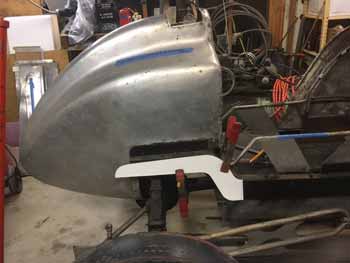
|
|
Card board pattern. Rounded end of it in production |
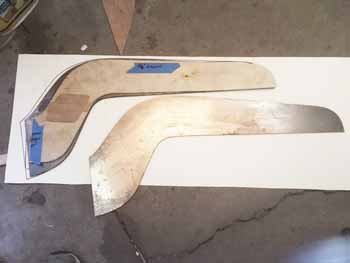
|
|
A friend sold me some 10 gauge kick-up webs but they were the wrong shape. So, I made a thin plywood pattern that I cut out using the old metal as on top one. |
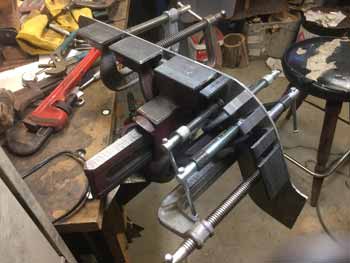
|
|
Cut lots of 2 x2x1/4 angle iron and clamped it to the web to hold the flanges square while bending. |
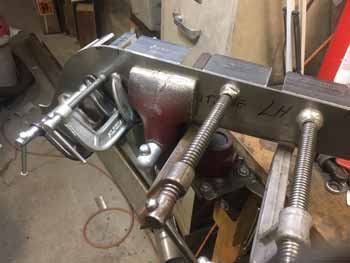
|
|
Outside view of angle iron. I would heat the flanges red hot and form around the angle iron and clamp into position until I tacked them. |
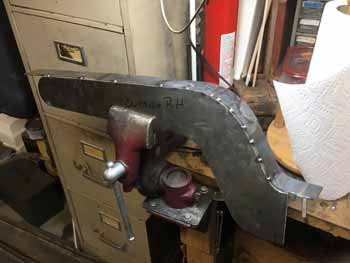
|
|
Tacked in position. Note I didn\'t tack or weld the flanges where they would meet the rails. I wanted the ability to dado the kick up flanges into the rail flanges and make them perfectly aligned. |
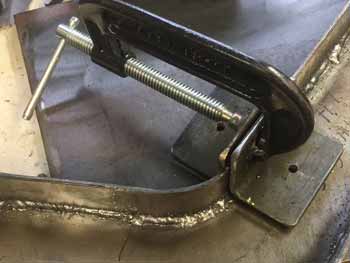
|
|
I welded some angle iron to a couple of C-clamps to act as heat sinks. I\'d weld an inch or so inside and instantly weld the outside at the same time and clamp the angle iron right next to the weld to suck the heat out. I don\'t honestly know if they helped but everything came out flat and square. Welding such short distances made for funky looking beads. |
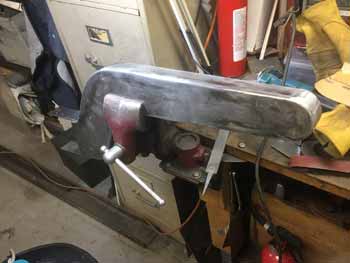
|
|
The final result. I think they\'ll work fine. Most of the work was done in 15-20 minute mini-sessions between other stuff. Made each day feel as if I was moving ahead in life. Not just getting older. |
30 Dec 18 - Old Age and Connectivity
Recently The Redhead and I visited one of our aging (if 78 can be considered aging) friend\'s home. A widower, he had relocated to a trailer park community and was still moving in, but it was obvious that housekeeping was well down on his list of priorities. Worse, he was desperate for conversation. He wore loneliness like an overcoat. The experience forced us to project ahead to when one or both of us will be in the same position.
You get to a point in life when the effects of age are among the primary subjects of conversation. This joint hurts, that one needs replacing, my doctor says such-and-such, another tooth needs to be pulled. This is assuming you even have someone to talk to, which isn\'t always the case. Our friend has few to talk to, so living in his trailer has to feel like long term solitary confinement. It\'s a storage unit that will keep him out of the rain until he is through with life. Not much to look forward to. Depressing!
As we were driving home, I thought about his situation in relation to me, my friends and family and how we would all fair in the same situation. It was then that I began to realize that our special interests and computer savvy were going to make our final chapters totally different from his.
There are some very definite things people can do to keep those wind-down years interesting and bearable, depending, of course on their physical condition.
Hands down the best thing an older person can do to prolong their quality of life is to exercise. Nothing more than a daily walk will make their life a trillion times more bearable.
Certainly, however, the ugliest scourge of old age is loneliness. But in the digital age, that is totally unnecessary. A person can be bed ridden, but, if they have even the most basic of computer skills, they need never be alone. Or bored. Unfortunately, the older generations are prone to poo-poo (how\'s that for a tech term?) the computer as a modern invention that they\'ve never needed before, so why now? This is where every one of us can do our elderly friends a huge favor by becoming computer advocates and introducing them to a world they can\'t even imagine exists.
Those of us who have been digital geeks from day one hardly notice the concept\'s unreal growth and incredible diversity. We take it for granted. It has expanded and engulfed us and has been part of our lives for so long that we don\'t realize that there are lots and lots of folks out there who have never even dipped a toe into the digital pond. They are put off by its perceived complexity. They don\'t realize how easy it is to gain access to an entire world that is populated with so many subjects, concepts and people that they can spend their days being entertained. Better yet, if they have specific interests, they\'ll be amazed at how easy it is to develop close friendships via chat groups. I can\'t even guess how many close friends I\'ve developed in the sport aviation community, many of whom I\'ve never laid eyes on.
I do, however, pity those individuals who have no special interests. Can anyone reading this imagine life without all of those goodies we call"neatsh*? I can\'t imagine a time in which I\'m not building/modifying just about everything I can lay my hands on like guitars, airplanes, cars, guns, knives, cannons and stuff like archeology, paleontology, etc., etc.. Whether I\'m hands-on, or simply surfing the web reading about them, I\'m frustrated that I know I\'ll leave so many interesting rocks unturned, when I finally check out. If a person has specific interests, they can jump into the web and build an entire life around them and never leave their bedroom.
And then there\'s the ability to converse with family and friends by Skype (which I avoid with some people only because I\'d like them to remember me as I was, not as I am) and other forms of visual communication. Inasmuch as all of our grandkids live on their phones and computers, this is one way to be part of their world (and vice versa).
Lonely? Only if we want to be. bd
23 Dec 18 - Bah Hum-whatever
This is my annual bitching about the holiday season. I have zero problem with the religion aspect of it, but I seem to get semi-morose because I\'d love to see Bing and the gang (or any one) cascade on us and give us a family-like Christmas, which we won\'t have.
Christmas with little family and zero kids around sucks! My kids and grandkids are in LA and NJ and Marlene\'s boys have their significant other\'s families so the best we\'ll do is a tiny Christmas eve dinner. And we\'ll have one of her ex-inlaws over who just lost his wife so he won\'t be alone. Even so, I\'ll still wake up early on Christmas morning with some joy in my heart but it\'ll be because no one can logically expect me to work on an article or fly so I will get a chance to start the final welding on the frame kick-ups for the Banger race car. Ho-ho-ho, little boy. You\'ll be building your own Christmas present! Which ain\'t all bad.
I am just a little bummed out because I\'ll be flying three times a day (takes a little over 7.5 hours) right up until both Christmas and New Year eves. Traditionally, those holiday gaps are when I often make major progress on shop projects and even might have kicked the latest novel in the butt in an effort at getting it moving. Ain\'t gonna happen. However, I\'m thankful for the work. It\'s been the weirdest flying year I\'ve ever had: first quarter, generally my busiest, was dead but summer, which is usually killed by temps was my busiest ever, so the year will turn out to be one of the best. Again, ain\'t all bad.
A couple of numbers that might be of interest to the aviators reading this: last month my poor old 1974, S-2A Pitts turned over 8,000 hours total time. I\'m on my fourth engine in it. And first quarter next year, I\'ll turn over 7,000 hours in type, most of it in the pattern at seven or eight landings an hour. No wonder N8PB and I are both tired!
As a sort of Thinking Out Loud Christmas gift to all who have the patience to wade through these words, here are some links you might find interesting.
https://www.wired.com/story/scramble-claim-worlds-most-coveted-meteorite
When I was a kid, there was an exhibit in the big museum at the Univ. of NE in Lincoln that was a part of a garage with a Model A Ford coupe parked in it that had been sectioned lengthwise so you could see the path where a meteorite about the size of a cantaloupe came through the roof, vertically through the entire Model A and came to rest on its muffler. I thought it was cool as a kid and would love to know if it still exists because I still think it\'s cool.
This is for those who think they\'ve been target shooting. This is a range about 60 miles north of me here and it\'s an annual event. Only in America! https://www.youtube.com/watch?v=2eV8N0bUzA0
For those who like to tinker. Try to imagine doing this! http://www.chonday.com/Videos /the-writer-automaton.
And just in case you think you\'ve fired everything, how about this?
https://www.youtube.com/watch?v=7_TaK0WZj2k
Ya\'ll have a good one. bd
8 Dec 18 - The Day After
Today is the 77th anniversary of the day after Pearl Harbor. Today is the day a very confused America tumbled out of bed to a world of uncertainty. And those in the Pacific to a world of fear. The world had changed in ways they could not yet comprehend. But, they knew it had changed.
The world of Dec 8, 1941 has to be put in context. For one thing, we\'ve become adjusted to the concept of seeing world wide events happening on our TV screens in real time. The most classic example being that the entire world, from bedrooms in AZ to cheering terrorists huddled around TV sets throughout the Middle East, watched the World Trade Towers collapse in real time. It was happening before our very eyes. There was an immediacy that compressed geography until every person in the US was, for a time, a New Yorker at heart.
The news and reality of Pearl Harbor took some time to make its way around the world to the farms and small towns of Nebraska. Or North Carolina. Or ethnic neighborhoods of Brooklyn. Or Flatbush. For most, the concept of an attack on an island somewhere"out there" was abstract. They didn\'t know where"there" was. Then, as attack after attack on islands called"the Philippines" and other unknown places was slowly relayed back the next day, it was difficult to assess the personal impact it had. Or would have.
To the citizens of islands spread throughout the central pacific, there was little doubt there would be a personal impact. The definition of what form it took or how severe it would be was lost in the confusion of the day. For Hawaii, today and the coming weeks 77 years ago began a months-long nightmare of invasion expectations. For the Philippines, attacked the same morning but on the other side of the date line, so it was the 8th, not the 7th, there were no doubts: the attacks began and continued until, four months later, the islands fell to the Japanese. Theirs was a four-year time in hell. The news of the fire consuming the Pacific was swirled into the massive amount of incoming information of a war that was now worldwide, with America pledged to winning it.
The day-after on Oahu is the stuff of legends. Memorialized in movies and novels. However, as the survivors...military and civilian... drift away from us, they take the immediateness of personal memories with them. We\'re left with searing photos and interviews with high level actors in the drama. I, however, would like to talk to those who lived normal lives. Someone who was a grocer, or was delivering newspapers, or a housewife and hear their personal tales of the days and weeks after the attack. I\'d like to sit with a young girl, now grown old, and hear her tell me what transpired in her life during those few hours that so transformed the world. But now, those memories are mostly lost.
The response of America to the attack is legendary. And absolutely unbelievable in the things we, as a nation working as one, accomplished. I often bring up one of the most amazing facts that is sometimes lost in the on-going rush of history: 7 December 1941, the concept of amphibious warfare, of invading an island or fortified beach, had existed for decades but had never been fully developed. Further, the US had no specialized amphibious assault forces or equipment and our standing armed forces were miniscule. Yet, EIGHT MONTHS to the day later, Marines waded ashore at Guadalcanal to violently gain possession of the critical airfield and port then protected by 30,000 dug in Japanese troops. I know I\'m probably repeating myself, but in eight months we produced everything from amphibious landing craft, to the ships to carry those craft, to recruiting and training the men, making everything from belt buckles to bombers and fighters and then transported it all to the South Pacific. IN EIGHT FREAKING MONTHS!!! Under any conditions could we do that today? No way!
Would we have joined the war if it hadn\'t been for Pearl Harbor? It\'s hard to say and I\'m not smart enough, nor clairvoyant enough, to say if we would have leapt to England\'s aid at the last moment. The concept of war became much more palatable when a surprise attack dominated the headlines. If Japan\'s political attaché in DC had delivered the declaration of war when he was supposed to, just before the attack began, so it had been a"normal" act of war, it might have made a difference in our attitude. The outrage might have been more subdued. Maybe not.
Also, don\'t forget: we didn\'t declare war on Germany. They declared war on us as part of its mutual support agreement with Japan. Would that have made a difference? It\'s hard to say. But these are all moot points because what happened, happened, and the amazing effects, both positive and negative, changed the course of history. The pressures of all-out war became a catalyst of change on every front, physical, mental and cultural.
Would the nuclear age have dawned were it not for the need to subdue a fanatical enemy? Would the role of women in society have been so radically changed, when they exerted their power and abilities on assembly lines and in cockpits? Would the overnight national/geographical assimilation have happened as quickly? Small towns all over the country were suddenly deluged by thousands of troops from all over the nation as bases were built in their proximity. Suddenly, people in places like Friend, Nebraska were face to face to youngsters from Brooklyn to Los Angeles, locations which previously were as foreign as Hawaii and Japan. Would the jet airplane have been developed so rapidly? Would the path to supersonic flight have been shortened by so much? Would missile warfare become so real so quickly? And on and on!
The day of the attacks across the Pacific and the lives lost were horrific. But, the next day, when the thought processes of the nation and its population began to deal with what had just happened,"change" went into after-burner and the America-that-had-been became a different animal. Today, we\'re the beneficiaries of that change and the improvements that evolved from it. Now, let\'s just hope we don\'t screw it all up by our current actions. bd
29 Nov 18 - Artificial, Artificial Intelligence
The other day at lunch the subject turned to WW II production and I was spouting out a bunch of interesting (to me) numbers. I pointed out (in a suitably amazed voice) that 49,324 Sherman tanks were built. The young man on the other side of the table said,"You do know that I can look that up on my phone, right? So why learn it?" I was floored!
I hated to admit it, but he\'s right. I don\'t know why we\'re spending so much time trying to invent artificial intelligence, when we already have it. It\'s called Google and to the millennials and Generation Z it is a substitute for both knowledge and experience. It\'s truly artificial intelligence. We gray dogs, and a sizeable portion of the human brain, have been replaced. Our lifetime of experience and knowledge is obsolete and unneeded!
It looks as if part of civilization is at a curious tipping point. Digital everything is replacing so many things that we\'ve taken for granted for generations that it\'s changing civilization. No, let me rephrase that. For newer generations, that have never known lives without Google and the associated digital universe, the need to know things simply because knowing them feels good appears (to them anyway) to be pretty much unnecessary. So, they don\'t bother to learn random facts that may be useful later in life. That can\'t have a good long term effect.
At the upper end of the age spectrum, where loneliness is rampant, it\'s sad that elderly generations that never bought into that whole computer thing are blithefully unaware of a massive world of constant companions that is only a keyboard away. While, at the same time, the newer gens have completely merged their social and mental processes with a gigantic digital blob that contains all the information they could ever need. The entire world of information is in their pockets and at their fingertips. And they depend on that. To them, it exists as an exterior brain. Disconnect that brain (kill their phones and/or iPads/computers) and they literally have a difficult time thinking for themselves. And they sure as hell don\'t know how to converse or entertain themselves without digital help. God help them if, when the time comes, they don\'t have You-Tube on which they can learn how to change a light bulb.
To my way of thinking, the ability to Google everything, making every possible form of information instantly available to us, is an unbelievably huge help to folks like those reading this. But it is crippling to those who didn\'t have a life before Google. To the former, it is an invaluable tool. To the latter, it is a crutch without which they have a difficult time functioning.
BTW, what follows could easily be seen as a tirade against millennials but it\'s not intended to be. There are lots of kids out there that really have their heads squared away. But, there are a few pumpkin heads, as well. That\'s who I\'m talking about.
In some areasm, what I may be seeing as problems being caused by digital partners in life, is simply a form of disinterest (and lack of educational support). Easily the number one area in that category is history. Corner a group of college-educated folks under the age of 30-35 and ask them what years WW II ravaged the world. I\'ve gotten ages from the late 1800s to the ‘70s. Ask who we fought in WW II and more than half the time England will be tossed in the mix. Ask who Lee Harvey Oswald was and the most common answer I\'ve received was that he had a band in the ‘80s.
In another area, ask how many feet are in a mile. Inches in a yard. Quarts in a gallon. The usual answer is a blank stare. They don\'t know the answer. But Siri does and that\'s all that counts. They don\'t see that as a problem. They simply don\'t care.
Watch how quickly they go to their Tip App, when figuring a restaurant tip. Mental math no longer exists for them. How hard is it to take .2 or .3 times a number? Or divide it by 4 or 5? They can\'t do it because it\'s not in their schooling. But, it is in their smart phones. Apple debuted their iPhone in 2007 (seems longer than that, doesn\'t it?) which blew all the earlier attempts at the smart phone concept into the weeds and captured minds worldwide. My 8-year-old granddaughter has one and is more proficient at texting and other digital endeavors than I am, yet I practically live on the damn thing.
The forgoing is probably just the random bitching of a gray dog who feels as if someone is constantly moving his dog dish and he\'s going hungry. He\'s functioning just fine in the digital world, but is increasingly out of step with the overall outlook of what life should entail and that makes him uneasy. The general effect of digits and the general lack of interest in much of life seems to have happened almost overnight. What is the next five or ten years going to look like? It\'s a little scary. However, it\'s also exciting. It\'s going to be a test to see how many of us can learn and acclimate and how many of us get left behind.
As for me, I\'m already running as fast as I can to try to stay ahead of the newest of the new. At the same time, I\'m finessing skills that in the digital age look archaic. Hey, knowing how to weld, shape wood and steel, keep an old timey engine running, and group less than an inch at 100 yards, may not help me on social media (I\'m not on any), but the dirt under my fingernails contains more practical knowledge than a lot of millennials will ever acquire. That\'s my story and I\'m stickin\' to it. Screw ‘em! bd
18 Nov 18 - On Being Sick and Remembering a Friend
Folks, I coughed my way through last night, my usual introduction to a major cold. And remember: my coughing record includes cracking ribs two different times. I\'m really good at coughing. So, this morning I\'m one of the walking dead and I\'m going to re-run a Grassroots column with which I\'m certain most reading this can identify.
Grassroots...Obituary for my Friend (published around 2007)
It was early the first day of the EAA Northwest Regional Fly-in (Arlington) and Marlene called me in the booth. She sounded a little strange so I walked away from the booth and stood in the middle of a wide, grass fire lane with lines of exhibit booths on both sides. Then a voice I knew, her\'s, said words that I understood, but that I refused to comprehend. She said,"Budd, Nizhoni died about an hour ago."
I can\'t even describe the feeling. Nizhoni was our dog and, next to Marlene, my closest friend. I received a similar call twenty years ago, when a voice at two in the morning said,"Your brother, Gary, has died." He was forty-two. Nizhoni was only eight. The impact was at least as bad.
When my brother died, it wasn\'t until the next day that it set in and I cried. After a minute or two on the phone with Marlene about Nizhoni, I came completely unscrewed. Right there in the middle of an airshow crowd, grief rolled over me and nearly took me to my knees. I sobbed as I\'ve only sobbed once before, for Gary. I couldn\'t, and I still can\'t, believe our little girl is gone. And I can\'t believe I\'m sitting here writing this. But, anyone who has read Grassroots for even a short time knows Nizhoni and I couldn\'t let her pass without letting our friends know. I\'ve put off writing this for several weeks because I knew it would be hard. And it is. I\'m only glad you can\'t see me.
She was part of everything we did. For instance, I so clearly remember flying home one afternoon with her and Marlene in our C-140A and the tach decided to eat its innards. It began making this incredible high-pitched scream and it was driving Nizhoni nuts. She couldn\'t get away from it. Marlene was flying, so I just put my hands over Nizhoni\'s ears and held her tight.
And then there was the time we spent at a friend\'s house in a fly-in community. They had this really unusual sort of stiff grass, like a tall crew cut in front of their hangars. Nizhoni (generic Navajo word for something nice) was still a puppy and would go bouncing through the grass like a wind-up toy, leaping higher and higher, before diving nose first into the grass and burrowing into it like a gopher. Then she\'d pop up and do it again. And again. Our hosts, who weren\'t even dog people said,"You\'re going to be sorry you don\'t video tape her." And they were so right. We are definitely sorry.
She was just a bundle of joy liberally coated with love and, like all dogs, asked for nothing back. There was the time, for instance, that our friend was taking us for a ride in his Sea Bee and was shooting landings in various lakes and channels. Nizhoni was standing up in the back seat on Marlene\'s lap absolutely mesmerized. She was loving it!
At one point, we were sitting on the water and I opened the door to let her see what was going on, and she jumped down on the floor and poked her nose into the water just to be sure it was real. Watching her reactions to the sea plane experience was so much fun, it made the entire afternoon just that much better.
I fully recognize that a lot of folks aren\'t dog people and haven\'t the foggiest why I\'m making such a big deal out of this. However, also know that every single dog lover out there is reliving their own grief at losing a dog even as they are reading this. Or they are dreading the loss of one of their dogs now.
A really heartwarming thing happened the instant I told the Bearhawk airplane builders chat group about losing our friend. One after another, guys who you knew were Marines and Vietnam vets, bush pilot types to border patrol agents, climbed all over one another on the site to tell their own stories of dogs they\'ve loved and lost. Some were so poignant that you knew the writer had tears on his keyboard. I know for a fact, the rest of us did while reading it. Some of these guys are clam-like in their lack of willingness to share their emotions, yet, there they were, spilling their guts because of a love for a dog. In many cases, it was obvious that they hadn\'t come to grips with it decades after the fact.
The loss of Nizhoni was one of those events that every single pilot who is part of my personal group can identify with. They are just that kind of person. At the same time, I wouldn\'t be a bit surprised to find that the pilot population in general is more likely to count dogs as their favorite people than many other groups. Or it may be that those who aren\'t dog lovers represent the majority of the general population, not just pilots.
Two comments popped right to the top of the discussions over the last of couple weeks.
- Don\'t trust anyone who doesn\'t like dogs
- The reason God gave dogs such short life spans is because if they were longer, the grief would be debilitating.
He\'s right.
A note from 2018: Nizhoni left us 11 years ago and I still choke up talking about it. But, I had to leave for Oshkosh four days later. I wasn\'t about to return again to an empty house so Marlene started auditioning dogs. We went to see one in a house on the outskirts of Phoenix and I was immediately repulsed by the woman (think Throw Mama From The Train). Smelled like cigarettes and house was a mess. But, the Pom puppy she had was a dynamo, racing around like she was on speed. Marlene was sitting cross legged on the floor while the pup ran around. Then, for no reason, the puppy ran straight at Marlene, jumped up in the air and dived nose down into her legs and instantly went to sleep. Sháhn-deen (Navajo for"ray of sunshine") entered our life at that moment. I\'m already secretly grieving for her even though, hopefully, she will be with us for at least five more years. Damn! I wish I hadn\'t said that! bd
3 Nov 18 - Tricking Old Age. Sort of
Not long ago I discovered I had a super-common terminal disease. I was working in the shop on a hot day and found I was having unexpected difficulties. I\'d go down on one knee and have trouble getting up. Stuff I\'d lifted a thousand times had gotten heavier. I sat there and realized things weren\'t likely to get better. I was getting older and that\'s terminal.
This is going to be a longer than normal Thinking Out Loud because I\'m passing on some stuff I think may be helpful to others.
For the rest of the day I spent a little time analyzing what was giving me the most trouble. Getting up and down was troublesome, especially going down on one knee. The right one. That put the load involved in getting up on the muscles on the top of my left leg and the tips of my right toes. Once I lost my balance and shot myself backwards into a pile of potentially damaging machinery edges. No injuries, but a serious lesson was learned: I learned that a given combination of my physiological parts had deteriorated to dangerous levels. At that moment I told myself that, as I have done dozens of times before in other similar situations, I once again had to do something about the situation.
I can\'t do anything about aging, but I can sure as hell do something about distinct problems like kneeling. The following paragraphs list problem areas I\'ve had to address in the long, some-times tedious journey towards the"end", which hopefully is a long way down the road. Some of these might be useful to others.
Curing Kneeling Problems
Now every time I walk past the end of the couch in my office, I do two kneels. I\'ve pushed those muscles enough that now I have no problems with kneeling on one knee. Also, when I\'m standing in the bathroom waiting for the shower to warm up, I do deep knee bends until my upper legs burn. Now every problem about getting up and down has gone away.
Working Through the Pain
Like everyone else, I sometimes have pains here and there, but, like the good soldiers we all are, I ignore it and push through the pain, hoping it will get better. Then I learned a lesson from a friend that altered my thoughts in that area. He\'s in his early 70\'s and in terrific physical shape because he\'s carried his exercising habits, which are pretty serious, right into his advancing age. This included a pain in one hip that he ignored and continued running, walking, etc. It started small but eventually got much worse so he had it looked at. It turns out the original pain was from a bone spur but, in the process of working out, the spur destroyed the socket and he lost a year of activity to a hip replacement. Had he had the socket X-rayed, a minor surgery would have clipped the spur and he would have had no further problems.
I learned something from that. Practically all of my joints from the hips on down give me heartburn from time to time. So, I set up a schedule with an X-ray lab and once a week had a different set of joints X-rayed, ankles up through my hips. All came through in good shape. In fact, the doctor said my knees were some of the best they\'d seen in months. So, at least now I know, when I\'m pushing myself, that local pains aren\'t structural in nature: I\'m not hurting myself by pushing through them. So, I keep on pushing. I may have tendons or something stiffening up, but so far, I\'ve found if I keep pushing, the pain eventually goes away.
About That Back Pain
Like most folks I have a problematic back that has given me pain and periodically laid me low since a teenager. L-3 and L-4 and their associated discs are slowly deteriorating but I\'ve learned what not to do to aggravate them, like I don\'t drape myself over a fender to work on an engine. Even so, I\'ll be just standing around minding my own business and it\'ll suddenly go out and I\'m in bed for a day or two. Then I started getting a new pain.
The new pain started as a low throb in my spine about level with the bottom of my shoulder blades. Over the years it finally progressed to where I couldn\'t do my morning walks so I had my doc X-ray it.
About a week later I get a phone call and his voice on the other end of the line says,"What in the hell did you do to crack the crap out of your T-8 vertebra?! Do you remember? You have four healed compression fractions and they\'re getting arthritic and bothering the vertebra under it."
I replied,"Yeah, I know when it happened but I didn\'t know it had happened."
I was shooting air-to-air photos of a four-ship Pitts airshow team and I was in the front seat of an S-2A Pitts with both feet on the right side of the stick and was twisted around shooting over my shoulder. Pitts are great airplanes but truly lousy camera ships. We were doing formation loops and I was catching them going vertical and inverted at the top. Everything was working out great until the guy flying me must have taken his eye off of the lead ship and got late in the pull. He tried to make up for it with G and hammered 5-G on the airplane with me twisted around backwards. I swear I heard the bones break.
It took four guys to get me out of the airplane and I laid around in the hotel for a couple of days until I thought I could drive the 200 miles home, my back hurting like hell all the way. Since, my back had always been a problem, I didn\'t go to a doctor and gimped around for a month or more and it slowly healed. Then, recently, it began flairing up and the doctor sent me to a specialist that had all sorts of cortisone and steroids that"might" help. I told him to hold off until I did some investigations of my own and this is advice I give anyone who has similar problems show up. I started looking at my daily life to see if I was aggravating the problem and found the following
- My typing chair back would slowly move forward putting the top edge right at my T-8, so I welded it in place.
- The cushions in my airplane ended right at my T-8 so I had new ones made that were 3 inches taller.
- Pulling the airplane back into the hangar with the tow bar loaded that part of my back so I started having students push on a strut and help me.
Two weeks later the pain had gone away never to return more than just a slight ache now and then. I\'ve had the same thing happen with ankle pain: I was putting my feet in odd positions while typing and flying. Changed positions and they got well. This after all sorts of medical tests. My right wrist has arthritis or something and periodically hurts like hell. Now, when I feel it start, I put on a wrist brace that\'s left over from curing my carpel tunnel (actual cure was putting a thick pad in front of my mouse to rest my wrist on). A couple of days with the brace, including sleeping with it, and the wrist is again good. I could tell another half dozen stories all with the same advice: look around and see if you\'re causing the problem yourself.
I\'ve been lucky in that every problem so far has responded to some kind of therapy or lifestyle change. I know that won\'t always be the case, but right now I\'m doing my best to hold physical limitations at bay. Look around and see if you are your own worse enemy. bd
28 Oct 18 - Daily Aggravations
At some ridiculously early hour this morning I once again found myself struggling to open a plastic bubble pack of allergy pills and again asked myself "Why don\'t they make these things easier to open?" The world is complicated enough without having to find a healthy pair of scissors or a hand axe to get the damn pack open to take a simple pill!
The world is full of tiny aggravations that simply don\'t need to be there. Some are in packaging, with bubble packs leading the way. Why does it take a full-on, frontal assault with a crowbar and a jack hammer to get a bottle, or a pack of pills, out of its transparent plastic/cardboard prison? This is flat assed stupid!
Same thing holds for opening a loaf of bread. At least the kind of bread we\'re getting. It\'s covered in some sort of heat-sealed cellophane inside of a healthy plastic bag. Getting into the outside bag is no sweat, but the cellophane is folded in on its elf at the ends as if it is some sort of origami puzzle. I know there is a folding sequence that probably leaves an edge you can grab, pull and it pops open. Unfortunately, it is so well hidden that, after a couple of failed attempts, I grab a steak knife and stab away at the cellophane forcing my way in. Opening bread should not include hand-to-loaf combat!
And why do two seemingly identical bags of the same brand of frozen blue berries have two different ways of sealing the bags? I eat a ton of frozen berries a day. Mixing the frozen berries in with yogurt freezes the yogurt on the berries and makes a great treat-at-the-keyboard. One type bag has an easy tear off strip that reveals the terrifically logical, snap-together re-sealing strip. The other, however, requires a pair of scissors (or a bowie knife) to cut off the end to get to the hard-to-seal strips. One\'s easy. The other definitely isn\'t. Why the difference?
The car key versus the key ring is another battle I hate. The keys with the built-in chip are really thick, so trying to put them on an old fashion spiral key ring means you have to force the ring to spring apart nearly 1/4". That breaks thumb nails because thumb nails turn to glass as you get older. So, it takes a letter opener or screw driver to get the necessary leverage after I\'ve again broken a nail trying. Yeah, I know, there are easier key rings, but that would force me to change my ways and I\'m really not very good at that.
Then there are TV remotes: I wish they had some sort of indicator that gives you some idea how much life is left in the batteries. One of our TVs will once in a while display the life left on the screen but does so in a random fashion. As it is, when the remotes (called the"clicker" by most of us deplorables) start to die, it is unclear that\'s what\'s happening. Small symptoms, like being slow to change a channel, sometimes foreshadow a battery change. But, only sometimes. Other times it\'s the TV that\'s out of whack. It takes a lot of screwing round to figure out which is which.
What\'s with the difference in shirt sizes? When flying during the summer I wear white golf shirts 100% of the time. They keep me from boiling over in the sun. I have probably 15 of them because I may change shirts mid-day as the get sweat soaked. I don\'t tuck them in and have found that between the three different manufacturers there is a solid 2" difference between their length. Some barely make it past my belt and some I could tuck into my back pocket. When climbing into the airplane the short ones give glances of my unnecessarily bulging belly and built-to-be-grabbed love handles. It\'s hard to be a heroic-looking Pitts pilot with your love handles on display.
And, as for clothing sizes: I\'m a 43 in the jacket department, but, of course, they only make 42s and 44s, both of which obviously don\'t fit me, when I\'m wearing them. I can\'t be the only guy in the world that falls into that gap. So, why not make 43s?
We all have daily aggravations that make us scratch our heads. Or bang our heads on the wall in frustration. However, at least they\'re small aggravations. Who knows, maybe they keep us from fixating on the serious stuff that we have going wrong around us. How\'s that for hard core rationalization? bd
20 Oct 18 - Gray Goodness: Experience takes time. Usually.
The other day we were in the office of an oral surgeon discussing the repairs being made to Marlene\'s teeth due to an unfortunate encounter with a hotel night stand: seven emergency room stitches on the outside, five inside, cap broken, teeth loosened. As I watched him thinking and evaluating, I recognized that he was sifting through his years and years of sorting out similar traumas. I was seeing experience at work and it caused me to relax. It was going to be okay.
I\'m certain I\'ve written about the concept of experience, or lack thereof, before but my experience says that talking about experience bears repeating. And watching this surgeon examine and explain things reminded me of that.
"Experience" is one of those words that it is assumed has a universal definition. It is assumed that the experiences of someone who has been alive for a long time or has invested years of his life doing something is better at something than the next guy/gal. Subliminally it is assumed their universe of experience breeds talent. Sometimes that\'s true. Sometimes it\'s not. At least not in my experience (there\'s that word again).
Generally, it is assumed that experience is something that everyone gains simply by being alive. It\'s another way of saying experience takes time. And it does. Usually, anyway. Sometimes, however, for certain people who aren\'t old enough to have experienced a huge amount of life and the lessons it teaches, they have gained"accelerated experience" often brought about by short episodes they\'ve gone through. For instance, most of us learn to handle stress and failure by simply dealing with life. Now think about what a combat soldier brings back with him from the front lines. It may have only been a few weeks or months, but they are much older, when they return, than when they left. Their experiences have done that for them. Think about surgeons in a military field hospital or doctors who have dealt with major catastrophes like earthquakes, high rise fires, etc. They may pack a lifetime of experience-building situations into a few days. And they never forget what they saw or learned and it benefits their judgement and skill for a lifetime. But, again, however, that is also not universally true.
In my mind, there is something I label"retained experience." It is comprised of things we have seen or done ("seen" being equally as important as"done") AND WE\'VE LOGGED THEM INTO OUR MINDS IN A WAY THAT THEIR INFORMATION CAN BE READILY ACCESSED WHEN NEEDED. Many people go through the road of life experiencing only that which is right on the centerline and affects them directly. This is"limited experience." It is limited to what directly affected them with none of the contextual aspects that surrounded them at the time included. Other folks are experiencing the same central episode but their mental and visual scan is taking in everything that is around them at all times. The bandwidth they absorb from everything they\'ve been around is enormous and comprises a huge amount of additional experience that can be brought to bear on a given project or event, when needed. They don\'t have to have actually done something to gain knowledge of it because, while doing their own thing, they have, through observation, watched others and learned from their successes and failures.
Whether a person is focused only on the centerline, or is cataloging everything around them and storing it for future use, is definitely NOT a skill. It\'s a personal trait that 99% of the time is unknown to the individual involved. It\'s not something they do, it is something they are. Whether they want to or not, their minds are always on a swivel soaking in tons of collateral information and experience as they fight their way through the jungle that is life. They know more because they\'ve seen more and they\'ve seen more because their focus is much wider.
The net result of all of this is guys like the oral surgeon I was watching at work. There\'s a level of comfort and confidence that comes with years of broad based experience. The person, the surgeon in this case, is totally unaware of it. It just is. Those around him, in this case the patient and her concerned husband, however, are very aware of it, but they not aware of what it is they are feeling. They just know that the expert they are dealing with is more than an expert. He is surrounding the problem at hand with so many unseen experiences that success is assured. That\'s a very comforting feeling. bd
13 Oct 18 - The "Other" Women in my Life
It\'s Saturday morning and last Saturday, when I should have been writing a Thinking Out Loud, I was in a really odd situation: I was in Bermuda walking a dear friend down the aisle in a ruined, roofless 1800s church. She doesn\'t really qualify as an"other" woman, but there are those that do. Sort of, anyway.
I met Siri on my way to meet my daughter at Disneyland in Anaheim three or four years ago. I was on I-10 just coming into the LA highway conflagration when I saw a catastrophe taking place: I suddenly realized I had just missed my turn-off to the correct highway that would take me to D-World. I\'ve driven in the LA basin almost continuously since I started road warrior trips during college out and back to play clubs and visit friends. Because of that I knew for a fact that I was screwed. If there\'s one thing you don\'t do in LA is think that you can jump off at the next exit and double back. Sometimes that works, more often it doesn\'t and you become hopelessly embroiled in the snake nest of highways that make LA what it is. DAMN!
I have no idea why using my cell phone at that instant occurred to me. Maybe I going to try to bring up Map Quest. Instead I just keyed the"Home" button, and held it down while I spoke directly into the phone,"Take me to the Disneyland Hotel." 10 Seconds later a pleasant female voice said,"In three and a half miles exit on XXX." I had just met Siri! From that point on, her gentle prodding took me directly to the hotel lobby. Unbelievably easy. DOUBLE DAMN!
Siri has become my go-to-gal for lots of things. ‘Want to know the population of Ireland, just ask her (6,197,100). Want to know how far it is from Phoenix to McCook, NE, ask (1032 miles by car, 786 as the crow flies). She is my always-ready-to-help personal assistant and almost never lets me down.
And then there is Alexa: I just met her a month or so ago via this cross between a mini-computer and what looks like a radio alarm clock. It was given us by Marlene\'s youngest. Alexa and I are becoming unnaturally close. As I drift through the kitchen, where she lives, we\'ll exchange pleasantries. Or I\'ll want something, e.g."Alexa, play 1950\'s rock and roll," and Jerry Lee Lewis, followed by many in his peer group, bounds forth and I relive my teen age years. I\'ll be sitting at my desk in the next room and my mood will change, so I shout,"Alexa, play 1940\'s big band music." Or maybe I\'ll be more specific"Alexa, Play Glenn Miller and Benny Goodman." I\'ve even found she can answer much of the same stuff as Siri. So, while I\'m fixing my breakfast (open face turkey sandwich and instant coffee), she and I will carry on a conversation in which I ask whatever is on my mind, and she answers. Inasmuch as I\'ll be doing that at around 0430, it\'s nice to have someone"human" to talk in addition to the cats and dog.
In one of my other worlds, Mary Ann and I have carried on tens of thousands of conversations over the 26 years I\'ve been flying at KSDL. Most of our exchanges are short,"Eight Papa Bravo cleared for takeoff. Fly straight out until advised." I dutifully reply"Roger, Eight Papa Bravo cleared on 21, tower\'s got the turn."
Mary Ann joined the tower crew only a year or two after I started at KSDL where I spend most of my time in the pattern teaching students the fine art of surviving landings in my sometimes-cantankerous little bird. By actual count, I\'ve flown over 6500 Hobbs hours in the pattern there at 7-8 landings an hour. A good percentage of them were done with her choreographing the sometimes-tedious dance routine that fits me between jets and helicopters. She is hands down the best there is at her trade and, when the traffic gets out of hand during Barrett-Jackson or the Super Bowl, she is plugged in like a pinch hitter to straighten everything out. This is all done with every transmission laced with her calm, always cheerful and amazingly easy to understand voice.
Mary Ann, along with the Scottsdale tower crew, make my life flow so smoothly it\'s almost obscene.
I could ramble on forever talking about some of my other women, like Shánh-deen and Eight Papa Bravo (the mini-redhead and the other-redhead), but you get the drift. The AZ Redhead is THE redhead, but the others sure do help. bd
29 Sept 18 - Mrs. Green and Me
There are maybe five people on the planet who will recognize the name, Mrs. Green of Seward, Nebraska. And all five would have been in the class of \'59 or \'60. I\'m class of \'60, was a total gearhead, and the widow Mrs. Green haunted my very thoughts: she owned a pristine \'40 Ford deluxe coupe she and her husband had bought new and we all wanted it. Desperately!
My blog last week about small town speed put me in a car mood for the entire week and Mrs. Green again floated to the top of my memories. Actually, there were two cars in town that every gearhead wanted: Mrs. Green\'s \'40 coupe and a \'50 Ford Club Coupe also owned by a widow, but her name has disappeared along with my youth. Both cars were super low mileage and, other than both being repainted in a bilious shade of beige, were as if they\'d just rolled off the show room floor. Perfect in every way. So, both were obvious high-value targets for any kid who was into hot rods or customs. And I was into both.
Considering that there wasn\'t a single hotrod of any kind in town (Hotrod...meaning old car, severely modified with a much bigger motor, no fenders), I can\'t exactly explain where the interest came from. However, as I\'ve mentioned in the past, I\'m certain it was ignited by two high-boy roadsters sans hoods with chromed engines and no fenders parking beside us in West Hollywood while we visited my aunt Inez. I was ten years old. Periodically, that exact moment still pops into the theater of my mind in brilliant detail.
Customs... a car that\'s been lowered, body mods, like pulling chrome off the hood and deck lid... were rampant in town. In fact, I made a fair amount of money pulling hood ornaments, filling the holes with brass (brazing), smoothing it and priming the area.
I left town to go to college in Oklahoma in \'60, but for the next three or four summer returned to work as a lifeguard at our big municipal pool. I\'d do that six or seven hours a day, but both before and long after that (generally until midnight), I\'d be out in the shop (a semi-used Quonset hut next to my dad\'s store) working on the roadster or someone\'s car.
A pivotal moment came, when I was getting ready for my junior year at OU and it was decided that I would need a car at school. I had to get back and forth to the north campus, where the airport was located, and I was starting to play a lot of clubs in the area. What car would it be? I decided it was going to be either Mrs. Green\'s \'40 or the \'50 Club Coupe, which, at the time, was one of the more popular cars for customizing. \'50 Mercs were much more desirable, but I never saw a single one in town until Danny Niehart\'s dad found one for him somewhere.
I descended on Mrs. Green but she wasn\'t budging: she wasn\'t about to sell her \'40 for any amount of money (It went to a grandson, whom I\'m certain didn\'t deserve it). I went as high as $150, which was a helluva lot of money in those days. The owner of the \'50, however, was much more obliging and $125 ($1100 in 2018 dollars) bought me my first real car. Before the engine had cooled, I had the hood ornament off and the paint sanded off around the holes, ready to braze. But, I didn\'t stop there. The modification list included:
- Decked it (removed rear chrome)
- Tunneled and frenched headlights (Set them back in the fenders using welded-on and leaded \'54 Merc headlight bezels)
- Scoops like \'56 Pontiac above headlights
- Filled in hood where ‘50\'s had the big circular grill piece
- Replaced circular type of grill with single bar between parking lights
- Welded grill surround to body, leaded it and painted same color as body so only the single bar was chromed up front.
- Tunneled and frenched tail lights
- Leaded in seam on top of quarter panels
- Molded license plate bracket into trunk lid
- Lowered car two inches.
- Had tuck and roll upholstery done locally.
- Had it painted Coronado Red, a cool truck color.
All body work (except paint and upholstery) was done by me and done in lead. This was before Bondo became a body man\'s best friend. It was a good-looking car and served me well until I bought my brother\'s \'62 Pontiac, which I mentioned last week.
I know there are a lot of meaningless details here, but there is an important point to be made. At the time that Mrs. Green\'s \'40 coupe grabbed us all by our hearts, it was only 18 years old! Can you think of any cars built in 2000 that inspire that kind of enthusiasm among teenagers? Or enthusiasm in anyone for that matter? I can\'t. And that\'s a little sad.
If I had managed to get that \'40 coupe, I\'d still be driving it. Count on it!
bd
23 Sept 18 - The Bandit Checks-out: Remembering Speed
With the passing of Burt Reynolds, it suddenly made me remember the allure of speed. It got me thinking about how, back in the day, speed was king and how many millennials today don\'t know the incredible abandon of watching the center line flash past at over 100 mph in the middle of the night for hours on end. His passing made me remember how speed was a central component of many years of my youth. Same for a bunch of past generations, actually.
I got my driver\'s license in 1958 and the family car was a \'56 Pontiac station wagon. Other than seeking out dark corners in which to park with my girlfriend, it didn\'t show me much excitement. However, I knew where to find excitement: in the pages of the little Rod and Custom hotrod magazines. There I saw the embodiment of speed on every page and, whether I was experiencing it or not, I had a yearning for it.
Through those pages, I knew there were lots of cars out there besides our station wagon and every one of them was faster. Better yet, you could build a fast car yourself. And I did. Sort of. It still sits in the garage, 60 years later not totally finished, but it\'s getting there. At the same time, Detroit was discovering that speed, or at least the illusion of speed, was a very saleable commodity and Seward, Nebraska, population under 3,000, proved that.
Enough of the twenty-somethings in town were into fast cars so that we had far more than the national average of Tri-five Chevys, especially the ‘57s, in town with Power-Paks and four on the floor. Some of the guys went with 56/57 Fords with what were considered big blocks at the time. All were nosed and decked (for any millennials reading this, the chrome on the hood and deck lid was removed) and they were lowered more than was practical. Some would leave a string of sparks every time they bounced over a railroad track.
My first experience with a fast car came when I talked my dad into buying a \'58 Pontiac Bonneville coupe with the tri-power engine. I only drove that car maybe 20 times and got in trouble every single time I was in it. This sucker was FAST and would smoke the tires for a solid block without even trying. The first time I did that my dad knew about it before I got home. The jungle drums in a small town spread news like lightning.
And then there was my first taste of real speed. Going north out of town in the Pontiac, I made the mistake of driving fast on a piece of road I hadn\'t traveled first to make sure there were no cops with one of those new radar thingies lying in wait. The then-shiny new Bonneville, with 370 cubic inches and something over 330 horses, buried the needle at 120 mph in a little over a mile. It was breath taking! I almost peed my pants it was so exciting! However, the real excitement started about 15 minutes later. As I pulled into our driveway and my headlights hit the garage door, my dad and the chief of police where standing there waiting. It wasn\'t pretty. But, I had discovered speed and found I loved it!
I went to college with a highly customized 1950 Ford business coupe that was a real looker that I dearly loved and it would cruise at 75 or so but that was about it. Then my brother bought the first GTO (1964) in Nebraska and sold me his \'62 Pontiac Catalina (not Bonneville) two-door hard top. This was a reasonably light, very special car that he had bought new (he was always better with money than I was) and I helped him outfit it. In those days, all of the Grand National Stock Car (now NASCAR) stuff was available over the counter at the dealer parts department. So, it had three (not four) on the floor, heavy springs and shocks, headers, big diameter dual exhaust and steeper rear gears. This thing was a real runner!
By that time, I was well into my college years and was making a run to NYC, LA, or San Diego, from Oklahoma about every six weeks or so. I\'d leave after class on Thursday and play a gig Friday/Saturday nights and be back in Oklahoma in time for class Monday morning. 1,400 miles one way! That big dude would sit there at 100-105 mph like it was 60 mph and hum along as smooth as glass.
I lost that cruiser when I was hit from behind by an 18-wheeler and schmushed into the car in front of me. The insurance, plus a little more borrowed from my dad, put me in my first new car, a 1965 GTO with tri-power, four on the floor, positraction and 360 hp out of 389 cubic inches. This frigging thing was REALLY fast. In a straight line, anyway! It didn\'t handle curves well at all so it got sway bars, heavy shocks and all the other neat stuff. But, it still wasn\'t the road car the \'62 was. The speed was there but not the heavy-car, high speed handling.
Decades later, when my son, Scott, turned 16, I tried to get him interested in restoring the GTO, which lasted maybe two days. He just wasn\'t, and isn\'t, into nuts and bolts. No biggie! He drives a Beemer these days. So, it never got restored. However, the first day he came up from the basement workshop with his hands wrapped around about a six-inch thick stack of folded paper. He had opened the center console between the Goat\'s front seats and found a gigantic wad of speeding tickets, the majority of them warning tickets.
"Dad," he said, with a crooked grin on his face,"what are these?"
I never claimed to set a good example, as a parent.
I wonder how many millennials even know what The Cannonball Baker Sea-to-Shining- Sea Memorial Trophy Dash was! I routinely lived my own little version of it. God, how I miss driving big motors! Cubic inches are a sure cure for the blues.
PS
These days on our many runs to LA to see daughter/grandkids, I\'ll run the speed limit plus 5-7 mph, usually 82 mph and people are blowing past me. I guess maybe speed addiction is a young man\'s thing. Not sure. bd
13 Sept 18 - Tail Wagging the Dog
For reasons I can\'t explain, every time I see the movie"Demolition Man" listed, I watch it. It\'s an incredibly dumb film but I think I like to watch a guy named Sylvester blow things up and snub noses that need snubbing. As a child, I\'ll bet he got kidded for the name. No longer. The point is, however, that the Demo Man story is built around a civilization in which an overarching organization governs all thoughts and conversation and I think there\'s the possibility that we may be headed that way today.
First, a personal point: Based on the fact that I\'ve gotten four e-mails in the last 24 hours asking if I was still vertical and part of the world, an explanation is warranted. I\'m very aware that I\'m always bitching about deadlines and crushing workloads but the last two and a half months have been the worse I\'ve ever experienced. Most of it was because my summer wasn\'t my typical summer. Normally, people have enough sense to avoid Phoenix during the summer so my flying usually drops almost to zero. Not this summer. Again, for reasons I can\'t explain, I was totally hammered and to fly two hours takes five hours. And some days I was flying three and four hops in 100+ degree weather. Plus at least twenty magazine deadlines lined up behind each other and Flight Journal had to be shipped.
For the entire period I was up at 0330 hours and didn\'t log off until around 2130 hours and I\'d fall into the rack ready to do it again the next day. Towards the end of that period we rushed to LA to see my granddaughters in a play, which was capped by food poisoning putting me in the UCLA emergency room by ambulance: another two days down the tubes.
Then, almost as if by magic, last weekend I looked around and realized everything had lightened up and returned to the normal level of crazy and I can breathe again. I\'m back to walking at 0430 (more on that another time) and actually got some good shop time in Sunday so, life is good. The Roadster shivered a little, when I touched it. It had been too long!
Back to Demolition Man and a world living under an umbrella of uni-thought.
You don\'t have to look too hard to see that technology may be in the process of getting ready to nibble huge chunks out of our collective butt. The tail is beginning to wag the dog. We\'ve already become so dependent on technology that it\'s as if it is a civilization-wide narcotic has been injected into us, as indicated by our addiction to computers and smart phones. And I\'m as bad as the next guy. However, looking ahead at the digital future, it\'s about to get a helluva lot worse and it\'s damn scary.
Because of our digital addictions and the way in which the universe has become totally interconnected, we are unbelievably vulnerable to control and damage at the digital level. Let\'s take Google as an example of someone/something that is capable of wielding unacceptable levels of control on the world in general and America specifically. I think most folks are uncomfortable with the way our privacy has totally evaporated at every level. This is because our digital dependence is making our lives available to those who want to affect them. A recent release of a video of an internal meeting at Google shows just how vulnerable we are and how easy it is for corporate opinions to be foisted on others.
Go to Google and see how upset Google management was in 2016. When Trump won, their world had been turned upside down and they vowed to do something about that."They", Google, may well wield more control over communications than any other single entity and as such, they can force feed us their opinion at every turn.
The scary part about this is that Google is far from being alone. There are lots of entities out there that comprise the digital universe who see nothing wrong with filtering the communications they control to achieve their own ends. This isn\'t a right or left thing. Yes, Silicon Valley is left leaning but that\'s not the danger. The danger is that a small number of corporate managers in certain industries can point their fingers and make things happen that affect all of us right down to the guy plowing a field in Nebraska.
This is scary stuff but what do we do about it? I don\'t have the slightest damn idea. God knows I wish I had an answer, but I don\'t. This is way above my pay grade or my ability to theorize. But, the trend is well established. Who knows, maybe, when it gets bad enough, society will split, as it does in Demo Man, and part will go underground in an effort to live life in a way they think it should be lived.
Wow! This isn\'t exactly what I thought I was going to write about, but it feels good to be doing it again. See you next week. bd
10 June 18 - Our Loss of Relevancy
It has become glaringly obvious to today\'s parents, and definitely to grandparents, who might be only in their 40\'s or 50\'s, that there is one phrase we absolutely cannot use in advising our kids:"When I was your age..." ‘Can\'t use it because we were never their age and practically nothing we experienced is applicable to today\'s generations.
The social, cultural and technological changes that have occurred over the past two generations, call it 40 years at two decades per generation, are mind numbing. Many are the result of the way both TV and the app generation, born first, of the computer, and second, the smart phone and its bastard child, social media, have changed social constructs. In discussing this, it\'s hard to know even where to begin.
First, we have to put things in time brackets: going back 20 years, it would be 1998 (which seems like it happened last Wednesday). By that time computers were a solid staple of life (Apple started business in 1978), cell phones were getting smarter and the Internet was already universal. So, if a kid graduated high school even in 1978 (technically he\'d be a senior citizen by now), as an adult, he never knew life without a computer and his remembrances of pre-computer times would be his school days. A 1998 graduate lived with computers and cell phones from the moment he/she was slipped into their first diaper.
In the years since home computers arrived we\'ve watched an overall evening out of the culture from urban to rural, West to East and North to South. The cultural differences of the different areas are slowly disappearing (but are still obvious) because there is so much interaction via social media and the immediacy of information transfer via every form of media. 9/11 is a classic example of that: Rather than reading about it in the paper the day after or seeing a TV broadcast of the high lights that night, at the time it was happening, my daughter called me and we watched the towers fall together on the phone, her in LA, me in Phoenix sitting on the floor next to the bed on Marlene\'s side. It was unreal! It wasn\'t something that happened in New York, which only a few years earlier was considered by most of us in the Fly-over States to be so far away geographically and culturally that it was located on the moon, it was something that happened to every one of us in our own living spaces at the same time.
This kind of immediacy was unimaginable only a few years earlier. Yet, today, you can\'t fart in public without it being on You-Tube, Instagram and TV news alerts in the next five minutes. All of this has rendered most of the life experiences of folks in my generation and the one following it, almost totally irrelevant. I look back at the happenings during my high school years and don\'t even bother bringing any of them up to my kids because the immense changes make them nothing more than quaint tales from a long ago time in a country that no longer exists. However, when you line a bunch of them up, they not only point out the differences but some are amusing. Here are some random remembrances of a time we\'ll never see again. Bear in mind, these were in a small town in Nebraska.
Shotguns in School Parking Lots. We did a lot of pheasant road hunting before and after school so shotguns were always around.
Guns Were Just"There": there\'s a two-minute 16mm film floating around somewhere that I shot with my dad\'s camera and my ten-year-old friends and I are using real Mausers and German Lugers playing war.
Offered first gun at 12: This was universal. In this case, it was a single shot and I turned it down in favor of roller skates (dad had a roller rink) and the next year I paid for my own Marlin lever action .22. Still have it. Rule was I couldn\'t go out shooting with any of my friends for two years, but I\'d be gone all day prowling around the rivers and small forests a few miles from town. The same year (this was NOT universal) I paid $25 for a wooden crate a vet brought back from WW II. Contained two live submachine guns (long story), a Mauser, American eagle luger, Walther PP and PPK, German flags. Still have most of it and the sub guns have been legalized. The money came from the $11.76/month I was paid for making boxes for shipping baby chickens (dad had a hatchery).
BB gun fights: five or six of us sniping at each other around farm buildings. Also had Roman Candle fights. Never said we were smart.
Bike accidents: Constantly losing skin. Trying to see how fast I could get my new speedometer to go, hit almost 30 mph going down the hill past Hughes brothers plant. Hit the railroad tracks, the fork jumped off the axle and I went over the bars. Lost a lot of skin. Again.
Bike buried in snow: storm hit while we were in school. Had to dig it out days later. No big deal. Just part of living in the Midwest.
M-80s: They were common and we blew up everything we could find. Constantly in trouble.
Match guns: Modified wooden clothes pins to light and throw wooden matches at least 20 feet. Eventually started a fire under the wooden Third Street bridge and had to call the fire department. Did I mention we were constantly in trouble?
It Was All About Cars: As soon as my friends could drive, we started scouring the countryside for old Fords, mostly Model As, which were $10-$25. I had a bunch of them usually found in wind breaks (narrow rows of trees where everyone\'s junk accumulated at the edges of fields). Found the roadster body stopping field erosion in a gully at 15 years-old and started building a hotrod because no one told me I was too young to be attempting such things. We didn\'t know any better and no one thought to tell us. They just let us do what we thought we could do. So, we did.
Drag Racing: the highway north of town going past the cemetery had a nicely marked ¼ mile so we were racing whatever we owned or could con our parents out of.
S-turn challenge: the highway coming into town from the north had a pronounced S-turn supposedly to slow traffic. It was a game to see how fast we could go through it.
TAB-Teenage Book Club: This was a savior program. You could buy all manner of paperback books for 25 cents apiece. The new list came around once a month and I\'d buy ten or 15 at a time and mom would go in to Lincoln once a month or so and drop me off at a book store, while she shopped. Also, spent hours at the local library. Books were our window to the world. Read late at night. This was before You-Tube and Google, which have turned the world of information on its ear.
Nothing here of use to pass along to later generations, except maybe that reading is important. But, I doubt any would listen. bd
3 June 18 - Digital Traveling Vs the Real Thing
I can\'t begin to explain why it has been so long since I wrote something here. No particular reason. However, I just looked around and realized a month or more had gone by and I don\'t know where it went. It\'s just gone!
It comes as no news to any of us, but I still find it amazing how quickly time changes as you move past life\'s mile posts. It has been said that life, like gasoline in an airplane, disappears exponentially: the last five gallons goes away much more quickly than the first five (actually, I think I said that). I\'m suddenly seeing that weeks are now only about three days long and days are measured in minutes. I\'m now on my summer time work schedule that sees my feet hitting the floor at 0330 to get work done before flying at 0600 to beat the heat and back in the office early enough to have an entire afternoon/evening to catch up.
I\'m certain that everyone goes through the same time warp I\'m experiencing but it is so obvious to me that it\'s nearly surreal. I\'ve never done acid (or any other drug), but during the ‘60\'s I served as"ground man" on others that were tripping out and worked at talking them down to keep them from going off into the ozone layer. These days I find myself periodically reverting to being my own personal ground man to keep the dizzying whirl of life rushing past from reaching in and tweaking my brain in an undesirable way. In truth, it\'s almost as if I\'m on speed and spend my days racing from one project to another before I finally crash and purposely take a 15-minute power nap while sitting at the computer. My life-long complaint of"so much to do and experience and not nearly enough years to do it" is constantly flashing on the horizon like a beckoning neon sign. Damn!
The most amazing thing, however, is that the genes I\'ve inherited (actually the result of picking the right parents), have kept my health at unrealistically high levels considering the miles and maintenance. For that I\'m wildly thankful. And I\'m trying to take advantage of those genes before they wake up one morning and decide to make me act my age.
BTW...the foregoing is definitely NOT what I sat down to write about. At 0400 I sometimes find my thoughts going in unintended directions. So, back to what originally crossed my mind, which is a recognition that it\'s conceivable that the computer and You-tube is slowly reducing the motivation to travel to far destinations because they do such a good job of putting you there without actually going there. Although, in some, it may increase that motivation.
I\'m noticing this because I\'m coming to the reluctant realization that some of the items still on my bucket list are no longer on the"maybe" list and have been shifted over to the"ain\'t-gonna-happen" list. Some are voyages of discovery. Some are hardware goodies. On the latter, just last week I saw this on the Bring a Trailer auction site (http://Bringatrailer.com) and my heart sank. Stuart. There it was, number one on my wanna-have-it list since fourteen years old (although I actually prefer the earlier M-3 version of the Stuart) and I knew I couldn\'t bid on it (it eventually sold for $220k, a good price). Frustrating! For most of my life I just assumed I\'d eventually own one. Ain\'t gonna happen.
Then, my good friend Tom Atwood, with whom I\'m constantly trading URLs on eclectic things of interest including stuff like tracing the actual development of mankind, understanding Neanderthals and generally answering historical questions, sent me some critical links. The latest from him addressed the number one destination still topping my travel bucket list: Machu Picchu in the high mountains of Peru. It\'s a nearly-impossible-to-believe Inca ruin in a nearly-impossible-to-believe location that has tugged at my heart strings forever. However, through the power of the Web, there is little I haven\'t experienced visually and intellectually about it. DON\'T TO GO THESE LINKS YET. FINISH READING AND THEN GO BACK AND WATCH THEM.
Go to: Machu Picchu Which is an I-was-there video filmed in an amazing sort of way. Then look at http://www.dailymotion.com/video/x2mkswr which explores/explains the engineering involved in Machu Picchu.
Once you\'ve watched both of those, you have to ask, what more could I learn by actually being there? Through videos like these, we now know all the facts and have seen the entire area from a multitude of angles, so, what would we gain by being there?
If you search You-Tube for any destination, from Egypt to Antarctica and everywhere in between, you\'ll find a mind bogging amount of coverage on everything. Since archeology, long-abandoned stuff and ancient man are some of my hot buttons, I only have to step over to the videos featured on the right-hand menu of virtually every You-Tube link I receive, to find tons of videos addressing all of those things I love. I\'d love to spend weeks prowling around abandoned military facilities, or climbing down into the digs where something ancient and unexplainable is found, etc., etc.. I see so much of that stuff, it would be easy to say that actually spending the time and money to be there might be overkill. Anything I see or learn on-site would be redundant.
Having said that and thinking about places like Machu Picchu, I know what I would gain and it\'s something computer traveling can\'t possibly give: the feeling of"presence." You can see a million photos of the Grand Canyon, for instance, but until you\'ve actually stood on the edge of it, teetering in space, you don\'t have the visceral feeling that comes from actually being there. I know for a fact that, if you\'re at Machu Picchu, the sheer sense of their immensity combined with the grandeur of their location would have an overpowering effect that would be as much emotional as it would intellectual and physical. Of course, virtual reality goggles are headed our way and those, linked into videos, may well give us that feeling. I hope not.
It\'s easy to let a big screen monitor and TV Travel Channel adventures become a substitute for actually getting up out of the lounge chair and doing something. Of going somewhere. At the same time, knowing that there are a lot of folks who can\'t get up and go somewhere, its nice to know that there\'s an alternative to sports and TV game shows. It\'s oddly comforting to know that there\'s always a window to the world of travel and knowledge on the other side of our key board waiting to be opened. bd
22 April 18 -Deadlines, Commonsense and Realities
A couple weeks ago I forced myself to look at a deadline I didn\'t want to face. Then, some realities rained down on me re-enforcing the deadline. Then a friend took me aside, explained life to me and commonsense took over.
This deadline is the one we all know is out there but for most of our lives we turn a blind eye to it because it\'s so far in the future. Even though most of us know we\'re not immortal, we tend to live as if we are. We put things off figuring we\'ll get at them"someday". Then, as we go past 60, the realization that someday,"someday" isn\'t going to be there. The realities of not living forever begin to creep into our planning of everyday life.
This was all brought to the fore when, a few weeks ago, I suddenly realized that the old race car, which we call The Banger (four banger, get it?), was going to cost much more than I expected. When finished, I\'d be upside down in it at least $7k. One of the realities here is that my ability to continue living as we do is contingent on my ability to continue working as I do. I know that\'s not going to last forever. So, I can ignore the inevitable deadline no longer. I looked at what it was going to cost to finish the Banger and questioned the advisability of losing that kind of money at some point down the road right when we\'d need that money the most.
This whole thing was made much worse when life\'s realities intruded in the form of terrible health happenings in my extended family. A sudden diagnosis of stage-four lung cancer that almost immediately lead to a hospice environment. Another case where major cancer surgery was needed to remove major organs in a young person. A stroke that took a totally healthy man younger than I am and locked him in his own home with his world limited to a lounge chair and a TV set. The realities of life suddenly intruded on my usually bright, hard driving thoughts. As most of us do eventually, I had to begrudgingly admit that sh*t actually does happen and it can happen to any of us with zero warning. Plus, I\'m entering the zone, where it is more likely to happen.
So, in a fit of responsibility, even though I had the funds squirreled away to finish the car, I declared The Banger Car a dead project. I was going to cut my losses (I have about $7k in it right now) and dump the remains for whatever I could get. Given that having a car like this on the street has been a serious dream of mine since childhood, this was not an easy decision. In fact it was damn hard. But, I knew it was the"right" decision. It was the"responsible" decision. This in spite of the fact that neither of those adjectives have ever swayed me before. It was"that" time of life, I reasoned and began thinking of how to sell the now-totally disassembled car (yes, I know I wasn\'t going to touch it until the roadster was finished, but...well...you know). Then a friend stopped by.
I\'m lucky enough to have a friend that I consider to be the most reasoned, most intelligent, and best at planning person I\'ve ever known. He has a way of looking at any situation and coming up with a solution that is inevitably right. He stopped by and we were standing around the Banger\'s remains, as he listened to me explain my reasons for selling it.
He said,"You figure you\'re going to lose about seven grand, when you sell the car. When do you expect to do that?"
I replied,"In ten to twelve years."
He said,"So, for $700 dollars a year, sixty bucks a month, you\'re going to deprive yourself of the obvious pleasure involved in creating something you\'ve wanted your entire life. You spend more than that on pizza, and you can\'t resell the pizza!"
And he\'s right, I\'m deliriously happy, when I\'m planning and designing and otherwise investing of myself in the old race car, whether I\'m actually touching it or not. So, before he left the garage, I picked up the phone and set a date with another friend to help me disassemble the engine, which I had thought was good enough to use, but isn\'t. Then I\'ll take the block and crank/pistons to a guy that does babbitt bearings. The Banger will have a heart transplant.
When is the time of life, when you should start pulling your horns in and prepare for"that" time? The more responsible among us start when they are in their twenties. Of course, that kind of process is quite often disrupted by divorce, job loss, kids, etc. So, how many dreams do you give up because being responsible says you should. We all have friends who were determined to learn to fly as soon as they retired at 65. I know several and neither made it past 67 and neither learned to fly, one of their eternal frustrations.
I\'m not going to die frustrated. I don\'t think it is healthy and I don\'t recommend it. Being frustrated that is. Dying is obviously unhealthy. So, damn logic and responsibility, I\'m not going to change my stripes just because commonsense says I should. Besides, just because I\'m going to die eventually, doesn\'t mean the Banger has to die too. If I don\'t bring it back to life I can guarantee no one else will either. It\'s mostly a junk parts car. And my specialty is taking nothing and making something out of it.
So, now I see it as my civic duty to bring the Banger back to life. How\'s that for rationalizing? Damn I feel good! bd
31 March 18 - Rants and Warnings
In the weeks since I last cobbled some words together and called it Thinking Out Loud, some things have happened that I want to comment on, but not dwell on.
On My Honor I Will Do my Best...
First, the Boy Scouts of America have finally pissed me off! They decided a kid with Down Syndrome hadn\'t toed the exact mark for every merit badge awarded so they voided those he\'d earned and said he couldn\'t qualify as an Eagle Scout. I\'m one of the BSA\'s biggest supporters but this is BS! Totally BS!
One of the prouder moments of my life was when my mother pinned the silver Eagle Scout award on my chest in a small public ceremony. I was just short of turning 15 years-old and felt as if I had really accomplished something. I know being an Eagle Scout in today\'s society doesn\'t mean what it did when I earned it in 1957, but it still indicates a young man has an above average will to work towards a goal. More important, each step along that path is salted with the seeds of morality and social consciousness. You\'re working within a code of conduct that, if not followed, means you\'ll not gain your goal.
I don\'t know all of the details (go to http://www.glennbeck.com/2018/03/22/shameful-dad-sues-boy-scouts-after-son-with-down-syndrome-is-rejected-stripped-of-badges/?utm_source=Sailthru&utm_medium=email&utm_campaign=20180322&utm_term=Glenn%20Beck) but it appears he satisfied all of the requirements of each merit badge"within the limits of his ability" and the BSA higher-ups decided long after he had started the climb that wasn\'t good enough. He hadn\'t satisfied all the requirements. This is wrong.
It would be easy to equate this to the way in which the military has had to soften its combat requirements for LGBT and females, which I think is wrong. The role of the soldier is to support those around them regardless of the circumstances, which is almost always a physical challenge. And the goal is basically to kill or be killed and blow things up. It\'s a very unequivocal situation. In combat, you can either cut it, or you can\'t and the training can\'t be compromised for any reason without hurting the organization as a whole.
The Boy Scouts are different. Their goal is to guide and mold young men in such a way that they can realize their full potential. This shouldn\'t be available only to healthy, mainstream, males. It could be argued by some that including LGBT in their ranks is pushing the limits, but in my mind, they deserve the same opportunities as anyone. Besides, the number that would want to be Scouts has to border on zero but the requirements should still apply.
I put Down Syndrome in a different category and I\'m not sure why. Maybe it\'s because I know it\'s just the luck of the draw. Normal human cells have 46 chromosomes, those with 47 or an extra Chromosome 21 exhibit what we now call Down Syndrome (named after the guy who diagnosed it in the 1860s). In recent times we\'ve seen how Down Syndrome can slow an individual, but it doesn\'t mean they can\'t think, don\'t feel and don\'t have goals. It may take some a little longer to do something, but like the young man who wanted to be an Eagle, they\'ll work their hearts out to attain a goal. In so doing he has done exactly what the Scouts stand for which, boiled down to the basics is: do your best and be a good person. I say give the kid his Eagle.
And now for a little warning about things to come.
If you don\'t know the name David Hogg, you\'re going to. He is a 17-year-old senior at Marjory Douglas High School in Parkland, Florida and is showing the rest of the world how powerful social media can be. He\'s one of the student leaders (although some of the organizational and financial support is coming from outside) of the March for Our Lives movement. He started out as an anti-gun activist but has spread his wings to be an activist in general. He says,"...we\'re about changing the world."
He would be easy to dismiss. A 17-year-old kid. What can he do? How much effect can he have? Even though he can be belligerent at times and is clearly thinks a lot of his effect on the world, it turns out he\'s not totally wrong. He and his peers are changing the world.
He was turned down by four colleges including UCLA even though this grade point is 4.2 and he scored 1270 on his SATs. Clearly a smart kid. But top colleges are experiencing extremely low acceptance rates because the competition is so fierce. Laura Ingraham, a Fox News headliner whose Ingraham Angle show is (or at least was) doing well, noted Hogg\'s college dilemma in a tweet:
David Hogg rejected by four colleges to which he applied and whines about it. (Dinged by UCLA with a 4.1 GPA...totally predictable given acceptance rates.)
I don\'t see where he was slammed or taunted, but apparently, he did. He took to social media asking his many followers to boycott Ingraham\'s advertisers and they did. The result is that so far 11 major advertisers have bailed because of media pressure. She apologized, but Hogg was unimpressed. He tweeted:
"She only apologized after we went after her advertisers," He said,"It kind of speaks for itself."
Ingraham just announced she was taking a week off, which in Fox-speak, says that she is probably fired.
Folks, we\'re in a different world where a high school senior can sit at his key board and so change public opinion that no one is totally safe. His latest targets have been Marco Rubio and John McCain for taking NRA campaign donations.
Right now, Hogg is the most visible social media warrior, but believe me, he\'s not alone. Social media lets anyone with a grievance point such gigantic fingers at those they disagree with that it is awe inspiring. Hogg has clearly demonstrated that the traditionally powerful are no longer as powerful as they think they are, nor as they once were. There\'s a new audience out there that can\'t be swayed by rhetoric, position nor life-experience. And they all sit at key boards.
PS
I hope Laura Ingraham comes back. I like her show.
10 Mar 2018...Frontiersmen, History and Daughters
This past Wednesday night (10 pm locally) the History Channel unveiled a new, 8-part series: Men Who Made America: Frontiersmen. The credits list Executive Producers as Leonardo DiCaprio and Jennifer Davisson. So, you guessed it, this is me bragging again. And talking a little history. Or maybe a lot.
As the title says, the series spotlights those explorers, guides and adventurers who opened the West at a time when anything on the other side of the Appalachian mountains was considered to be outer space. In the first episode, which was built around Daniel Boone, the Revolutionary War and the development of Kentucky Territory, you quickly gain an appreciation for several facts: although the Kentucky Territory was known to exist it was a true wilderness with little general knowledge about it and no easy (a relative terms) access through the Appalachians into it. As was pointed out, anyone thinking of going into the Territory might as well have been going to the moon, because so little was known about it.
The history of the area is terribly convoluted because by the 1770s, when Daniel Boone became one of the few that had explored it in its entirety, there had been over 75 years of French and English explorers floating up and down the major rivers going through it and around it but never actually getting to know the territory. Still, they all laid overlapping claims to the land. Eventually, in foreign wars with France, England prevailed and essentially said The Crown owned everything from the Atlantic to the Mississippi and forbad any from the 13 Colonies from going over the mountains to settle.
All of this nationalistic bravado blithely ignored the fact that every piece of land on the other side of the mountains was fairly densely populated by various Indian tribes, all of which laid claim to their own areas but none of which claimed to actually own the land. The concept of land ownership was foreign to Native American culture. It was simply their home. Nobody owned it. It just"was".
The Frontiersman Daniel Boone episode clearly points out, without beating us over the head with it, that every bit of frontier expansion existed in an aura of invasion. Even though the pioneers initially did their best to buy land from the Indians and sign treaties with them, it was a fact that, when Boone blazed a trail for settlers through the Cumberland Gap into Kentucky, he was under the employ of a real estate speculator from NC, Richard Henderson. Henderson had bought many tens of thousands of acres of Kentucky Territory land from the Cherokee. This even though the area had never been surveyed, The Crown claimed ownership, the Cherokee didn\'t actually own the land they sold and other tribes, notably the Shawnee, lived and hunted the area and considered it their home. Conflict was unavoidable. Native Americans had to protect their home against invasion and settlers had to protect themselves from attack. As the episode pointed out, this was brought to a head, when the Revolutionary War British command on the western frontier allied with the Shawnee and charged them with destroying Boonesborough, the fortified settlement Boone and his party had built.
Some of the other facts that were made clear, although unspoken, in the episode is the incredible hardships of traveling 100s of miles in totally uncharted, often mountainous, wilderness. The individual determination and resourcefulness of all who pushed the frontiers is often forgotten. Life was as hard and as dangerous as it could get.
Incidentally, it is to Boone\'s credit that, when, as a member of the militia, they were asked to massacre a Shawnee encampment, he refused and left Boonesborough never to return.
The entire series is done in docudrama format but the talking heads that explain the importance of what we\'re seeing are kept to a minimum. The production value is super high. As good as any major movie and I can\'t imagine what it cost to film it.
I am, and always have been, a history nut. My daughter, Jennifer, was dragged through hundreds of antique stores and museums as a kid, so some of that might have stuck to her. However, she tells me Leo D. loves history, so, knowing that, in my mind he just moved up the totem pole a couple of notches. She also says that although their company, Appian Way, is very much a for-profit operation, they really don\'t think of the money aspect of these kinds of projects. That\'s heartening to hear. Explaining history should be it\'s own reward although a little profit is okay too. What is not heartening is to talk to the average millennial, or even those under forty, about history. They just don\'t seem to care about it. And the clearly know little to nothing about it.
I could be wrong, but in looking around, I get the feeling that American History is becoming a generational thing. People who sport a modicum of gray hair seem to have a pretty good handle on how America was built. Millennials and lots of folks under 40 don\'t. This is, of course, is yet another hole in our education system. Plus, I feel as if a good portion of the population figure,"Hey, it happened a long time ago. Why is it important today?" In fact, increasingly in the younger population it appears as if"today" is all that counts and yesterday and tomorrow come in distant seconds. But, again, I have to admit that I have limited exposure to younger age groups and actually shouldn\'t be talking about them because I seldom talk to them.
Anyway, tune in. I think you\'ll enjoy the series. I learned a lot out of this one. bd
PS
Not a single coonskin hat was seen, thank God! And did you know bat guano was critical to making gunpowder back in the day? I didn\'t.
24 Feb18 - Of Pets, Furry Kids and Families
Old habits take a while to die. This morning, as I stumbled down the dark hall, barely awake, heading for the office, it struck me that something was missing. Smoki Jo, the big gray cat wasn\'t at my feet threatening to make me stumble. Then I remembered: we had to put him down yesterday. And I felt myself choke up. I\'m betting most folks reading this totally understand because most are dog or cat people. Or both.
The relationship of man with his cats, dogs, horses, etc., especially dogs, is one that isn\'t universally understood because not everyone buys into the concept of having something around the house that has to be fed. Or cared for. Or is a factor in making vacation/trip decisions. Or any of the other responsibilities that are attached to our personal animals, from gerbils to horses. In refusing to let those responsibilities invade their lives, those folks miss out on the incredible benefits of having something in your life in which you can invest love, knowing that, in one way or another, it\'ll be returned. There will be no family borne animosities from something that happened long ago. They won\'t read things into e-mails or texts that aren\'t there. They won\'t judge you by the color of your skin, your politics, who your friends are, whether you fart or drink too much, constantly swear or belong to a cult. They respond to how you treat them. They love to be loved and, in one way or another, they love the one who loves them.
We\'re now down to two cats and a dog and in any discussion like this we have to set those two species in two totally different conversational categories. Dogs, almost regardless of the breed, even though their personalities may vary, in general, they truly do become your best friend. Some are smart, some are dumb, but they almost all have an incredible ability to love us. And we want to be loved just as they do. So, the relationship is almost human in nature but without all of the human characteristics that so often sour a relationship. With a dog, the relationship is pure. The devotion complete. With a cat, you never know what the relationship will be until you\'ve lived with them for a while. In that respect, cats are like people.
Of our four most recent felines, two no longer with us, Corki, a big orange tabby, had so much dog in him, it was amazing. He\'d come when called, he sensed when you were in a funk or feeling bad and would pay even more attention do us. He had very little cat in him. Abigail is a seven-year-old, coal-black, runt kitten who refuses to grow up and is an incredible hunter. She dismantles birds in our living room on a regular basis. She loves us intensely, when she\'s in the mood, but only when she\'s in the mood. In other words, she\'s a typical cat. Meezer (Sia-meeser, get it?) was a typical Siamese, when we inherited him: nasty, combative with us and the other cats. Now, however, after six years of being in a loving household he is a scratching whore and will be in your lap in a heartbeat seeking attention. Cats vary as much as people, both good and bad.
The one we lost yesterday, Smoki Jo, a magnificent, huge, dark gray was what you think of when imagining a reclusive cat. He was sweet but would have nothing to do with anyone. Except me. He was constantly at my side and almost as soon as I started typing in the pre-dawn dark, he\'d be by my chair meowing and reaching up with a paw, trying to drag my arm down to scratch him. Which I always did. I was his connection to the world. I was his social life.
Smoki was brought to us by Corki as a tiny feral kitten. We have no idea where he found him as our backyard has block walls around it. When Corki died, it had a bad effect on Smoki, who then retreated into himself, only letting me in. I always felt as if Smoki wanted desperately to be loved but didn\'t know how to go about it so he avoided contact. I showered him with love and felt a responsibility to give him what I thought was missing in his life. Then about six weeks ago, he started losing weight like crazy. Vet said all his vitals were normal, blood test included. But, he finally got down to 8 pounds from 15 and was barely getting around. The vet suspected rampant cancer. So, we cuddled him and loved him. Then we gave him up. It was hard. Harder than I expected.
In the 26 years the Redhead and I have been together we\'ve had three dogs and five cats. The first dog went the way of a divorce and lived out her life somewhere else. The second dog, died unexpectedly at 10 years and part of us died with her. I went for a solid month before I didn\'t breakdown at least once during the day. The grief was almost unbearable. Only suddenly losing my brother at 42 hit me that hard. Still, we recognized that the good outweighs the bad and we got Shahn-deen four days later. She is like having a lovable, incredibly smart and obedient, fur-covered two-year-old in the house and at 11 years is still very much a puppy. It\'s amazing! She is such an integral part of our life that, in a way, we\'re already grieving losing her. That should be anywhere from four to six years in the future, but we know it\'s coming. So, we love her as much as we can, while we can, and she returns it many times over.
This is why many people never want to have"pets." When we adopt any kind of animal to share our lives it\'s like having a child that you know you are going to outlive. That\'s part of the deal. Many folks don\'t want the grief, which can be damnably painful. Still, as long as I\'m living life on an independent basis and not curled up in the corner of some old-age holding cell until I check out, I\'ll never be without a dog. Never! They complete me. Dog owners know they give something that no human being can give yet not one dog owner can explain exactly what that is. It just is.
Incidentally, saying that we\'re a dog owner isn\'t exactly correct. None of us"owns" a beloved animal any more than we own our kids. You don\'t own your family. You\'re just blessed when you have one. And Smoki was part of ours. Adios big guy! BD
17 Feb18 - Another One
It hasn\'t been a week since the Florida shootings and it\'s pretty hard to find any station that is covering anything else. As far as that goes, it\'s pretty hard to even think about anything else.
It\'s really difficult to put thoughts about this into words. It\'s terribly complex. This time it was a crazy teenager. In Vegas it was a...we don\'t yet know what he was. In Orlando and Santa Barbara, it was terrorists. Yada, yada, yada. And the bloody beat goes on. Oddly enough, the terrorist\'s attacks are the most logical. The killers had a specific motivation. We don\'t agree with the ideology, but at least it\'s there. We can\'t even begin to understand the causes of the others.
Thinking of Sandy Hook, I can\'t get the image out of my mind of looking through the sights at a toddler\'s face and pulling the trigger. Over and over. What kind of animal does that kind of thing? How can anything or anyone do something like that? But they can. And they do. And they live amongst us.
Of course, the bodies hadn\'t even cooled or moved before the media jumped on the anti-AR-15 band wagon. And I totally understand that. If I could push a button and make every gun disappear, I would. If that gun hadn\'t been available, those children wouldn\'t have died. Or would they? Crazy people come up with imaginative ways to kill. The worse school massacre in US history killed 44 (38 students) in Bath, Michigan in 1927 (Google it). A nut case planted dynamite under the school. Still, I can see how anti-gunners become anti-gunners. Especially the anti-AR crowd. Their thoughts make a certain amount of sense. If there were no guns, children wouldn\'t have been shot. Get rid of the ARs.
First, let it be known that I don\'t have a dog in this hunt. I don\'t own any ARs and probably never will. I just don\'t like the way they feel while shooting. I feel as if they should be stamped Made by Mattel. But, confiscating them won\'t solve the problem. Plus, confiscating them is impossible, just as bussing illegal immigrants out of the country is impossible. The numbers are too big. The logistics too difficult. There are roughly 5-6 million ARs in the country. That is one for every seven men between the ages of 20 and 70 in the US. How do you round all those up? And, if you try, you turn a bunch of otherwise law abiding citizens into criminals, when they don\'t obey. More important,, that\'s not the mass shooting problem.
Just as the reason that the drug trade is so lucrative and difficult to stop is because the US is such a huge drug market, the same is true of mass shootings. Stop drug use in the US and the drug trade will dry up. In mass shootings, the operative word there is"mass". You need a lot of people in one place to make the concept work. Further, it is helpful if that mass is unarmed with easy access. Look back at all of the mass shootings. Few, if any, have taken place in a zone that wasn\'t gun free. Schools, concerts, churches, etc. They were, and are, all soft targets and soft targets attract mass shooters.
Don\'t tell me we have to get rid of mass shooters. We all know we have to identify and treat the mentally unstable. That\'s a wonderful idea but just as impractical as getting rid of ARs. Or the drug market. There will always be the crazy amongst us. There will always be an increasing number of terrorist tracking our civilization. The threats are huge and you only need a small number of nut cases or terrorists to cause catastrophes. Six or eight a year in a population of 330 million is all you need to perpetrate the most horrific acts. Finding them all is impractical and impossible. It is, however worth a solid effort. In doing so, we might catch a few, like the one in Washington state this week that a grandmother turned in. But, try as we may, we\'ll never get them all.
Our children are our softest and our most valuable target. So, the debate about guarding them shouldn\'t be a debate. It should be a concentrated bi-partisan effort to come up with a method that makes the targets harder to penetrate. We don\'t know where the bad guys are but we very definitely know whom they would like to harm. So, let\'s concentrate our efforts at guarding those. Bad guys are like running water: They\'ll almost always take the path of least resistance. The harder a target, the more likely they\'ll go looking for some place easier. It\'s not by accident that so many of the shootings we\'ve had are aimed at unprotected targets. Shooters are often crazy, but not always stupid.
Let\'s take a look at what Israel has done in this regard. Their entire country is a battleground and they\'ve developed the methods and the technology to make defensive perimeters work.
It is far past time that we stop foraging around in the wilderness trying to placate and treat the hostiles, when we can simply throw up defenses around our known targets. It\'s just not that complicated. bd
3 Feb18 - Thought Sandwiches
As I\'m sitting here at the key board, I\'m suddenly aware of how random the human mind can be and how many thoughts can sandwich themselves together at one time. Is this A.D.D. or just part of modern life? I\'m going to illustrate this mental peculiarity by stripping thoughts off the top of my mental stack like rounds out of a loaded magazine.
Right now, even though it\'s mid-afternoon on Saturday, I feel like going into the bathroom and trimming my beard (‘supposed to be a Monday morning ritual). It\'s a 90-second exercise I keep forgetting to do because it carries requirements all its own. This time of the year, I usually wear black T-shirts under an unbuttoned, untucked long-sleeve shirt, wearing it like a light jacket. This means I have to remember to trim my beard (using electric clippers: I like it a really short, a salt and pepper shadow). I must do it before I shower. Not after. Why? Because, if I trim it after, the, tiny, cut gray hairs that are loose but still nesting in my beard, fall out on my black T-shirt and look like a torrent of dandruff.
At the same time, I\'m recalling our two days last weekend in New Jersey. For a change the weather cooperated and didn\'t freeze us out and the time spent with my son, daughter-in-law and grand kids (one of each flavor) was absolutely perfect. Basically, all we did was talk and kitbitz our way from one meal to the next and the feeling of family was palpable. We LOVED it!
A third layer of thoughts keeps my mind skipping back out to the shop where I\'m waiting for a little Bondo to cure on a piece I\'m working on for this month\'s installation of Shop Talk in EAA\'s Sport Aviation magazine. The subject centers around the necessity of trusting our eyes and reflections/shadows, rather than our hands, in deciding whether a surface is level or not. I\'m especially hounded by my mind trying to figure out how to photograph the shadows/reflections in a way that makes sense. It won\'t be easy.
Popping up into every vacate space between neurons is the"deadline disease." Lots of writing and magazine editing to be done and some dark corner of my mind is constantly working on meeting those schedules. It\'s the cricket chirping in the corner that periodically turns into an enraged Doberman.
And then there is the big, gray cat, Smoki Jo. I can\'t get him off my mind, no matter what else I\'m supposed to be thinking about. He started losing weight about a month ago and, according to the vet yesterday, is down to 9 pounds from his usual 15. We didn\'t catch it earlier because he has a really thick, long coat. The vet says all his vital signs are good, but he seems to have lost interest in eating. To everyone else in the world, he is a hermit that associates with no one. To me, however, he is my ever-present little office buddy who is (or was) constantly begging for head scratches and food. I\'m his only social connection with the world and I take that responsibility very seriously. He\'s 12 years old, so we may lose him and I\'m not good with this kind of thing. Not good at all. I can\'t shake the feeling that I\'ve somehow let him down.
I know for a fact that multiple thought patterns are totally normal for everyone reading this. Sit back for a moment and listen to what\'s going on inside your head. I\'ll bet there are so many themes in progress that it sounds like Saturday night in a neighborhood bar. If it\'s quiet up there, you\'d better check your pulse. bd
21Jan 18 - Random Thoughts on 2018
We\'ve just completed three weeks of the new year, with the first two in our household dominated by the flu and watching TV. It\'s hard to tell which was worse.
A Clear Decision on Politics
So far, if you watch the news, especially recently, it\'s pretty damn hard not to be overwhelmed by all that\'s happening. It is SOOOO hard to keep track of everything that\'s coming out of Washington but the net-net of just about everything is that I clearly hate politicians. All of them, regardless of flavor. For crying out loud! You have hordes or supposedly smart, talented individuals standing around in a mob pointing at each other like a bunch of kids screaming,"You did so.""Did not!""Did too." And it goes on and on. It\'s almost impossible to remember that we-the-people sent them there to run the country, not play games.
You have the congressionally fanned flames of"The Memo" that is supposed to be released this week that has one side gleefully claiming it\'ll be the end of civilization, as we know it and"they" did it.
We have investigations launched from one side or the other seeking to prove that the leaders of the other side were smuggling gophers into the White House or holding séances and planning witch burnings. Or whatever. As I\'m typing this, I honestly can\'t keep track of all the investigations and claims being made and I can\'t remember who is making them.
Right now the government is"shut down" although it really isn\'t. What is a fact, however, is that Congress still gets paid but members of the Armed Forces don\'t. That flat ass sucks!!!
This is disgusting!! And disappointing and I don\'t care which party you ascribe to. Both are wrong and neither are doing what we sent them to Washington to do.
Artificial Intelligence (AI)
Technically we already have Artificial Intelligence in process. You just have to look at virtually every one in DC. They\'ve managed to dumb-down the very concept of intelligence making it artificial. That having been said, however, Artificial Intelligence in computing is becoming a VERY big deal and could well become the savior or the killer of our world.
I\'m hearing AI being compared with the invention of fire, the wheel, etc. in terms of what it will do for society. The concept of computers, and, therefore machines, being able to think and reason for themselves has been the basis for a lot of science fiction movies (iRobot, Terminator, etc.) but it is now a very real thing and developing rapidly. The lightning is definitely out of the bottle. There were two rather disturbing things about AI that have come up recently.
First and mildly disturbing was the announcement by China that it is their national goal to become the world leaders in AI. That one statement sounded the opening gun for the AI Race and everyone will be doubling down on something that could easily end civilization (yes, I\'ve seen the Terminators too many times.)
Second, and definitely something to think about, was the report that just for the fun of it, two experimenters sent up an eBay sort of face-off where two computers were negotiating to buy something. They were given basic parameters and the two computers started going at one another. In a matter of only a few minutes the computers started talking in a coded language no one involved recognized or could figure out. Even more intriguing/frightening, they somehow arrived at a price. And continued talking with one another in their own language. It was scary enough that those involved unplugged them.
The concept of computers/machines developing self-consciousness and the ability to think and reason has good and possibly really bad consequences. The problem is, you won\'t know if it is bad until it has already gone bad and at that point the computers will be far enough ahead of us that they can\'t be unplugged. If you haven\'t seen iRobot, don\'t. Put it against where we are right now in regards to AI and, if you have any imagination at all, it\'ll scare the hell out of you.
The point at which computers equal man is called"singularity" and apparently that point is in sight.
An ARF World
Within in the model airplane society, there\'s a category of kits called ARF, Almost Ready to Fly. They come completely covered and ready to be bolted together and the radios installed. The same thing is true of the sport aviation, experimental market. The homebuilt kits have become so well designed and thought out that the concept of actually scratch building an airplane from nothing is alien to the majority of builders. Same thing within hotrodding. Rather than pulling a hulk out of a ditch (as per my Roadster) and scrounging or fabricating parts to make it into a car, you just go on the internet and buy whatever component you want, ready to go. We call those 1-800-hotrods.
You can buy steel bodies for most of the Fords from 1927 (Model T) through 1940 (skipping a few years). Complete frames with full independent suspension and motor mounts for anything you can think of are available for practically every car into the 60\'s. Think how complicated a frame would be that a \'57 Chevy body or something similar can be simply bolted to and a new motor installed. Very complex jigging and manufacturing involved!
Practically all of society has adapted an ARF mentality. Whether it is trips abroad, clothes, food, whatever, increasingly people want everything to be plug and play. No one thinks about taking nothing and making something out of it. Imagination and creativity appear to be dying before our very eyes.
Traditional Hobbies are Dead or Dying
A follow-on to the above, the traditional hobby market, model airplanes, cars, boats, trains, etc. is on the edge of disappearing. A few months ago the oldest, biggest hobby distributor in the country filed Chapter 11. This because the entire market is aging out. Kids don\'t build model airplanes any more, just like you see very few of them at fly-ins or car meets. The predominant color in the hobby world is gray. It\'s only the gray dogs who put their time into whatever the activity is. Kids just aren\'t part of the equation any more. Yes, all of it is expensive and some is difficult to get into, still the interest just isn\'t there. I can blame it on computers and malls, but it\'s more than that. There is something fundamentally missing in the younger generations, when it comes to doing things with their hands, and I haven\'t a clue what that is. I only know it\'s sad.
And, on that happy note, have a good week. I\'ll be late again next week because we\'re going to see my son and his family in NJ for the weekend. Think of that concept: a guy from Arizona voluntarily going to NJ in January. It\'s frightening what we\'ll do for love. bd
PS
It\'s going on a month and we\'re still coughing. Do what you can to avoid getting it. And a plane ride to the East coast in the dead of winter isn\'t the way you avoid it.
7Jan 18 - Survived. Barely!
Yeehah! Yesterday we both felt, and began to act human again. After two straight weeks of living as if we might die, suddenly, we\'re not totally well, but we\'re not on the edge of dying, either. So, life is good. When the doc said this could last two weeks, I didn\'t believe her. But it did.
This whole sick-thing has been an education, if nothing else because, for the first time in my life, I had a hard time writing. It was as if half of the brain wasn\'t in the game. More important, I didn\'t want to work. Not once in my life have I not been able to motivate myself to get my work done, even if it meant I had a roll of toilet paper on the desk and blew my nose or coughed and hacked between every sentence. That part of my consciousness seemed to run on automatic pilot. Not this time. And it hasn\'t totally returned, so this is going to be a shortened Thinking Out Loud, backed up by an old Grassroots.
One thing that did happen is we made up a list of provisions that we should always have in the house should this kind of thing happen again. Or in case we happen to get old.
Another thing that happened is we discovered television. I guarantee I haven\'t watched this much television since Kennedy was killed. Or 9/11. What was different this time was that we weren\'t locked into the networks. With all the cable channels and the ability to record, we rediscovered things like Walker: Texas Ranger and Gun Smoke. I was surprised to find them as entertaining as we did back in the day. By recording on different channels at the same time, we managed to put together enough John Waynes to last for an entire day and a half. I wonder what happened to the 4 ¾", single action Colt with the yellowed ivory grips that he carried in a lot of his movies. An afternoon of the Duke makes any sickness almost tolerable. Sure beats the hell out of being too sick to read and just laying around groaning.
Anyway, we\'re a week into 2018 and the national/international news is as chaotic as ever but I predict the year will be a good one. For one thing, I\'m certain we\'re not going to come to blows with North Korea. But, the national political stuff is hyper volatile with one side or the other constantly stoking the fire, so anything could happen there. However, as I told Maria, our house cleaner/friend, her daughter, a dreamer who has gone through med school and is now in her residency, is NOT going to be forced to leave. If nothing else is accomplished this year, I think the DACA thing will get worked out. Which is a good thing. bd
GRASSROOTS
Fast Forward, Please
Sept, 2001
(17 years later, it\'s interesting to see what was going through my mind at the time)
As this was being written, it is September 11 plus one week. The ruins of the World Trade Center are still smoldering and an aerial armada of potential retaliation is streaming across to Air Force bases in the Far East. As I sit here struggling to find words that won\'t sound trivial, I know for a fact that no matter what I say or think, by the time these words are read, several months from now, they will be dated. So much will have happened to change our world that it is frustrating to even guess at those changes.
Perhaps it is the sure knowledge that"something" is going to happen, but we don\'t know what, that is making so much of the current situation untenable. The list of possible incidents/actions/outcomes is long and maddening. However, when these words finally find their way into print, most of our concerns will be history. We will know much more, when I next read these paragraphs, than we do now.
It\'s not that often in history that a single event casts such a long shadow that an entire civilization strains to see ahead to guess the outcome. I was born shortly after Pearl Harbor, so that event didn\'t imprint itself on my mind as being that kind of event. During my lifetime, the momentous happenings that call forth images of where we all were at that exact moment include only an assassination and a man in a bulbous suit making a giant leap for mankind. But, as momentous as those events may have been, they didn\'t carry with them the endless"what if" scenarios that are attached to the sudden introduction of terrorism into the fabric of daily life in American. We know our lives have been changed. We just don\'t know how. In the months ahead, we\'ll have a better handle on what the effects will be. Now, however, we just wish we could fast forward into the future and see exactly what lies there.
Right now limited VFR flying has returned, but my part of aviation, flight training is suspect because we were made unwitting accomplices in what is turning out to be the single most dastardly act in mankind\'s history. Some of this came close to touching me personally. It turns out one of the terrorists was trained right next door to me and I undoubtidly flew the pattern with him. The thought of being within sight of a man who is willing to sacrifice his own life and thousands of others for some obscure political/religious agenda is mind numbing. If I had known he was ahead of me in the pattern, would I have been willing to sacrifice my own life and take him out of the sky in an Arizona version of a Kamikaze attack? I\'d like to think so, but I don\'t know.
Another of the terrorists took training at a school operated by old college flight school friends of mine. It sickens me to think that the brethren of flight instructors were duped into helping develop the essential tools for mass murder.
Flight training, as defined by the FAA and the world in general, is simply teaching people to fly. What goes unnoticed is that for many of us, flight instructing is a way of life. It isn\'t something we do, but what we are. Yes, there are thousands of instructors who are simply transiting through the seemingly obligatory CFI thing to pad their log books as they lunge towards the first rung of the airline ladder. However, there are also thousands of instructors who for some unknown reason have decided that this is what they are going to do with their lives. Every kind of job pays more. Every job includes more recognition. Every job has less overall aggravation and responsibility. So, what keeps us coming back?
Flight instruction, if it is done right, is the best combination of a calling and a challenge. The attraction is similar to what makes school teachers what they are. They too could find better jobs but those other jobs wouldn\'t scratch an essential itch. A good instructor HAS to instruct. We are almost driven to teach. Something about the process of passing along hard-won knowledge is satisfying enough to ignore all the downsides to the career. Also, as the instructor builds hours, he or she builds a psychological understanding of the cockpit environment that continues to increase until they realize that the more they instruct, the less they feel they know.
I\'ve been instructing for 36 years, not a long time compared to many, but long enough to give me a perspective. At about the twenty year mark I was thinking that I\'d seen it all and nothing would surprise me. I thought I had my instructional road show down pat and it wouldn\'t change. But, I was wrong. Increasingly I find myself discovering new and wonderful things about flying I didn\'t know before. Correspondingly, I\'ve discovered new and wonderful ways to get a point across to my students more clearly and I\'m doing a better job of understanding each student\'s needs. I used to think that instructing would get static and boring, but instead it has become more dynamic and exciting than ever.
It is this thought pattern that has me looking down the road wondering exactly what the FAA has in mind for flight instructors. Regardless of how it is phrased, when their grand pronouncements say"flight training" they are actually saying"flight instructors." We are the hands of the body labeled"flight training." I wish I know now, what you readers already know. I wish I knew what they are going to require of flight instructors.
Underlying all of the vague suspicion pointed at the flight training community is an unspoken assumption that we don\'t know a possible danger, when we see one. In the past, as recently as several weeks ago, that was true because that particular danger hadn\'t yet manifested itself. Today, however, we all have our antennae up. Unfortunately, there are going to be incidents of inadvertent cultural profiling by instructors who refuse to fly with Far Eastern appearing individuals. In the short term, that can\'t be avoided, but at least the FAA and the nation won\'t have to worry. We are aware of the problem and are looking for the bad guys too.
Regardless of what the FAA implements, every policy and procedure will depend on the individual instructor to make it happen. Now that we know what to look for, don\'t let anyone kid you: there will be no more terrorists trained by American instructors and it makes no difference what new, cumbersome rules are instituted. We\'re going to be safeguarding our little corner of America because it\'s the right thing to do, not because it\'s a new FAR.
31 Dec 17 - 2018: The Germs are Winning This one
It is New Years Eve day. Mid-morning. And I\'m not convinced anything I write is going to make any sense because the flu has run away with a good portion of my brain. However, what is left has made some observations that have previously escaped me and are worth discussing.
First, from what the news has to say, I\'m guessing that about a third of you receiving this have, or already had, the flu. Something like 36 states say it is rampaging through their area. So at least you can identify with what I\'m feeling. First, I\'m amazed how fast it hit me five days ago. In the morning I felt normal, mid-afternoon I could tell something was changing. By dinner time I was absolutely coughing my guts out with my brain threatening to extrude out of my ears with every cough.
And, before you ask the question: Yes, we did have our flu shots.
A little context, which I\'m certain I\'ve mentioned before: when I get any illness that includes coughing, I know I\'m in for a bad period. I\'m the only person I know who has actually cracked ribs coughing. I\'ve done it twice. So, when I say I\'m coughing my guts out, I am. Violent beyond imagination. That first night was the worst I\'ve ever experienced: No more than 10 seconds between spasmodic, long-term coughing bouts for the entire night. No let up. My doctor was booked forever but I made it into an Urgent Care facility the next day and the doctor said the flu was the most widespread and vicious as she had ever seen (she looked to be about 18, so...). Her calendar was packed with touristas. I pitied the thousands of folks who had come to Phoenix to escape winter only to get violently ill.
The upside here is that I\'ve lost six pounds and Marlene has lost ten. And we\'re still basically down for the count.
Marlene had come down with it a couple days before I did so, this morning, after five days of us being barely able to care for ourselves I found some interesting thoughts roaming through my mind. First, it should be noted, that in our nearly 30 years together, this is the first time we\'ve both been sick at the same time. Usually, one of us (most often me) would still be functioning and could keep the boat afloat and off the rocks. This time the USS Davisson, was totally adrift. After the first three days, I regained a little footing after coughing my way through a shopping spree at Walgreens, where I bought everything they had that looked like it would subdue coughing and congestion. Even rat poison was beginning to look inviting.
One of the good, but not necessarily pleasant, things to come out of this is that it\'s not until both in a household are down that you fully realize how dependent we are on one another. That\'s not just us. That\'s in any partnership. But, this time it happened at a time in our lives when part of our daily mindset is focused on our future. How many more years can I work 70-80 hrs a week and shrug it off like it\'s nothing? How many more oddball ideas can I come up with and put into print? How much longer will my brain be capable of orchestrating the Pitts Rudder Shuffle and stay ahead of a student who seems bent on killing my airplane? All of those kinds of thoughts rained down upon me, when I realized how easily a couple can become helpless when serious illness, or something as simple as age, erodes their self-sufficiency? I looked around at the last few days and realized we may have been living our future! This is what old age can look like. This is a pretty damn scary feeling! And depressing! Just another thing to be planned for.
Some of the planning goes back to my age-old discussion about the dozens of projects we all know I\'ll never get finished. So, I sent out a feeler this morning to see if there\'s any interest in my artillery piece project: Field Gun, 3.2", Model 1885. Something I thought I\'d never do. Wheels are finished, rest needs serious restoration but I have all the parts. Bring a trailer.
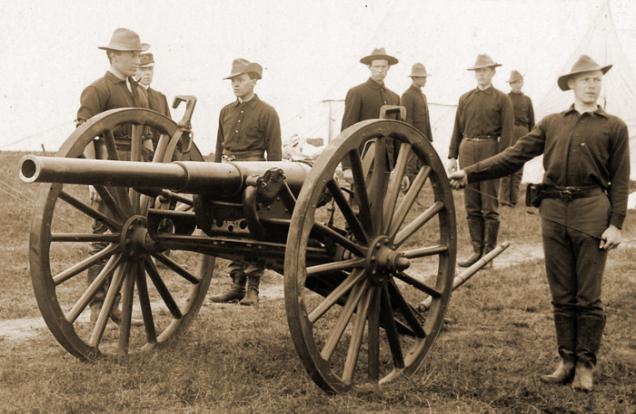
|
|
It will look like this, when finished. It\'s a breech loader but uses powder bags. |
At one point, the two of us were laying back in our favorite chairs, hand-in-hand covered in blankets, watching TV, floating in and out of consciousness. Right then, the thought went through my mind that we should probably tell someone that, if they don\'t hear from us in the next 36 hours, send the coroner and bring body bags so the mess doesn\'t kill the value of the house.
And that\'s the way 2018 will be coming in at the Davisson Household.
Ya\'ll have a good one! bd
PS
I probably shouldn\'t blog while running a temperature. Sorry!
23 Dec 17 - Bah, Humbug and Other Christmas Sentiments
For unknown reasons, I\'m a long, long way from being in the Christmas spirit. Not sure why. Just not. Some of it may be because my family is spread coast to coast. Some is because Christmas is on Monday, which means you show up for work on Tuesday with a food hangover and don\'t get to wind down slowly. And some is because we\'ve had overly cool weather (for us, a high of 65 is close to being intolerable), which makes me miserable.
This morning I was looking at the weather for the day on my phone while I was taking care of a morning ritual and couldn\'t believe what our week was going to look like. Damn! Enough is enough. But, my trusty iPhone weather service said today would be in the high 30\'s, which isn\'t unheard of here but is very rare. Then I noticed the entire week was going to have lows in the high teens. Double Damn!!
I\'ve only seen a hard freeze, in the ‘20s, three nights since I\'ve been here. 25 years! And they\'re talking about six days of high TEENS at night! 30\'s during the day! This is going to be a city-wide plumbing disaster! My mind was racing as I was trying to remember where I put the little heaters I have for the water pipes that are exposed outside the house. DAMN! I couldn\'t remember where one of them was. My day was going to be dominated by prepping the house for those kinds of temps, which wouldn\'t be easy.
A little background, which I\'m certain I\'ve mentioned before: it is standard practice throughout Phoenix, especially in older homes like mine (1974), for water lines to be exposed. My main water line comes out of the ground a foot in front of the house and then goes inside a foot up the wall. Two foot of exposed copper piping! And my house is better than most. Many have water lines running across their flat roofs. When we had the three nights of hard freezes about ten years ago, every plumber in town was driving a Mercedes two weeks later.
According to my smart phone, we were going to have five or six straight nights in the high teens. I was going to have to build tents over my exposed water lines (house and irrigation system) and put 100 Watt bulbs in drop lights in them. And leave the water slowly running at night. Our vegetation was going to be slaughtered. Bougainvillea can\'t begin to survive in this and we have lots of it. Palm trees will be severely damaged. I know I\'ve said it before but, Damn!
Then I looked at the top of the phone screen...I had accidentally switched it to Newark. Went to PHX and our weekday highs are going to be low 70s, night lows, high 40\'s.
I just remembered why I love it here so much.
That two-minute scare took the edge off my non-Christmas mood, but I\'m still in it. Christmas without young kids and family doesn\'t actually suck, but it leans in that direction. We\'re splitting a step son with his fiancé\'s family, which is just part of living, so the"family" part of the day is seriously truncated. Basically, it\'s just Marlene and our furry kids, which we love more than is logical.
Adding to this is I\'m about caroled-out. I can\'t find a channel on my shop radio that\'s still playing old-time rock and roll or country. Just carols. That\'s the best part of the day after Christmas. Radio will get back to business. However, someone forwarded me a link of a musical genre I didn\'t even know existed: worship bands. And, while I\'m certain some readers are going to be put off by their rendition of Little Drummer Boy, I\'m really loving it! If you watch this, go to some of their other videos in the side menu. To me, it\'s a really enjoyable way of modernizing religion and still getting the message across. And this is from a non-believer! https://youtu.be/5l1CS0Jhk90
Then, for a change of pace in a non-Christmas-holy-crap way, go here. This I know you\'ll enjoy. https://www.youtube.com/watch?v=txiR7oEVGd0
Have a merry, happy and healthy Christmas. I know that\'s a platitude, but I seriously mean it! bd
17 Dec 3 - Rainy Day Frustrations
Right now it\'s 0515 Sunday morning and it\'s raining. Rained all night. And it\'s cold (for AZ). 48 degrees. I opened the garage door intent on stealing a few hours from my responsible-life and investing it in my irresponsible-life by working on The Roadster. That, however, ain\'t gonna happen. Maybe.
I\'m still paddling around in a sea of deadlines and we\'re shipping Flight Journal this week. This means"frenzy" is the operative scheduling word until we ship on Thursday. However, I have it all under control courtesy of a leaking propeller that has to come off, which means my little red playmate can\'t leave the ground for a week. This gives me about 25 extra hours during the week to take care of business. This is HUGE! So, I can screw off this morning and not cause any major scheduling problems. But, will I?
Right now, The Roadster is up on jack stands just inside the garage door. So, it can\'t easily be moved. During last month\'s work session, I wrestled (literally) a leaf out of the rear spring and now have to replace the electric fuel pump and rewire it. This requires removing the roll bar braces (done) so I can remove the trunk floor (done) to gain access to the fuel pump wiring (not done). I know...too many details of interest only to me, but to do all of this I have to work through the open trunk. Last time I worked on it, it was about 80 degrees out and sunny so the garage door was open and I could stand in it working on the car. It was pleasant. Right now, it is anything but pleasant and I can\'t leave the garage door open because rain will get on unpainted metal and there\'s not enough room to work with it closed. Buggers! This kind of gloomy weather reminds me of why I hated living in NJ. I border on being morose on days like this.
So, here I sit, more than a little frustrated with my mind wandering in circles. One of those circles keeps coming back to me sitting in front of the TV last night watching John Wayne\'s 1950\'s movie, Red River. I was certain I\'d seen every one of his bigger movies, but this was as if I was seeing it for the first time. It\'s a good movie! Walter Brennan, Montgomery Clift, Noah Berry, both Harry Careys, Jr. and Sr. (fixtures on any of the Duke\'s films). It was old home week and I found myself sinking into the chair, as enjoyment forced me to relax, which I hadn\'t realized that I hadn\'t done for some time. My wife is having minor blood pressure problems, so, when I came to bed, the high-tech BP machine was between us and just for the helluvit, I plugged myself into it. 115/70! Lower than usual. Did it twice, same numbers! I guess going back to a simpler time for a few hours has its benefits.
I\'m positive that Marlene and I spend too much time watching the news. And I don\'t think it\'s healthy. Usually it\'s Fox, but we do networks and CNN periodically just to remind ourselves why we don\'t watch them but we do want the other points of view. Basically, there is absolutely nothing uplifting or remotely enjoyable on any news station."The Five" on Fox comes closest to that because there\'s so much sometimes-entertaining back and forth banter and Juan Williams, a staunch liberal, is there to let the other side be heard. He doesn\'t hold back, which is a good thing.
We know it\'s not good for our blood pressure, but we still seem drawn to keeping abreast of what\'s going on, and, what is noticeable, is the way that news coverage seems to run in cycles.
There is the Russian collusion cycle that seems to be losing steam as it is replaced by the OMG-look-at-what-the-FBI-is-doing cycle. Every bit of frat-boy-like behavior (Al Franken, one of my least favorite persons) is lumped in with deserve-to-go-to-jail behavior (Matt Lauer, Harvey Wienstein) as it sweeps the nation under the ratings-sensationalist flag. The liberals even pummeled Matt Damon, himself a hyper liberal, when he pointed out the error of equating a pat on the butt with out-and-out rape. Trump always leads the news cycles, which are usually tied to his often-unnecessary tweets and the palace intrigue within the White House. Considering how many big political guns are constantly firing at him, I have no idea how 1: he gets any sleep and 2: how he gets as much done as he does.
With all the foregoing soaking up news time, North Korea is mostly forgotten until the troll that is Kim Jung Un (actually, that\'s being unkind to trolls), decides he\'s being left out of the lime light so he fires another missile. He\'s our number one, most serious problem, yet the possibility of having stolen a kiss in high school making headlines has Congressmen giving up their seats. It\'s nuts.
In the meantime, I haven\'t seen one single news story about how Texas, Florida and the Islands are recovering from the storms. Right across the board, the media, the government and, it seems, the population, really suck at setting priorities. bd
PS
Forget everything I said. The sun just came out and I\'m going out in the shop. :-)
3 Dec 3 - We Ain\'t Nothin\' Special: Just Robots Within Robots
Fasten your seatbelts, folks. And put on your thinking caps (I\'m going to prove we aren\'t actually thinking) and read the following essay http://www.bbc.com/news/science-environment-39482345 Don\'t try to continue reading Thinking Out Loud without soaking it in or nothing I say will make any sense, assuming it ever does.
The opening line of the essay says,"The cognitive scientist Daniel Dennet believes our brains are machines made of billions of tiny ‘robots\'...our neurons, or brain cells." So, the author asks,"Is the human mind really that special?" This is an intriguing thought (or internal robotic reaction. Having read the essay, I\'m not sure which).
The single most depressing part of this essay is that being an engineer, both at heart and by training, is that I agree with Dennet. What he is saying is"The total is the sum of the parts," and, if each of the parts (a neuron) is capable of some level of internal activity and control, we are just a very complicated machine comprised of trillions of little bits of learned information that is being carried around in a not very reliable chassis.
For most of my life, I\'ve held that there is such a thing as"perceived Intelligence" which is what my daughter used to see in me before she became a self-contained movie mogul. When she\'d ask me a business question and I\'d give an answer and, when it proved to be right, she\'d say,"Oh, dad, you\'re so smart." When she\'d say that, I\'d reply that what she was seeing as intelligence, is actually just"long term trend analysis:" After you\'ve seen the same thing 19 times, you have a pretty good idea what\'s going to happen the 20th time. That is how Dennet says our brain works and each of our bazillion neurons has been learning from our experiences since our chimpanzee days.
An observant human being catalogs what he has seen and, with knowing it, recognizes the trends and, when the time is right, he will recall the results and guide himself accordingly. This, according to Dennet, is essentially what each neuron has been doing for millions of years and it has made mental evolution akin to a series of hard drive and operating systems upgrades. With all of that trial and error and trend analysis our brain takes on what appears to be an ability to actually"think". However, it is really just us using the experiences and stored observations subliminally passed down by our ancestors to apply logic to many situations. This is Dennet\'s theory boiled down to coloring book level. And I don\'t think it is off the wall at all.
While all of this is probably/maybe true, I also think that there are shades of gray in this concept in terms of the degree to which it applies to individuals. I think some brains are more observant than others. There are bound to be groups of brain cells floating around out there that don\'t see or retain the trends as well as others. This, is why we have so many gray dogs who haven\'t learned crap while aging. As I\'ve said before, it\'s quite easy to live a lifetime and not learn much. Just look around and you\'ll see lots of proof of that.
A problem in all of this is that there\'s a"something" about humans that makes us different from most other organisms. It\'s interesting how our collective chimp-to-modern day experiences can be combined to generate emotions like hate and love, charity and greed. It\'s even more interesting to see how the collection of our neurons\' past can result in such different individuals. Some of us are cute and lovable, others are jerks.
There\'s probably lots about Dennet\'s theory that I don\'t truly understand. I guess some of my neurons didn\'t get the right experience along the way to give me that little bit of perceived intelligence. Oh, well. I can still fly better than a chimp. Most of them, anyway. bd
24 Nov 17 - Guilt, Blogs and Grassroots
It\'s the day after Turkey Day, usually labeled Black Friday, for what reason I don\'t know. I\'m so far outside of our cultural mainstream, I routinely miss some of the more obvious stuff. However, what I\'m feeling right now is NOT the usual Turkey Day food hang-over. I\'m feeling guilt. I\'m feeling bad that I haven\'t been able to attend to Thinking Out Loud as I usually try to. But, I have a fix. And an explanation.
First, an explanation: I\'m experiencing an explosion in every revenue-producing aspect of my life. For the last two months and for the next eight months, I routinely have a day or two a month where I have four to six articles due on the same day. This is unheard-of in the world of article writers (I think). And this is going to be the second highest flying year I\'ve ever had, so I spend five or six hours a day at the airport, seven days a week. I\'m getting all the work done but it means my feet hit the floor at 0400 and I don\'t log off until 9-10 pm. Again, seven days a week.
On the one hand, it slows all my personal projects, including Thinking Out Loud, which I complain about. But, on the other, it keeps beans on the table and seems to hold Old Man Age at bay. Pushing my brain and body has very positive effects but I can\'t allow very much white space to intrude on my schedules. I do, however, purposely log off for a few hours every couple weeks and let my brain coast (more on that later).
Now, the proposed fix: Yesterday I was digging through my computer looking for something and ran across a folder marked Grassroots and, just for the helluvit, I popped it open. For 46 years, I wrote and published a column beginning in Air Progress magazine in 1969, then it moved to Private Pilot and then Plane and Pilot. Last year the new PnP editor decided he didn\'t like my writing (I was wondering how long it would be before someone discovered I\'m not actually a writer) so Grassroots was dropped and I disappeared from the masthead. The net result of that 46 years of monthly columns is that I have a hundred or so of the more recent ones, starting in the ‘90s, in a folder on this computer.
Some of these Grassroots are on Airbum.com, but a lot aren\'t. So, I\'m proposing that on those occasions where I just can\'t take the 3-4 hours needed to crank out a blog, I slug in one of those Grassroots. One is pasted on the end of this Thinking Out Loud.
Now about forcing some white space into a clogged schedule: last Saturday morning at around 0600, I was hard at work grinding out something for some magazine but part of my brain was already driving to the east side of town. I knew the street rods and customs were already lining up to wind their way into the annual fall Good Guys Rod and Custom show at Scottsdale. Something over 3,000 of my favorite kinds of cars would be there. But I wouldn\'t be. I couldn\'t afford the time. This even though I knew my right, rear jeans pocket held three free tickets and a vendor parking pass courtesy of my buddy who is a major manufacture of chassis and was exhibiting.
I successfully ignored the tickets until about 0730. Then, the Screw-it Alarm went off in my head: I called two of my good friends, and we met at the airport next to the car grounds, jumped in my 17-year-old Maxima (Marlene\'s old one) and proceeded to immerse ourselves in car heaven. Truth is, I actually go to Good Guys for the huge swap mart and I scored a couple of old spoked rims identical to those on my newest project, the four-cylinder race car we call The Banger (four-banger engine). They are 19" Model A hubs re-spoked to 16" rims. I thought the four on the Banger were one-offs, but apparently not. Then we had to carry them to the car!
We were joined by another of our friends and the non-stop ribbing, insults and guy-stuff did a lot to revitalized my brain, that had become seriously overwhelmed. There\'s nothing like roaming through acres of fantastic and largely unexpected cars with irreverant good friends to scrap the crud off of a soon-to-be-stagnant brain.
Anyway, that\'s my story and I\'m sticking to it. Enjoy the Grassroots below and drop me a note at buddairbum@cox.net to let me know if you like the idea of running the old columns from time to time. bd
GRASSROOTS
Dreams:
They only die, when we let them
(From 2012)
I just discovered an important fact of life: dreams don\'t die. And, if they do, it\'s our own fault. We kill them through inattention. I realized that when I met Lloyd Baker this week. I\'d like to tell you where Lloyd lives but he flashed through my life so quickly that I missed all but the most important facts about him: his name, his age, and his dreams. I tried to track him down before I wrote this, but couldn\'t. So, Lloyd, if you see this, give me another call. It\'s time to go flying.
Lloyd has called me probably half a dozen times over the past year. Each time, the years in his voice made me think that he was mostly calling to have someone to talk to. That his words about buying an airplane and needing my flight training were just that: words. Or so I thought. I enjoyed the short conversations, each of which ended with,"I\'ll be seeing you." But, I knew that would never be. I get dreamer calls like that more often than you\'d imagine. And I welcome every one of them. Then I got yesterday\'s call.
It was Lloyd again. I knew it as soon as he uttered the first syllable. Then he said he was in town. And I was incredulous. He hadn\'t given me any warning at all and he\'d flown in specifically to see me. And to do some flying. I instantly put him in a different category. If he was a dreamer, he was someone who acted on his dreams. And now he was on my doorstep. What to do?
A fantastically patient young airline customer service agent came on the line and it turns out that he had come in the night before and went down to the main airline airport, Sky Harbor, the 5th busiest airport in the US, thinking I was based there. I only got part of the story, but she told me that Lloyd was asking around the airport for me and she called for him to find out where I was based. I\'m at Scottsdale, diagonally across the city, from Sky Harbor. She said, he\'d get him a taxi and I told her to make sure she told Lloyd\'s driver to drop him off at the Main Terminal, not one of the FBO\'s at SDL.
I didn\'t give much thought to him until about the fifth touch and go that morning and I saw a slim figure in a white shirt, sleeves rolled down and buttoned, fedora pulled down over his eyes standing at the end of the row of hangars. I knew instantly who it was, but couldn\'t imagine how he got there. SDL is locked down tighter than an auditor\'s heart but he\'d somehow found someone to take him out to my hangar complex. Then he found his way to the runway side of the hangars and spent most of an hour watching us ricochet off the runway. I later found that the taxi had dropped him off on the wrong side of the airport but somehow he\'d gotten someone to take him to the other side of what is a major airport AND take him through the security gates to where I saw him. I had to admire him. He was hardcore tenacity personified.
As I climbed down off the wing and stuck out my hand, he grasped it with both hands and I found myself looking into a pair of rock steady eyes that absolutely defied age. He stood straight. His walk was a quick gait, with just a little spring to it. There was no hint of what I knew had to be at least 80 years stacked up behind those eyes. And he didn\'t find it unusual that he had made his way to Phoenix (from Arkansas, I later found out) by himself and, even more remarkably, had figured out how to get where he wanted to go on a high-security airport with no problem. I can absolutely guarantee that the majority of folks reading this couldn\'t have done the same thing. Like I said, tenacity personified.
We went to lunch and talked about airplanes, his early jobs traveling for various aerospace companies and how he thought he wanted to buy an airplane like mine, but he wanted to fly mine to make sure. I sat back and marveled. Although I didn\'t know his exact age, I knew it was long past the point that most people settle for what is, rather than dreaming what might be. But, he was definitely dealing with the future and what he wanted to do with it. However, when I asked why he didn\'t call and let me know he was coming, he said,"At this age, I don\'t schedule things, I just do them to make sure they actually get done."
Finally his age came out: he\'s an incredible 95 years old! That\'s right...95 years old! And he flew half way across the country and dealt with the vagaries of finding his way around the big city to accomplish what he\'d come for. More important, he\'s still dreaming. He still has goals.
I have to say that I was a more than just a little flattered that Lloyd had gone to so much trouble to make me a part of his dreams. Unfortunately, I was scheduled to take my airplane to another airport for maintenance, but my hangarmate, Ron, took him up in his S-2C Pitts (a real hotrod). Ron said Lloyd absolutely loved it. Plus, they did more than their share of cavorting (loops, rolls, snaps, etc.). Lloyd apparently came down with an excited smile on his face and the dream of doing more of the same was stronger than ever.
As the miles pile up and the gray takes hold of us, it is so easy to forget what it was that made us young in the first place. It was not the small number of years behind us or our slim, strong bodies. We were young because of the way we looked at our future. It was unlimited. We knew anything was possible and we had time to do it. But, then, one day you look around and realize that there is more sand in the bottom of the hourglass than the top and our future looks neither as bright nor as inviting as it once did. At that point, we start living the life we have and don\'t think past that to what, or who, we would like to be or what we would like to accomplish. We stop dreaming. However, as Lloyd clearly shows, that isn\'t necessary. As long as our minds can conjure those dreams into existence, there is no reason to stop dreaming. And no reason not to act on those dreams.
So, now I\'m having trouble prioritizing all those dreams that Lloyd\'s unexpected visit reawakened. Suddenly, it\'s fun being me again. I have an unending list of things to look forward to and Lloyd\'s next call is one of them.
8 Oct 17 - Micky and Bangers
It\'s been a while since I\'ve thrown words on these pages and I don\'t even know where to start, so much has happened. Some good things happened in my life. Some bad things happened in all our lives. First the good things.
Disney Gets It Right
I did something entirely out of character: I went to visit my daughter in LA alone (Marlene was/is recovering from a ligament separation in a foot) and we went to Disneyland. D/L was in full Halloween Freak-out Mode and it was terrific! My daughter set up a guide for us so we didn\'t have to wait on rides and everything was smooth as can be. The two granddaughters, Alice (7) and Rosie (2.5) were absolutely amazing and it was fun being part of the action.
Just going through the gate, I could feel my brain open a dump valve at the bottom letting every negative thought I had drain out. The problems of the world disappeared for the better part of a day.
ßI was supposed to drive home that afternoon (383 miles), which is typical for me, but we got home late and I was pretty beat up. So, I got as far as Palm Springs, three hours, and holed up, only to find I had left my bag and computer case in the parking lot at my hotel. Called them and had to drive back in, the three worse hours of traffic in the US, the next morning and then back out headed home. A 6.5 hour trip became a 12+ hour trip. But, it was worth every second of it to be with the California Davisson Clan. Love her and those kids!
Doing Another Stupid Thing
Although I had sworn I wasn\'t going to add any more major projects to my to-do list, I knew I was lying at the time. I\'m too compulsive and out of control to actually do that. Especially since one of my dream projects was out there staring me in the face: a 1930\'s open wheel dirt track racer. The staring in the face thing changed dramatically this weekend, when my friend, Ron Johnson, showed up from Rockford, IL with said dirt track car on a trailer and it now sits in the shop where the Honda sat. The \'90 Honda (never to be sold) is wrapped up in its personal cocoon in the drive way.
First a note: the roadster is on the street and going through the inevitable tweaking necessary to get it"right" and making everything work as advertised. All very minor stuff like getting the generator to charge right, tune the carbs, etc. It drives fine, but I don\'t take it farther away from home than I\'m willing to walk at the moment. My goal is to get it so I can treat it as a"normal" car and take it anywhere in town. Then, I\'ll yank the engine out so I can paint the firewall then complete it. It only needs upholstery and paint to be finished. With a little concentration, I think I can do that in a year (he says with great hope in his voice).
Another note: I\'ve promised myself not to do anything that\'s either time or money consuming on the racer until The Roadster is totally finished. Totally!
Some background race car history: During the ‘30s and into the ‘40s there were only two types of dirt track cars: Midgets and Big Cars. The Sprints, etc. come on the scene after WW II. The difference between the Sprints and the Big Cars is that the Big Cars had transmissions like a regular car where the Sprints only have"crash boxes." They were either in or out of gear. This racer, hence forth referred to as The Banger, has a regular three-speed transmission. This is important.
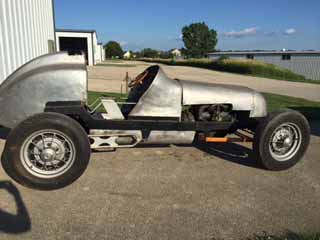
|
|
Picture sitting at a stop light and a gray dog in this pulls up beside you! I LOVE IT! It\'ll have the same red and black paint scheme my Pitts has. |
The Banger is going to be restored to racing status with a few minor changes: it\'ll have small head and tail lights and a license plate holder in the rear (AZ doesn\'t have front plates). I\'m going to put it on the street. The engine is a Model A Ford four-banger, as many of them were in the day, and shows signs of maybe not needing rebuilding. But, I won\'t know until pulling it apart, but with the head off, the cross hatching in the bore looks fresh, so.... It turns and is possibly the simplest engine on the road, so, I\'m going to lube it up with Mystery Oil, make sure it\'s free and ignore it until ready to work on it.
It\'s a much simpler project than The Roadster, so hopefully it won\'t take 60 years like The Roadster has.
Vegas
There\'s nothing I can add to the massive amount of media coverage to come out of this. However, we\'re a long way away from understanding why the shooter did what he did. It appears the planning leading up to this was long and intense, so he had plenty of time to re-consider what he was doing. I\'ve heard lots of theories, including a drug interaction break down (go to, https://www.facebook.com/notes/john-ringo/a-theory-on-las-vegas/10155111388257055/) but nothing I\'ve heard sits right with me. My BS meter hasn\'t come off the peg since this thing happened. ISIS has claimed credit three times, which is probably just them trying to take credit for something they didn\'t do, but the vote is still out on that too. We\'re going to learn a lot in coming weeks.
It took about five minutes for gun control to enter the fray. The bodies hadn\'t even cooled. But, I can understand why folks on the side did that. This thing is so horrific we\'re all looking for causes and cures, but I\'m afraid this is one of those cases that neither exist. Yes, I\'m for regulating Bump Stocks. They have almost no accuracy and are essentially a"range toy" but I can see looking into them. The kill-shots would have been higher if he\'d had a better, more accurate, sighting system (a scope) and had just fired it in normal mode without the bump stock. In fact, if he\'d been sitting up there with a very slightly modified bolt action and a good scope, there would have been fewer shots fired but they would have been much more accurate. But, I can think of no scenario that would totally prevent this. This guy was so methodical that even engaging in Monday Morning Quarterbacking, I can\'t see a way he could have been caught. That thought alone is incredibly depressing.
BTW...if the entire crowd had been carrying hand guns, not a single thing would have changed. Nothing. They were all helpless.
So, looking back over the last couple of weeks, I prefer think of Mickey and Bangers. They make me smile. The other stuff definitely doesn\'t.
Incidentally, have you noticed how little North Korea has been talked about in the last few weeks. Too much news covered them up.bd
10 Sept 17 - Surviving Blowhards
This is the third straight weekend that environmental disasters have dominated the airways and we\'re barely half way through the hurricane season. Then, of course, there are the ancillary tornadoes hurricanes toss off like weeds growing around the edge of our yard. All of this got me thinking about my version of a house for all seasons and locations.
I\'ve never lived in hurricane country, but I was born and raised in Nebraska and Oklahoma so tornadoes, epic thunder storms and killer hail are just part of my childhood. I\'ve seen far more piles of kindling that used to be some\'s home-sweet-home than I care to think about. And I\'ve had a house in mind that I\'d build, should I ever yield to the temptation to move back to Oklahoma. Or Texas.
Here in AZ, we really don\'t have much in the way of natural disasters. The closest we come are forest and desert fires. And don\'t think a desert fire is something like a front yard grass fire. It\'s not. It\'s a wall of flame 20-feet high moving faster than the average man can run. But, with the right equipment (airplanes, etc), they\'re relatively easy to contained.
When I think of places like Oklahoma, or Florida, parts of Texas and other similar places. I think of Moore, Oklahoma which was only a few miles from where I went to college (OU, Boomer-sooner, boomer-sooner, yada, yada). I knew Moore fairly well because there was a little airstrip close to the middle of town just off of I-35 where an airplane scrap dealer held court. I got a lot of pieces from him and was temped like crazy by a couple of dilapidated old Staggerwings that could be bought right, if you were handy with your hands. Of course, if I had bought one, it still wouldn\'t be finished and that was 50 years ago.
The reason Moore fits into this conversation is that five times in the last 18 years it was flattened by tornadoes. All were F4 or F5s, the last three were 2010, 1013, 2015 and it was totally obliterated. If you live in any of the states from Nebraska to Texas, when the sky turns that sort of sickly looking dark color you\'re keeping your ear to the radio/TV looking to see what\'s headed your way.
The ability to predict hurricanes and track tornadoes (which are less predictable and happen almost too quickly to be tracked) has revolutionized life in those areas. Think what it would have been like to live in Texas or Florida over the last three weeks in 1900. You wouldn\'t have known the storms were coming until they came over the horizon.
Knowing a storm is on the way is at least half of survival, but that doesn\'t help your home. Or provide instant protection, which the right kind of home would.
I know the discussion that\'s about to follow probably has some holes in it, but bear with me and please, let me know where you think I\'m wrong in the way I\'d build my house in a disaster-prone state.
First, I\'d avoid flood plains. All of them. Even where there are no major rivers, oceans or dams. There is almost never a drawback to high ground. If you move to any coastal area, you do so knowing things like hurricanes and tsunamis, etc., etc. are your neighbors. Ditto known earthquake zones. Tectonic movement is a given. The Earth is unlikely to ever be done moving. Some areas are worse than other.
Then, if I\'m building my very own Okie-proof house, it wouldn\'t be a house as such. Essentially, it would be a bomb shelter masquerading as a normal house. The core would be a re-enforced concrete cube including a poured concrete sloped roof. You could do something similar with cement block but pour the blocks full, use re-screen every other course and drop re-rod down through the block (of course, with that much steel in the walls, your wireless connections would suck).
The outside of the concrete shell could be made to look like any kind of house, with wood siding, bricks, whatever, because the outside would essentially be an ablative shield that is expected to be destroyed and then replaced. It might even have a normal pitched roof, but the concrete sloped roof is underneath. Sloped so it would drain, if the outside roof were destroyed or damaged.
The windows would be the highest tech money could buy. Or, if blast-proof glass isn\'t financially viable, the ornamental, normal-looking shutters would be plate steel (1/8" plate, minimum) with gaskets around the edges. The alarm sounds, you race around the outside with a drill with a socket attachment and bolt the shutters shut. Or, if you want to complicate things, they could have latches that can be worked from the inside. Or thumb screws on the outside. But bolts are simple and quick to tighten. All of the outside doors would be similar: steel and able to be locked with a water tight seal.
A part of the structure would probably include a natural gas-powered generator and maybe a well.
You could fancy this up with all sorts of solar power and other gee-gaws, but, if you keep it plain and simple, I\'m betting you could build it for around 25-30% more than stick-building the same house. And it wouldn\'t stick out in any suburban housing development (until after the tornado).
The upside to the extra cost is that, assuming you haven\'t thoroughly pissed off Ma Nature, you would never be without a home. After a serious twister or hurricane is done with it, your house is going to be really ugly, but livable. And re-buildable. Plus, it gives you all the protection needed against anything that doesn\'t generate a mushroom cloud. And it might even work there. Think about it. bd
2 Sept 17 - Impossible Logistics
On the one hand I\'m pretty much Harvey\'d to death. I\'d think I\'d get tired of watching guys dragging sodden people into their boats and taking them to safety. On the other, it\'s like a train wreck: You can\'t NOT watch. But the more I watch, the more overwhelming the logistics of the recovery become. I can\'t imagine it!
They were talking about the schools being indefinitely suspended until they\'re rehabbed and ready for kids. Let\'s look at that one problem for a second.
You have a building that has been five feet deep in water and may have bad roof damage on top of that. So, what do you need? You need crews that will come in and rip out sheet rock, kill the mold, redo the sheet rock. Plus all the electrical and air conditioning work. And then the"But..."s begin.
-But the required crews work for some sort of rehab company
-But that company was flooded too and probably needs its facilities rehabbed and its equipment rebuilt or replaced.
-But the crew that would do that and work for them have to rehab their own houses.
-But, they don\'t have vehicles to carry them either to and from work or around the area to get sheet rock.
-But sheet rock and building supplies of all types are also needed by tens of thousands of others in the area.
-But, the suppliers of building supplies have been flooded and their facilities need to be rehabbed, but there\'s no one to do it.
-But, even though the companies that supply building supplies to the building supply companies are located somewhere out of the flood zone, they are overwhelmed and there\'s not enough sheet rock in a three-state area to come close to satisfying the demand so it has to be trucked in. Maybe manufactured.
-But the local building supply companies can\'t absorb the sheet rock (etc.) anyway because they aren\'t really open for business (this all assumes their facility can even be rebuilt).
-But even if the schools were magically rebuilt, they can\'t re-open until replacing all the desks, books, etc., etc. required to be a school. Plus, their entire staff is distracted by trying to solve their own problems.
This scenario is focused entirely one problem: sheet rock and one building. Now magnify that by every other single product and/or service in an area that includes the fourth largest city and covers a flooded, densely populated area that totals 11,000 square miles. That\'s the same size as Maryland. Or Hawaii. Or it is DC, RI, DE, CT and half of NJ combined. More important it has affected 2.5% of the total population of the third most populous country in the world. This is unreal!
In watching it, I\'d sometimes find myself choked up because of the incredible way in which people jumped in to help one another. They came from all over. The son of one of my Bearhawker friends lives in Seattle and he and a friend ran down to Texas a few days ago, rented a truck and some boats, and then joined the rescue fray in Houston. It\'s unreal and is actually inspirational: maybe the whole country isn\'t going down the tubes after all. However, the next several weeks is going to test all concerned to their limits.
Phase One was getting them out of the water. Phase Two is what to do with them. A good percentage of the flooded houses that can be saved will be uninhabitable for weeks. Black mold is not a good house plant and is aggressive as hell. A big percentage of those houses will be condemned. So, it\'s either build a new house or move out. The"new house" option is an entire chapter in itself: the financing, the labor, the city inspections. Think about how much it takes to build one house. And there are tens of thousands! And those houses will all be competing in the labor market against government buildings, commercial buildings, small businesses, and the houses that can be saved but need a rehab crew.
The immediate labor solution is to bring them in from the outside. But, from where? More important, let\'s say the area needs 10,000 construction workers and magically comes up with them. Where do they stay? FEMA is going to be up to its butt trying to house those that were dispossessed. Even if the temporary housing units were available for the dispossed, it would take time, too much time, to get them to Houston. And then where do they set them! They\'ll have to build small cities and that too takes labor. And time. And land. And then a wave of construction workers shows up.
Damn! Double-Damn! This is going to be a very interesting six months, leading into a year or two of ferocious work! I\'m just glad I\'m helplessly watching from the outside. Somehow, however, I know Texas will work it out. I just hope the federal government doesn\'t get in their way too much. bd
27 Aug 17 - Harvey, Wolfman Jack and Random Thoughts
We haven\'t watched this much TV since 911. Harvey (not the giant invisible rabbit...and if you get that you\'re a gray dog) has taken stage center nationwide and it\'s difficult not to watch the drama unfolding live and in real time. Here it is a Sunday afternoon and rather than being out in the shop sweating, I\'m sitting here ruminating on the past week.
Harvey
When talking about this particular storm it\'s difficult, when watching all of the flood footage, to remember that Texas is only a day and a half into what is projected to be a four or five-day nightmare. The numbers sound like science fiction. 20" of rain already in some spots and 30 to 50 inches are predicted. That\'s insane! They\'re already talking about this being the biggest natural disaster in US history and the rest of us are sitting in our living rooms watching it happen. It\'s a disaster movie in real life only Dwayne Johnson is nowhere in sight. We\'re sitting here watching thousands and thousands of lives being destroyed. The kind of flooding they\'re going to be looking at will know no mercy and countless people will lose everything.
And don\'t forget, it\'s not just people\'s homes. All of the businesses, large and small, are going to take a hit. At a time, when the people are going to need grocery stores and gas stations, they\'ll be shut down. And tens of thousands of people will be told not to report to work. The problems feed upon themselves. On the personal level, it\'s going to be grim.
The oil business is going to come to a standstill. They say something like 40 refineries are in the area. The drilling rigs in the Gulf, of which there are 100s, won\'t feel the effect of the flooding, but, they can\'t keep pumping because there\'s a high probability that the oil facilities will be incapacitated for weeks. And there\'s no telling how much the storm surge is going to damage the docking facilities for tankers. This is going to be felt nationwide in the form of higher gas prices. Locally, it\'ll be felt in the form of human tragedy.
How serious is this? They just showed an alligator on someone\'s steps and someone else catching a fish in their living room.
A Week of Batteries
This falls into the category of"minor stuff", when judged against Harvey. But, so far this week, I\'ve had the battery in my car go to hell (8 months old but it\'s August in AZ and it gave up and died), the battery in my airplane died and we still don\'t know why. On a 105-degree day, the inside of a closed hangar is 115-120, when you first open the door, so I\'ve been trying to diagnose it in spurts. The Roadster battery, a high tech Odyssey dry cell, is also giving me fits. I suspect some sort of wiring issue, but don\'t have the energy to tackle it.
Public Service Programs
If I\'m going to be in the shop on a Sunday, I try to be in the office at 0500 so I can be in the shop at 0600. Like all good dirt-under-the-fingernails guys, the shop radio is as important as the tools and mine is wired into the main light switch. Lights come on and the radio comes on. At that time of the day on Sunday, my usual classic rock station has some public service programs that range from worthwhile stuff like autism or foster parenting to the need to neuter your cat/dogs. I just let it go because the program is only an hour long and it\'s an old radio and it\'s hard to find specific stations. This morning, however, I was driving to the airport during that time frame and had the luxury of a pre-programed push button radio. Imagine my dismay, as I pushed one button after the other, to find that seven of the nine stations were doing public service programming. I could not believe that even my hardcore country rock station came on with this same somber, serious-sounding, self-important PBS tone of voice. Different people. Same voice. Fortunately, it\'s only a 15-minute drive, so I survived.
No Wonder We\'re Screwed up
There\'s this catchy song floating around by Ed Sheeran that I\'ve found myself liking. His age group audience is reportedly 15-25 year olds, so what does that say about me? Then, on the way to the airport I had a chance to actually listen to the lyrics. The name of the tune is The Shape of You and the lyrics lead off with,"I\'m in love with your body. And last night you were in my room and now my bedsheets smell like you..." and on and on. DAMN! I\'m not even sure how to process that.
Changing Desert Radio
Talking about the radio, for most of the years I\'ve been driving to LA to see my daughter, often in the dark early morning or late night, there would be a couple hundred miles I\'d find myself listening to Spanish stations. I would be within 5-10 miles of the Mexican border and that\'s all I could pick up. If it was on a Sunday, I could swear that Jesus was Hispanic as all the religious programing was in Spanish. Lately, however, some sort of radio conglomerate has established stations in Tuba City, Ship Rock and a few other places across the high desert. It\'s obvious that each is a little one-person electronic outpost by all of the local radio ads. Aunt Martha\'s Killer Chicken, Johnny\'s Gun Store, that kind of thing. It might be remoted out of one major station with localized ad inserts, but I prefer to imagine Wolfman Jack in the Fresno station in American Graffitti. Those kinds of little independent stations do still exist, but most have been gobbled up by corporations and remoted.
This week, however, is, and will be, centered around an American Tragedy in progress. Harvey, try to be gentle. bd
13 Aug 17 - Make \'em all Count!
As the whole universe knows, we lost Glenn Campbell a few days ago. I\'ve been watching myself all week as I processed that information and I\'m surprised. It aroused so many thoughts and got me thinking in so many different directions that, as I\'m sitting here typing, I still haven\'t sorted out my thoughts.
First, I want to clarify that, although I hated to see him go, I\'m not talking about losing-a-legend stuff. What I\'m talking about is the"way" he left us (Alzheimer\'s) and what that can say about each of our own lives. I\'m going to put a couple of links at the end of this missive, one of them to an article that USA Today did about him a month or two before he died. It chronicles his recognition of the way in which he was slowly losing himself and what he did about it. And this got me thinking about the rest of us because, in one way or another, we have, or will, face similar facts of life.
The process of aging that leads up to the inescapable conclusion, varies considerably from person to person. The lucky ones are plugging along doing their thing and suddenly the lights go out. I had a friend who laid down to take a nap under his T-6 before flying another show and quietly died. Simple as that. Unfortunately, we all have many friends and loved ones who slowly decayed, watching one thing after another being taken from them. In the case of people like Campbell, whose personal identity has always been intensely focused on one narrow facet of their lives, in his case, music, it has to be excruciating to watch it slowly slip away. Especially, when it is so obvious. The USA Today piece touches your heart as it describes the process he went through.
It makes you angry to think of the absolutely unfair character of aging. However, each time we see someone being slowly sucked under like Campbell, an alarm should go off that says,"Hey, this could happen to me at anytime, anywhere. Do something about it!" Our first downhill step towards the pearly gates could start at sunrise tomorrow and there\'s not a damn thing we can do to prevent it. What we can do, however, is so obvious that it\'s a cliché, but few of us do it: we can live today on the assumption there will be no tomorrow and set our priorities accordingly.
The bottom line is to leave no white space in our lives until the time arrives when we have no choice. Don\'t let our lives become a worn recliner, a six pack and a wide screen until that is absolutely forced upon us. Resist the fatigue, the aching joints, the favorite TV shows and peck away at the to-do list that makes our life worth living. End each day by looking back at it and experiencing a warm feeling because we made headway, however small, and didn\'t waste it.
Read the following. It\'ll make you sad but is, at the same time, inspiring. Either way, it\'s instructive to see how Campbell dealt with what he knew was his future. Bear in mind that music and playing a guitar were as natural to him as breathing. And he was going to lose it. There\'s something to be learned there.
https://www.usatoday.com/story/life/music/2017/06/08/exclusive-hear-glen-campbells-funny-how-time-slips-away/102639556/
Both Alice Cooper (the rocker) and Glenn Campbell were local Phoenix boys for a long time and, from the outside, you couldn\'t have picked two individuals who would appear to be farther apart. But this wasn\'t the case. They were close friends. I hope there is someone out there who, when I\'m gone, will talk about me with the same love and humor that Cooper talks about Campbell. https://www.youtube.com/watch?v=B6q2hsdXenQ
bd
6 Aug 17 - Oshkosh, Gray Dogs and Health
Okay, I\'ll admit it: I\'ve been back from Oshkosh for a week and I haven\'t said anything about it. That\'s because I rolled into the house Sunday about midnight after 13.5 hours on the road and it took over two days for my body and brain to start to feel normal. Fun can sometimes be totally exhausting!
Oshkosh, or AirVenture (its new millennium marketing label), was, as it always is...huge! Actually, bigger than huge. The official stats say only 5% growth but to those of us who have going since Orville and Wilbur were both kids (this was number 49 for me), it felt much bigger than usual, which I can\'t exactly explain. The crowds, number of aircraft and the spectacular spectacles we all witnessed were all grandiose and numbingly wonderful. I\'m not going to dwell on those here as the tale is currently being told everywhere on the web. You all know we saw two B-29s up together, three P-63s, a trio of F-86s (be still my heart!) and on and on. But, I\'m going to rattle on about other aspects of the Big Show, all of them positive.
For one thing, the military was there. Big time! During the last Administration, budget cuts kept the military out of the spotlight. Not this year! As if having the Blues\' brilliance center stage wasn\'t enough, we saw B-1, B-2 and B-52s, F-22s and F-35s in formation. For the first time ever, I saw an A-10 Hawg do a roll. F-35s, BTW, had to have deafened every gopher in a ten-mile radius...they are LOUD! The center exhibit square on the grounds was packed with all sorts of military stuff: America\'s might was on display right along with the overtly patriotic attitude of the crowd. It was hard not to feel good about America when watching something like 100,000 people scattered down the nearly two-mile flight line, drop what they were doing to salute the flag or put their hands over their hearts, when the airshow started and the Star Spangled Banner was played. It felt as if red, white, and blue had returned to the land of the airplane freak.
I arrived there a couple of days before I usually do, so, when the show weekend came around seven days later my forums were all behind me and my article note book was nearly full. This gave me the rare opportunity to just hang out and watch people. In so doing I found myself surprised that one of my current pulpit-rant subjects was not necessarily true. At least not on the grounds at Oshkosh.
Everyone has heard me ranting about the way that just about every special interest niche is graying out. I\'ve been saying that everything from model airplanes to hotrods to airplanes to every kind of narrow niche area you can think of is dying because most of today\'s youth don\'t seem to have any interest in any of those subjects. In fact, except for the Internet and associated digital activities, I don\'t know what they are interested in. However, when I started actually watching the crowds milling around the grounds at Oshkosh I saw I was at least partially wrong. When carefully studied, it became obvious that there were lots twenty-somethings, often couples pushing baby strollers, mixed in with the crowd. In fact, although the crowd had its share of gray dogs, there were actually lots and lots of folks in the under-40 brackets. Even teenagers. So, maybe everything isn\'t totally going to crap after all. At least not in that little corner of the world.
I was also struck by the number of wheel chairs, canes and crutches in evidence. Some were playing out their final days in the place that still made them feel young. Others, however, were suffering from differing cruel acts of nature, but they didn\'t let that slow them down. Those that could, were wheeling themselves. Others had those who loved them the most helping them enjoy what they loved the most. It was humbling. Suddenly, your back and feet no longer hurt.
Oshkosh/AirVenture was, and is, the way most of us signify the beginning and end of each of our personal years and this one was more than memorable.
On a different, initially scarifying subject:
I wasn\'t going to talk about this for reasons that will be obvious in a minute, but it was something new to me that I think is worth passing on. The last two days of the show I began having balance difficulties. I wasn\'t exactly dizzy, but I wasn\'t right either, and the grueling 13.5 hours getting home didn\'t help. I have had that happen a few times in the last few years. Generally, it is gone in a day or two, but this time it hung on for nearly four. I\'ve avoided going to the doctor with it because I didn\'t want it in my medical records because of the FAA can do unpleasant things with this kind of information. But a light bulb went off in my head that said I was being silly. This could be something serious. So, I went to the doctor and it took him about two minutes to explain and fix what was going on.
Some background first: I\'ve never had allergies in my life but they\'ve developed in the last few years and this year they were really bad. My doctor said here in AZ and in most of the country it was the worse allergy season he had ever seen. I have no idea what I\'m allergic to but it manifests itself as various forms of post nasal dripping that results in coughing. This is important.
When the doctor scoped my ears, he said I had a little fluid in them and that was messing with my inner ear. And that was the result of my allergies. A couple squirts of Flonase, which the FAA is okay with, and all was right with the world. Considering that I was expecting to wind up with a surgeon opening my skull with a sawsall to take out a cockroach nest or something, I was more than a little relieved.
Just letting ya\'ll know that there are still a few of life\'s problems for which there is an easy (and FAA approved) fix. bd
18 July 17 - Small Victories: Progress on the Home Front
When I sat down to write this, I scanned back over past blogs and re-read the one I wrote on New Years day. There I said that project-wise I was only going to work on The Roadster and an iBook. And now, half way through the new year, I\'m pleased and amazed to report some progress.
The iBook hasn\'t moved but the roadster is not only licensed and insured but I have nearly 20 miles on it running around an ever-increasing number of city blocks as I expand its envelope. It\'s far from finished. It still needs paint and interior, but I\'m doing neither of those until I drive it enough to know what\'s wrong with it and fix it as I go. The last thing I want is finished paint or upholstery on a car I\'m constantly banging on fixing one glitch at a time.
As I backed it out of the garage for the first time and ran down to the end of the block, I was elated but, at the same time, worried. The engine didn\'t want to take the throttle on shifts. The clutch (hydraulic) was/is much too stiff. It\'s drivable but too much work. The steering was just loose enough to be a little worrisome. And it took me some time to re-acclimate to driving a three-speed transmission with reverse where first is in a five-speed car. I was constantly moving back, when I wanted to go forward. Plus, it\'s a \'39 Ford trans so neither reverse nor first is synchro-mesh: you have to be dead stopped to get it into gear, although double clutching will let me into first while rolling, if I\'m careful.
I have to admit that after the first couple of miles (a series of different around-the-block trips), I was just relieved that it didn\'t catch fire or blow up. So, I did something unnecessary and spent a weekend getting the grill insert finished. That turned out to be a MAJOR job that I\'ll do a separate story on when I finally chronicle the building of the car. However, one thing worth sharing (if you don\'t like details, skip this paragraph): there was a major gap (2") at the bottom of the stainless steel strip that surrounded the insert itself. I hadn\'t the foggiest how to fix that but had a brain storm. I went to the hardware store where they have those little displays of small tubing and sheet metal for hobbyists? Sure enough, they had thin-wall, ½" stainless tubing. Six bucks! So, I sliced pieces of that down one side, and flattened one side making a"J" shape out of it. The straight part would go under the surround to be riveted in place. But how was I going to join them in a V-shape to match the shape of the grill? Again, no idea at all, but again had an idea. I\'ve never actually welded stainless before, especially stuff that\'s nearly paper thin. However, using a tiny weld tip and stainless safety wire as rod, I fumbled my way through the welding process and after filing and sanding found it all polished up great with a buffing wheel and came out looking like it was factory made!! Something about pigs finding the random nut fits here.

|
|
This was shot on the Fourth of July, where I celebrated by taking it around the block for the first time. Very cool! You can\'t believe how "right" it sounds. |
I now have the engine tuned so it takes the throttle like a normal car. The loose steering was traced to the nut holding the steering wheel needing a .032 shim under it. The battery died a couple of times and then I found it was only rated to 113 degrees and ambient temp was 106-110 and an exhaust pipe ran right next to the battery box! Duh! Made a new pipe with more space and a stainless shield between it and the battery. Also insulated the battery box. Problem solved. I hope.
Next big steps are to build a new clutch arm for the transmission with better mechanical advantage and make a top for the hood. I\'m going to leave the sides open to show off the old flathead.
So, now, I\'m going to continually drive it farther and farther, with the goal of gaining enough confidence to drive it to the airport and back (nine miles each way). Right now, the fastest I\'ve had it is 40 mph (due to gearing changes the speedometer isn\'t even close, so I use the Speedometer app on my phone, rubber banded to the steering wheel. I\'ve identified 1,200 rpm as 35 mph so far). I need to push that to 50-55 so I don\'t hold up traffic. Baby steps.
If I get enough miles on it that I\'m satisfied with its reliability and handling, I\'ll pull the engine out of it this winter to paint the firewall, body and frame. Then, maybe do the interior and some chrome (windshield posts and windshield frame).
Hey! ‘Know what? After working on it for 60 years this month, it\'s actually possible I may get this thing finished! This is a very big deal in my life. bd
PS
I\'ll be gone the next two weekends at Oshkosh. It\'s part of my job. No, really!œ
28 June 17 - Long Rifles and the Internet
You\'re going to find this next statement hard to believe: there actually was life before the Internet. No, really! Before computers too! I was reminded of this, when a long, skinny crate arrived at my door this week and an artifact from my earlier life rejoined me.
When the crate, which was about 6"x4" x five feet (!) arrived, I held my breath. I knew what was in it and I knew how easily they were broken in half by UPS. Been there done that. It held the very first Kentucky muzzle loader I built. The year was 1980 (an unbelievable 37 years ago) and it has been hanging on a good friend\'s wall for the last 20 or 25 years. I hadn\'t seen it for that long. As soon as it came out of the crate in one piece and I breathed a deep sigh of relief, I couldn\'t help but reflect on what had transpired in the 37 years since I started hogging on a big piece of maple. A million things in life have changed, and many of them can be seen in the rifle. Or at least in the way I approached the project.
Let\'s think of the year 1980. It represents a watershed period, although wasn\'t an important year itself. Apple opened its doors in 1978, so, if you graduated high school anywhere in that general vicinity, you\'ve never known life as an adult without computers. However, although computers immediately became a mental appendage for most of us, the Internet didn\'t become common place for another decade. Computers changed our lives, but the Internet turned everything on its head. Suddenly, everything and everybody was instantly available and the trend accelerated like a top fuel dragster.
In 1980, I decided I wanted to get good at building Kentucky rifles (If you don\'t know the type, go to http://www.airbum.com/NeatShtpix/LongRifle.html .) and, from this vantage point, it\'s hard to believe how hard researching everything was at the time. We had libraries, the postal service, telephones and telegraphs. That was it. In fact, our communication/research capabilities hadn\'t changed one iota since before WW II. And we fought a war that way! However, being a typical guy, I hate waiting for answers and I hate reading the directions. But, in those days, I had a system for getting information. It was a crude method that did what Google does for you today. But, not as well or as fast.
When I\'d get into any kind of specialized niche where the skills and knowledge required were hard to come by, I\'d look up the top magazine that fed that niche (wooden boats, machinist, etc.). Then I\'d buy all the back issues the publisher had available, usually three to five years. I\'d spend the next month reading nothing but those magazines. Think about it: If you bought the past five years of Plane and Pilot, by the time you read all of them, you\'d have had a crash course in aviation. You\'d know about all you needed to know to jump into it. That\'s what I did for building Kentucky rifles. I buried myself in Muzzle Blast magazine, which is dedicated to those passionate about recreating black powder weapons.
By that time, I\'d been a magazine guy for 12 years, so, after reading all of those articles, I not only felt as if I knew the editor\'s taste and article preferences, but I\'d singled out the individual whom other authors often quoted as a point of reference. Read five years of any airplane magazine and it\'s impossible not to know who Patty Wagstaff, Chuck Yeager and others of their ilk are. The name that popped up in reading about black powder rifles was John Bivins of Winston Salem, NC. So, I pitched an article on Bivins to the editor (I was pretty good at writing pitches), he bought the idea and I quickly found myself standing on the porch of Bivin\'s restored 1890s Victorian home knocking on the door.
To cut to the chase, Bivins and I turned out to have one of those instant connections you see only two or three times in a lifetime and he became my friend and mentor on the rifle building side of things. He was an incredibly unique individual and known worldwide not only for his rifles but for his expertise in many other things like colonial architectural decorative arts.
So, I\'d gone through the whole magazine-reading thing as a way of gaining access to the leader in the field which would give me instant access to all the knowledge that individual possessed. He was my personal Google guy. And I thought of that, as I pulled my old smoke pole out of the crate and instantly saw a dozen things about it that I would have done differently had I known then, what I know now. And the reason I know those things now is because of all the Google searches I\'ve done on the subject in the last 20 years. I don\'t think I embarrassed myself in building this rifle, but I would have done it differently, if my friend Mr. Google had been there to hold my hand, as he does almost every day in almost every area of my life. And I know I\'m not alone in that.
We\'ve become so used to having everything in life available to us through a key board, from asking Siri to take us to our destination to finding the caloric value of a blue berry (less than one calorie/berry) that we\'re psychologically dependent on the Net. This is very convenient, but I\'m afraid it also lets our brain take the easy way out. Plus, this means we\'re dependent on something that can break down or be shut off, and invites bad guys to poke around inside our digital life.
How hooked are we? I don\'t know about anyone else, but we\'ll be watching television and I\'ll hear my brain ask,"I wonder how old that actor is" and the next thing I hear is Siri giving me the answer. Or as soon as I park my butt in a doctor/dentist office, out comes the phone and I\'m Googling something or checking out what\'s for sale on Backpage.com. This is not good.
Do I have a solution? Oh, hell no! You don\'t ask an addict how to cure other addicts. He might have to give up his addiction to cure the other guy. So, if you have ADD (Active Digital Disease), you\'re on your own. I\'m not about to give up my phone or computer. Will you?
FYI-I\'m kind of sorry the rifle was shipped here because it has me foaming at the mouth to build another Kentucky rifle. And I\'ve already started. bd
PS
About the rifle: Today you can buy high dollar kits all day long for a wide variety of blackpowder rifles, but this definitely wasn\'t a kit. I didn\'t have a band saw, so I laid a heavy board of curly maple scaffolding lumber (3" thick, ten feet long) up on two saw horses. Then, I stood on top of it and roughed it to shape with a chain saw. I cut a lot of the fittings out of brass or 4130 and bought the lock, barrel, trigger guard and butt plate from Dixie Gun Works. Today we have Track of the Wolf for that kind of stuff and it\'s mind boggling what they have (https://www.trackofthewolf.com ). Incidentally, the .45 caliber barrel is the usual Kentucky length of 42". That\'s a foot and a half longer than a Garand. Very cool!

|
|
I hadn\'t worked up the guts to do the requisite Roccoco carving at this point, which is just as well because stylistically the star and butt plate shape would have been wrong for it. Mr. Google would have told me that. |

|
|
The Lancaster style patch box is "okay" but not the right historical match. It\'s actually brass, but has tarnished to where it looks like steel. |

|
|
Flint locks can be frustrating but once you get them right, they\'re cool. Click-fizz-bang! |
20 June 17 - It\'s Summer Time!
It\'s June in Phoenix, which means we\'re nearly halfway through summer. What? You say the official first day of summer is just this week? Summer just started? I guess that depends on your definition of summer.
Summer in our neck of the woods starts as soon as we hit 100, which is usually mid-May. It\'ll bounce up and down between 95 and 101 for a month. Then June arrives where we seem to have one week, only one week, that the weather goes bonkers. This is that week. I just checked the ATIS at the home aerodrome and it says it is 115 degrees and the relative humidity is 6%. This one week of bat-sh*t weather early in the season seems to be a desert tradition. It\'ll threaten the record books and make national news and then return to"normal." If the forecasters are right, we\'ll have 118 tomorrow and 117 the day after, which I\'ve only seen a couple of times in the last 25 years. Then it\'ll drift back down to what June in the desert usually is: 105-108 with humidity in the 5-8% range. Believe it or not, but that is usually tolerated well by almost everyone. Even those from back East that haven\'t acclimated yet.
As I say the above I can hear people repeating what they ALWAYS say,"How can you possibly live somewhere that it\'s hot enough to fry cats on the sidewalk!?" I used to try to explain that a) it\'s not that hot all day and b) we only have those kinds of spiked temperatures a few weeks a year. I used to say,"Let\'s have this discussion in January and see what you have to say." But, I don\'t try to explain any more. First, they don\'t believe me and second, I\'m not doing myself any favors by trying dispel Arizona\'s national reputation. Now I use that reputation to protect what we have out here.
My approach to the subject these days is to sadly shake my head and agree with them. I say, yes, it\'s a terrible burden trying to survive out here. And think of all of those poor fried cats stuck to sidewalks all over town! It\'s such a tragedy! You\'re right, you should never think about moving down here. Besides the heat, we\'re surrounded by nothing but flat, featureless bare sand, with the occasional cactus breaking the monotony. And north of us we have this gigantic ditch they try to glorify by calling it a"grand" canyon. There\'s nothing grand about it. In fact, it has now been proven that sometime in the late 1930s\'s a bunch of tourists from Brooklyn dug it by hand as a place to dispose of their trash. It\'s such an eye sore that there\'s now a local project aimed at filling the ditch in and making it into a skateboard park. They are right now letting contracts to knock down the tall, skinny rocks in Monument Valley and using them to fill in the grand ditch. It\'s a really boring, nothing-to-see area and it badly needs a skateboard park, so it\'s a win-win for everyone. Monument Valley gets cleaned up. The Grand ditch gets filled in. And all of the skateboarders in the area (it\'s a Navajo tradition) have a place to do their thing.
As if the topography isn\'t bad enough, you can\'t step out of your car without the rattle snakes (or the scorpions) grabbing you by the ankles and dragging you under the car to lunch on your tender vitals. It\'s just terrible! It\'s not fit for man nor beast. However, during the winter, we do have maybe a bazillion golf courses and hotels with swimming pools you might enjoy. So, yeah...come on down and visit, suck down your fill of Matai\'s and abuse some golf balls in the sun (which almost never actually shines), but don\'t think about staying. You\'ll hate it.
Oh, yeah, I forgot: we\'re a really rude, obnoxious people. And we lie a lot. bd
4 June 17 - The Battle Between Love and Grief
This week was unique in a couple of ways. Not the least of which I was forcefully reminded that grief never actually goes away, regardless of the years. Regardless of the source.
This is probably a little too much information, but I do some of my clearest thinking and planning while I\'m taking a shower in the morning. Hence the SCUBA diver\'s note pad hanging on the shower head. There\'s a floor to ceiling window in our shower that looks into a little patio that is faced by a glass door into the bedroom. Since I usually shower around 0430-0500 (depending on when I walk), I keep the lights off so they don\'t wake Marlene. Having better sense than I do, she\'s not up that time of the morning and she has a hard enough time sleeping as it is. I\'m so damned considerate I amaze myself. :-)
Standing in the steaming hot water (I like it REALLY hot!) in the dark, it\'s almost as if I\'m in an isolation chamber. The world is far away and exists only in my mind, so it tends to ramble all over the place. Sometimes it\'s tackling the day\'s goals. Other times it\'s picking away at personal long-term dreams. I have little or no control where it goes. Which is largely on purpose. Sometimes, however, it decides to focus on something that catches me by surprise. This particular morning, it was my late brother, Gary, whom we lost totally expectantly in 1985 to a massive heart attack at the age of 42. To say it caught me flat footed is a gross understatement. And 32 years later, it still gets to me.
There I was, stark naked, the water doing its best to boil me and I suddenly found myself crying like a baby. Sobbing. My body wracked from top to bottom in a way that it hadn\'t felt for years. Everything in my being was reacting to the grief and it surprised the hell out of me. I hadn\'t seen that coming. At the same time, I was pleased to know the grief was still that strong. It felt good. And I felt closer to the bro I\'d always been close to. Then I thought about my dad. And other dad\'s.
The day before I had written the Memorial Day blog about Ernie Pyle and, standing there in the dark, I thought about all the gold star fathers and mothers who, on Memorial Day, had memories that brought forth much more grief than what I was feeling. I remembered my father at Gary\'s funeral. He was a strong, but at the same time, emotional man. But, that day he was a shell of the man I had known. In his early 70s, he was moving and talking in a mechanical, zombie-like manner. A hard-core, tough Midwesterner who had weathered the depression and a half-dozen wars, he wasn\'t purposely hiding his grief, as was traditional with his generation. Now I know that his grief was so strong and overwhelming, he simply didn\'t know how to let it out. How to deal with it. It was far, far beyond his comprehension and left him totally numb and incapable of feeling anything.
As I\'m writing this, I feel guilt at not being able to be there to help him over the mountain that grief had placed in front of him. However, at that moment, standing in the shower, I realized that he had never conquered that mountain. A father or mother losing a son or daughter never do. As that thought went through my mind, I momentarily thought about my own kids but I absolutely refused to let the thought of losing one enter my mind. I couldn\'t. If I did, it would haunt me for the rest of the day, rather than flitting around the edges of my thoughts as it does for every parent. We all know the possibility is there. But we refuse to let the thought gain traction in our mental processes. We hold it far out there in a dark place where we put things we don\'t actually want to face. We have our heads mentally and emotionally buried in the sand, but the thought never actually goes away.
In retrospect, last week, instead of writing about Ernie Pyle needing to be remembered on Memorial Day, I should have focused on the gold star families. Included in the awful statistics of those killed in war are the innocent civilians who are always part of the collateral damage. During WWII, that number was much bigger than the actual combat deaths. However, a statistic that is never included in any of the cost of war statistics, is the immeasurable damage a single death in combat does to those surrounding it. Especially, the parents. Each death generates grief that lasts a lifetime, knows no boundaries. It\'s universal on both sides of every conflict. And there are no monuments to those who suffered the loses. But, there should be.
The pleasant memories of my brother, Gary, never leave my mind. Never. But, as the years go on, when I least expect it, the grief comes to visit. And that\'s a good thing. It proves that I\'m still human. Better yet, it proves that love can go toe-to-toe with grief, and will eventually outlast it. bd
28 May 17 - Memorial Day: Remembering the Typewriter Warriors
Tomorrow is Memorial Day and I\'m once again mentally immersed in a million images of long ago battles. Of strangers faces I know are gone. And the few I did know who we\'ve lost. Tomorrow we\'re going to remember the blood and guts warriors. Today, however, I\'m choosing to remember another kind of warrior. Those with the typewriters. Specifically, Ernie Pyle.
I\'m betting that the majority of those reading this are either gray dogs or heading that way. Many will remember Ernie Pyle. However, I also know of at least a few millennials reading this who I know for a fact don\'t know of Pyle. I\'m also betting that few in either group give much thought to guys like Pyle, the war correspondents and photographers who were in the middle of the fight and brought us the images, mental and photographic, that have made all of our wars so real to those of us who cared but weren\'t there.
In the world of war correspondents, Ernie Pyle looms large for a lot of reasons. The biggest being that during WWII he was the nationwide voice of the dog face. Just as Bill Mauldin graphical brought the public the war with his sometimes irreverent"cartoon" drawings of G.I. Joe, Ernie Pyle kept a steady stream of columns streaming back from the front to newspapers throughout the US. Plus, four books came out his efforts, Ernie Pyle in England, Here is Your War, Brave Men and Last Chapter.
When I was in Junior High and High School in the last half of the ‘50\'s, Ernie Pyle and his ilk were my heroes. I devoured every book written by anyone who was actually there and Here is Your War and Brave Men were nearly bibles to me as was Richard Tregaskis\' Guadalcanal Diary. If you go back and read any of his words, you can see why Pyle was awarded a Pulitzer for his work.
One of the things that sets his work apart is the voice he gives war. It is him talking, Mark Twain style, in a spare, to the point voice that makes you forget you\'re reading something. It\'s more as if you\'re hearing it. More important, he doesn\'t talk about the tactics, the high-level planning, or the campaigns. The Pattons and Eisenhowers of the war are seldom, if ever, mentioned. He talks about the individual men, by name, and the experiences he shares with each in their foxholes. When reading it, you can sense the mud that\'s under his fingernails while he\'s writing.
Pyle is a long way from being the only war correspondent/photographer in our history. Every war, of almost any kind, has had its scribes keeping the action alive on paper. Most, however, talked about the war in the third person, from a distance. Only a few were right there on the front lines exposed to the same life and death combat lottery as the troops themselves. As such, in the enemy\'s eyes they were no different than the infantrymen in their sights and many paid the price. However, I was surprised when I did a Wiki search and found the number killed during WWII was only nine. I would have thought it to be higher. Korea lost five, Vietnam three. However, Iraq saw 27 killed (many local Arab state reporters) and Afganistan has so far racked up 20 (BTW-I don\'t believe the numbers).
Memorial Day is our time to remember those who died in the service of our country. This time, I\'d like to remember those who died bringing the tales of the everyman soldier to our country. Ernie Pyle is one of those. On April 18th, 1945, on a small island next to Okinawa, Lejima, a 7.7mm machine gun bullet caught him in the left temple just under his helmet and the brilliant, communicative mind of Ernie Pyle was no more. War correspondents all leave a lasting legacy out of proportion to their numbers. They should not be forgotten. bd
20 May 17 - Is Technology Killing our Past and Damaging Our Future?
We drive a 27-year-old Honda, a 17-year old-Nissan Maxima, a brand new Maxima and a 1929 hotrod powered by a 71-year-old engine. Which one do I think will still be running 20 years from now? The old hotrod! Why, because technology is going to eliminate antique cars for the future because we won\'t be able to service their computers. Same thing with electronic documents, digital pictures, etc. Model A Fords and flathead roadsters, of course, are bullet proof.
We have become so addicted to digital everything and are so accustomed to the absolutely mind-boggling speed of changes in those fields that we\'re slamming the door on our past. Actually, the door is already part way closed. Besides the older cars, we have a couple of older Nikon digital cameras and two higher-end Canons, one that I use in my work, and every one of them uses a different storage medium. I have no way of reading at least one of those, so the personal history represented by those photos is gone. Ditto for the 5 ¼" floppy disks on which I wrote the welding book on an Apple IIe for the EAA back in the dark ages. I haven\'t researched it, but someone like Data Doctor may be able to read the mess of 3" floppies, Ziequest, Jazz Drives, etc. that I have around here, but I doubt it. Even the Word documents I\'ve carefully copied to each new computer and new software variant are about 30% unreadable. In fact, although I\'m writing this blog on my super new MacPro, I have to put it on the web via my 6-year-old Mac because the new one was specifically designed to not recognize nearly half of the software or files/photos in my nine Tb of storage (If you don\'t know storage, that\'s a helluva lot!).
Smart phones are where rapid obsolescence has become most obvious. The other day I dragged out my old Motorola Razor flip phone and found I\'d totally forgotten how small and convenient it is. My new 6s iPhone is a wonderful machine and I depend on it just as I do my computer. In fact, SERI and I have become close friends. Maybe too close. But, as fantastic as it is as an electronic companion, it\'s only so-so as a phone. It\'s cumbersome, unnatural and big. The Razor was a great phone. You just flipped it open to answer it and it fit in a shirt pocket. It was, however, more than a little irritating to text on. Technology does have its draw backs. Still...
A tangential phone story: getting into my airplane is a major physical exercise. I have to get over a 3-foot cockpit side, whether I\'m in front or back. Starting sometime last year, I found it more difficult getting in the back. Old age, it seemed, had started to limit the amount my right hip would move. But, I soldiered on, forcing it and finding handholds to help me. Then, a couple of weeks ago I realized that my new iPhone, which I carry in a BD-designed holster inside my right hip pocket was about 1.5 inches longer than my earlier 4Gs and was stopping my leg from going up as it should. I took it out of my pocket, clipped it on the shoulder harness and found I could swing that leg into the cockpit like a teenager. So, yes, digital electronics can make you feel old.
Incidentally, I save all my old phones and my digital recorder and periodically charge them all up to protect the batteries. No, I don\' t know why I do that, but it seems like a smart thing to do.
Our cars, like Marlene\'s new Maxima, are typical of how dependent we are on digits and how quickly everything is obsolete. It is essentially a four-wheel computer with a million different systems just waiting to fail. It\'s the first car I\'ve ever owned that the first step, should you have problems, is to shut it off and reboot it (I think).
Look around you right now. Should we have a big solar storm or the Krazy Korean succeeds in an EMP attack, what around you would no longer work? My watch wouldn\'t work. My desk lamp would be kaput. I couldn\'t write, and you couldn\'t read, this blog. All of our cars with the exception of the old hotrod would be doorstops. Our heating/air conditioning unit would no longer receive commands from the thermostat, which might be moot because I doubt if the natural gas plant is shielded from solar damage. EVEN OUR DAMNED DOOR BELL WOULDN\'T WORK!
In essence, should the Sun or The Korean Kook decide to play electromagnetic games with us, we\'d be back to the stone age in something like 10 seconds and there would be little or no help coming. Civilization, as we know it, would cease to exist and we\'d immediately have a dog-eat-dog (or whatever munchies you can lay your hands on) existence. Estimates are that nine out of ten of us would be dead in a year. And, I hadn\'t thought about this until just now, but a high percentage of the survivors would be Amish (horses don\'t have many digital systems) or high country or desert native Americans who still cling to the old ways (not many of them left). The rest would die a miserable, slow death, except for those of us who would go down in a blaze of something-or-other while defending or acquiring food for our families.
In short, the more we depend on technology the more we lose our past and threaten our future. What\'s the alternative? Short of retreating to the hills and becoming a mountain man, there isn\'t one. What\'s the solution? The only one that comes to mind is to use technology to protect our technology. Come up with a way of"hardening" even the most elementary devices (pot them in lead-flavored epoxy?) so they\'re protected from EMP effects. However, there is no way to protect the photo history of our lives. That was doomed the instant digital cameras were invented. And on that happy note, enjoy your day! bd
16 April 17 - Is 117 Years Enough, or Too Much?
This week, crammed between the North Korean crisis, the China meetings and ongoing revolts against the Administration, was the news that Emma Morano of Verbania, Italy had died. None of us knew Emma, but she was the last known person to have been born in the 19th century. She was 117 years old and officially the oldest person in the world. Was living to 117 a good thing or a bad thing?
The whole concept of living is open to definition. What exactly is"living"? Also, does that definition change when the pearly gates are staring us in the face? Will we want to hang on to life, no matter how fragile, no matter what the aggravations, when there\'s a possibility we won\'t see the next sunrise? I have no damn idea, but I have some thoughts on the subject.
Let\'s begin with the definition of"life." This, I am convinced, is a very fluid subject that differs wildly from person to person and is dependent on their age and quality of life. Even the terms"age" and"quality of life" are open to definition. BTW, this indicates that I\'m about to walk off of solid ground into a swamp of intangible definitions.
How old is old? Theoretically, there should be no question of the definition, but I\'m not convinced of that either. The other day a student was laughing about me and my hangar-mate and the banter between us that would qualify as a working script for Grumpy Old Men II. This was going on while we were climbing into our respective Pitts Specials to either work the pattern (the definition of staring death, or worse, embarrassment, in the face) or to teach a newby about inverted spins and such. Pitts aren\'t usually seen as mounts for gray dogs.
The student said,"It\'s wonderful to see you still doing this at your age."
Naturally I pulled myself up to my rapidly diminishing full height and said,"What age? What does that have to do with anything? We ignore it. Besides, from my view point, I\'m still in my mid-forties. A person seldom sees their own age. That\'s an external observation made by others. We see ourselves as Seenagers."
Even as I was saying that I knew I wasn\'t necessarily speaking for my generation. I don\'t have to look very far around me to see lots and lots of folks who are younger but think of themselves as much older. The definition appears to be driven first by how relevant a person keeps themselves by continuing to function in the real world. If a person\'s definition of"world" is a living room, a TV set and a beer, they have no choice but to grow old, no matter how you define it. A sedentary life is the soil in which old age grows. However, if your world is a tiny cockpit filled with thunder, a view over a steering wheel of a pair of chrome carburetors, a chisel shaping a long range shooting device, or constant communication with people where your words matter, age becomes a non-factor."Functionality" is all that counts. That is, of course, driven by health. Some of our health is out of our hands, but it\'s a known fact that sitting in front of a TV, beer in hand isn\'t helping it. There\'s a great line in a current commercial that fits here. It says,"Sitting is the new smoking." Enuff said?
Then comes the question of"quality of life" and I think that may be defined by the functionality issue, which itself is defined by the individual. How much of your life style are you willing to give up due to limited functionality? Some of that is again, driven by health while some of it is driven by finances. Sooner or later I know I\'m not going to be able to fly but I\'m hoping that, as I\'m driven into the narrowing tunnel of age-related finances, I can still make a keyboard talk and some income will tumble out as the result (this blog being one of the less productive, but still necessary, enterprises.). But, who knows? My dad, at 90, was in an extended care wing of a hospital for the last years of his life but continued researching and writing his newspaper column until his last two weeks, when my mother died and he slipped into a coma. He was still relevant up to the end and that sustained him.
At some point, as with Emma, who was bed-ridden for the last four years and unable to leave her room, is it actually worth continuing the fight? What we"do" is what defines us as a person. At least that\'s how I see it, and, if I can no longer do any of my things, how am I going to cope with that? How does anyone cope with it? But, many do.
At this stage of the game, I\'m thinking a person should have the ability to say,"Okay, this is no longer living, I want out." And they should have the right and the mechanism to do that with no repercussions from authorities, friends or family. When I can no longer"do", life would no longer be life.
I\'m not usually quite this morbid. Blame it on Emma, who, incidentally, was not the oldest verified person on record. That would be a Frenchwoman, Jeanne Louise Calment who died in 1997, aged 122 years. The official title of oldest living person in the world now goes to Violet Brown of Jamaica, aged 117, born on March 10, 1900. However, Mbah Gotho, of Indonesia, is unofficially 146 years old and Indonesian records say that is true, but they have yet to be verified. That would have made him 43, when WWI started. Zowie! bd
2 April 17 - Big Data Versus the World
This is gonna make your head ache. We all know we have a digital footprint. So, what? Who cares? After an essay I received yesterday, I care. I care because those digits that we so thoughtlessly toss around have become an unimaginable tool that can be used to alter our world.
What this Thinking Out Loud will develop into is a reading assignment. I want you to read something that\'s on the Web. But, I\'ll give you a Cliff Notes version of the essay before I give you the link. It\'s a little on the long side and a little involved, but it\'s well worth the read because it makes the reader aware of things that are developing in the background of our lives. And no, Russia has nothing to do with it. Nor Wikileaks. Not even Donald Trump. It\'s just a way of looking at more-or-less commonly available information and using it to predict behavior.
This whole thing started with one guy in Europe, Michael Kosinski, who was doing some data analysis of social media five or six years ago to determine what it said about the people using it. Then, almost overnight the concept gave birth to some huge companies doing"interesting" things with that data. And no, these aren\'t bad guys doing bad things. They\'re just using our habits in interesting ways.
The basic concept is that, using Facebook as an example, they can tell a lot about your psychology and the way you make decisions by measuring Facebook data. It\'s called Psychometrics. The Facebook subjects that get your likes, the way you respond, all say something about you (I say"you" because I\'m on no social media) and allows them to judge five factors: Directly from the Web, these are: openness (how open you are to new experiences?), conscientiousness (how much of a perfectionist are you?), extroversion (how sociable are you?), agreeableness (how considerate and cooperative you are?) and neuroticism (are you easily upset?). While the info doesn\'t say that much concrete about the individual, when thousands of these are lumped together, they can come up with serious conclusions.
The essay says,"In 2012, Kosinski proved that on the basis of an average of 68 Facebook ‘likes\' by a user, it was possible to predict their skin color (with 95 percent accuracy), their sexual orientation (88 percent accuracy), and their affiliation to the Democratic or Republican party (85 percent). But it didn\'t stop there. Intelligence, religious affiliation, as well as alcohol, cigarette and drug use, could all be determined. From that data it was even possible to deduce whether someone\'s parents were divorced." That\'s pretty wild stuff!
Interesting, but so, what? What can they use that kind of stuff for that\'s of any importance? The short answer is"lots." They can do lots of things with it and the concept has given birth to several companies that have built a form of marketing around it. One of the more interesting clients they\'ve had lately is the Trump campaign (among many others, including the Brexit folks, Ted Cruz, etc.). Using psychometrics, they can isolate the characteristics of groups of people as small as a few square blocks, which allows folks trying to sell something, like a candidate, in a much more efficient manner. Rather than casting an advertising net over large audiences while hoping for the best, using the web/net, they can fine-tune their message so it exactly matches tiny audiences that would largely ignore TV-type messages that don\'t match them. This is apparently what Trump\'s people did. The consultants treated him like a product and used the same message slanted in different ways to exactly match the reader/listener/watcher.
There\'s an old advertising mantra that my dad repeated all the time that says"Only 25% of your advertising does any good, but you don\'t know which 25% it is." The psychometric approach addresses that problem and increases message effectiveness like crazy.
This concept is going to be a game changer in so many ways. But, we won\'t know it\'s even happening because eventually everyone who has anything to sell will all be using the same methodology. But, they\'ll be much better at selling. The question is whether we\'ll get better at analyzing whether what we\'re buying is actually what we want. Or it is just what we think we want.
Here\'s your reading assignment. Have at it:
https://motherboard.vice.com/en_us/article/how-our-likes-helped-trump-win
25 Mar 17 - Stars, Stripes and Dual Exhausts
For those who don\'t know, Goodguys Rod & Custom Association produces something like 20 car show/get-togethers, all of them huge, in almost every part of the country. It was at the Spring Goodguys in Scottsdale a couple weeks ago that I caught a welcome glimpse of Americana: respect for the flag.
To put it in context, there were tens of thousands of people spread throughout the thousands of cars. It was a mob scene covering acres of grass and asphalt, with pole-mounted speakers continuously overlaying the sound of thundering dual exhausts with vintage rock and roll. Hotrodding has an ever-present 50\'s/60\'s vibe to it and rock and roll is part of the culture. On the grounds, you couldn\'t avoid the music. Or the mob. Or the heat. Or the pervasive happy attitude. You got to where the music was just white noise on top of other white noise. Then a song came on that caught us all by surprise with equally surprising results.
A vaguely rock and roll version of the Star Spangled Banner settled over the crowd. At first you didn\'t notice it because you weren\'t listening to anything. Then someone did listen. Then another. Then folks started to notice others standing still, hand or hat on heart, staring at the horizon. In maybe 30 seconds the entire crowd came to a standstill, hats came off and we found ourselves searching for a flag. We found them in different places. On top of distant food stands. Hanging from a chopped Merc\'s antenna, standing tall and proud on the tongue of a teardrop trailer. Where ever there were stars and stripes waving in the sun, people found them and focused on them for the duration of the oh-so-familiar song.
Flags are where you find them. And we found them.

|
As I looked around, I found myself choking up. It had been a long damn time since I\'d seen such overt demonstrations of love of country. And it literally brought tears to my eyes. I don\'t go to ball games. Nor, apparently, am I often in crowds when The Anthem is played. So, I can\'t judge how other crowds behave in these situations. But, I was so goddamned proud to see the universal reaction of the hotrod crowd that I couldn\'t keep it all in. It was one of the most gratifying things I\'ve experienced in a long, long time. And I think we\'re seeing more of it. It\'s as if there is a rebirth of national pride. Or, more probably, I\'m just more aware of it and it hadn\'t actually been gone.
For far too long it felt as if flying a flag automatically said something about a person\'s politics, when it shouldn\'t. Now, however, I think I\'m seeing more flags and less resentment. That may be a Pollyanna attitude on my part. Or it may be misplaced optimism, but I don\'t think so. I hope it\'s not.
Standing there with a cowboy hat clutched to my chest, a Deuce roadster in front of me and a heavily chopped shoebox Ford behind me, I felt as if I was home again. And it felt good. REALLY good! bd
19 Mar 17 - Random Frustrations
Alright! Who is jacking around with the calendar?! How did 2017 show up so quickly? I\'d see that far away date on my driver\'s license and dismiss it as nothing to worry about. Until Friday, when the bank notary pointed out it out that my license had expired! Damn!
That discovery pretty much capped off a week of similar surprises/discoveries/near-disasters.
Monday I did something I NEVER do: I took the entire day off to make a gigantic leap on The Roadster. I had done barely three hours of"real" work early in the morning, when my friend showed up with his truck and trailer to take the little road toad to the DMV to get a VIN number. Model A Fords didn\'t have them and, even though I had a Nebraska title (from 1962) in my name, there were no numbers on the car so I was expecting a real hassle convincing them it was the same car. I took a bunch of photos to convince them. Me working on it as a 16-year-old in 1958. It sitting in dad\'s Quonset hut covered in junk. Me pulling it out with a tractor in 2000. Me unloading in in AZ 2001. Me working on it in 2008. They were convinced (and mildly amused) and slapped the genuine VIN number sticker on a door post. I was over the moon!! I thought I had it made! I figured I\'d take my old title in and they\'ll convert it to an AZ title. WRONG!!!
8 hours later, after driving back and forth across town (125 miles total), $630 paid to an insurance company to give a bond to the state I still didn\'t have a title. BTW, the car is worth less than $10k in its current condition, but the bond was to cover $42,300 which is what the State Computer valued it at including a 50% margin for the State. Now, I have to get a legal statement from Nebraska that says this is a clear title. That required a local notary stamping my request application (plus sending them $1!). And that\'s how I found out my license had expired. This after at least a half dozen State licensing folks handling that license never noticing it had expired. Whew!
So, now I wait until Nebraska responds.
This was one hassle.
Then I get a phone call Monday from the gunsmith I had sent a bunch of stuff to as part of my birthday gift to myself that it hadn\'t showed up. It had been ten days and sent Priority Mail. So, I trace it and find it has gone to California (it was headed for New Mexico) but was returned to our local post office. So, I stand in line there for a while. Yes sir, it was here but it isn\'t here anymore. No, sir, I can\'t show you our internal tracking information. Why not? Because!
A call to USPS customer service puts one of the most helpful, pleasing customer reps on the line that I\'ve ever had in any situation. I was openly amazed! She tracked it down and found that the post office where I\'d mailed the package (it was a big one) accidentally put their own zip code on it so it kept going back to them. Two days later it was in NM and I was relieved.
While all of this is going on I\'m flying four times a day which drains me of anything resembling either energy or patience. This was aggravated by someone again jacking around with the calendar. The temperatures were in the low-to-mid 90s! Hey! It\'s only March! It\'s snowing in New York. We\'re only supposed to see 70\'s. And half of that flying was in an S-2B that has a solarium attached that\'s masquerading as a canopy. Blistering hot! What the hell happened to spring?!
Then every night I was being pestered by those half-awake dreams we all get where we think we\'re awake, but we\'re not. Reality gets seriously blurred. There was something I was supposed to be finishing for work, but I wasn\'t getting it done and soon someone was going to find out and I\'d be in deep guano. I\'d wake up with this horrible feeling of guilt that I was letting everyone down. I don\'t remember the subject of the first dreams but the last one had to do with some sort of program I was supposed to be running in which I was training moles. No, you read right! Moles! The kind that root around in your yard! I\'m feeling guilty because I\'m not training my moles!! Try as I may I can read nothing, sexually or otherwise, into the symbolism represented by training moles.
The good news is that I got my VIN number and my package made it to my gunsmith. The bad news is I\'m about to start another week will begin with me standing in line for my driver\'s license. Why do I have such a strong feeling of foreboding over such a menial project? bd
7 Mar 17 - Grandma\'s Parrot
My old friend, banker and former neighbor, Jay (Johnny) Cattle, who was a year behind me in high school, just sent me a cryptic e-mail. BUDD - Blog requests = Skunk hollow and Grandmother\'s parrot in the old store! That\'s the first time I\'ve ever gotten a blog request and both ideas are good ones.
The subject of Grandma\'s Parrot uncorks a bunch of really pleasant memories. However, these memories are unlikely to be shared by anyone who didn\'t drift in and out of the House of Davisson, the big store on the north side of Seward, Nebraska (population about 4,000) during the late 1950\'s.
In those days, if you had walked through the front door, you would have found a relatively tiny, rounded, gray haired woman sitting in a rocking chair surrounded by a bizarre blizzard of merchandise and stuff that\'s hard to categorize (antiques, bear traps, stuffed shrunken bodies, etc.). The first indication that this is not your normal, bigger-than-average-rural-sell-anything emporium, is that the woman, my grandmother, always had a parrot next to her. Sometimes in a cage. Sometimes just sitting on the back of her rocking chair as if she was some sort of wizened pirate queen.
Looking back at it, I now realize that I didn\'t really pay much attention to the parrot. It had been there as long as I had been alive, so it was just part of the woodwork. Didn\'t everyone\'s grandma co-exist with a parrot? The fact that it was pretty exotic to my friends and dad\'s customer was lost on me. It\'s obvious I pretty much ignored the bird because, given my propensity for getting myself in trouble at that age, had I given the bird any thought I would have taught it to swear like a sailor just because I could. Its name was Polly. Not a terribly original name, but, it was the only parrot in town so he/she could get away with it. I also only remember its vocabulary as barely making it past"Polly want a cracker." Apparently, Nebraskan parrots aren\'t given to witty, nor creative, banter.
Incidentally, I just did a Google search to find out what kind of a parrot it was and found myself in Parrott Hell! There must be a zillion different types and they can live as long as 100 years. Most do about 50 years, which I find pretty amazing. That being the case, I\'ll have to ask my older sister if she has any idea when Grandma got the parrot, but I\'m betting it may have been before WWII. My dad/mom started the store in 1934 and Grandma had lived with, or around, dad, since he was 18, IIRC.
The store sat in the middle of something like five acres in a high-end residential section with a big U-shaped driveway with the parking lot and store at the apex. Grandma had a warm-feeling little grandma-house right in the middle of the"U" where she (and the parrot) lived for the entire time I knew them (16 years). She passed in 1959 (or thereabouts) and the house came down shortly thereafter. The Time Capsule (http://fox42kptm.com/news/local/worlds-largest-time-capsule-in-nebraska-shows-glimpse-of-history ) now sits where her house did.
Another clue that this wasn\'t your normal country store was that for years, just to the right of Grandma and her parrot was a substantial sized cage that housed George the Monkey. George was a Java monkey (My sister, Mona says it was a Mona monkey...no, really! She may be right.) and had a definite attitude problem. Plus he was a born kleptomaniac and lightning fast. If anyone ventured closer than one monkey arm length of the cage, their glasses and everything in their front pockets immediately became property of George The Kepto. Immediately! I remember many, many confrontations between George and my dad, while he tried to retrieve the lost items. I also clearly remember when Dad had me walking George on a leash one day and that damn thing turned into an enraged Doberman. He weighed no more than three or four pounds but he came screaming at me with sheer hate in his eyes, mouth open, fangs bared. I was about 12 years old and not prepared to do battle with a maniacal primate. So, I beat feet and let dad worry about catching him.
Then for a time there was Napoleon the Mexican burro. He lived just behind the store and, although passive enough to let us ride him, he was just as mentally derranged as George. He loved getting up a head of steam, stiff-legging his front legs, and unloading the urchins on board by lowering his head. Even though you knew it was coming, you couldn\'t avoid a face-plant on the ground. As a side note, he was also the only burro in town. At the time, I didn\'t find that unusual either. Now I do.
There was also a Shetland pony behind the store that didn\'t last long. He loved biting you on the ankles while you were playing Long Ranger and was a generally bitchy little animal. He ran away one day and dad told the guy who found him to keep him.
FYI-as a kid, I never had a dog. Or a cat. Nothing normal lived in the Davisson household, which might explain a lot about how my life turned out. bd
PS
Any more blog requests out there?
19 Feb 17 - The Ziegarnik Effect
TMI ALERT (too much information)! It was 0500, I was sitting there tending to my required anatomical introduction to the day and I found myself reading psychologist Kurt Koffka on the actual goal of Gestalt psychology. WHAT?! Koffka/Gestalt is pretty heavy stuff for a small town boy from Nebraska to be reading while riding the porcelain pony (told you: TMI).
I wasn\'t reading Koffka for Koffka\'s sake. It was part of a research project. Gesalt is an attempt to understand the laws behind the ability to acquire and maintain meaningful perceptions in an apparently chaotic world. That\'s a quote from Wiki and it took me three readings to understand that one sentence. And the only reason I was reading any of that stuff was to gain a better understanding of something pointed out to me by one of my B & B/flying students.
He was a doctor and we were talking about the fact that my very existence appears to be based upon unfinished projects. Dozens and dozens of them, big and small. I\'ve mentioned this here before because it\'s a constant irritant. However, he pointed out that my apparent ability to tolerate a massive number unfinished projects, while maintaining interest in them all, may well be contributing to what appears to be my pretty favorable mental health. This is especially true considering my miles and maintenance. In short, he was saying that the very fact that I wasn\'t finishing all of those projects was keeping my brain limber because of what he called, the Zeigarnik Effect.
I\'m the first to admit that it takes very little to remind me that there\'s a helluva lot out there in the world that I know nothing about and the Zeigarnik Effect was one of them. So, I called on my friend, Mr. Google, to better educate myself on what he was talking about. And, yes, he may have something there.
The Zeigarnik Effect was developed by a Lithuanian psychologist (who knew they even had such), Bluma Zeigarnik, in 1927. She was studying the ability of people to remember details about the tasks they were assigned to do. Initially, she noticed that waitresses had far less trouble remembering the details of orders that hadn\'t been completed than they did those that were finished and served. In other words, once a project is finished, it tends to fade from our memories where one that still has work to be done on it remains alive in our mental hard drive. This is because, although we\'re not actively working on the project or task, some portion of our mind is still thinking about it and mulling over the tasks that have to be considered and completed when we finally do start working on the project again.
My doctor friend/student mentioned this and we began building some theories based on the usefulness of not finishing projects. You can see where this is headed, right?
First, basically the brain is nothing more than a muscle. As such, it reacts to being exercised. Ignore it and it just sits there, getting fat and flaccid. We were talking about various older relatives we know who are sinking into a couch watching television just waiting to die. To a person, everything having to do with their cognitive connection to the world is in the process of being dulled to the point of uselessness. Their brain is corroding from the lack of being used. It\'s bad enough that we all let our bodies atrophy as we get older, but there\'s no excuse for letting our brains rot.
Almost everyone I know is into building and doing things so their brains are awash with the details of those projects. When we\'re at lunch, it\'s obvious that our being together, gives them a chance to voice some of the project-oriented stuff that\'s been occupying their thoughts but they often can\'t voice at home. This isn\'t putting our spouses down at all. It\'s understandable that The AZ Redhead wouldn\'t be excited about my finally finding the long-sought-after old long range peep sight. Nor can she expect to willing sit through my thought processes in developing a router guide to be used in quickly inletting Mauser trigger guards on stock blanks. So, when we\'re with a kindred soul, we start sharing all of those bottled up thoughts knowing they\'ll be understood, appreciated and possibly improved upon.
The mental health benefits of having a bunch of tasks/projects always underway is now obvious to me. As are the benefits of doing work-related tasks (articles, etc.) in several pieces rather than in one long sitting. When I\'m writing, I always do a bit here, a bit there and it continually amazes me how, when I sit back down and start typing, the words seem to come easier than before. That\'s because my brain has been thinking about it and writing paragraphs while I was doing other things. The studies on the Ziegarnik Effect clearly point that out. Disruptions/interruptions are not necessary bad for progress and may actually benefit the task at hand.
Studies also show that the degree of the effect is determined by the motivation of the individual to finish. If you don\'t really care if you finish the project, when your not working on it, your brain isn\'t drifting back to it. If, however, you\'re motivated to finish, your brain is constantly poking at it even though you aren\'t even close to physically working on it.
All of this being the case, I tracked down a vintage, long-slide Lyman receiver sight on eBay for one of my Mauser actions and shipped them off to John McGlothilin, my recently discovered magic gunsmith in NM. I\'ve always wanted to build a rifle similar to the .308 competition PALMA rifles where they shoot 800-1000 yards with iron sights. No glass. This\'ll be that rifle (as if I actually have the time to go shooting).
My excuse for starting yet another project is that I thought I felt my brain slowing down and had to do something to stimulate it. So, can I claim this as a medical expense? I\'ll let you know how that pans out.
The Ziegarnik Effect is now my latest go-to bit of rationalization to start another project. Don\'t you just love it!! bd
9 Feb 17 - On Being a Piece-Worker
Okay, I\'ve been MIA for nearly a month and it\'s driving me nuts. I can\'t tell you how many times I\'ve been at the keyboard to write a blog (usually to get something off my mind) and something happened to stop me. It\'s as if I have zero control of my life 24 hours a day. But, then, that\'s often what life is all about. Is that a bad thing?
Right now it is 0530 and I went to bed 7 hours ago (lost a half hour to bathroom necessities after getting up) with the promise that I\'d hammer out a blog. I\'ve been getting"are you okay" notes from readers and figured I owe everyone a note to assure them that I\'m still kickin\'. And still frustrated. I hope I can finish this and jump over the various digital hurtles my computers represent in getting it up on the web. I write it on one computer but have to use a different one to comm with the web because my new one refuses to cooperate.
Going back to the losing control of one\'s life: I should probably explain that. Although I often feel as if I\'m a chip of wood being pushed along by a wave, there are lots of us who feel the same way. Almost anyone who is in business for themselves feels that way. Whether it\'s a big business or a teeny one, like me and mine, small business is driven by the never-ending thought that"I could be doing more. I can\'t afford any white space in my schedule. I have to find business." We subconsciously create our own pressure and, when that pressure isn\'t there, we know we\'re goofing off. Or have forgotten to do something.
Every one of us continuously bitches about a sometimes-oppressive lack of free time. But, given that we\'re pushing hard to fill in the revenue gaps (remember: this is universal, not unique to me), when we suddenly do stumble upon some free time, our inner self tells us that something is wrong. If we have free time, we know it\'s not free. It came from somewhere in our schedule and it\'s not paying for itself. This, I believe is what underlies the so-called workaholic, which I think is a term that is often mis-applied.
I\'ve heard that term applied to me, when it is anything but true. To me, a workaholic is someone working because he/she would rather work than do anything else. That\'s not me. Nor is it most small business owners. I think most of us have tons of interests outside of the business that we\'d dive into if we didn\'t have that last deadline to meet or that last little bit of book keeping to complete or that last phone call/e-mail to take care of. Our priorities are doing what has to be done, when it is supposed to be done.
One of the difficulties a lot of small business types have is balancing a family and personal life with the business life. That\'s definitely me. But I think I more or less have the family/wife part under control. Even though my office is in the house, The Redhead and I actually don\'t see each other much during the day (BTW- it\'s a helluva big home office, a double garage long-ago converted to a family room is now a comfortable work space for Marlene and me). We whiz past each other in the hall or I\'m at the airport. But at night, we spend a minimum of two hours entertaining ourselves on the tube or voicing our rage by watching the news (BTW-has anyone caught the series The Shooter, Lethal Weapon or Designated Survivor? Surprisingly good). Incidentally, we miss Meghan Kelly. Then I get back on the computer for an hour or two before hitting the sack.
My personal life is what suffers, which is I\'m betting is the same with just about everyone making a living the way I do. When you\'re a piece-worker (magazine guy, plumber, dentist, etc, we\'re all the same), if the crank isn\'t turned, no revenue is produced. So, we give up doing personal projects in the interest of keeping the pipe-line filled. To me, this is just about the only aggravation in what is otherwise a really fun-filled life.
I\'ve said this before, but if I were to hit the lottery tomorrow for a gazillion dollars, there is not one single thing that I do on a daily basis that I\'d stop doing. This I\'m certain is one thing that separates me from many other small business types. I\'m head-over-heels in love with what I do (edit a magazine, write articles, flight instruct, etc.). Each of my endeavors scratch a psychological itch and, as the saying goes,"...they complete me." So, even though I\'m far past the point that most people retire and am still regularly doing 80 weeks, I wouldn\'t change it if I could. I\'m only thankful I still have so much work to do and enjoy it all. Many aren\'t so fortunate.
Just a couple weeks ago, when the weather in Phoenix looked and felt more like New Jersey (cold, wet, raining, low ceilings), I took off with a student to give the tower a report on the actual ceiling. My little red toy rocketed off the runway at 1800 fpm climb and almost instantly I was in hard IFR. The clouds hadn\'t looked that low and a quick, forceful push at 500 feet was needed to keep contact with the ground by looking straight down. A hard turn around the tower kept everything in sight and I arced around onto downwind and dropped clear of the clouds ("We can see you now" said the tower). Then, in a hard slipping turn I put it on the numbers. As I pulled around the tower in what was at least a 60-degree bank at less than 500 feet, a little voice in my head literally screamed,"This is so damn much fun, I can\'t believe I\'m being paid to do this!"
So, I have nothing to complain about. Except I sometimes have a hard time getting Thinking Out Loud out the door. Please, bear with me. bd
15 Jan 17 - Lottery Losers
For reasons I\'m not sure I can articulate, I\'m vaguely disturbed by the series of TV ads being run by Publishers Clearing House (PCH). Their pitch is that they give the winner and one of their kids, after they pass, $5,000 for the rest of their lives. On the surface, this sounds like a good thing. But is it?
This is a semi dumb subject to be discussing, but I had to get it off of my chest.
A normal lottery, where you win a lump sum, doesn\'t bother me. I personally know two people who have won big ones (relatively speaking). One hit it for $25mm but I can\'t comment on how it affected her because she instantly disappeared. I have no idea what happened to her. Another got $12mm, which was a little ironic because he was already a self-made millionaire (and a nice guy). But, at least he knew what to do with it: he put it in an account to be used by him and his brothers to finance further business ventures. At last, a lottery winner who didn\'t squander it all and wind up living in a cardboard box!
This $5k for life thing bothers me because I can\'t help but wonder what happens to the winners. More often, however, I\'m thinking about their kids.
First of all, although $5k a week is a lot ($260k a year or about $180k after taxes), it\'s not as much as it sounds. Everyone would like to have an extra $5k a week. It would make all of our lives easier, but it would not be big enough to suddenly hang it up and begin living like a millionaire, which I\'m willing to bet is what a lot of the winners do. I\'d like to know how many Ferraris or Cadillacs show up in their driveways the next day. That\'s a helluva lot more $$ than I have ever made, but I\'d hope I\'d be smart enough to know it\'s not enough to go Hollywood on. If handled properly, it would give a normal working guy a security blanket for the long haul that he/she might never achieve otherwise. That would be me. So, it\'s well worth having. However, I can easily see where it could royally screw up a life. Especially the winner\'s kids. If they know they have $5k a week coming to them forever, what\'s that going to do to their motivation? Chances are that right from the beginning, they\'d see themselves as rich kids and would live their lives accordingly.
And then there\'s the problem of equitable distribution. If you have two kids, which one gets it? Also, if the key to their windfall is you croaking and there\'s a bad seed in your litter, you\'d be worth more to them dead than alive. Not a terribly comforting thought.
BTW, this is definitely NOT the kind of thing I can bring up to Marlene. Her comment would be,"My God, Budd! Do you have to worry about EVERYTHING!?"
Hmmm! I guess the answer is yes.
Sorry. bd
PS
If PCH is thinking about sending me $5k a week, do it. I won\'t turn it down (actually $100 a week would be fine). The concept doesn\'t bother me THAT much!
8 Jan 17 - Adios Friend
Recently, the world lost one of its real characters and prototypical males: Mike Dillon of Dillon Precision. I started to write this blog a couple of times in the weeks since he passed but couldn\'t get my head into it. Now, I guess I can.
Mike was a longtime friend (45 years) and is the reason I moved to AZ: he had me run his company for a year with the goal of expanding it, which we did. He and his wife, Carole, were central to me surviving a really bad time in my life (divorce, businesses going to hell, two kids in college, etc.) and I lived in their home (huge house) for the first three months I was out here until I found an apartment. They\'re family.
Mike was an unusual character. In fact, he was almost totally unique in my experience. I don\'t think I ever saw him not smiling and chuckling, even when we were thrashing out some business challenges. He was one of the most invigorating guys I\'ve ever been around and loved it because his enthusiasm was hyper-contagious. You couldn\'t help but be fired up. And he was enthusiastic about just about everything. Because of that, he played as hard, or harder, than he worked and expected those around him to play with him. It was exhausting in a very pleasant sort of way. :-)
One of the many aspects that made him so different is that he was a borderline genius in a number of areas, including machine design and marketing, which don\'t usually go together. Plus, he basically built his business so he could fully enjoy his two main passions, airplanes and machine guns. Because of that, when he and his friends played, it usually involved those two interests totally intertwined and included another of his serious interests, making videos.
You need to get his Machine Gun Magic DVD to fully understand the previous paragraph (Dillonprecision.com, search it by title). The first half of it is explaining the machine gun hobby and shows him and his grown kids firing various vintage machine guns. But, the real reason for making the video was so a bunch of us could stand on a firing line in the desert at dusk firing 100% tracer out of a wide variety of weapons at six and eight-foot R/C model airplanes trying to blow them out of the air.
Mike was serious about everything he did. Serious to be point of being border-line obsessive in a sort of happy, comedic way. When he decided to start shooting models out of the air, he knew he\'d need a lot of models so set up a full time, one and two-man production line hot-wiring the delta-wing foam cores and building models by the dozens. But, these weren\'t just any models. They had Cyalume glow sticks on their leading edges and tips so we could see them well into darkness. Eventually, they also had bottle caps filled with black powder and blasting caps taped onto the airframe in various places. Hey, if you\'re shooting models with machine guns, you just have to include explosions! It\'s only logical.
Hitting one of them was incredibly difficult. This, even though, when firing full auto, full-tracer, you essentially have a brightly lit, visual fire hose. With six or eight shooters on the line, the air in front of us was literally laced with tracer, but we\'d repeatedly see a model fly through a veritable cloud of tracers and not even get scratched. At one point, I was firing a French Minime (Mike had two them before the Army adapted them as the SAW249), and had a guy standing next to me feeding the belts while I fired from the hip. I waved the visual string of 5.56mm tracers onto one of the aircraft, literally keeping the"hose" right on it for a few long seconds before it split-S\'d into the ground. I just knew it was going to look like screen wire with dozens of holes in it. However, when I picked it up, it had exactly one hole that happened to hit a servo.
The only time I ever saw one of them shredded was when the R/C pilot (who was fantastic by the way) made the mistake of coming directly at Mike\'s son, Steve, who was firing the .50 cal. quad-mount. But, rather than having four fifties, the mount was equipped with one of Mike\'s 7.62 Gatling guns. Steve centered the airplane at 3,000 rounds/minute and it came apart like a party balloon. Outstanding!!!
The coolest things I ever did with Mike included a number of occasions, when we were shooting film for a video he never finished. He owned and flew a bunch of airplanes, including a Hughes 500 chopper, a fully armed UH-1H Huey, 3 T-34s w/big motors and aTemco TT-1 Super Pinto jet trainer (Google it). One of the T-34s was a YAT-34. It was one of three T-34s modified by the Canadian government (if scuttlebutt is to be believed) to include hard points under the wings and one gun bay per wing mounting a Browning .30 cal. We shot video of it firing the .30s, with Huey Mini-gun pods under each wing (REALLY a kick!) and mounting chain guns under each wing. I cannot even guess how many tens of thousands of rounds of 7.62 NATO (.308) we fired from that airplane.
Our targets were usual 50 gallon drums filled with black powder and shredded magnesium. A hit was REALLY spectacular, and always accompanied by a Dillon Chuckle over the intercom. Those flights are not in my log book only because there is no"strafing" column!
So many times we\'d be out looking for ranch land for him (he dreamed of having thousands of acres where he could shoot what he wanted, when he wanted). We\'d be in the Hughes 500 and scooting along in canyons looking for Indian ruins and possible wrecked warbirds. Or just looking around for the hell of it.
Mike started as a crop duster pilot, flew 707s for TWA (and positively hated it), managed to buy and rebuild a P-40 while living on a shoe string, but all the while was pursuing a dream. I remember him saying very concisely,"I didn\'t want to be rich. I wanted to be obscenely rich!" But, it wasn\'t the money that attracted him. It was the freedom the money would give him to buy and fly what he wanted, when he wanted. But, the process had to be fun. The work had to be fun.
He designed and built his first ammunition loading machine in his garage and, while a TWA pilot, would carry one in the cargo bay so he could demonstrate it to police departments on layovers. Then he designed one for the average shooter for pistols. Then one for rifles. One that does everything but make coffee for you. And on and on. Dillon Precision became the 800-pound Gorilla of the ammo reloading community. You might think that\'s a pretty small community but, while I learned a thousand things working for Mike, one has always stuck with me: now matter how small the niche market may be, if you own most of it, you\'ll be doing well. And he owned, or got patent payments on, much of it. And he did well.
Another lifelong lesson was the value of a committed customer base. Every Dillon machine carries a lifetime warranty assigned to the machine, not the purchaser. If you find one in an alley that has been run over by a couple of trucks and set on fire, drag it into the lobby or ship it to them and, no-questions-asked, it will be repaired or replaced. That\'s one reason Dillon customers may be the most loyal customers on the planet. That and the fact that his machines are really good.
I also came to value the concept of running your life by simple rules. He was very much a what-you-see-is-what-you-get guy. And if he said something, he not only meant it, but you could count on it. He was as honest as he was inventive and as much fun as anyone I have ever met, or am likely to meet.
It took three or four years for the Alzhiemers to grind him down. And, he fought it all the way. He knew no other way. He was the very definition of a man and, on so many levels, set a standard for the rest of us to aspire to.
He was fond of saying"adios." So, I\'ll do the same: Adios friend. If there\'s a heaven, you\'re going to be a super star in it. Just as you were on Earth. bd
31 Dec 16 - 2017: A Personal Pivotal Year?
Today, New Year\'s eve day, a Saturday, it\'s raining, dreary and doing its best to make Arizona look like New Jersey on a bad day. It\'s supposed to rain tomorrow too. Not an auspicious beginning to the new year. Still I feel something I haven\'t felt for a long time on this day: optimism. And it\'s not political optimism. It\'s personal optimism with a tinge of determination.
I have a long standing New Year\'s resolution to make no resolutions. This is mostly because of the personal disappointment I feel, when I don\'t stick to them. Sound familiar? This year, may be a little different (he says with great hope in his voice). For reasons I can\'t quite explain, I feel as if I can resolutely state a few things that sound suspiciously like resolutions.
No, I\'m not going to resolve to lose 15 pounds, which I obviously need to do. That\'s an on-going thought pattern that will come to fruition only when my brain indexes into that small mental notch it needs to find before the losing-weight machinery kicks into gear. And it will. It always has. I\'ve lost thousands of pounds, so I know the cycle will start eventually.
And I\'m not going to resolve to finish The Second City (novel number three) this year. I\'m a third of the way through it and it too depends on a mental pendulum swinging in the right direction at the right time. Forcing it would only result in another resolution failing.
I think this may be the first New Years that I\'ve been in position to make resolutions (of sorts) that I\'m confident I can make happen.
Incidentally, I\'m writing this more for me to read than for you to read. I think that part of me knows that, if I put my thoughts down in black and white, they\'ll be more concrete. Therefore, making more sense and increasing the chance they\'ll actually happen.
What differs this year is that the tattered remains of many past years\' resolutions have actually produced enough movement forward that I can make them work this year. I\'ve tried and failed on them, but in the process, made halting steps forward in several areas and those steps have put me only a step or two short of the goals originally set on several fronts.
For the past few years, when I\'ve had a half hour or so available, I\'d invest it in The Roadster, making mini-steps forward. As I look at 2017 for the little road toad, it\'s obvious that I\'m out of little things to do. I crawled around it yesterday and realized that fine tuning the parking brake, an hour project, is all that\'s needed to take it to the DMV and get that all-important VIN number that stands between me, AZ registration, insurance and taking it around the block. Even though I have a Nebraska title on it, I can\'t transfer it to AZ registration without a VIN number and Model A\'s didn\'t have VIN numbers so I have to physically take it to the DMV for their blessing and a tag. I\'ve already set it up with a friend to use his car trailer this week for the all-important DMV trip. A HUGE step forward for the project, officially anointing it as being ready for the street. Sure, there are a lot of cosmetics (interior, paint chief amongst them) to be attended to, but those are unimportant in the big scheme of things.
I have my first eBook in about the same condition. The words are all written and ready to be edited, an enjoyable process. The photos are sorted and ready to be scanned. It just takes some commitment on my part to take the final steps to get it layed out and ready to be digitized. Then, of course, I need to figure out how to market it. I\'m hoping this e-book will give me enough experience that I can get serious about that market. I haven\'t gotten myself totally educated yet on the marketing process, but I\'ll figure it out. I\'m hoping I can make this into a viable revenue source to cover us, when I can no longer bounce around the pattern in a Pitts. Damn! Is that realism sneaking into my thought patterns?
The working title is"Warbirds and Me: A Grassroots Pilot Flies the Big Iron". It is a compilation of my thoughts when I flew solo in such icons as the Stearman, Texan, Mustang, Bearcat, P-38, etc. and is profusely illustrated with my photos of each.
Probably the biggest reason I\'m confident I can accomplish these two goals is that I\'m not only down to the wire in terms of work to be done, but they are the only projects in which I\'m going to invest any significant time this year. Rather than spreading myself over the dozens of projects I have hanging fire, this is The Year of the Roadster/eBook. Period.
So, that\'s 2017 for me. What about you? Let\'s make it a goal for us to meet 12 months from now and compare notes on our progress. Deal? bd
24 Dec 16 - A Weekend Christmas
I have no idea why, but, here it is Christmas Eve day and I don\'t have a hint of Christmas spirit. None. I\'m not really in a humbug mood. I\'m in a normal, Saturday morning mood. And that may be part of the problem. Among other things.
First, when Christmas falls on a Sunday, there is no wind-up to it. There\'s no rapid tapering off of everything in our workaday lives leading up to Christmas Eve like when it\'s on a Thursday or Wednesday. Nor any wind down afterwards, although some businesses are seeing themselves as being benevolent by giving their worker bees Monday off. That\'s a three-day weekend, of which two were already owed most folks, so it doesn\'t feel like they\'ve gained anything. I don\'t know why that bugs me, because, being very self-employed, none of this actually changes my living/work patterns. However, the general feeling of the population seems to reflect my own. Thanksgiving, always being on Thursday, creates a sizeable hole in everyone\'s calendar and the general vibe changes as everyone anticipates it. Not so a weekend Christmas.
With the thought of picking a given day of the week for Christmas, as we do for Thanksgiving, I got to wondering: what day of the week was Jesus actually born on? Inasmuch as you can Google one of those calendar sites that tell what day any date in history fell on, I did just that and got hit right between the eyes with a major lapse in my understanding of history. I have a feeling I may be the last person on the planet to learn some of these facts, but maybe not.
First: no one actually knows when Christ was born! No one!! I\'m not talking about what day it happened. Not even what month. I mean no one knows for sure what YEAR he was born in! Here\'s some interesting facts from Wiki (who we all know is ALWAYS right, right?):
Two methods have been used to estimate the year of the birth of Jesus: one based on the accounts of his birth in the gospels with reference to King Herod\'s reign, and the other by working backwards from his stated age of "about 30 years" when he began preaching (most scholars, on this basis, assume a date of birth between 6 and 4 BC).
Look more closely at the last sentence"...assume a date of birth between 6 and 4 BC...". That\'s a shocker, if nothing else because BC means Before Christ. Holy Crap! Is nothing in our lives cast in concrete? So, they think Christ was born before he was born?! Or something like that. My head hurts! This is stomping what little Christmas spirit I had into the dirt.
Wiki goes on to say:
The first recorded date of Christmas being celebrated on December 25th was in 336, during the time of the Roman Emperor Constantine (he was the first Christian Roman Emperor). A few years later, Pope Julius I officially declared that the birth of Jesus would be celebrated on the 25th December.
Think about this: the date was chosen out of thin air. It\'s arbitrary. It relates to nothing. For all we know the Pope could have picked the date that his favorite dog was born. Or made it a celebration of the last time he got laid (there\'s a last time for everything, especially if you\'re a pope). Picking this date had major impact on a huge number of aspects of modern life.
He could just have easily picked August 3rd. Or March 1st (by coincidence, my own birthday). If he had picked dates during which the weather would be more inviting, think of how that would impact us today.
... The concept of a"white Christmas" would be shattered
... Santa Claus would be wearing Bermuda shorts and driving a hay wagon
... Some of the best Christmas movie musicals would be made on the beach
... The snow man wouldn\'t be a seasonal celebrity
... Jimmy Stewart\'s AWonderful Life would have him wandering the streets in a T-shirt, sweating, rather than freezing.
... I, for one, would enjoy it more if it were warmer. And I live in Phoenix! That speaks volumes.
Anyway, in the hopes that other folks are feeling more festive than I am, Merry Christmas to all of you. I truly hope that enough of your loved ones will be visiting that you can throw your arms around them. The day may be named after one man, but Christmas is actually a celebration of what that man stood for and that centers on love of family and friends. So, enjoy! bd
18 Dec 16 - Talking Tools
This morning I fired up my ancient, but trusty, Rockwell 6 x 48 stationary sander to reshape the nose of an open-end wrench. As I did, my old friend, Ken Brock, danced through my mind, as it always does when using this sander. It\'s my everlasting connection to him.
A lot of folks won\'t know the name Ken Brock because, unbelievably, it has been 15 years since we got the sad news. He was known by many as the guy with the wild airshow routine in a gyrocopter. To others, he\'ll be remembered as the manufacturer of wide range of specialty parts for a wide range of homebuilt aircraft. Still others will know him from his aerospace manufacturing company. A lot of folks, however, those who knew him, will remember him as one of the most straight ahead, what you see is what you get, friendly people in their lives.
When he died and it became obvious to his widow that she\'d be selling their house in the Anahiem area of So-Cal, she called me with an unusual request: she told me that Ken would want me to come and browse through his workshop behind the house and take whatever I wanted. I was choked up by the end of the phone call. It was something that had never entered my mind and I almost couldn\'t reply.
I\'d never seen Ken\'s private workshop and, when I did, I was blown away. It was about the size of my current house and contained every tool and machine known to man. Everything from Pexto box breaks and slip rollers to big Clausing lathes and DoAll band saws. And I could have what I wanted. Part of me wanted everything. But, I recognized two things immediately: this treasure trove of"stuff" represented a sizable source of potential cash for his widow. Second, even if I could figure out how to move something like the lathe or a metal break, I\'d have no place to put it. My shop isn\'t that big and was maxed out for space.
I wound up taking three multi-drawer drill index files which gave me every drill bit from wire sizes to 1/2 " in fractional, numbered and lettered sizes. I also took the 6 x 48" Rockwell sander which, in typical Ken Brock fashion, runs microscopically true and I use it constantly. Now, every time I retrieve some sort of odd sized drill bit or fire up the old sander, I think of Ken and Marie and remember some of our good times together.
The walls of my shop/garage are lined with dozens and dozens of tools from long gone eras and I quite often find myself using one to solve some kind of problem. Some of the tools, like the blacksmith tongs that were part of an old blacksmith shop I bought while still a teenager, are handmade, each for a special purpose. They each started out as a thick strip of steel that some unknown blacksmith stuffed into a coal forge and hammered into the shape needed to do a specific job for him. A few have worked for me. The rest just hang there taunting me with the mystery behind them: who made them and how long ago? And what were some of their purposes? I don\'t have the Ken Brock connection to them.
I also have a smallish anvil (60 pounds) I picked up at a hotrod swap meet a few years ago that has seen a lot of use. It\'s chipped and scarred and clearly shows the hard life working anvils always live. I use it periodically, but, more important, it\'s always sitting there as I walk in the shop, trying hard to tell me its background. Who forged what on its anything-but-smooth surface constantly frustrates me. But, that\'s generally the case with most old tools. They can\'t tell us their history, which is one of the most pleasant things about the 6 x 48 sander. As I stand there making sparks, I envision Ken doing the same thing and it\'s nice. It\'s a special moment that never loses its attraction to me.
I have dozens of my own wrenches that I\'ve cut and welded, bent and ground on and otherwise mutilated to serve a specific purpose. Each has a stripe of yellow fingernail polish around it to identify it as being a"special purpose" tool. They\'re all strung on a gigantic carabiner ring so they stay together. Years from now, when my kids are struggling with what to do with all the crap in my shop (a major problem), I\'m certain there will be an indiscriminate garage sale in which a bunch of the stuff winds up in boxes on the curb, the carabiner ring of wrenches among them. Someone will hand whomever my kids have running the sale a single dollar bill and walk off with all those wrenches, many of which will make absolutely no sense to anyone.
My hope is that some rabid"toolie" will buy those wrenches and hang them on the wall, with the sure knowledge that the time will come when one of those tools will solve a problem for him. When that moment comes, I hope a thought goes through his mind,"I wonder who modified this and why? If I could find him, I\'d thank him for saving me a lot of work." If I\'m remembered, even as an unknown, that\'s fine. At least something containing my DNA has worked for someone, the same way it worked for me. Maybe that\'s my way of paying it forward. bd
11 Dec 16 - Random Stuff
This has been an"interesting" month in terms of things just not going right. Or more properly, a whole bunch of things reaching the point that they\'re worn out. This was made obvious this morning when I bathed via sponge-bath from a bucket.
No, I\'m not camping out but I am doing my best to survive the latest in a long string of"Guess what? Everything around you is aging out". This time it was hot water bubbling out of the carpet in front of the master bathroom door. I sensed that was probably not supposed to happen. That illuminated epiphany was rapidly followed by"Crap, the carpet is laid on a concrete slab so, the fix ain\'t immediately gonna be easy or cheap." And it wasn\'t. On both scores. And the fix hasn\'t been completed yet. So far the recovery process has only been a long day of plumbers and a guy with an electronic pipe locator saying things like"Holy, crap! Where does that pipe go and what does it do? Why would anyone design plumbing like this?" Very disheartening.
The fix is in sight, as are numerous gapping holes in both sheet rock and concrete. However, as is ALWAYS the case, this happened on a Friday so we had three nights of bucket bathing and pouring swimming pool water into toilet tanks to endure.
Modern living is so much fun!
It did, however point out how spoiled we are. You don\'t have to look outside of our own borders to find hundreds of thousands of people who don\'t have hot water. Or maybe even running water. Or worse yet, are wandering around homeless with nothing remotely resembling a civilized existence.
During the early ‘90\'s, while suffering through what my kids call my"dark period", when a money-sucking divorce coincided with just about every revenue-producing thing in my life taking a hard, left turn, I spent plenty of time thinking about being homeless. Although I never was, for a couple of years I was close enough for it to be a constant worry. I was eyeing vacant buildings and groves of trees I passed as possible dwelling sites. I also became acutely aware of how little it took to put someone on the street. And, how quickly it could happen. More important, I analyzed how difficult it would be to come back from that condition. Once you\'ve been on the street for more than about four or five days, with no shower, no way to shave or clean yourself up, you\'re not in condition to interview for any kind of job. And, it gets worse from there. It\'s a nearly hopeless situation that only help from family, friends or institutions can act as a rescue rope. I told myself, that if it ever happened, I couldn\'t bring myself to ask for help. That I would wander out into the wilderness and become a caveman or something. But, even that\'s not possible: how do you get out into the wilderness from a major city? You can\'t, so you wind up trying to survive in the wildness that a city becomes, when you\'re homeless.
So, this morning, as I was drying myself off in my waterless bathroom after using a bucket full of the hot water that was still available in the kitchen, it never crossed my mind that this was inconvenient. I just remembered how lucky I was to have that bathroom. And that towel. And a roof over my head. And the opulent luxury of hot water.
I will, however, be obscenely happy, when I can take a shower again!!
And now for some slightly weird stuff I stumbled across this week.
How\'s the following for something right out of science fiction? Russian, Valery Spiridonov, a guy, is having a team of Italian surgeons do a HEAD TRANSPLANT!!! Yeah, you read that right. He\'s going to have his head transplanted onto a healthy body. And the head surgeon (not a play on words) says the process has a 90% chance of success! Unreal right? I wonder what the guy is going to think if he wakes up and finds that the original donor body wasn\'t available and they had to substitute that of a twenty-something, very well constructed female? The possibilities are endless. See this link!
http://www.telegraph.co.uk/news/2016/09/20/russian-man-set-for-worlds-first-head-transplant/
Now for news of a slight variation on the head transplant theme, but a different head. The Secretary of the Air Force has decreed that Air Force pilots who are in the process of gender re-assignment (read that as removing their personal pitot tube) can skip physical fitness tests. Any following typos are the result of me laughing my butt off. Is this really a problem in the Air Force? We have so many pilots facing that problem that an official policy from the head honcho is necessary to deal with it? Damn! I guess being raised amidst cornfields many generations ago hasn\'t prepared me for thought processes like that.
http://dennismichaellynch.com/transgender-military-pilots-can-now-skip-physical-fitness-testing/
And so the world turns. And us along with it. I\'d like to hang around and chat, but I feel the need to go bounce a happy little biplane around the pattern. Later! bd
13 Nov 16 - Forging Ahead
I\'m not certain why I\'m writing this except I\'m once again watching myself doing things as if I\'m having an out-of-body experience. I\'m physically and mentally taking steps in a direction that makes no sense and I know I shouldn\'t do it, but I\'m doing it anyway. Am I the only one with this affliction?
Given the political turmoil of this week, you\'d think I\'d be ranting about that. However, I figure everyone else is beating that horse to death, so I\'m going to explore a totally different mental factor of my own that has been overshadowing the whole election thing: my fascination with working steel. Specifically making knifes and, now, forging steel.
Bear in mind that I\'m up to my butt in magazine deadlines and flying and basically always worried about paying the bills (THAT everyone can identify with). Add to that a determination to get my little roadster on the road and I really shouldn\'t be even glancing at any other projects. I have no such thing as free time. But, I can\'t help myself. I\'ve always been a closet case knife maker, y\'all know that. But, I\'d never considered forging because it\'s so much easier to just buy a blank of steel and grind it to shape. To that end, over the past couple of years I\'ve spent a lot of money buying the specialized belt sanders, the right steel and building materials and all that stuff is still in the boxes they came in. I have the equivalent of a knife factory stacked up in a corner waiting for the day I have the time to jump into it. Then, I stumbled across a cable TV show, Forged in Fire. Bad mistake!
This is a border-line hokey reality show/contest in which four contestants are given three hours to rough forge a blade that is to meet the criteria set by the judges. They have to use steel they salvage from something different the judges give them each week. One week it was a chain saw, where the only hardenable part of it was the chain, so we got to see them chop the chain into little pieces, load it into a mild steel canister, heat and forge it together into a form of Damascus steel that would take an edge. Another time it was the bucket from a back hoe. Another time a big coil spring. Through forging they have to make the junk into a blade that can be heat treated and tempered.
The assigned blade might be a chopper, a stabber, whatever. It\'s never the same thing week to week. Then the rough blade is judged and one contestant is cut (clever use of words, right?). Then the blade is finished and equipped with a handle in another three hours. They are put through a series of tests that judge its cutting capability and toughness (severing a huge fish and chopping at a 50-pound block of ice, for instance). One more contestant goes away.
The remaining two are sent home to their own shops with the order to forge/make some sort of historical cutting"thing" assigned by the judges that range from wildly-shaped swords of Indonesian head hunters to Zulu stabbing spears. The assignments are always something seldom seen and they have a week to complete it. Then they come back, the item is put through a torture test and the winner crowned. And given a check for ten grand.
It\'s one of those kinds of shows, like the old Biker Build-off, where you get to see craftsmen doing their thing and, in the process learn so much it\'s amazing. In this case, you learn a lot about forging and heat treating steel, something that\'s always fascinated me. When I was a kid, we had a for-real blacksmith shop in town and I\'d watch the three ancient brothers working over a coal forge doing everything you can think of. They let me try my hand at hard facing plows that involved running a layer of hard arc welding over the edge, then forging it to shape, heat treating it and shaping it with a grinder. I was 12-15 at the time. Can you imagine a parent letting a kid do something like that today? Can you imagine a worker letting a kid incur that kind of liability today? Of course not, but that was then. This is now and I\'m again feeling the"steel disease" boiling up in my system.
This past week I ordered a stack of 2.5-inch-thick fire bricks, should I ever want to start building a propane forge (a very "in" thing). Then the yellow sticky pad on my desk started showing sketches for a tube-shaped forged lined with the aforementioned bricks (incidentally, I ordered the bricks through Amazon mid-afternoon and they delivered them at 10 the next morning. FREE! Damn!). Originally, I was going to use a piece of 10" square tubing with 1/4 " walls. But it would be too heavy and the inside dimension and curved inside corners would mean trimming the blocks like crazy. But there was another solution.
Yesterday, in an out-of-body experience, I watched myself stop writing and take a break at about 0745 and climb into my car. Then the person that I know was me, found himself at a steel yard where he ordered 10" wide, 3/16" steel sheared into four 12-inch pieces. At the same time, he bought a foot of 2", 1/4 " wall DOM tubing. He would use two inches of that to mount the burner tube that would come in from the side through the fire bricks. It would heat the 4 1/2 " square, one-foot long cavity formed by the fire bricks, when they lined the square tube that he would eventually create by welding the steel plates together. This way the inside corners would be square and exactly dimensioned to hold the bricks. If he ever gets around to it.
The plate and bricks safely stored away, this guy then scrounged through the pile of crap behind the garage and pulled out the vaguely-remembered truck spring. Springs are usually 1095 steel, which forges well and is heat treated by oil-quenching. So, he could do it all himself. Something he found attractive, it not practical. The web sources said such a forge could easily produce the 1800-2000 degrees needed to forge steel. The same guy then brought the bathroom scale out to the shop and wrestled the old anvil he had bought years before knowing he\'d eventually find a use for it. It tipped the scales at 68 pounds. A little light, but workable. Now, all he needs is a tree stump to lag-bolt it to. And he knows where to get one custom cut. If he ever gets around to it.
So, now all that stuff is sitting on shelves and in corners waiting. Biding its time. I know it\'s there. It creates an awareness of its own. How long it will wait is unknown. But, what we have here is another example of a person who is clearly not remotely in control of his impulses. I wonder if that\'s illegal. Yet. Please tell me I\'m not alone in these kinds of mental lapses! bd
5 Nov 16 - A Mary Jane Surprise: If I hadn\'t Seen it...
A side note in many states during this election cycle, besides the obvious and catastrophic differences in the two parties\' views of our future, is legalizing marijuana. Arizona is one of those states. Last week, while I was giving some thought to this subject, a very surprising thing happened.
Incidentally, I don\'t understand how something that is patently illegal under federal law can be made legal in a state. But, then, think of sanctuary cities that ignore federal immigration law and nothing happens. Just saying...
First, a couple of facts to put this in context: I neither smoke nor drink and may have set a record during the ‘60\'s in that I was a hard core guitar player and never did ANY drugs of any kind. I\'ve never taken even one toke off a joint. I\'d take a little Dexadrene (low level speed) during those 1,400 miles non-stop drives to play a club somewhere to keep me awake, but that was occupational, not recreational. Some part of me has always rebelled at the concept of giving up any control of my senses to anything. This may be because I have enough trouble keeping them under control as it is. I\'ve thought that way since a teenager and I can\'t really explain why. It just is.
Also, I don\'t draw a hard line between alcohol and drugs. Especially marijuana (MJ, Mary Jane). If you are mentally impaired, I don\'t think the cause is important. Only the impaired state and the problems it can cause not only for the individual, but for innocents around them, matter. And, to be frank, that pisses me off. I think that any drug dealer who sells drugs is in the same category as those who willfully drive drunk. If either kills a kid, I think the parents should be given a hunting license and the offender given a two-hour head start and the hunt is on. And legal. I have zero tolerance for either. None.
Incidentally, here are some interesting stats on marijuana, alcohol and firearms.
In 2014, there were 88,000 deaths due to alcohol, roughly 10,000 were traffic accident related. Alcohol is the fourth leading preventable cause of death in the US.
At the same time there were 32,000 deaths due to firearms, with 21,000 of them suicides (which would have happened regardless). Firearms are the 12th highest cause of death with homicides being a fraction of that and the vast majority of those being gang related.
There are apparently zero cases of MJ overdose deaths with healthy people but a couple that involved a pre-existing cardiac condition and past alcohol abuse. However, MJ is starting to be a major cause of traffic deaths, with Washington state saying they\'re seeing 17%. So, it\'s just taking up where alcohol leaves off, which is to be expected. In my mind it\'s also criminal.
All of this having been said, I\'ve always considered myself a fairly open minded type and thought I pretty much had a handle on MJ and its uses. But, this week I found that was absolutely not the case. I had lumped medical MJ in with the recreational use of MJ which is a totally wrong thing to do, but I didn\'t know it. This was made abundantly clear by a personal experience.
We have a long-time book keeper and friend, female in her 50\'s, that over the years has become positively deformed because of the pain from her spine and pelvis, which were damaged while lifting something 25 years ago. She has had any number of surgeries, none of which helped. The net result is that her pelvis was so tilted that one leg was essentially about two inches too short, her arms and legs had trouble doing what they were supposed to do and she was in constant, close-to-debilitating pain and on a wide range of drugs. She needed someone to drive her everywhere and help her.
Today, she was working here and I noticed she didn\'t seem so"bent" and I asked her about it. She bounced up out of her chair, did deep knee bends, balanced on one leg, the other out behind her swan-like. Her body was completely straight, normal and capable of anything. And I mean anything. I was astounded!
She\'s taking zero pharmaceuticals and hasn\'t had any for well over a year. She switched over to what we\'d usually call medical marijuana, which is not as I would have expected it to be. They\'ve extracted the CBDs (whatever that is) and put it into salves and tinctures that she rubs-in or places under her tongue. There is absolutely no buzz or mental alteration of any kind. All she feels is relief from the pain.
But, it has done MUCH more than that.
This stuff has totally straightened out her body. Every joint is normal. I had no idea this stuff could do that. The results have floored her normal doctor who thought she was going to be the way she was permanently.
I\'m only passing this along because I guess I didn\'t really understand what medical marijuana could do. I thought it just got people high enough that they didn\'t mind the pain. Here there is no high and no pain. It has actually cured her. Absolutely amazing!!
Of course, I\'ve been told that I\'m the last person on the planet to know this, but I\'m betting I\'m not, so I\'m passing it along.
I did just a little research and found that the high associated with MJ comes from the THC in it. CBD, however, also a major ingredient has no mental effects at all. It also turns out that they can grow marijuana that has almost no THC but is CBD-heavy. They can also extract the CBD and that\'s all that\'s in the medicines that are legal in a lot of states, including AZ. Right now, however, CBD is still a Schedule 1 drug and requires a permit to purchase.
Inasmuch as marijuana has about the same effect as alcohol but has negatives attached to it like cartels, black market, questionable quality, etc., I\'ll probably vote to make it legal for that reason alone (not to mention the ability to make it a cash crop and tax it). However, given a choice, I\'d prefer the ability to push a button and make every kind of mind-altering material like alcohol and drugs disappear. Not illegal. Disappear. Civilization would be the better for it. However, man has been fermenting alcohol and chewing cocoa leaves almost since Neanderthals roamed the Earth, so there is little chance of that.
Of course, I have my own intoxicants. You haven\'t lived until you\'ve experience the high associated with ripping up off the runway in a high performance airplane. Or pushed the nose down from level flight curving into an outside loop. Or experience the total abandon associated with a three-dimensional machine that is unlimited in its aerobatic capability that reduces gravity to a minor irritation. There are highs and then there are highs.
Go here to do a little CBD research: http://www.leafscience.com/2014/02/23/5-must-know-facts-cannabidiol-cbd/
30 Oct 16 - Coming Full Circle...Sam Phillips, Life and Me
This from Deadline Hollywood:
EXCLUSIVE: Paramount Pictures has acquired the Peter Guralnick book, Sam Phillips: The Man Who Invented Rock ‘N\' Roll. The film will be developed by Appian Way\'s Leonardo DiCaprio and Jennifer Davisson for DiCaprio to play the title character, the pioneering music producer.
The release goes on to explain how Sam Phillips and his tiny Memphis-based Sun Studio made stars of the likes of Elvis Presley, Ike Turner, Howlin\' Wolf, Jerry Lee Lewis, Johnny Cash and Carl Perkins. Above all, he was a major player in bringing black musicians to mainstream America and a force for integration.
This is a dream project for my daughter who, for some unknown reason, picked up on my own very special connection to Sam Phillips and his so-called"million dollar quartet." From the time I picked up a guitar in the mid-50\'s (I have yet to lay it down), the most influential musicians to me were those under the Sun Label. In fact, Scotty Moore, Elvis\'s original guitar player, can be heard resonating in a lot of the stuff I still play (Chet Atkins too). Those four, Presley, Cash, Perkins and Lee, were, and are, the sound track from my youth. And somehow that bled over to my Hollywood mogul daughter. And from her to my granddaughter, Alice. Very, very unlikely match-ups.
In the background of all of this is a subtle structure that affects both movies and popular music that is so intimately familiar to everyone in the universe, yet is generally not recognized.
Rock ‘n roll and so much more of American music (which then became an art form worldwide) is based on the blues that came out of the African American experience. I\'m not smart enough to explain how the music of the slaves during their dark period evolved into the blues sometime around the turn of the 20th century. It probably started with"field hollers" but it established the soon-to-be accepted musical structure, which everyone recognizes without realizing it. It\'s commonly called 12-bar blues, which is almost simplistic, but very comforting, in its structure: 12-bars of three, four-beat periods each and three chords. Sing any rock ‘n roll song you can think of to yourself while counting the beats, one to four, then starting over and you\'ll see what I mean. It is the very essence of the majority of popular music. We all sense the structure, but seldom think about it.
"Standin\' on the corner, baby
Match box is holding my clothes.
Yes I\'m standin\' on the corner, honey
Match box is holdin\' my clothes.
Ain\'t got no matches
but I sure got a long way to go."
Invisible structures are all around us. Take the almost cast iron way of telling a story, which is most evident in the structure of the majority of movies and novels. They are all three-act plays with Act I being very short, Act II is long and Act III, inbetween the two in length.
Act I can be as short as three minutes in a movie but is more likely 5-15 minutes. It will be as short as two or three pages in a novel. During that introductory time frame, all of the main characters are identified and set in motion and the conflict/mystery is set in place (a strong story ALWAYS has some sort of conflict/mystery to be sorted out, some obvious and big, some internal and maybe emotion-based). Act I also sets a goal that must be met to solve the conflict.
Act II is the longer, middle section where the writer has his main characters flailing around in various ways focused on solving the mystery and/or conflict. Then, a light bulb goes off in the lead character\'s mind or something pivotal happens and the way to solve everything is clear to the hero. It is this plot point that kicks off Act III.
Act III is always a fast pace, downhill run during which a lot of action and solutions resolve everything that was set in place during Act I.
Very few movies or novels stray very far from this formula. Just as most popular songs stay close to the 12-bar, three chord structure. The Beatles were among the first to wander away from it.
I had a bunch of the old yellow-labeled, Sun 45\'s as a kid and listening to Cash, Presley and especially Carl Perkins (I like his Blue Suede Shoes version better than Elvis\'. It\'s raw rock-a-billy) really drove home the 12-bar concept. And Jerry Lee couldn\'t survive without it. As I got into writing I began to see how the three-act play concept wasn\'t that much different than wailing away in 12-bars. There was the set-up, the acting out and then the wrap-up in each verse just as there is in each novel/movie/play. And, to a certain extent, life is lived by the same structure.
We spend the all-too-brief first years of our life, usually entitled"youth", getting set up for Act II. During that time, the character we are going to be and the way we are likely to develop is clear to us and everyone around us.
Then we hit life\'s Act II: that usually covers mid-life where we\'re raising a family, struggling to get a career moving, facing our conflicts, etc. It\'s a hyper active period during which too many of us fail to remember the lofty goals (also called dreams) we had during our youth/Act I.
Then, a critical plot point is hit, with 65 years being the artificially imposed point for many, and we drift into the final chord change/Act III. For many, that plot point is gleefully accepted as a time to lay the tools down and just"live." For me, that kind of finale isn\'t a finale. It is a vague, intangible flat-line existence that, if a person isn\'t careful, can become nothing more than a waiting period, playing the same chord until physically unable. For most reading this, I suspect that isn\'t the case.
I\'m guessing that for most folks reading this, their Act III is/or will be a free form guitar solo where they do and become all the things that life prevented in Act II.
Personally, I haven\'t hit the plot point yet that says Act III is about to begin. I\'m still bouncing from wall to wall solving conflicts and living adventures that seem to be choruses unto themselves. They are moving the song along but the finale is nowhere in sight. This is just as well because I don\'t know the last verse so will just keep playing riffs as long as I can manage. When I can no longer do that, physically and mentally, I\'ll know Act III is about to begin. Hopefully Act III be only a page, or a couple bars, long.
PS
I\'m dying to see what my little girl does with the legends on which her old man\'s life and much of musical and cultural society was built.
23 Oct 16 - Cars, Jerk Politicians and Realities
My wife Marlene, AKA The Arizona Redhead, accomplished a major goal this week when, after ten years of saving, bought us our first new car in 16 years. Then, that night I watched a few minutes of the Al Smith Catholic Diocese dinner and made a resolution that\'s as firm as Marlene\'s desire to have a nice car (which by the way is a real head trip).
Watching Trump and Hillary savage each other at that dinner in completely inappropriate ways in the totally wrong venue sickened me to the core. Whatever happened to common decency? Both of them should have known better and Trump didn\'t just cross the line, he wound up in the next county. And I think it\'s going to get worse until this frigging election is over. So, to protect my mental wellbeing I\'m going to do my best to stick my head in the sand and not watch a single bit of political television until it\'s over. I\'m going to vote, but I\'m going to hold my nose while doing so. This election is where the old cliché about thinking you can pick up a turd by the clean end fits. Damn!
On to happier subjects: a multitude of revelations came from Marlene\'s new ride. First, she\'s been squirreling away (and paying taxes on) her B & B money almost as long as I can remember with the sole purpose of us having a reliable, classy car. Our last new car is still with us. It\'s a 16-year-old Maxima that\'s still running and looking great (if a little frumpy). Further, I\'m still driving my own last new car, a Honda Civic hatchback that is now 26 years old and couldn\'t run better if it tried (234,000 miles). I had the body cherried out a while back so it looks good too.
Warning: what I\'m about to get into concerning Marlene\'s new car is probably really old news to most of those reading this. However, during a celebratory drive up to Sedona for Mex food (100 miles each way) yesterday, I suddenly found myself driving something several generations ahead of what I\'m used to. Our 2000 Maxima is a good solid road car, although it has too much wind noise at 80 mph. The biggest change is that a 2017 Maxima is, as I\'m assuming all new cars are, nothing more than a four-wheel computer. This thing has so many sensors giving the driver so many informational inputs and warnings, it\'s unreal! The monitor that\'s where the dash should be can even link up to my iPhone and run all its apps of which there are about 50. I\'m positive that if we keep scrolling through the menus, we\'ll find one that senses when the driver needs to pee and will give directions on how to get to the closest peeatorium.
The forward traffic sensors are really wild! Again, I know every single person reading this has experienced them, but I find it amusing that I can set speed control and, when the sensors say I\'m about four car lengths behind the car in front of me, it slows me down and holds that interval. Then, when I slide into the left lane, it accelerates back to the original speed.
I played with those in slower traffic and found it worked as well at 25 mph, as it did at highway speeds. The downside however showed up immediately in traffic circles (yes, those damnable things are now popping up in Arizona). It will happily accelerate you into the path of an oncoming car, when the car ahead of you moves on.
The car\'s dash/instrument panel is a wonder of technology but I think it\'s dangerous as hell. If we\'re not supposed to text while driving, why should we be allowed to play on a computer while driving? All that stuff is entirely too distracting. Not to mention I bet a high percentage of it will die long before the vehicle does.
The Maxima was solved one personal crisis, but my tools are another crisis-in-the-making because they\'re reaching their own end of life well ahead of when I\'ll reach my own. My trusty old Black and Decker radial arm saw, for instance, bought new only a little over 40 years ago, had the audacity to totally fry its motor. The motor is one of those sealed, exotic looking things and I don\'t know whether it can be rebuilt or not. I need to get the time to take it down to a motor shop and find out. All my power tools are over the hill or getting there. If I expect to be having fun at the work bench as a greying Gepetto in a few years, I\'m going to have make some investments.
It\'s pretty obvious that I believe in wringing the last possible drop of use out of every tool or mechanical contrivance I buy."New" has no allure for me. Eventually, however, you reach a point where, if you want to own something worthwhile during that slow-down period at life\'s end, you\'d better buy it now, while you\'re still making money. But, you have to do it with a different mindset than you\'d use five or ten years ago. We can\'t just say,"Screw it! I\'m going to buy it and take my time paying for it." I, for one, don\'t want to find myself in my 80\'s with monthly payments hanging over my head. At the same time, some things that we buy will last a lifetime simply because there\'s not that much life left. For instance, assuming the new Maxima lasts as long as the old one did (which I very seriously doubt), it is very likely we just bought the last new car in my life, which is a scary thought in itself.
Anyway, The Red Head looks good in her shiny new, gun metal gray, high-tech toy. Fortunately, I still look like I usually look tooling along in my hatchback antique, which is just fine by me. bd
16 Oct 16 - A Trunk Latch Versus the Real World
As I\'m sitting here trying to think of something to write about, I\'ve become aware that I\'m sick at heart. I actually feel vaguely nauseated at what I see around me. But, I think I have a silly, but viable, temporary escape, and maybe a cure. At least for me.
First, I look at the two candidates and I can\'t help but want to throw up. I\'m embarrassed by both of them. So, I\'m going to just ignore the entire circus. I don\'t care who wins any more. In three weeks it\'ll thankfully be over so we can begin to deal with the realities of the final victory...except that it won\'t be a victory. Everyone loses. But, I have a fix for my mental/emotional state that has rescued me multiple times in the past.
People like me have our own kind of"safe place" where we can go to temporarily escape the crap storm and give our hearts (and heads) a rest. It\'s called The Work Shop. Or, in this specific case, the escape is called"Coming up with a trunk latch that\'s better than the last one I came up with." I\'m talking about my little roadster, of course. And, while I know "trunk latch therapy" may not sound very profound sounding, it is part of a type of a mental process that is an excellent anesthetic for diverting the mind from truly ugly thoughts. There is simply nothing better for mental health than forcing yourself to concentrate on solving some sort of tangible/mechanical problem.
In this particular case, the challenge at hand is, on the surface, absurdly simply: come up with a latch system for the truck lid of a lifelong project (\'been working on this roadster for 59 years so far). Should be super easy. It\'s a Model A Ford. How difficult can it be? But, now it has no trunk handle, so the old latch won\'t work. And any latch designed for it (I picked up a small"bear claw" latch at a swap meet) is more or less done in the dark because you have to be inside the trunk to see it in action. I solved that by removing the trunk floor (again!).
Without getting into the details, I wound up modifying the hell out of the swap meet latch and mounting it only to find that the matching protrusion on the trunk lid won\'t clear the lip of the trunk. But, there\'s another way (there is ALWAYS another way) and I hope to get time today to start working on that. I estimate that, when I\'m finished, I\'ll have at least 30 hours tied up in that stupid latch. But, the first time it precisely clicks into place and I pull the invisible handle under the body and it pops open, I know for a fact that a wave of achievement will roll over me and make every second invested worth it.
Part of the success of using hands-on work to cure our mental/emotional aches and pains is just that: it\'s hands-on. It\'s tangible as opposed to being some sort of ethereal, philosophical"thing" (like politics) that is gossamer in concept. Politics, for one, have no finite edges and are impossible to quantify in terms of the effects we have on them. Making sawdust and sparks (not at the same time) is unbelievably satisfying because the achievement is clearly quantifiable. At the end of just a little effort, we find that we have made measurable headway on a project so we know for a fact that we are better off today than we were yesterday. We set a goal and we achieved it. Those kinds of feelings seldom happen in society today.
So, if you find yourself throwing things and screaming at the TV, it\'s time to take a short trip out to the garage/shop/garden/whatever. It\'s time to get your hands dirty and your mind clean. You\'ll be the better for it. bd
27 Sept 16 - The Debate Circus 2.0: Random Observations
It\'s interesting to see what has happened to the concept of truth. We used to think that a person who lied was the lowest. And then there were the debates last night. Now, it appears a person who lies is bad...unless they\'re a politician or running for office. Or both. In my book, neither side won the debate. But, we, the people, lost.
This is going to be super short, as I have more important things on my plate than worrying about The Donald and Hillary. So, here\'s a quick summation of what I saw last night...nothing new. Trump was Trump and Clinton was Clinton and never the twain shall meet (what exactly is a"twain" anyway?)
We didn\'t need the fact checkers, who went nuts the second the thing was over, to tell us the stage was awash in BS from both sides. So, we\'ll ignore that and call the debate a factual draw.
You could clearly see the difference between the preparation each received. In Hillary\'s case it appeared closer to indoctrination, or maybe even hypnosis, than strictly"preparation." I\'m not kidding one bit when I say that, as she answered her first question, I honestly thought she was reading from a teleprompter. Even her eyes were tracking the rehearsed answers being projected on the teleprompter in her head. And this served her well throughout the evening. There wasn\'t much improvisation in her act last night because her handlers had foreseen 90% of what she was likely to run into and had all the tapes queued up in her head. It was very well done. She did, however, have a smug, almost contemptuous look on her face part of the time, while listening. That irritated the hell out of me and I\'ll bet I\'m not alone.
They also had her programmed to go on the attack, which she did well, putting Trump on the defense for most of the night. That pushed him to the edge of"non-presidential" a number of times, which I\'m certain was part of their game plan. In general, however, he didn\'t totally derail. He came close a few times though. And he did land a few good zingers ("I\'ll release my tax returns when you release the 33,000 e-mails you deleted.")
Donald\'s prep appeared to have been mostly sitting around in a bar somewhere BSing about the world and politics in general."Casual" would be the word to describe his prep. And that didn\'t serve him well.
At the very least, Trumps troops have to prep him better on what to attack and what to do about explaining his own programs. I was disappointed that he didn\'t leap on the question about bringing companies back into the country and explain how dropping the corporate tax rate to 15% would do that. He assumed people would make the connection between a lower tax rate making us a much more attractive place to do business than it is now. We tax corporations higher than any place in the world. So, it\'s only natural they look for safe havens. Lowering the tax rate is not rewarding the rich. That\'s common sense and will eventually mean more jobs as companies move back. But, he didn\'t spell it out and should have.
There were lots of missed opportunities like that one and that tells me his handlers didn\'t have him very well programmed. Wait...did I just say"programmed" and Donald Trump on the same page? Sorry!
So, what happens now?
There\'s a high probability that, while you\'re reading this, Trump and his advisors/family/handlers are in a dark room somewhere watching game tapes and going back over what he did right and what he did wrong. He\'s a smart enough guy that when he watches himself in action with a critical eye, he\'ll see what needs to be improved.
It can\'t be forgotten that this was Trump\'s first debate. Nor can it be forgotten that it was far from Hillary\'s first. One of the talking heads said that Hillary had been involved in over 100, which I find hard to believe, but a talking head said it, so it must be true...they never lie.
Let\'s see how he does in the second debate. I think that he\'s a quick study and is entirely capable of upping his game. Hillary was very much at the top of her game, so the Trump camp now knows clearly what they\'re going to be faced with next time around and will prepare accordingly.
The next debate might actually be worth watching. Last night\'s wasn\'t. bd
24 Sept 16 - The Debate Circus
I don\'t want to talk about politics. In fact, the first thing I looked up this morning was the guest cameo of Jack Lord, the original Steve Garrett, that showed up on the first episode of Hawaii Five-Oh for the season. I thought he\'d be ancient. But, he wasn\'t. WTF? But, the debates are looming out there and ready to steam roller over us. So, I\'ll make a quick comment or two and revisit the subject on Tuesday.
I doubt if any Presidential debate ever held had the audience this one will have. I won\'t be among those watching. I try to avoid seeing things that are either painful or embarrassing. And these debates definitely have the potential for both. I\'ll let the talking heads on CNN and Fox sum it up for me afterwards. Combining those two should give me a view from different perspectives.
If there is one word that fits the debates at this juncture, it is"unpredictable." And that\'s what\'s going to draw the audience.
People aren\'t going to be watching to see each candidate\'s position on important matters. They are going to be watching to see how nuts the two of them get (both have high"crazy potential") and this will depend on several possibilities:
1- Will the moderator, who is a hardcore liberal, go out of his way to trip Trump up with questions that require knowledge Trump has been proven not to have? Will he be baiting Trump trying to set him off? I doubt it, but could be.
2- Will Trump be able to contain himself and maintain a presidential demeanor? Actually, will he even be able to remain civil? If he doesn\'t, he\'s toast! This is the biggest question every one has about the debates.
3- Is the moderator going to soft ball Hillary or go for substantive stuff with her? Even though he\'s a liberal, it\'s his moment in the media spotlight and I\'m betting he uses it to build his reputation and he won\'t cut either of them any slack.
4- Has Hillary\'s preparation team loaded her with comments she can make which are guaranteed of setting Trump off? I would, if I were them.
5- Will the moderator be able to ask Hillary anything for which her team hasn\'t pre-loaded her with the correct answers? I don\'t mean the moderator giving her the questions ahead of time. I mean her team has been grilling her with all the most likely questions and will the moderator be able to come up with some they hadn\'t thought of? That\'ll be tough to do.
6- Will Hillary be able to stand up there for 90 minutes under intense pressure without it causing her to deteriorate? This speaks to the question of her health.
This election cycle is as much circus or Kabuki as anything else. It is so hard to believe that, as a nation, we\'ve come to this. However, both candidates are there because voters put them there and that says something about both sides of the aisle.
Incidentally, and I\'ve said this before, the thing that amazes me most about this cycle is that the Clinton Machine, which we thought was invincible until BHO beat it (which might have been part of a Soros-type plan), is anything but invincible. Ditto the DNC machine. Hillary was nearly beaten for the candidacy by a 74-year-old grandfatherly socialist that not a living soul in the Nation had ever heard of prior to him announcing. Now, despite her spending millions and millions on advertising and has a ground crew that is the size of a small army and very good at what they do, she is neck and neck with a total non-politician who is continually putting his foot in his mouth and has even pissed off many in his own party. How can this be? Again, this is a reflection of the voters and this too is something we\'ve never seen.
I\'m going to try to put another Thinking Out Loud up Tuesday and give a country boy\'s opinion on the circus. And, yeah...I\'ll probably watch. Who can ignore a train wreck in progress?
PS
Jack Lord did a cameo on the new version of Five Oh courtesy of CGI. It was very convincing and a nice nod to the original series, which ran \'68-\'80 and was the biggest cop show to that time. Lord died in \'98. Just thought you\'d like to know.
11 Sept 16 - 911: What Have We Learned?
It is 0600, Sept 11, 2016. 15 years ago at this time, I was sitting on the floor leaning against my bed, phone in hand talking to my daughter while we watched our world changing right before our very eyes on television. It seemed unreal then. It seems unreal now. But, what have we learned, and what have we become, since then?
911 is this generation\'s December 7th. Both are dates that will live in infamy, to quote FDR, but December 7th was, and is, unequivocal in its effect and in our reaction to it. We had been sucker punched at Pearl Harbor and suffered an extreme act of international, state-sponsored, terrorism. We lined up behind our country and didn\'t waiver for an instant. Although Admiral Yamamoto didn\'t actually say it (a script writer for Tora, Tora, Tora did), his attack did indeed"...awaken a sleeping giant and fill it with a terrible resolve." To a very real degree, the attacks of 911 did the same. At least in the short term.
For several years, after that terrible morning, the American flag was everywhere you looked. Then slowly and irrevocably the national enthusiasm began to wither and die. I\'m not sure why. Maybe the war in Iraq wore us down. I don\'t know. By a few scant years later, 2008, we were no longer the country we were on September 12th seven years earlier. Our solidarity had withered to be replaced by different opinions that over the next eight years became a national divide that was/is the equivalent of a continental drift.
A lot of us came of age in the 1960\'s when history would have us believe that we were terribly divided, as a nation, and we were. But, it was nothing compared to where we stand today. I find it difficult to believe how far apart we\'ve drifted and how hard it is to have civil discourse over our communal problems. And that is horribly sad.
We were one nation following 911 because we sensed a common enemy. The planes that hit the Trade Centers didn\'t recognize party affiliation, gender, race, religion or culture. The pilots of those planes only recognized that they were attacking Americans, whom they saw as a monolithic entity, rather than the wildly diverse nation that we are by nature. America is one of only a small handful of nations that actually have no defined ethnicity. We are born of immigrants who bonded together to form a nation and following 911 that bond was clearly evident.
Today, we are facing the same enemy but terrorism is slowly but surely creeping into our consciousness making us aware of the threat. As I look around, however, the real terrorism isn\'t the result of radical Islaam. It is the result of our own peer group-induced dislike for any who have opinions other than our own. Or who are different than us. It\'s sort of a social terrorism, the result of which is intense fighting, not squabbling, but actual verbal (sometimes physical) fighting between every group of every definition. They might be defined by color, gender, sexual orientation, political, you name it. If there\'s a difference, there\'s an environment of discord surrounding them.
I\'m guessing that even folks who are left handed are beginning to feel put upon by a right handed world. I know that being chromatically challenged (color blind), I think it showed some ignorance/arrogance to make red and green so critical in controlling our lives when 8% (call that one out of twelve) men can\'t tell the difference. Think of that the next time you pull up to a stop sign that many of us see as the same color as the foliage behind it.
If I were to pick any single trait that is causing this national divide it would be an overall lack of tolerance. By everyone. Not just the right or left. Even those of us who are right leaning and claim to just want to be left alone, find ourselves intolerant of the left. Yes, we wildly disagree on some subjects, but, we should just ignore them. Especially the small arguments. Both sides should be looking for ways to bridge the gap so we can work together to fight the common enemies of terrorism, economic development, social unrest, debt, government over-growth and over-reach and other factors that affect us all, right or left.
I\'ve said it before, but clichés become clichés because of the truth they contain and the cliché that fits us right now is"United we stand, divided we fall." Never have those words been more accurate.
Our memorial to those we lost 15 years ago today should be a national resolve to pull together, to pull with, not against each other. Our bickering, considering what we\'ve been through together, is an insult to their memory. bd
4 Sept 16 - Maybe We Should Let Hillary Win!?
With all the Donald and Hillary crap swirling around our heads, I suddenly found myself thinking ahead four years and am starting to see things I\'d never thought about before. I am, right now, finally understanding the overwhelming importance of maintaining control of Congress in the event Hillary wins, which I think is probable. Bear with me on this.
Ignore what the GOP hasn\'t done in Congress for the past two years and think of the way a congress is supposed to function. Part of the job description for the Senate is to control decisions like the confirmation of SCOTUS nominations. On top of that, the House can control funding on just about everything so essentially has control of everything in government by approving, or not approving, funding. So, if the Legislative and Executive branches of government are working the way they should (an apparently gigantic IF), a President can only do just so much on his/her own. He/she has to work within the framework of the laws created by Congress. Ignore the rogue Presidential actions of the last eight years and picture them trying to go against a Congress that actually exercises the power it has under the Constitution.
Hold that thought. We\'ll get back to it in a minute
Now, look at what both candidates are promising: they are promising to do huge, wonderful things all of which cost lots of money, which this country simply doesn\'t have. 67% of our budget goes to entitlements (they include Social Security in that). Debt service is something like 9% (could be 7%, I forget). Regardless, by the time all the liabilities are covered, the budget has only 6.5% for discretionary spending. That\'s a real number and verifiable. That would barely build a wall much less make college free for everyone who wants it.
The net-net of the above is that almost none of the high-profile projects from either candidate are going to happen. None of them! Unless, of course, they want to raise taxes like crazy and it\'ll take a huge increase to fund that much increased spending. Or, they could choose to keep depending on China and other debtors to fund our extravagant national life style, but that can only go on for so long. To do any of these, they have to work through Congress.
As an aside, I truly believe Trump\'s promise of a 15% corporate tax would, in the long term, result in a lot of manufacturing returning to the US, because our corporate tax structure makes our country one of the most hostile to manufacturing. Increased manufacturing means increased corporate profits which means increased tax revenue. But, that takes time, years, actually, during which time we\'d be functioning under a tax revenue short fall which would make things temporarily worse.
Another way to fund the new projects proposed would be to cut government spending, but that\'s too logical and not likely to happen. Besides, even if you practically eliminated government, it wouldn\'t let us pay down the national debt in our lifetimes.
In other words, we\'re hearing a bunch of election promises from both sides that simply can\'t be kept, even if they wanted to. They\'re lying to us and they know it.
Now, let\'s look at the overall situation around us: terrorism is on the rise, our international position has eroded to nothing, our economy is in the tank, just about everyone in the nation is pissed off and our social issues are going off the chart. Everywhere you look are seemingly insurmountable tasks. Now, ask yourself a question: can ANY President cure all of this in one term? Can he/she even make a worthwhile dent in it?
The answer to the above is no. Whichever candidate inherits this sh*t sandwich is doomed to failure and likely to be a one-term President. Plus, there\'s a probability that either candidate will actually make the situation worse. At least in the short term (it takes a while for even good programs to have wide spread effect).
So, when the next general elections come around in 2020, what kind of mood is the electorate going to be in? Their favorite told them things were going to be both hunky and dory under their reign. But, that is very unlikely to happen, no matter who wins. So, come the next election, those folks that are pissed off now are going to be even more pissed AND they\'re going to be joined by folks from the other side who are also pissed. Who are they going to blame? Whomever wins this election is going to be left holding that particular bag. So, four years from now, whichever party wins this election is likely to lose the next one. The winner of this election will have made their party into a loser because that party will be blamed for the continued mess the US is in and the other party will automatically become top dog.
Now, let\'s say Hillary wins, which is many conservative\'s worse nightmare, but, ASSUMING CONSERVATIVES HAVE A SUPER MAJORITY IN CONGRESS, it shouldn\'t be. If the GOP holds both the Senate and the House, they can at least control whom she puts on the Supreme Court, which is of extreme importance. If she tries to ram through big tax increases, she can be stopped.
If Hillary wins, the next four years would be essentially a stalemate IF IT IS A GOP CONTROLLED CONGRESS. If that doesn\'t happen, and she wins, the right is pretty much screwed.
If Trump wins, we have no idea what or where we\'ll be in 2020 but just his promised reduction of corporate taxes and the effect that would have on business growth might be reason enough to vote him in. But, in the long run, benefits like that may not be worth jumping on the Trump Train.
I know this is a crazy thought, and maybe I\'m saying all of this just to make myself feel better, if Trump loses (which it appears he will). However, since winning this election could screw conservatives in 2020, maybe losing to Hillary wouldn\'t be such a bad thing. So, as crazy as it sounds, to protect our conservative butts for 2020, maybe we shouldn\'t vote for The Donald. However, we absolutely can\'t afford to lose Congress, nor can we afford a Congress that isn\'t doing their job. So, maybe we\'re concentrating on the wrong race and should be worrying more about those political races more local to us, the Senate and House races. They\'re the ones that actually control our future.
Yeah, I know: it sounds nuts but, in a way, letting Hillary win makes a certain amount of sense. Or maybe not. bd
20 Aug 16 - Of Flips and Flops
To say that I\'m"sports challenged" is an understatement. I\'m just not into sports. Having said that, I found myself fascinated by the Olympics. I also found that the best part of the Olympics was that they overshadowed politics for the entire week.
As far as politics goes, I was getting to the point that I\'d grit my teeth every time I\'d see Trump speak. I\'d be asking myself,"I wonder who he\'s going to piss off this time." The guy would make a decent leader (I think) but he\'s a lousy campaigner. But, he\'s all we\'ve got and Billary is flat scary. Then the Olympics came along. The AZ Redhead become an absolute Olympic-junkie, and, if a TV was on that\'s all we watched. It was like taking a TV vacation from reality. Plus, I found myself really enjoying certain events. I loved the personalities and the drama involved.
Like most of the world, I suppose, I was absolutely amazed by the women\'s gymnastics: how can a human being do things like that and do it with such perfection? Seems absolutely impossible.
We\'d been watching the girls for most of the week and I even got to where I knew some of the names, especially Simone Biles and Aly Raisman, America\'s top dogs. Whenever I saw Raisman, I\'d think to myself,"She\'s a little older and closer to being ‘normal\' size because Simone, like most female gymnasts is shorter than average." I put Raisman at about 5\'5". Then I noticed a stat on her and saw she was only 5\'2" but she looked MUCH bigger than Simone Biles, so, I asked my friend Siri (iPhone) about Biles. SHE IS 4\'9"!!! And she appears average for most female gymnasts. What a joy she was to watch! Pure energy, showmanship and a smile that won\'t quit. Cute as a high powered button!
At the other end of the scale was one of Marlene\'s favorites, Jamaican Usain Bolt. He\'s 6\' 5" and a runner. But, not just any runner. In almost every race he\'s been in for the last three Olympics, everyone was racing for the silver because Bolt automatically took the gold. Yes, he has an ego and loves to show it, but in a fun sort of way. The guy is a showman as much as he is an athlete and he\'s good at both. He\'s the Michael Jordan of sprinters.
A side fact Marlene picked up from her binge-watching: the gold medals are reportedly valued at over $9,000 and the winners have to pay taxes on that. Or at least that\'s what commentator\'s claimed. I just did a little digging around and found that the actual scrap value (they are 494 grams of silver and only 6 grams of gold) is barely $587 at today\'s prices. Looks like politicians aren\'t the only ones stretching the facts. Or maybe not. The medals are valuable in other ways.
Take swimmer Michael Phelps (31 years old), who has won a total of 23 golds including the 2016 wins. He is officially reported to have a net worth of $55 million (!!!). That number is based on his previous 18 gold medals. That makes them worth about $3million a piece in endorsements, etc. So, the five golds from the 2016 games should net him out another $15million. Probably worth it since he\'s considered the best swimmer of all times.
Hey, I used to be a decent swimmer. That should be worth a few hundred bucks, don\'t you think?
The thing about the Olympics is that it\'s all about the winners. Which is pretty much how life is, in general. But what about the losers? I don\'t think any of us can totally grasp what kind of dedication it takes to be a competitor at that level. Just being there means you have won. Every single person who is at the starting line for any race or competition has essentially given up their life to be in that position. However, in many of the events they do so knowing their sport is dominated by a team or an individual who is essentially unbeatable. So, why, for instance, would someone give up their life and train for the 100-meter sprint knowing they have next to zero chance to beat Usain Bolt? Or what is the mindset of the swimmer who dives into the water in the lane next to Michael Phelps? In situations like that, even giving 110% isn\'t going to be enough. Still, they try.
I look at the competitors from countries who you know aren\'t supporting their Olympic teams well at all. So, the individual sportsman/women are out there early in the morning and late at night while trying to hold down a regular job knowing they probably don\'t have a chance. But there IS a chance. And that keeps them sweating and straining and giving up so much of themselves to simply be in the race.
I often wonder what becomes of those people after they no longer strive for gold. Does their competitive nature stand them in good stead in life? Or do they feel beaten and sulk in the corner? I wish someone would do a study of Olympic athletes after the games are over for them. I\'m betting money that the majority of them, in all countries, are among the more successful people in their population. This, of course, assumes they find a passion that they can throw themselves into. Somehow, I\'ll bet most of them find it and become winners in their own right. I certainly hope so. bd
8 Aug 16 - Weddings, Oshkosh, Family and Tattoos
I stirred in bed and opened my eyes:"Holy crap, there\'s someone sitting on my bed." Instinctively, my arm flashed back and I was in the process of getting a hay maker going from a prone position, when I realized it was Marlene. I wasn\'t in a motel/hotel. I was home. And I was about to sucker-punch my wife. Probably not a smart thing to do.
Thinking Out Loud is out of synch because today is Monday and I usually do it Saturday or Sunday. But, I was still at Oshkosh last Sunday and just got back from a niece\'s wedding in Minneapolis/St. Paul last night. So, the majority of the last two weeks has been on the road. Somewhere. Doing something. The result was me trying to ambush my wife because I didn\'t know where I was. So, the images of the past days are still flicking through my mind\'s eye and some of them are worth discussing.
It\'s about this time of year when, once you\'re home, the usual greeting is,"Hey, how was Oshkosh? (‘ever notice how few people say AirVenture?)" This, is, of course, impossible to answer. The question is right up there with"So how are the Rocky Mountains?" although some of the same adjectives apply: huge, unbelievable, never seen anything like it, yada, yada, yada. Just like you can\'t get a true sense of the immenseness of the Grand Canyon or the Rockies without being there, same thing holds at Oshkosh. You ‘gotta be there to understand it.
Oddly enough, even though I saw a Martin Mars off the ground for the first time and a Bell P-39 for only the second time in 48 trips to aero-mecca north, my favorites were decidedly lower profile. The one that sticks in my mind was a Pietenpol by Dan Helsper. Powered by a modified Model A Ford engine it was"old school" personified.
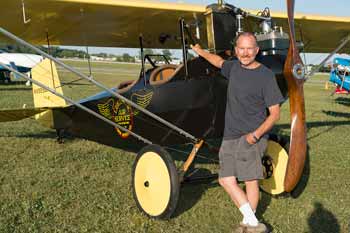
|
|
Dan Helsper created a little chunk of 1930 aeronostalgia with his Model "A" Ford powered Pietenpol. It was exactly how they would have done it back in the day. Hard not to love it! Photo: EAA: M. Kelly
|
Maybe part of the reason I airplanes like Helsper\'s Pietenpol is that right down to carving his own prop, it was totally created by the guy who flew it in. There were some magnificent antique and homebuilt airplanes on the grounds, each more perfect than the next, but few of them were done entirely by the owners.
Four days after OSH I left for Minneapolis/St. Paul for the wedding. That turned out to be almost as much fun and as interesting as Oshkosh. Several things stand out in no particular order. For one thing, no matter where I turned, I found myself immersed in a digital world.
I don\'t know how long it has been since I was in the Minneapolis airport, but I was IMPRESSSED!! Damn! You step out of the airplane and it\'s as if you just entered a gigantic restaurant in a massive shopping mall. Where there are generally lines of uncomfortable, nondescript seats, there were line after line of eating counters with iPads permanently attached. The iPads were not only computers that you could use at will but were menus that were magically hooked up to a number of"kitchens" scattered around. You selected what you wanted, paid for it via credit card, and in a few minutes a young lady walks up and hands it to you.
Then, when you transit the terminals to the baggage claim, you realized you\'ve covered a mile or two and never left the aforementioned mall. Everything is new, shiny and well laid out. The crowning miracle was that our bags beat us to the carousel. I almost fell over! That NEVER happens!
Then we hooked into Uber, yet another extension of new-millennium digital service. We typed in our destination, a blue dot gave our location, a computer somewhere found a driver closest to us and soon we were on our way to the hotel with a driver named Omar. He was Nigerian, an immigrant and he filled us in on his whole journey: applied for a visa while in Kenya, it was over five years before he was granted a work visa. Then five years after that he was allowed to apply for citizenship, which he did. Now he teaches in an elementary school and drives for Uber during the summer. That\'s the way immigration is supposed to work and he\'s a solid addition to our country. He wasn\'t asking for any favors and worked through the system on his own hook.
While all this was going on texts (which, four years ago, I swore I\'d never do but now live on) were flying back and forth between family members.
Two images keep coming to mind of the stay in the rather up-scale (for us) hotel: the first was the literally hundreds of Zombie-like people, mobs actually, in the park across the street spilling over into the thoroughfares on all four sides. They were totally oblivious to everything around them as they kept their noses to their phones playing Pokemon Go. This is a game where they try to capture or kill or something, little"things" their phone projects on the screen in front of them and they chase after it. It\'s a national addiction but this was the first time we saw it in action. It\'s actually a little disturbing to see everything from teens to middle-age people literally giving their lives up to a game and paying no attention to their surroundings. None!
The second image I thought unusual was that nowhere have I seen so many tattoos. The hotel had lots of weddings going on and we\'d constantly be running into brides and maids-of-honor in high-zoot dresses with tattoos covering almost every bit of exposed flesh. I\'m not talking about seeing it occasionally, there were full-sleeve tats on young men and women everywhere we went. The scene was like a cross between a church social and Sturgis.
The best part of the weekend, of course was family. Mine is scattered around every bit of the US, border to border in every direction, so it is seldom we get together. This time it was very warm and wonderful. And something both Marlene and I needed. I haven\'t seen my two sisters or their families for three years. Ditto just about every other relative at the shindig, so there was a lot of hugging and occasional tears. I got a lot of quality time with each of them, which, as the years pile up for all of us becomes increasingly important. It struck me that even some of my nieces are technically senior citizens. That, of course, mirrors back on me, letting me know I too am building up mileage. Maybe that realization is what made the weekend so special.
Life\'s first get-togethers are built on births, seeing a baby for the first time. Then it\'s events and graduations. Then weddings and anniversaries. Then a few grandbaby things. Then, before you know it, it all grinds to a halt at the final get-together that is minus one member. Knowing that\'s always hanging out there, it behooves every one of us to spend as much time as we can with those we love. And, if there are problems between family members, they should be worked out before we run out of time. It\'s a cliché but, clichés are clichés because of the truths they contain. So, saying"life is short" may well be the most underestimated cliché of all. There\'s always a last hug, so make them count. bd
22 July 16 - I\'m Headed for Sanity
I\'m going to miss doing a Thinking Out Loud for two weeks in a row, beginning right now. I\'m leaving the real world, politics and BS behind while I head up to Oshkosh for my yearly innoculation against reality.
Although I\'m leaving all this mess behind, I can\'t do so without a couple of passing comments about the last week. There were a couple of cop shootings, some terrorism in Europe and Donald Trump, as the old novelists used to say, "...strode upon the land." Yes, he made his mark, but not nearly as big a mark as his kids did. What a family!!!
I wasn\'t prepared for his 38-year-old, oldest son, Donald, Jr. What an incredibly polished, well thought-out speaker. AND HE DIDN\'T USE A TELEPROMPTER! All of his kids fit the same mold and, regardless of what you may think of The Donald and his style, one of the talking heads summed it up nicely, when he said, "You can\'t fake good kids." Quality shows and it has nothing to do with money or position.
The Donald himself spent an hour telling us everything that was wrong (which was a helluva lot) and what he was going to do to fix it. And everything he said was right. It\'s all wrong for the reasons he outlined. And his fixes sounded doable. However, there were so many things that need fixing and he has so many self-induced projects on his plate that I don\'t see how he can do even ten percent of them. However, even if he only does that much, he\'ll be miles ahead of anyone else who has held that position.
During the course of the week, between the convention and life happening, it became increasingly clear what an awful train wreck we\'re going to have if Billary gets into office. While The Donald is an unknown quantity, his agressive "Succeeding is everything" approach and attitude give me hope. Billary is NOT an unknown quantity. Whether you vote for her or not is a direct function of how you feel about where the country is going. If you like what\'s happening, you\'ll love her, because she\'s going to plow straight ahead not looking either direction.
One of the big differences between the two candidates, besides just about everything, is that Trump has an almost overwhelming love for the country that appears absolutely genuine. In fact, he seems genuine in most ways. Brash and sometimes hard to take, but genuine.
Every single thing Hillary does appears scripted. And every word and every move is being delivered by a second rate actor. Nothing about her appears genuine. Even if you totally ignore her 30 years of scandals, even if you had no idea who she is, she would come off as if she is being who she has to be for that particular occasion. She\'s been a politician for entirely too long and she no longer knows exactly who she is.
Much worse, I get absolutely no feeling of warmth or love of country from her. She gives me the very clear feeling that she is doing this because she wants the position, the power, the recognition. She\'s not convincing me that she\'s doing it because she wants to help set things right. In fact, she doesn\'t seem to think there is anything wrong.
Ignore the importance of the position she is seeking and try to picture her at the head of a local PTA or Girl Scout troop. She would be one of those know-it-all, better-than-thou leaders who make every one in the room uncomfortable because of the obvious condescention. She wouldn\'t be down in the dirt playing with the kids. I can, however, easily see The Donald doing that.
It\'s easy to take cheap shots at her based on the scandals and the obvious platform differences between the two parties. But, I don\'t think that\'s necessary whether it is warranted or not. The way I like to look at people is I try to imagine them suffering a badly broken leg and needs a place to rest up for about a month. Would I be comfortable having them in my home? In this case, I\'m positive I wouldn\'t be comforable because everything about her just strikes me "wrong." I can\'t put my finger on it, but there\'s something about her that tells me she\'s not who she wants us to think she is. And that\'s just a little scary.
Damn, looks as if I wrote a blog after all. Sorry, didn\'t mean to rant. bd
16 July 16 - Is This Our New Normal?
I refuse to believe that, as of today, the Orlando shootings took place barely a month ago. The weeks since have been so severely punctuated with escalating tragedies and unbelievable news events that our lives are changing daily and we\'re watching it all happen in real time on cell phone videos.
First, I have to blame another long delay producing Thinking Out Loud on yet another sick computer. Turned out to be a thoroughly dead monitor. So, it was around the 12th of July before I was back on line and during the three weeks that have elapsed since the last Thinking Out Loud, it seems as if the US has lost its mind. The world too!
First: the Week of Corruption
When so much news happens so quickly, it\'s easy for the fast-changing news cycles to cause some events to be forgotten much faster than they should be. For instance, the best thing that has happened for Hillary is that recent cop killings and terrorist events have been so overwhelming that we\'re already forgetting the facts that led up to her skating on all aspects of her e-mail scandal. This was something I predicted would happen because the fix was in. I just didn\'t think the background intrigue would be so obvious.
Monday: 27 June (two weeks after Orlando) Bill"casually" runs into Loretta.
Lemme see: she was heading for Colorado from the East Coast but for some reason stopped in Phoenix, which is about 600 miles due south of her destination. By sheer coincidence Bill\'s plane happened to be parked on the ramp too. And their meeting was so casual they asked everyone to leave the aircraft so, even though it is standard protocol for all meetings involving the Attorney General to be documented, this was not done. ‘Just talked about grand kids and golf. Yeah right!
Saturday: 2 July (Fourth of July Weekend), Hillary is interviewed by the FBI.
She was not under oath and no notes were taken. There is zero record of what she was asked or what she said. However, her comments were moot anyway because she wasn\'t under oath so she could lie and not be committing perjury. Then, to make sure there was no trail to follow, all agents signed a Non-Disclosure Agreement.
Tuesday: 5 July at 0900: Comey lets Hillary off the hook.
Somewhere in Washington there is a horse without a head: that wound up on Comey\'s bed. This all stinks to high heaven! However, Comey\'s findings, which he clearly stated, contradicted everything Hillary had said in public about the subject and will make great commercials for Trump.
The net result of these kinds of blatant backroom dealings is that we\'ve apparently entered America\'s third-world-country phase: corruption is rampant and will be accepted because we have no choice and even less recourse. A sad, maddening step in our decline.
Then, the Week of Tragedy
In re-reading what follows, I realized that I had left out some major events because there have been so many, I can\'t keep them all in my head. As you run through the following paragraphs try to keep the dates in mind. The rapidity with which things happened is amazing!
Tuesday: 28 June, Turkey Airport Bombing, 41 dead
Viewing it on TV, we have a tendency to look at terrorist attacks like these as something that only happens"over there". The Orlando massacre has told us otherwise. And then terrorism of another, closer-to-home flavor, began to take root.
Monday: 5 July the same day that Comey blessed Hillary, Alton Sterling was shot and killed by cops in Baton Rouge.
Tuesday: 6 July, the next day, Philando Castile, is shot by a cop in Minneapolis.
The investigations have yet to be concluded and the facts are still a little fuzzy, but that didn\'t stop the racial flames being whipped into a fire storm by the likes of Black Lives Matter. The news coverage of the protests had radicalizing effects on unstable individuals watching the coverage from the sidelines. There are those out there who hear things like"What do we want? Dead cops!" and, in their own sick minds, think that\'s a viable way of acting out their complaints.
Friday: 8 July: Three days later, Lakeem Scott, Bristol TN began randomly shooting at white people, one dead, more wounded
Sunday: 10 July (five days after Alton Sterling was shot), Micah Johnson snipes five cops in Dallas and wounds many others. The US goes into a frenzy of finger pointing. In the background you have activists like Louis Farrakhan, the leader of The Nation of Islam, urging guys like Johnson on. Read what Farrakhan said just a few hours before the Dallas shootings. http://www.theblaze.com/stories/2016/07/08/hours-before-officers-were-gunned-down-in-dallas-louis-farrakhan-posted-this-shocking-message-of-racism-and-violence/ . Chilling!
Since Farrakhan\'s rhetoric, and that of so many others, is clearly crafted to incite violence, I can\'t understand how he has gotten away with it for so long. The First Amendment definitely does NOT cover that kind of speech. He gave a speech in the ‘60\'s where I went to college and was shouting the same acid-filled phrases and that was nearly 50 years ago. That\'s a lot of hate. And he\'s made a lot of money from it.
Tuesday: 12 July, two bailiffs killed. This was tied to nothing but was just another bad event stuffed into the sequence of other sad cop happenings.
Thursday: 14 July, more terror in France. As I began writing this, the toll from the terrorist-driven truck in France was still climbing. It was 84 at last count with 52 on life support and a couple dozen critical. The President commented on it without pushing for gun control (sorry, ‘couldn\'t resist).
Friday: 15 July, the coup in Turkey is still taking place with no obvious conclusions in sight.
UP DATE ON COUP: It appears to have failed and commentators are saying a large reason why is because Ogedon had purged the top military ranks of any who weren\'t in lock step with him. Sound familiar? The net-net of this is that Turkey (the single most important country in the region and formerly a strong US ally) which has been prevented from becoming another hostile Islamic state will now continue its slide to becoming another Iran. Word is that he has cut power to our Air Base there and prevented any in or out traffic. Essentially, he is holding the base hostage and declared war against any who support or harbor Imam Gulen, whom he says was behind the coup. Gulen now resides in exile in Pennsylvania and Turkey is demanding extradition. The following link is worth reading.
I don\'t many of us on this side of the pond realize the importance of Turkey and what the failure of the coup means to the world.
http://www.express.co.uk/news/world/690106/Turkey-threatens-war-America-cleric-Gulen-military-coup
Sunday 17 July - OMG!! AS I WAS TYPING THE ABOVE, THE NEWS JUST CAME IN THAT AT LEAST 3 COPS HAVE BEEN KILLED!! - Baton Rouge, LA
We\'re in a state of war!
All of this has taken place in less than three weeks! The world, as a whole, has gone flat out nuts! Worse than that, here in the US we now appear to have a two-tier terrorist threat developing: radical Islamist/Jihadists and cop-killers. And I see absolutely no way to stop either because they are, for the most part, single individuals who themselves are psychological soft targets: they are sick in the head and easily influenced by inflammatory rhetoric. How do you root out some guy who is sitting in his bedroom watching ISIS videos or hyper-dramatic news coverage of events that play to their mental disabilities? You can\'t. And these kinds of individuals are not necessarily of any specific religion, sex or race. Mental instability is universal and easy to tilt in a bad direction. I just hope this isn\'t an organized effort. That will change the equation entirely. Also, I\'m afraid the French terror truck has set an example for copy cats everywhere making mass murder easy. About all we can do is be aware of our surroundings and be ready to act immediately.
I\'m afraid we may be turning the corner into a new normal. bd
25 June 16 - Too Much News!
This week an absolute glut of news meant that too many little happenings were overshadowed by big ones. So, I\'m going to mention a few that should have gotten more attention than they did and comment on big ones that got more attention than deserved (In my opinion).
And Then There Was One
One of the more important events that happened with little or no fanfare was the passing of Staff Sgt. David Thatcher, 94, of Missoula, MT. We are losing WWII vets at a frightening rate but the loses are generally judged against the total population of vets, not against a small, limited population. When Thatcher died, that left exactly one of his fellow Doolittle Raiders, Lt. Col. Richard"Dick" Cole, 100, to represent the 80 volunteers who, not even five months after Pearl Harbor, did the impossible: against overwhelming odds they let Japan know they were not as invincible as they thought they were. The boost to US morale was incalculable. Thatcher was engineer-gunner aboard Captain Ted Lawson\'s airplane, the famous"Ruptured Duck." Their story was told in Lawson\'s book,"Thirty Seconds Over Tokyo", and later made into a movie. Surviving Raider, Dick Cole, was Doolittle\'s co-pilot. All of the other supposedly momentous happenings of the past week pale beside Thatcher\'s passing and what it says about the warrior generation that is disappearing before our eyes.
The Supreme Court Versus the President
For the umpteenth time, SCOTUS told POTUS,"No, that\'s not within your power to do." This time it was when they struck down his attempt to essentially legalize 5 million illegal aliens. That was a major loss to him and a major win for the Constitution. The President only has the powers which are given him by Congress in such situations and they didn\'t.
What hasn\'t been discussed much, however, is that a Congressional okay for limiting immigration does exist in Section 212(f) of the Immigration and Naturalization Act (https://www.law.cornell.edu/uscode/text/8/1182). The act specifically says that, if a given segment of immigrants/aliens poses a perceived threat to the US, the President can keep all aliens from a given region or with particular traits out with the stroke of a pen. That might come in handy. To read more: http://dailycaller.com/2015/12/08/host-obama-has-legal-power-to-suspend-muslim-immigration-if-he-wanted-to-video/#ixzz4Cba2X4hG
This Seems Like a Really Bad Idea
Apparently the Administration is getting ready to shift control over parts of the Internet to an international concern in which entities like Russia and China are major players. Go here for details. http://www.theblaze.com/stories/2016/06/24/cruz-obama-proposal-puts-internet-freedom-in-hands-of-russia-china/?utm_source=Sailthru&utm_medium=email&utm_campaign=Firewire%20-%20HORIZON%206-25-16%20FINAL&utm_term=Firewire
Brexit
Let me get this straight: Britain was a major world player as a sovereign nation for hundreds of years before joining the European Union in 1973. However, her dropping out to again function as a sovereign nation means the sky is falling around the world. I\'m certain I\'m missing some of the finer points here but it appears to me that, after the initial shock wears off and all of the entanglements with the EU are sorted out, that things will return to pre-EU normal.
To me, the entire concept of the EU, in which an external, non-elected central governing agency can tell all of the member nations how to run their internal affairs is total BS. Who wants to give control of their country over to vague, mostly invisible"managers" who have no connection to that country. If for no other reason than immigration, Britain needs to re-establish its borders to get the invasion that\'s in progress under control. This is true for all EU members, all of which are suffering horribly under the borderless, free immigration policies of the EU.
Gun Control Sit In...No Fly, No Buy and Due Process
When was the last time anyone saw the ACLU on the same side as the NRA? Like NEVER! But, that\'s the case with the Congressional Sit-in. In what amounts to a petulant display of naiveté, members of Congress are sitting around thinking they\'re carrying on Dr. King\'s non-violent form of protest but aren\'t even coming close. This is really silly!
First, let me say that with certain modification I\'d agree that if a person is on a No Fly List or a Terror Watch List, they shouldn\'t be allowed to purchase a weapon. The modification would include making sure the individual involved has due process available to him/her just as it is everywhere else in our law.
There is no due process connected with the lists. Which is unconstitutional under a number of Amendments. As those lists are now set up, an individual has limited recourse, should they find themselves on the list, and can\'t even determine why they are on the list or who put them there. They won\'t know the name of their accuser. Thousands of absolutely"normal" people have found themselves on those lists and then find that getting off of the list is damn difficult. Even worse, they aren\'t notified when they\'re put on the list. It pops up when they try to fly so they are stranded at an airport with no way to solve the situation. Zero!
Those sitting on the floor of Congress are pushing a concept that I don\'t think they totally understand. Or, more likely, they don\'t care. They just want guns kept out of people\'s hands and the unintended consequences be damned.
This all needs more thought given to it before an elected official, all of whom supposedly deserve a certain amount of respect because of their position, makes a fool of themselves by camping on the Chamber\'s floor.
Declaration of Independence
July Fourth, Independence Day, is just around the corner and I\'m giving you a reading assignment in preparation for it. When was the last time you actually read the Declaration that the Fourth celebrates? If you\'re like most of us, it might have been in high school. Or possibly never. We just know it exists. I hadn\'t read the Declaration of Independence since a kid but did earlier this week and it was something of a shock. It is impossible to read it in this day and age and not put major portions of it in the context of modern times rather than colonial times. Read it: it\'s where we came from and holds some truths about where we\'re going.
http://www.archives.gov/exhibits/charters/declaration_transcript.html
Did anyone notice I got all the way through this without mentioning Trump? Or Hillary? Refreshing, isn\'t it? bd
19 June 16 - Orlando, ARs, Trump and our Future
A week ago today, unknown to me as I was writing Thinking Out Loud about aging airplanes, an incredible tragedy had happened in Orlando. I thought about writing about it but decided to give it a week to percolate to see where it went. And it is the Post-Orlando happenings that have me scared.
Tomorrow, 8 days after the events in Orlando, only a few days after the identities of all 49 deaths were known, the Senate is voting on banning AR-15\'s. When was the last time the Senate did anything that fast? ANYTHING? That kind of knee-jerk speed seems to typifies things these days.
It is no exaggeration to say that all of those bodies hadn\'t cooled to room temperature before the predicable sources started screaming for gun control. Much, much worse, they started pointing fingers at political entities who were said to have caused it with their Republican rhetoric and not a word was said about those who lost their lives. Or their families, loved ones, and friends. By Sunday night every possible news or opinion outlet had thoroughly trounced the Right and totally ignored the magnitude of the loss or the ISIS-linking words and texts sent out by the shooter. With his own words connecting him to Islamic radicalism, the Left was saying he was something he was not: a disenfranchised, mentally unstable, homophobic who should not have had a gun and it all somehow traces back to the Right. They are wrong. No one is to blame here except radical Islam.
First, I agree, he shouldn\'t have had those guns. Especially after having been under suspicion by the FBI (TWICE!). To get the handgun, he had to pass an FBI background check but apparently the FBI background checks don\'t interface with FBI Investigation data. Yes, I know they investigated him and found nothing wrong, BUT, they wouldn\'t have been investigating him, if something wasn\'t wonky enough to worry about arming him.
As much as I hate to admit it, I think background checks do need to be somehow cleaned up, but that\'s a very slippery slope. Who for instance who decides someone is mentally incompetent? What is the definition of"security risk" and who defines the definition? Inasmuch as lots of normal people mistakenly wind up on no-fly lists and getting off the list can be a pain in the butt, is that a viable barrier to gun ownership? Initially, I\'d say yes, but....
First, before addressing the whole AR-15 thing (incidentally, he apparently didn\'t use an AR. Reportedly it was a Sig Sauer, much more expensive and functions differently but has the same look) I should point out that I personally own no ARs. I don\'t like them. Just not my kind of weapon, although I do own some semi-automatic battle rifles. However, I guarantee that what is likely to come out of the whole the-gun-is-the-problem thought pattern are rules that pretty much parallel what California already has in place. The focus will be on semi-automatic weapons that feature detachable, box type magazines, which obviously can be expanded to any capacity. This effects a huge number of rifles and even makes the lowly Ruger 1022 .22 an"assault rifle." The facts attached to the ‘90\'s assault rifle ban show no decrease in crime, but when knee jerk political reactions are in play, when do facts matter?
The net result of draconian gun laws will be turning totally law abiding citizens into criminals because many, probably a majority, won\'t obey the law. Look at Connecticut which totally banned ARs. Reportedly approximately 10% to 20% of the total thought to be in the state were turned in, sold or accounted for. So, a large cadre of citizens became criminals rather than comply. There are reportedly five million (!) ARs in the country. That\'s about 1.5 for every 100 citizens (man, woman and child) or about one for every seven males between the ages of 20 and 75. That\'s impressive as hell!
Howard Stern, who has never been thought of as a paragon of Conservative thinking said,"So your response to them using a gun to kill us is to take away our guns." There\'s some inescapable logic there that leads a discussion of the concept of Gun Free Zones. Go back and look at all of the mass shootings over the last few years and you\'ll find that nearly all of them were in gun free zones. And why wouldn\'t they be? If you\'re a bad guy looking to cause deaths, you don\'t want any competition. Even Florida, which has pretty decent and logical gun laws says that CCWs can\'t carry in a place that serves alcohol. Which is logical on the surface. However, AZ lets CCWs carry in bars but they can\'t drink and there have been no reports of problems. Approximately 3% of the total population of AZ has a CCW. If that same percentage holds true in Florida, there could have been at least nine people in the Orlando crowd that could have offered resistance to the shooter had it not been a gun free zone.
Gun Free Zones, along with all other gun control measures, are obeyed only by lawful citizens. Outlaws, nut cases and terrorists of all stripes not only ignore them, but champion them. Gun laws make it easier for bad guys to accomplish their evil deeds.
As for the concept of Radical Islamic Jihads and immigration: it\'s really sad when you see the recommendations of leading law enforcement officers of the country (FBI, CIA, DHS, etc.) being totally ignored by the Administration. The experts have stated categorically that any refugee population is impossible to vet and will absolutely include a percentage of ISIS plants. ISIS has even said as much. What else do you need to know?
We\'re going to have our hands full just with radicalized American citizens, like the Orlando shooter, without importing more terrorists who are trained for the purpose. For that reason, it is nothing short of amazing to see politicians point out Trump as being a racist because he\'s proposing a temporary hold on accepting refugees from terrorist nations until we get our processes in place. Like he says,"Let\'s wait until we know what the hell we\'re doing." A totally logical thought pattern that has caused him to catch an incredible amount of grief. Trump was not my first choice and I really wish he would talk less than he does, but there is so much logic in an immigration/refugee moratorium. Why are"they" resisting it?
It doesn\'t take much imagination to see where we are headed: we are joining the rest of the world in which terrorist attacks are just a fact of life because we\'re importing them, our borders don\'t exist, and the Internet knows no obstacles. Whether we want to or not, we\'re going to have to develop a certain amount of"wild west" mentality and conduct our lives accordingly. The Boy Scouts were right when they adapted"Be Prepared" as their motto. We should do the same. bd
12 June 16 - Airplanes Can Make us Feel Old
I\'m about to make everyone reading this feel old. Some more than others. This is because I just put together an issue of Flight Journal and part of it is a salute to the aircraft and pilots who presently make up our Armed Forces. Finished, I suddenly realized how so much stuff I think of as new definitely isn\'t. So, neither am I.
First, before I give you the answers, I want every av-guy to guess (no cheating and looking them up) how old the aircraft on the list below of current USAF/USN combat aircraft are. Grab a pencil and scribble them down. I\'m doing them alphabetically, not by age.
-A-10 Thunderbolt II
-B-1 Lancer
-B-2 Spirit
-B-52 Stratofort
-F-15 Eagle
-F-16 Viper (or Falcon, your call)
-F-18 Hornet
-F-22 Raptor
If you\'re even remotely like the rest of us, you\'ll get in the right decade on one or two (B-52 probably) but that\'s about as close as you\'ll get. Because of Flight Journal, I spend a large portion of every day messing around with aircraft history and, when I compiled the foregoing list, I wasn\'t even close on anything but the Buff (B-52). And I suddenly felt very old because aircraft I have always thought of as being new, or at least newish, aren\'t.
Here are the ages since their first flight.
-A-10 Thunderbolt II...44 years
-B-1 Lancer...42 years
-B-2 Spirit...27 years (that\'s un-frigging real!)
-B-52 Stratofort...64 years (every crew member is now younger than their airplane and they expect at least another 20 years out of it!!)
-F-15 Eagle...44 years (I wasn\'t even close!)
-F-16 Viper (or Falcon, your call)...42 years (Ditto)
-F-18 Hornet -38 years (super Hornet is 21 years)
-F-22 Raptor...This will kill you...19 years!! (How can that possibly be?!)
I don\'t know about you, but I find some of those numbers, especially the newer aircraft, to be almost outlandish. The F-15 at 44 years?! Damn! And it\'s still one of the very best. An F-16 at 42! The Hornet is such a new kid how can it be approaching middle age at 38 years? And I remember so clearly the awe-inspiring photos of the prototype F-22. Man, that was the razor edge of technology. I had no idea that was nearly 20 years ago. Double Damn!!
Think how many leading edge airplanes have come and gone in the meantime. I thought the F-117 Nighthawk had so much Star Wars technology in it that it would last forever. It was another of Lockheed\'s super-secret projects that didn\'t surface until actually operational. It has been gone for eight years (It lived 27 years). The F-111 Ardvaark was supposed to be all things to all services. It lasted 30 years but didn\'t make much of a mark. Almost none of the Vietnam era designs are still in inventory.
Incidentally, the development period on almost every airplane listed ran 2-4 years from inception to first flight and another 2-4 years before going into service. The F-35 was more than a decade getting to its first flight in late 2006. Nine years later, although"they" say it\'s operational, they also say it\'ll be another two years before it can fire its guns because of software problems. Every month news comes out about this or that software or hardware problem is keeping it out of combat zones. It\'s also by any measure, the most expensive aircraft acquisition the US has ever experienced. And it doesn\'t work!
Then there\'s the hyper old -52 that is still the answer to serious bombing and the F-15 and F-16 that still carry on the dual roles of ground attack and air superiority. Same thing for the Hornet. The A-10, of course, may be ugly, but it\'s the hammer that consistently hits the ground support role nail right on the head. And"they" say the F-35, which, according to Warisboring.com, costs between $148 and $337 million (USN F-35C) is going to take over the role of the old A-10 Hawg. What are"they" smoking?! Besides the fact that the F-35 doesn\'t work and isn\'t going to work anytime in the near future, it would be cheaper to drop huge bails of hundred dollar bills on the bad guys with dating service 800 phone numbers attached. Try to introduce them to the concept of luxurious living and take them out of the fight rather than risk a single rifle bullet punching a hole in an onboard computer and downing the government\'s shiniest new toy (and its pilot).
So, now that I have successfully depressed myself, I\'m going to go bang on The Roadster and put a little logic back into my life. bd
29 May 16 - The Future is Now
Lately I\'ve been feeling a little overwhelmed by the overall progression of everything. Be it time, age, deadlines, etc. But, the blinding acceleration of technology is especially overwhelming and, even though I\'m as tech-savvy as most gray dogs ever get, it is threatening my peace of mind. It appears, however, that I\'m not alone in that.
What follows is not mine. It has been circulating around the Internet for the last couple of weeks and does an excellent job of summarizing the overall effect of technological advance. It\'s longer than the usual Thinking Out Loud, but I think it is all necessary. Unfortunately, it\'s just a little scary. Especially for coming generations.
I\'d like to credit this to someone, but have not been able to track down the author. However, I\'m familiar with many of his points, so I know most of it is valid. If anyone knows where this came from, let me know so I can attribute it.
In 1998, Kodak had 170,000 employees and sold 85% of all photo paper worldwide. Within just a few years, their business model disappeared and they went bankrupt.
What happened to Kodak will happen in a lot of industries in the next ten years - and most people don\'t see it coming. Did you think in 1998 that three years later you would never take pictures on paper film again?
Digital cameras were invented in 1975. The first ones only had 10,000 pixels, but the digital concept followed Moore\'s Law that basically says that data density in computer stuff will double every 18 months. So, as with all exponential technologies, the digital camera was a disappointment for a long time, before it became far superior and became mainstream in only a few short years. The same thing is now happening with Artificial Intelligence, health, autonomous and electric cars, education, 3D printing, agriculture and jobs, and everything that involves any kind of technology. Welcome to the Fourth Industrial Revolution. Welcome to the Exponential Age.
Software will disrupt most traditional industries in the next 5-10 years.
For instance, Uber is just a software tool, they don\'t own any cars, and are now the biggest taxi company in the world. Airbnb is now the biggest hotel company in the world, although they don\'t own any properties.
Artificial Intelligence: Computers are becoming exponentially better in understanding the world. This year, a computer beat the best Go player in the world, 10 years earlier than expected. In the US, young lawyers already have problems getting jobs. Because of IBM Watson, you can get legal advice (so far for more-or-less basic stuff) within seconds, with 90% accuracy compared with 70% accuracy when done by humans. So if you study law, stop immediately. There will be 90% fewer lawyers in the future, only specialists will remain. Watson already allows nurses to diagnose cancer, four times more accurate than human nurses. Facebook now has a pattern recognition software that can recognize faces better than humans. In 2030, computers will become more intelligent than humans.
Autonomous cars: In 2018 the first self-driving cars will appear for the public. Around 2020, the complete industry will start to be disrupted. You don\'t want to own a car anymore. You will call a car with your phone, it will show up at your location and drive you to your destination. You will not need to park it, you only pay for the driven distance and can be productive while driving. Our kids will never get a driver\'s license and will never own a car. It will change the cities, because we will need 90-95% fewer cars for that. We can transform former parking space into parks. 1.2 million people die each year in car accidents worldwide. We now have one accident every 100,000 km, with autonomous driving that will drop to one accident in 10 million km. That will save a million lives each year. (BD NOTE: I think this will only apply to large cities.)
Some car companies might go bankrupt. Traditional car companies will try the evolutionary approach and just build a better car, while tech companies (Tesla, Apple, Google) will do the revolutionary approach and build a computer on wheels. I spoke to a lot of engineers from Volkswagen and Audi; they are completely terrified of Tesla.
Insurance companies will have massive trouble because without accidents, the insurance will become 100x cheaper. Their car insurance business model will disappear.
Real estate will change, because, if you can work while you commute, people will move further away to live in a more beautiful neighborhood.
Electric cars will become mainstream by 2020. Cities will be less noisy because all cars will be electric. (BD doubts that)
Electricity will become incredibly cheap and clean: Solar production has been on an exponential curve for 30 years, but you can only now begin to see see the impact. Last year, more solar energy was installed worldwide than fossil. The price for solar will drop so much that all coal companies will be out of business by 2025. (BD: optimistic time frame?)
With cheap electricity comes cheap and abundant water. Desalination now only needs 2kWh per cubic meter. We don\'t have scarce water in most places, we only have scarce drinking water. Imagine what will be possible if anyone can have as much clean water as he wants, for nearly no cost.
Health: The Tricorder X price will be announced this year. There will be companies who will build a medical device (called the "Tricorder" from Star Trek) that works with your phone, which takes your retina scan, your blood sample and you breath into it. It then analyses 54 biomarkers that will identify nearly any disease. It will be cheap, so in a few years everyone on this planet will have access to world class medicine, nearly for free.
3D printing: The price of the cheapest 3D printer came down from $18,000 to $400 within 10 years. In the same time, it became 100 times faster. All major shoe companies started 3D printing shoes. Spare airplane parts are already 3D printed in remote airports. The space station now has a printer that eliminates the need for the large amount of spare parts they used to have in the past.
At the end of this year, new smart phones will have 3D scanning possibilities. You can then 3D scan your feet and print your perfect shoe at home. In China, they already 3D printed a complete 6-story office building. By 2027, 10% of everything that\'s being produced will be 3D printed. (BD: he has underestimated here. 3D is already making major metal components like five-foot pipeline valves).
Business opportunities: If you think of a niche you want to go in, ask yourself: "In the future, do you think we will have that?" and if the answer is yes, how can you make that happen sooner? If it doesn\'t work with your phone, forget the idea. And any idea designed for success in the 20th century is doomed to failure in the 21st century.
Work: 70-80% of jobs will disappear in the next 20 years. There will be a lot of new jobs, but it is not clear if there will be enough new jobs in such a small time. (BD: in other words unemployment is going to be a problem).
Agriculture: There will be a $100 agricultural robot in the future. Farmers in 3rd world countries can then become managers of their field instead of working all day on their fields. Aeroponics will need much less water. The first Petri dish-produced veal is now available and will be cheaper than cow produced veal in 2018. Right now, 30% of all agricultural surfaces is used for cows. Imagine if we don\'t need that space anymore. There are several startups who will bring insect protein to the market shortly. It contains more protein than meat. It will be labeled as "alternative protein source" (because most people still reject the idea of eating insects).
There is an app called "moodies" which can already tell in which mood you are in. By 2020 there will be apps that can tell by your facial expressions if you are lying. Imagine a political debate where its results are being displayed when the candidates are talking.
Bitcoin will become mainstream this year and might even become the default reserve currency.
Longevity: Right now, the average life span increases by 3 months per year. Four years ago, the life span used to be 79 years, now it\'s 80 years. The increase itself is increasing and by 2036, there will be more than one-year increase per year. So we all might live for a long long time, probably way more than 100. (BD: with our current limited medical and social services, a slow die-off would be a disaster).
Education: The cheapest smart phones are already at $10 in Africa and Asia. By 2020, 70% of all humans will own a smart phone. That means, everyone has the same access to world class education. Every child can use Khan Academy for everything a child learns at school in First World countries. We have already released our software in Indonesia and will release it in Arabic, Swahili and Chinese this summer, because I see an enormous potential. We will give the English app for free, so that children in Africa can become fluent in English within half a year.
For more info about the future see: http://thefutureishere.economist.com/
So, what\'s the takeaway from all of this? I read it as the following: While there are bound to be tons of as-yet-unidentified jobs, if you seriously want your kids to have a job in the future, tell them to become a plumber or something similar. Many trade skills will never be automated and will always generate good income. Plus, you don\'t have to wear a tie to work! bd
15 May 16 - Rambling: Life and the Art of Luck
Yesterday I had a really interesting and fun lunch with a couple of guys who were part of making history. One retired as a Rear Admiral the other as a USN Captain and both were fighter pilots beginning in 1963 right through Vietnam and all of the major fracases for the next 25 years. One lead the Blue Angels (among other things), the other was a test pilot and CO at Top Gun, and they covered everything in between.
Since they\'d both known each other since flight training, they flew formation on each other\'s comments weaving an excited, non-stop peek into a community that the rest of us can only view from afar.
It\'s a fact, that just like none of us will ever have meaningful conversations with a vet who has experienced hard combat, if you\'ve never been a fighter pilot, you can\'t actually be part of their conversations either. They lived in a world we can\'t truly understand, no matter how many times we watch Maverick and Goose play the roles. And a major part of their souls still lives in that world, regardless of how many years may have elapsed since their last military flight. Just as there is no such thing as an ex-Marine, a fighter pilot will be a fighter pilot until the first shovel full of dirt hits him in the face. And I\'m jealous!
Right out of high school, I had a USN college scholarship (I was a USMC option heading for flight training), but lost it because I\'m color blind. This essentially took me out of any military flying program. The only one open would have been as a Warrant Officer flying choppers, but by this time it was 1965 and it was obvious this wouldn\'t have been what I wanted in terms of flying. Since that time, I\'ve been fortunate enough to have lived a dream life, when it comes to aviation, so I don\'t actually regret not living out my fighter pilot fantasies, even though they had been a dream since a toddler. Still, there are times when I think it would have been soul-satisfying to be part of that community. However, as I see how I developed both as a pilot and as an individual, I wouldn\'t have faired well in the military.
I most definitely don\'t see myself as an individualist, rugged or otherwise. However, looking back at my track record during the last nearly half a century (W-2 income for only two years), it\'s obvious I don\'t function well within the restrictions of an organized existence. I don\'t totally understand why and can\'t explain it any more concisely than that. It\'s not that I don\'t play well with others. I do. But, somehow I feel better doing my own thing. Which is both limiting as well as totally open ended. It means zero security while at the same time offers unlimited opportunity to expand at your own rate. And I know I\'m not alone in this thought pattern. A lot of folks, without consciously thinking about it, feel the same way. Among other things, this is what gives rise to small businesses.
I\'ve probably talked about this before, but I would love to see a study done on self-employed people to see how many were raised in households where the parents were also self-employed. That was the way I was brought up and none of the four Davisson kids went out and got jobs. They all did their own thing. Why?
I theorize that, when your adolescence is built around seeing mom and dad working for themselves, several basic concepts alter your view of life. The most important one is the concept of"security." Our view of security isn\'t built around a job guaranteeing an income. In our view, security hinges on our ability and willingness to hustle our butts off because we know the next dollar is going to come in the door only if we get out there and look for it. There is no such thing as"free" time. Especially, if you\'re doing"piece work," e.g. a carpenter, electrician, etc. A free-lance anything means, if you\'re not working, you\'re not making money. So, you\'re very jealous of your time.
The risk of failure, when working for yourself, is high and is always dogging you. You know that risk can only be mitigated by hustle. However, when you\'re brought up in that environment, this is the norm. The concept of a regular paycheck is the anomaly. And this is the basis for those who start any business, large or small.
The foregoing is why our President pissed off so many people last week, when he made such a big deal out of the role luck plays in successful business enterprises. His tone ("...this is one of my pet peeves.") clearly said that if it hadn\'t been for luck, none of you would have succeeded. None of you. In truth, to a certain extent, he is right. But, there is luck and then there is luck.
So much of life is built around being at the right place at the right time, but this ignores some basic facts. Most important of those is that you can easily be in the right place at the right time (luck), but, if you don\'t have the right skills, the right attitude, the right product, the right amount of hustle, that opportunity is going to sail right past you because you weren\'t capable of capitalizing on it.
To very large extent, we manufacture our own luck by developing our skills and expanding our capabilities so we are always ready to take advantage of the right opportunity, when we stumble across it. Or, more likely, when we look at a market, we realize what it needs, and configure our skills to supply that need at a profit. Whether we\'re a one-man show, like I am, or a gigantic corporation, the basic concepts are always the same and they always carry the same risk of failure: read a market and supply a need. Or, in the rare cases like Steve Jobs, Bill Gates, etc, through a flash of genius, coupled with unreal hustle and market savvy, create your own market through innovation.
Whatever it is that spurs people to strike out on their own and create their own luck, we owe many aspects of the life we live to them and their willingness to take on risk. And that, Mr. President, is what successful business are based on. bd
7 May 16 - It\'s Trump, Deal With it!
This past week has been borderline silly: you can\'t turn on TV, talk to a friend, or walk down the street without hearing Trump being bandied about. Some act as if any minute the Earth is going to open up and swallow us all. I\'ve never seen this much panic in so many flavors, from so many people I\'ve respected in such a short time. If it weren\'t so serious, it would be hilarious.
I want to get out of here and finish fabricating the windshield wiper mount for The Roadster (a man has to have his priorities), so what follows is just a random collection of observations on the silliness. Then I\'m going to give/direct you to some analysis from a couple of good sources that give different views on the subject. Also, just for the record, I would have preferred Cruz, but it\'s not, so I\'m behind Trump, as all Conservatives should be because, if nothing else, he\'s not Hillary.
More than anything else, I think everyone concerned needs to stand back and give the situation time to breathe and settle down. Right now, we have absolutely zero idea what Trump is going to do during the campaign and how he is going to mature. Or not. He\'s unpredictable and that may be his most valuable asset as a President. In addition, the fact that the RNC hates his guts is a plus. We need something new and we wouldn\'t get it if the RNC had its way.
Incidentally, where do people like Speaker-of-the-House Ryan, get off saying they can\'t support Trump? What they are saying is that "We don\'t care what the voters want, we don\'t agree with them." If that\'s not the definition of "Political Elite" I don\'t know what is. The insiders have drifted so far from doing what they were elected for that the entire election process means nothing, which seems to be the DC way these days. Hearing Obama and Clinton both swear they are going to get rid of guns, for instance, is them perverting the Republic to a monarchy. It\'s not their job to make laws or interpret the Constitution. It\'s their job to enforce it.
As far as Trump goes, Burt Rutan, clearly the world\'s most innovative aircraft designer, ALWAYS starts with a clean sheet of paper when he approaches a problem. Rather than coming at it in an evolutionary, what-did-we-do-before, manner, he looks at the facts and the goals and works out ways to make them fit. Coming out of a business background, I\'m thinking Trump will do a similar thing and, like Burt, he\'ll surround himself with the best and brightest, rather than those who are clones of himself. He\'s going to"captain" a team, not"be" the team, which has been Washington\'s \'s trademark. That\'s a business-like approach and it\'s about time we run the government in a business-like manner rather than as a political fiefdom.
And speaking of Burt, what follows is an e-mail he forwarded that came from Brent Regan, whom he considers to be one of the smartest people he knows. Coming from Burt Rutan, clearly one of the, if not THE, smartest person I\'ve ever met, that is high praise. I\'m pasting the e-mail below. Then, below that you\'ll see a link to one of the better, new perspectives I\'ve read.
Brent Regan wrote:
Friends keep asking my thoughts about Trump. Here they are:
I like Ted Cruz, and I also like Trump, but for completely different reasons. In my experience, as a manager, I have found that if you look for a person\'s talents and then find a way to apply them, then success will be close at hand. Cruz and Trump have completely different skill sets but they are both very good at what they do.
I had arrived at the conclusion that Trump would win the nomination back in December because I could see Trump\'s skill set and how he was applying it to the task. My experience in business allowed me to recognize Trump\'s marketing and negotiation techniques, which caused me to read"The Art of the Deal" and conclude that Trump was approaching the problem in a way that is never (rarely) done in politics. As a consequence, his opponents have no effective defense. His victory was assured before the battle was fought. Very Sun Tzu!
I told my close friends that Cruz was who I wanted to win but Trump was who I thought would win based on a reasoned analysis of the situation. First you must understand that, as Scott Adams points out, reason is what we think we use to make decisions but emotion is what we actually use most of the time.
Now, here is where I make some people angry: if you are in the"never Trump" camp you have made that decision based on emotion and not reason. You may wrap it in"reason" and call it"principled" but what you are saying is that your mind is made up and there is NOTHING, no new information, which would cause you to reconsider. This is, by definition, irrational, which is the inability to make a rational choice based on all information. It is especially egregious when you consider that the information you DO have is deeply flawed and incomplete: it has been carefully filtered by the media for optimal shock value.
If you watched a modern interpretative dance without music or sound, you may well conclude the dancer was having some kind of seizure and perhaps suffering some pain or disease to cause such unnatural motions. The truth would be hidden because you lacked all the information. Because Trump was being viewed through a distorted political"lens" HIS actions were equally incomprehensible. In the struggle to explain the situation, many offered ridiculous comparisons; He is Hitler, he is working for Hillary, he\'s a bigot, and he hates women, on and on. This was fueled by the media that feeds on controversy, while Trump used this need to serve his own purposes. He OWNED Fox news. Even Meghan Kelly got a Trump haircut.
Hillary doesn\'t stand a chance against Trump because Trump will hollow out all the moderate democrats and men. It isn\'t going to be pretty to us conservatives but there is a big blue pile of democrat electoral votes and Trump is going after them so gird your loins, it\'s going to be a tough ride.
The good news is that Trump is the asteroid that we need to kill the political dinosaurs and the smart, successful, productive conservatives will be able to fill the void. It is a long game but it has a happy ending.
A Cruz victory would be a happy beginning but the consequences of eight years of BO would ultimately come crashing down on"THE CONSERVATIVE", forever stigmatizing conservativism as the thing we were doing when the crash happened. I cannot imagine the media, the liberals and the establishment not scapegoating conservatives. Better to have Trump in the breach when the wave hits.
Will Trump make a good president? It\'s impossible to say with certainty. I do think it is highly likely that a Hillary or Bernie presidency would be VERY bad for our prosperity. Therefore, I\'ll take my chances with the successful billionaire who is the product of using persuasion in the free market rather that a socialist who uses the lethal force of government and the power of the mob to coerce the people.
Finally, stop heaping all your expectations in one spot. Government is the product of our culture, not the other way around. A president can\'t change the morality of a nation, nor should he. Our Republican government requires a moral people and THAT starts with you and me. We don\'t get to offload that responsibility to some guy living in a white house.
Of course I could be wrong and, with new information, I could change my views.
Brent
Nicely said, Brent.
Now, click on the below for an unexpected point of view.
George Will vs Edmund Burke
30 April 16 - Sometimes Sleep Ain\'t Easy
This probably falls into the category of TMI: Too Much Information. But, I accidentally slept eight hours last night, I feel like crap and I feel like doing a little good natured bitching. Sorry!
First, the whole concept of eight hours of sleep being healthy was invented by someone with a different body clock than mine. I can\'t do it. At six to six and a half hours, my body clock goes off and I can\'t stay asleep no matter what. This morning I tried. And it didn\'t work. In fact, all it gave me was two more not-quite-asleep, dozy hours punctuated with crazy dreams and a lot of time to reflect on sleep itself and the many details that often constitutes sleep. I doubt if my sleep is much different than anyone else\'s. It\'s just that I had two hours to reflect on it while in the throes of a worthless sort-of-sleep and it pissed me off so I want to vent.
It used to be sleep was easy. Lay down, close your eyes, open them and its time to start another day, all perky and ready to face the world. Actually, I think I just lied...I don\'t think I ever slept eight hours. The only thing in my sleep patterns that has changed over my life is that, when I moved to AZ and was running a manufacturing facility that started work at 0530, I purposely reset my body clock to be on deck at 0500. This was a big deal because it goes against my natural patterns.
I once read a study that said we all have two energy peaks during the day (this is a little like bio-rhythms) during which we\'re sharper and better at doing what we do. This is what determines whether we\'re morning or night people. Examine how your days progress and I\'m certain you\'ll see that\'s true. You\'re more capable at some times than at others.
My peaks are very obvious, one at about 4:30 PM and another around 10 PM. For that reason, until I moved out here, I was always a night owl. I wouldn\'t even try to do productive writing, for instance, until the late afternoon and the best stuff was done between 10 pm and midnight or 0100. But, I wouldn\'t get up until 0700-0730. And when my feet hit the floor I was a borderline zombie.
Some of the above may have been influenced by the three years, while in college and graduate school, when I had so much crap to do (school, playing clubs, rebuilding 195 Cessnas, traveling to out of state gigs, etc.) that part of my routine was to stay up all night three times a week so I had three 48-hour days. I have no damn idea how I managed to both survive and graduate. It tires me out to think it.
Today, I play to the brain-energy peaks by trying to do most of my creative writing late in the day before and after dinner. I do the editing and planning early in the morning, when I seem to be better at mechanical stuff but creative juices aren\'t flowing as well. Early, I can generally force a little trickle to come out (it\'s now 0645) but it\'s not the"good stuff." Of course, at least two dual hops in the little red airplane punctuate the day and, when I fly four hops (two students), all bets are off because I\'m so beat up by the end of the day my brain is nearly flat lined.
Anyway, this morning, when I was phony-sleeping and kept re-analyzing sleep (a totally counter-productive endeavor, while you\'re trying to sleep) I came up with a list of things that affect the quality of my sleep and I\'ll bet most would be on your sleep-list too. Maybe not.
- Peeing...If I drink a normal amount during the day, I pee once or twice, if I\'m really buried in writing, I drink too much and may be up four times.
- Good Ideas...I try not to think, when I\'m peeing because, if I get a good idea, it keeps me awake thinking about it.
- Sharing a Pillow...Sháhn-deen often has one end of my pillow, which is no problem until I roll over, which is often.
- Underwear Creep (TMI for sure)...why won\'t it stay in one place?
- Cat with no Conscience...Meezer, who is a monster, thinks nothing of walking the full length of my body and plopping down on my chest in the middle of the night. In a weird way, I like that.
- Pillow-Specifics...I didn\'t used to use a pillow, but now use a super thin one but sometimes like the one that\'s a little thicker and I usually change my mind in the middle of the night.
- Position Changes...I can\'t sleep on my back, which frustrates Meezer. Prefer sleeping on my left side (Sháhn-deen slide over) but sometimes roll to the right just for a change, then back to the left. End the night on my right so I can read the alarm clock.
Like I said at the beginning. Entire too much information. And entirely too much thought going into"sleep" which isn\'t supposed to be that much work. Oh, well...at least sleep gives us something to do until we have to go back to work. bd
13 April 16 - Heirlooms and Kids
My son surprised me recently by saying he wanted something that he could visually connect with my life: my old Nikon 35mm cameras. I didn\'t create the Nikons, as I have so many other DIY heirloom type things, but I sure used the hell out of them and I was unexpectedly happy to see he wanted them.
Historically, an assumed role of parenting has been to create wealth or assets that would be passed on to our kids as some sort of gift. Or as a remembrance. My parents left a few assets but nothing that would qualify as heirlooms to remember them by. Which I regret. The closest I come to something that connects me to my parents is my dad\'s flannel lined denim jacket with a leather collar that I wear on cold days. I always picture him in that jacket toward the end of his life.
I\'m the direct opposite of my parents: I have close to zero assets to leave my kids (they\'re both financially very comfortable anyway and they are diametrically opposed to the way I dress...no hand-me-down jackets.), but I have spent a life time creating a truckload of stuff, large and small, some of which is of heirloom quality that you\'d think kids would want displayed somewhere to remember dad/granddad by. That, however, is just not the case and it took me some thinking to figure out why and to agree with them.
Jennifer has dibs on the 1874 cavalry belt buckle I\'ve worn daily for nearly 50 years. However, interestingly enough, Scott didn\'t ask for the Nikons strictly because of the personal connection (just one body/lens combination shot over 200 national magazine covers and the other two chocked up another 100 covers or so). He has developed a serious interest in photography and, better yet, my grandson, Mason, is also delving into the subject in great depth. This couldn\'t make me happier. Both, of course, are working with new digital cameras. However, it turns out that there is a retro movement among millennials in which film is being re-discovered as a medium and they are flocking to it. Just like vinyl records are now in come-back mode, my old (1969), and very battle-scarred, Nikon F\'s are now an"in" thing. I never expected that they\'d be seeing a second life 45 years after the fact.
This all raises questions about what exactly constitutes an heirloom. When I\'m pushing wood or metal into a pleasing shape, be it a car, a rifle, a knife or whatever, I sometimes find an irritating little voice inside my head saying,"...why are you doing this? It\'ll just wind up in a garage sale and you don\'t have that many years left. So, is it worth it?" This is a very self-defeating way of thinking. Eventually, I looked in a mental mirror and realized I\'m spending all these hours and dollars on what many might consider silly projects. However, I\'m not doing them for someone else. I\'m simply giving dimension to artifacts that exist only in my mind until I bring them to life and that effort pleasures me in ways only I can identify.
The whole heirloom question has been bobbing to my mental surface recently because the last six weeks, or so, has been another of those pressure cooker periods in which you can hardly find time to pee. So, none of my projects have moved forward. Which is frustrating. This is where the Internet becomes a form of comfort food: every couple of days I\'ll order something specifically for those projects. Like a classic-looking checkered steel butt plate, or the little $4 shell plate holder to load a thoroughly obsolete caliber (38-55). If I take five minutes to do something like that, I feel as if I\'m making baby step progress.
A few of those projects would come under some people\'s definition of"heirloom", but only if they are gun or car people. This includes artifacts like a Budd-built, single shot buffalo-type rifle (read Cobalt Blue: it\'s a clone of the rifle found with Ivan-the-mummy). It uses wood from the tree where I hung my chain hoist, when building The Roadster as a teenager, and the 1897 rolling block action Marlene and I found on our three-hour, honeymoon-drive home from the wedding. Lots of circular connections. But, regardless of how hard I try to rationalize projects like this, since all I did is build them, I don\'t think they qualify as hardcore heirlooms because I haven\'t really used them. They haven\'t actually lived with me. The Nikons have.
Over three decades, I spent thousands of hours peering through each of those old cameras and they became part of my being. Now that I think about it, that may be what makes something an heirloom: it is part of someone\'s every day life. Just like my dad\'s old jacket and the images I have of him wearing it, Scott probably has images of me with a Nikon slung from each shoulder and pockets bulging with film while walking the grounds at Oshkosh.
The final test of an heirloom is probably just that: the images it conjures up to those it is handed down to. On that score I\'m glad he wants the cameras. They are a good connection between the two of us. Still...I wonder... if he listens closely enough, will they tell him some of the wondrous, crazy, happy, hair-raising things they recorded? Probably not. I guess those images are strictly mine. bd
27 Mar 16 - The App Generation is...All of us.
A minute ago I suddenly got a clear indication that I\'ve been solidly sucked into the Cellphone App Generation: I unconsciously picked up my cell phone, rather than the remote control, and pointed it at the air conditioner to turn it on. I\'m doomed. As we all probably are.
First, let me make several things abundantly clear: I think the most important inventions of mankind include the garage door opener and TV/Air conditioner remotes. Not long ago I couldn\'t find the TV remote and actually got up and manually changed the channel. Can you believe that? It felt so Jurrasic! As if I\'d stepped back through a time portal. But the cell phone phenomena, which we sometimes think of as a generational thing (teens instantly turning to the cells for gratification), has infected all of society. Whether this is a good or bad thing has yet to be determined. However, last week I left the house and five miles later realized I\'d forgotten my phone. The sudden, undeniable feeling that I was adrift in the ocean out of sight of land, with no means of communication, forced me to turn around and get it. That\'s when I knew I had a problem.
You know you\'re hooked when you automatically say"thank you" to Siri when she answers a question. She floats around our unconscious mind as a spirit who leaps out of the bottle at our slightest command. And she\'s saved my butt any number of times.
I was driving AZ to LA to meet my daughter at Disney Land and suddenly realized I\'d missed my exit off of I-10. That is tantamount to vehicular suicide. I\'m positive people have turned off LA freeways thinking they\'d find their way back on and have never been seen again. They\'re still out there aimlessly wandering around. I stayed on the freeway and, for the first time, brought up Siri and said"How do I get to Disney Land?" It must have been the plaintive sound of my voice that led her to immediately start giving me directions,"In two miles exit on..." Half an hour later I\'m in the hotel parking lot. We\'ve been close friends every since.
Then I discovered the App Store: is there anyone reading this who doesn\'t bring up a weather app (I have two) a couple times a day? And My Radar? Forget it! I live by it! Fore Flight? An absolute necessity for some. But it is the ability to put websites and such on our home screen that has been my undoing in so many areas by giving me unlimited access to far too many sites that sell stuff. I bought a pre-war Mauser while sitting in the lounge area waiting for an X-ray. I can\'t guess how much stuff I\'ve bought on eBay while on the john (yeah I know, too much information, but time is too valuable to waste). Or, if not spending money, I find myself unconsciously looking up stuff like the muzzle energy of a .44 Special out of a 16-inch barrel (that nags at you, doesn\'t it?) or figuring out how far it is from Santa Fe to Phoenix or anything else that I\'m thinking about.
Am I the only one who will be watching TV and something crosses our mind prompting us to ask Siri important questions? Things like,"How old is Jennifer Lopez?" (a good lookin\' 46) or"How tall is Tom Cruise?" (a shorter-than-expected 5\'7").
In truth, cell phones have become extensions of our computer. In some cases, because I have so many important websites resident on the phone\'s home screen, I don\'t bother looking up stuff on the computer. I go directly to my phone. I don\'t, however, think smart phones are as good as the old flip phones as pure telephones. The old flip phones (the Motorola Razor was my favorite) were tiny and all you had to do is flip them open to answer. No touching buttons or swiping screens, which is tough, when driving. Also, dialing favorite numbers back in the day just meant punching a button a specific number of times. And it was an actual button that clicked so you could do it without even looking at the phone. Of course, texting on them sucked!
To tell you how far we\'ve come in technology, you and I are talking about the pros and cons of devices that 20 years ago would have been looked at as pure magic. We used to think the Motorola"Brick" was amazing! Unfortunately, we\'ve come to expect"amazing" and the manufactures are engaging in a technology war vying for our technology dollars. So, obsolescence is to be expected. And hated. My old 4GS iPhone is dying so I begrudgingly bought a new 6 (the"small" one, which isn\'t small). I don\'t even have it on line and just heard that Apple has done an overhaul on the old 5, which is smaller and more convenient. If I wasn\'t almost done with making the new leather holster for the 6, I would try to trade it in.
Yeah, I know I\'ll acclimate. We always do. But it irritates the hell out of me that technology is leading us around by the nose. On the other hand, how would we live without Siri? I don\'t want to even think about it. bd
20 Mar 16 - Reality and New Age Politics Suck
An amazing thing happened to me a couple weeks ago: I suddenly realized that the miles are piling up and my body was telling me that, like it or not, age may be creeping up on me. Then I watched the political nomination coverage and realized that alone could make me feel old. And more than a little depressed. And angry. And confused.
Actually, my body wasn\'t telling me that I was getting old. It was telling me that I\'m not a Honda: I won\'t run forever. Not even with diligent oil changes. Parts are starting feel the miles and may need a little tending to. The fire running from my neck through my shoulder into my hand was traced to four seriously deteriorated vertebrae in my neck. I have chosen to ignore the pain and learn to handle it. However, the experience has given me a huge appreciation for those millions of people who have really serious problems and really serious pain. I\'ve been so lucky for so long, this amounts to having a hang-nail in the big scheme of things.
I don\'t know why the health thing is such a new realization for me, especially considering that when I\'m watching the GOP circus, I\'m thinking back to the first time I voted, which was a helluva long time ago. I was young and apparently a Democrat at the time as I voted for Kennedy (given his stances, he\'d be a Republican today). The year was 1960 and I\'m not kidding when I say that I didn\'t actually know the difference between a Republican and a Democrat until early 2008 when the sh*t started hitting the political fan. I now DEFINITELY know how their platforms differ. But that\'s only in theory. In reality I have a hard telling them apart. For instance, it\'s next to impossible to believe the GOP has a super majority in Congress because they sure haven\'t acted like it.
I find the overall political situation wildly unbelievable. Let\'s run down a greatly simplified list of what we\'re looking at.
-We have a billionaire as the GOP front runner and is ahead by a mile. Why? He has insulted everyone in sight and not in a skillful manner. If he were one of his follower\'s children they\'d have him standing in the corner for talking so much trash about so many people. The words"decorum" and"Presidential" mean nothing to him.
-The crowd following him have near-messianic belief in him."Worship" is a word that comes to mind and that is precisely how our current administration came into power. That scares me.
-The reigning GOP elite hate him. HATE HIM!
-The second place contender, Cruz, scares the bejeebers out of the GOP Establishment because he can\'t be controlled. They hate him worse than they hate Trump.
-The first and second slots comprise probably 75% of the votes cast.
-The GOP Insiders are reported to be figuring a way to get rid of both via nomination maneuvering at the Convention. In other words, they are reported to be picking someone who the political leaders are comfortable with but The People haven\'t voted for. This is dangerous! Probably politically suicidal.
Here are the options we appear to be facing (and remember that I\'m for Cruz, not Trump):
1. The powers-that-be rule that Trump doesn\'t have enough electoral votes so they trump up (odd play on words) another candidate and run him. So, the now disenfranchised high-profile Trump supporters say"screw you" and don\'t show up. Hillary wins.
2. The"establishment" is far more afraid of a Cruz presidency than one run by Trump, so they begrudgingly run Trump. Now the bazillion or so GOP voters who hate Trumps guts (and there are plenty), don\'t show up. Hillary wins.
3. Both Trump and Cruz are backed by voters who hate the DC status quo, so, if the GOP runs neither of them, their supporters all say"screw everyone in sight" and they don\'t show up. Hillary wins.
The whole thing shows the incredible rage of the conservative voter but the chances that the GOP will screw those very voters is about 90%. They\'d rather live with Billary than someone in their own party who threatens to upset their highly lucrative applecart.
Confucius, or some one, said something to the effect of"The goal of those in power is to stay in power," and therein lies the problem. It has been this way all the way back to when we were living in caves, but at least in those days they didn\'t have social media to fan the flames.
BTW-wanna see flames being fanned? Follow some of Trump\'s Twitter threads. I just don\'t understand him. While I think he really does have the potential for turning the Nation around, it seems as if he can\'t stop himself from insulting people just because he can. Usually there is no reason for the jab. This is arrogant and mean spirited and I guarantee is turning a lot of people against him who would otherwise support him. I\'m one of those.
And then there is the liberal competition, which is almost comedic:
-First, a self-avowed socialist is running who promises his voters the entire store. Never mind that they don\'t have the foggiest about where money comes from, they idolize him. But, who ever thought we\'d see the Clinton Machine being seriously challenged by an ancient, borderline Communist?
-Second, the Dem leader is a hyper-left extension of the current Administration, who undoubtedly should be headed for jail but probably won\'t be. Even if indicted, tried and found guilty, she\'ll be pardoned and none of this will deter her supporters. It\'ll be as if it didn\'t happen. Totally insane!
And what of the irony of the Left saying Republicans are just a bunch of old white men when the original GOP slate included two Hispanics, a black man, an Indian and a woman. Then the Left fields two ancient whiter-than-white candidates both of whom are in their seventies, one of which, if elected would be the oldest to ever be sworn into office.
Me? I\'ll vote for whomever isn\'t Hillary/Bernie. It\'s no wonder my joints (and head) hurt! They feel a bad moon a\'risin\'. bd
12 Mar 16 - I HATE FRIGGING COMPUTERS !!!
I\'m lucky I\'m not typing this in a jail cell where I\'d be serving time for "computercide." I just went through the agony of upgrading computers and, to show you how well that worked, I\'m typing this on my old one. I came within inches of putting a 9mm through the new one.
What follows is incredibly boring, but I need to vent! This has been too much!
I\'ve been six weeks wrestling with the new one which wouldn\'t let me get into Airbum.com to up date it. Or print my shipping labels. Or my letterhead. Or any of a couple dozen other daily chores I have to attend to. Finally, we dragged out my old computer and got it working so I could get myself working. And this wasn\'t cheap!
If anyone is thinking about buying one of the new hotdog Apple MacPros, do so with this warning: displaying the arrogance only a gigantic company can afford, their new operating system categorically refuses to recognize many, many slightly older softwares. I just counted: I have 31 different softwares installed. It won\'t let me use just short of half of them. This has been a disaster!!
The chonology of events is as follows:
- Was advised my five year old MacPro was going to be hoplessly out of date by the end of the year. Plus, the start up disk (1 Tb, that\'s TERRABYTES, which I thought was huge) was getting over loaded and didn\'t want to start. I needed a bigger start up disk: already had about 7 TB for storage.
- Bought a new MacPro (about the size and shape of a small flower pot. Very stylish, but...). $3000!!!!
- Started to hook it up and realized its start up disk was only 256 Gb! WTF?!
- Back to store, they can\'t sell the upgrade in the store so I had to order it online while standing in the store: $4000!!! (I was having to borrow money to do this, but too far in to quit...DAMN!)
- Hire my friend who is a high end computer tech to hook it up. Takes two days! My old computer had 6 Tb of data to be transferred. Took 8 hours!
- Instantly find that my most-used software is now trash.
- Tech is back at least six times now. Total bill is over $700 and still not working.
- Tried to update website software so I could keep up with Airbum.com. Updating required inserting the disk I originally loaded it from. Problem: MacPros no longer have a CD drive.
- Bought external CD drive and installed. $100
- Tried to insert CD but MacPro refused it because it no longer recognizes those formats.
-Now have to get on phone with Dreamweaver web folks and do upgrade by hand while on phone.
- Solution: set the old system up on a separate desk and use it for tasks the MacPro won\'t let me do. So, approximately $5,000 (which I didn\'t have) later, I\'m still on my old computer.
Excuse me, while I go load a magazine with hollow points! Damn!
23 Jan 16 - Y2K Revisited.
This is not the blog I started out to write. However, as I typed"23 Jan 2016" the thought went through my mind,"Can it possibly be 16 years since Y2K and we thought our world was going to end the second that the new millennium began?" That turned out to be a silly fear but so much has changed since then that it almost feels as if we did reset the clock on our lives at that time.
Remember how crazy folks got as Dec 31, 1999 came? The survivalists moved out into the boondocks to get away from the cities. Many in the general population were convinced civilization was going to degrade into anarchy and total pandemonium. Closets were filled with Spam and cans of anything that looked edible. Today, most are still in those closets, which is probably a good place for Spam. We thought that any mechanism or software that included a clock, from our stoves to our computers, were going to simply stop working. Worse, electricity would stop flowing because the power plant computers would go crazy at the stroke of midnight. Airliners would, if not fall out of the sky, no longer be able to find their way to airports, and every car with a memory chip of any kind on board would coast to the side of the road, silent for eternity. But, not a single thing happened. Nothing. To a certain degree, some of us were a little disappointed. Much adieu about nothing is always a let down. However, 21 months later, some of what we expected of Y2K came true on 9/11. That\'s when the new millennium actually began.
The ups, downs and changes since then have been monumental. Even to those of us who came of age in the 50\'s and the supposedly nutzo 60\'s, the last 16 years has been a sometimes confusing kaleidoscope of changes, some good, some bad. In fact, some of the bad changes have had good effects hidden within them. Terrorism is a classic example of that.
We tend to see 9/11 as the horribly negative event that it was, one that has cut a swath through our world as no other has. It literally changed our way of life. However, at the same time, it birthed an incredible number of industries and spurred others to new heights.
The security industry has gone absolutely bonkers and there\'s no way of knowing how many jobs that has created. Entire industries have popped up to supply a dizzying variety of security equipment, from house systems that work off our cell phones to the big see-you-naked systems at the airport. Unfortunately, many of the jobs are at tax payer expense. On the one hand a lot of people have jobs providing for our security. On the other hand, TSA and its ilk have proven to as much of a hindrance as a help. However, even there, there\'s a silver lining.
Since 9/11, in response to the combination of terrorism and body cavity searches, the corporate aircraft industry has literally exploded with new private jet designs hitting the market place on almost a monthly basis. They range from tiny little 6-place birds (VLJs-Very Light Jets) up to monsters like the Grumman GVI and the Global Express, which are literally private airliners. And Grumman is actually working on a supersonic private jet! On top of that, the fractional ownership concept in which a company or individual drops a chunk of change on a management company, essentially buying part of a jet but having access to all of those managed by that company, has become HUGE!
To put this in context, NetJets one of the many players in that market, has 400 jets, 3000 pilots and reportedly has a couple dozen Global Expresses on order, which is mind boggling. All a person has to do is call a phone number and NetJet\'s service folks jump on their computers and find a jet in your general vicinity that is free to take you where you want to go at the time you want to go. Bin Ladin, Al Qaeda and the US Government can be credited with this huge growth. Between terrorists and the TSA, airline travel has become so difficult that a monied market segment spawned the development of a parallel transportation industry that solves the question of security and lets those with the money move freely about the country. The employment in that industry is strong and getting stronger. Plus, think of all the employment that\'s attached to building all those airplanes and supplying the support services.
For me the most disturbing trend since the initial outburst of patriotism right after 9/11 is what appears to be a form of"anti-patriotism" and the incredible divisiveness through-out the country that accompanies it. If you\'re seen displaying an American flag in any way or form, it automatically puts you in a specific class politically and socially. You\'re not only right of center but are far right of center out into the scary fringe. It appears that Democrats don\'t wave flags. I\'m sure a few do, but I\'m certainly not aware of it. And I don\'t know why. The left should be as much American as the right are, but they don\'t seem to want to show it. I could be wrong about this, and I hope I am, but someone is going to have to show me otherwise.
I, also never thought in a million years that I\'d see such a strong push to eliminate a segment of our history from public view. I\'m talking about the gray half of the Civil War. It took less than 30 days for the flags to come down, the heroes to be disinterred, street names to be changed, and monuments to be moved. In terms of eliminating history that the ruling political class disagrees with, that has been a move ISIS couldn\'t have done better themselves.
Hmmmm...if this is what millenniums bring about, I\'m glad I won\'t see the next one. On the other hand, wouldn\'t it be fun to see what the world looks like in another 1000 years. Either good or bad, I doubt if we\'d recognize it. bd
10 Jan 16 - My Kid\'s Latest Homework Assignment is Finished
Alright, this is a dad boasting about his kid, so you can hit"delete" if you want. Or, a better idea would be to go see her latest project, the movie"Revenant", with Leo DiCaprio.
For those who I haven\'t already beat over the head with what my daughter does for a living, I\'m doing it now: she co-manages a number of names including DiCaprio, but also runs his production company, Appian Way. In other words, she makes movies. Big ones. And a few little ones. Remember last year\'s Wolf of Wall Street? If it has Leo as a producer or Appian Way in the credits as the production house, that\'s her at work.
We saw Revenant a few hours ago and in a marvelous show of self-restraint, when they rolled the credits at the end and there was"Jennifer Davisson" in great big letters as an Executive Producer, I did not stand up and scream hysterically"That\'s my baby!" I just said it loudly (kidding). But, the temptation was almost overwhelming.
The word"revenant" is of French derivation and essentially means"one who has returned", which is the central theme of the tale. If there is one thing that is sad about the movie production it is that very, very few know that the movie is more than just a little based on the tale of Hugh Glass, an 1820\'s fur trapper, explorer and guide in the Montana/Dakota/Platte region of western Nebraska. The incredible nature of the truth, which they portrayed so well on the screen, seems almost impossible to be real, but"almost" is the operative word, because Hugh Glass actually did it. If viewers knew that going in, the movie would have so much more credibility. However, as it is, it really doesn\'t need it.
Glass was picked up and thrown around by a grizzly that severely mauled him so his injuries were many but included a broken leg, bite marks everywhere and many claw marks in his back that laid his rib cage bare. The fur trapping party he was with figured he was going to die, so they left two of their party with him to bury him, when he finally checked out. However, the two, which supposedly included soon-to-be legendary frontiersman Jim Bridger (this is disputed by some Bridger fans), grabbed his rifle and all his supplies and took off after the main party leaving him to die. Which he didn\'t. In fact, being left with absolutely nothing and severely injured, he still crawled, limped, floated 200 miles through the wilderness to an Army fort over a six week period, which took him well into winter. Eventually he faced down the two that abandoned him but I won\'t spoil anything here by giving you the facts. However, the movie stayed closer to them than they usually do.
I\'m several steps closer to this tale than just having a movie mogul daughter because one of the pieces of literature I was expected to read while in high school was"The Song of Hugh Glass" a longish poem about the incident. It was written in 1915 by an uncle of one of my best high school friends and in the ‘50\'s was still considered high literature, probably because the author was from Nebraska. So, it was fun to have my daughter involved in the project and even more fun to see the movie, although...viewer be forewarned...this is not a movie you go to for yuks. It\'s serious in every sense of the word. In fact, you won\'t see a single smile anywhere in it. It\'s intense from beginning to end with zero let up, which is part of its magic.
Maybe it was my knowledge of Hugh Glass as a teenager that has always made me so enthusiastic about the time period and the mountain man culture this movie epitomizes. In fact, the two books that had the absolutely strongest effect on me as a teenager were"Two Hands and a Knife", about an 18-year-old getting stranded in the Canadian wilderness and his survival (fiction) and the classic"The Long Rifle" by Stewart Edward White (1933 or so) which dealt entirely with the mountain fur trade culture (also fiction).
Besides being close to the real deal, the tone and detail of the movie is super true to the period, which was no-sh*t frontier adventure at its crude, threatening best. The West was still being explored, Indians were still 100% in control and, when you were out there trapping beavers for the idiot high-rollers to wear as hats in NYC, you were absolutely on your own. To get there, you went to the ends of the known Earth and keep on going for a long, long while. It\'s no stretch to say it would be the equivalent of a private venture to the moon.
Survival in every sense of the word was the name of the game and everything in the environment was trying to kill you (and probably eat you afterwards) and the movie gets that truth across in gut wrenching detail. DiCaprio is known for his"pretty" roles but this one is anything but pretty. In fact, it\'s easy to forget who is playing the role because it is so incredibly gritty. It\'s a dark movie, but in a bright sort of way, if that makes any sense.
It\'s a good thing the story and the character development makes you forget it\'s a movie because you\'re so tied up in the action that you loose sight of the awful agony DiCaprio and the other actors went through during the filming. Stuff like plunging (repeatedly) into icy water, always flopping around in snow, etc., etc. There\'s a great interview with DiCaprio in Wired magazine this month and it shows how difficult and physically exhausting movie making can be. It\'s a real eye opener.
The blackpowder/muzzle loader shooters will love pointing out some basic misunderstandings about how a flintlock rifle works, but I\'m pretty certain that I\'m the only one in the entire theater that noticed them. Hey, no one is perfect but this one came close. For instance, I was impressed that during a fight, the Bowie-type knife that was used was true to form for the period and culture: rather than being finely finished and threatening, it was roughly hand forged with only the edge dressed. In mountain man functionality the edge was all that mattered: the movie tech guys and costumers got almost everything right. I give them a 9.5 out of ten for the way they depicted frontier life (any building was crude and leaking, clothing was mismatched and worn, everyone was dirty with matted hair, etc.). Life out there was grim and they portrayed it beautifully.
It\'s a great movie with wonderful cinematography and DiCaprio has to get at least an Oscar nomination for his work. He was so convincing it hurt to watch. Who knows, he might take home the gold statue for this one. His first.
Go! You\'ll like it. bd
1 Jan 16 - Ballistic Procrastination
I had to share this with kindred souls. However, even if you don\'t identify with the hardware, most will identify with the psychosis imbedded within us that\'s called procrastination. And no, this has nothing to do with a New Years resolution not to procrastination. It has to do with recognizing that trait for what it is.
Here it is New Years morning and I\'m doing my darndest to finish eight full-length articles, six of which are due either Monday or Thursday. The other two a week from Tuesday. Unfortunately, a new student checks in on Monday, so huge chunks of time will disappear. Thank God it\'s a three-day workend, all of which will be spent beating on a keyboard. Knowing this, I\'ve been trying to plan ahead but found myself falling into the mood that often accompanies a three-day-weekend. It\'s a form of spring fever so my brain is wandering around the universe looking for anything possible that will let me avoid my responsibilities. The net effect is that in the last 24 hours I\'ve raised procrastination to a higher art form. Shame on me!
A contributing factor here is that my ex-brother-in-law unexpectedly died on Christmas day. He was a health freak but was only two years older than me. That spun my brain into OMG-I\'m-running-out-of-time-and-have-so-many-unfinished-projects mode. I found myself looking around the office and my life at the awful mess I\'m going to leave Marlene, if I get hit by a bus. Or simply age out.
One of my many major personality flaws is that I\'ll get up to the last ten percent of a project, where just a weekend or two will finish it off, and then drift off to something else. After a lifetime of that, I\'ve wound up with far too much crap lying around that Marlene would be lucky to sell for ten cents on the dollar compared to it being finished. This gave my procrastination something to dwell on.
A lot of the unfinished projects are rifles. All kinds of rifles. So, between trips to the refrigerator (the most required form of procrastination activity) I started ferreting out rifles tucked into corners and stacked under couches (futon sofa, actually). However, where the goal was to commit to finishing the small details on a bunch of project rifles, the scavenger search rekindled my love of screwing with rifles and odd calibers. Writing was losing out to fun.
Case in point, I\'ve had an 1884 trapdoor Springfield since a kid that someone bubba\'d and cut the barrel and stock down to carbine length. Ha, I said. It\'s not original, so it\'s not worthy of my attention. Then I picked it up early this morning. Hmmm-the metal and wood is actually in pretty damned good shape and they did a good job with the end of the stock where they cut it off. Wonder what the barrel looks like? Bear in mind that I\'ve owned this for around 60 years and never peeked down the barrel even once. HOLY CRAP! The bore looks brand new! The front sight is just a shotgun-like sharpened screw but this thing could be a real shooter.
I know how I\'ll waste more time! I\'ll Google "front sights for Trapdoors". Oh, sh*t, they\'re only $15 from Dixie. Gotta have one. A few key strokes later and it\'s on the way. Hmmm, ‘wonder about the front sight hoods the 1884 carbines wore. Damn! Here\'s an original for $40. It\'ll help cover up the bluing where I\'ll mess it up while silver soldering the sight in place. A big voice in my head yelled, "Let\'s get this thing ready for shooting, YEEHAH!!!"
Then I realize I\'m not totally set up for loading 45-70. Some key strokes later and I have brass and 350 grain slugs inbound. Also ordered one of those funky-but-work-like-a-charm Lee Loaders where you use a mallet for most of the loading chores. I have one but haven\'t seen it in ages.
That I got to thinking about Lee loaders in general (remember, I\'m supposed to be writing something in the hopes of being able to pay the rent). Each one is good for only one caliber but are dirt-simple. So, I looked them up on eBay. Hey, I didn\'t realize that there is so much traffic in Lee Loaders that were no longer being made. OMG, there\'s one in 8 x 57 Mauser. I\'ll want to load that some day. And another in 7mm x 57. Bids went in and now I wait.
Incidentally, just so ya\'ll know, I love long distance shooting with iron sights. No glass. However, I also know there\'s a very high chance I\'ll never actually take the trapdoor to the range. Same thing with most other project rifles around me, BUT, having the little $30 Lee Loader kit laying around I know that if the urge strikes me, in 45 minutes or so, I can load 30-40 rounds of any odd caliber I want for a fraction of the retail price. That\'s a lot of ammo, when shooting a single shot that, as much as you enjoy it, is very capable of beating the snot out of you.
This whole long-term, procrastination brain fart started a little over 24 hours ago and, in trying to avoid working, I\'ve already spent far more than I\'ll make off the article. Sounds pretty counter-productive, doesn\'t it? But, you know what? I don\'t give a damn. While procrastinating, I\'ve scratched a ton of long-time itches. And, I\'m fired up and once again dreaming of the day, when I\'ll toss a bunch of rifle cases in the car and head for the range. Better yet, an unfinished project is on the way to being finished. That\'s a great way to start off a new year.
PS
Somehow, I just now finished the article. Absolutely amazing! bd
20 Dec 2015 - A Thank You Note to a Thief
Hi! Although we haven\'t been properly introduced, I felt I had to write you a thank you note for stealing Marlene\'s jewelry and knocking some sense into my head. The next time it won\'t be so easy.
I\'m still not sure why our friend, who was house sitting for us, saw fit to let you into our home. You being just out of jail for burglary and all. I guess you shouldn\'t be blamed: you just did what comes to you naturally and the opportunity was laid right there in your lap. Don\'t you think it considerate that Marlene so carefully arranged something like 40 years worth of gifts, purchases and inheritance jewelry? That made it much easier for you to pick out the gold. We\'re figuring you grabbed about $4000 worth. Bummer that you only got about $1,200 for it at the pawnshops we traced it to. We\'re a little surprised your girl friend pawned it under her own name. That ties her directly to it. Not smart. Oh, well.
Oh, yes...the thank you note. Forgot...sorry. You see, I\'ve been meaning to do a bunch of security-oriented stuff to the house to back-up our security system for a long time. So, your little escapade got me off dead center and, little-by-little, I\'m tightening up the gaps. Our area is such a low crime area, that I\'d gotten lazy.
The existing iron grates on our windows (just about the only ones in our neighborhood) are courtesy of the paranoid wife of the guy from whom we bought the house. He traveled a lot and she wanted the grates. So, I only had to build one big one for the window we added in the back, plus beefing up all the rest. No biggie. I enjoy ironwork and came up with some really cool, impossible-to-figure-out locks. If you want to defeat our gates, windows, etc., you\'d better bring a cutting torch.
I\'ve also learned a lot about security systems: it\'s amazing what\'s now available on the Internet for ridiculously low prices and how much I could add to our already killer system for next to nothing
And, the normal sized dog door in the backdoor that you imagined sending your girlfriend through? It is now 1/8" steel plate and sized to our biggest cat so you\'d better be dating a really tiny person.
Anyway, I just wanted to thank you. There\'s nothing like the image of a known felon standing in our bedroom going through our drawers to make me get serious about throwing a net around our place. And make us more selective about who babysits our house. Besides, if the paranoid fantasies of the survivalists prove to be true and the lights ever do go out in America, you\'ve done a lot to get me better prepared for it.
So, thanks. And one other thing: it would probably be good for you to remember that this is Arizona, so, if we should ever meet anywhere on our property, the law is on my side. I\'m never more than a step or two from a loaded weapon: you picked on the wrong goddamn gray dog and I\'ll drop you where you stand. Count on it!
Ya\'ll have a good holiday season now. :-)
bd
5 Dec 2015 - Five Steps to a Good Day
What defines a good day? Sometimes it feels as if a good day is simply one that doesn\'t beat you half to death with problems as most do. It\'s similar to not knowing for sure whether"happy" is just the absence of"unhappy." Once in a while, however a day defines itself by leaving no doubt as to what is"good." I just had one of those.
Although it\'s going to differ for different individuals, I found that what follows is a recipe for a really good day.
Step one: Have a great flight. It was absolutely bell clear. You could easily see 100 miles and the temps hovered around 50 degrees. Cool-bordering-on-cold by our standards but the airplane loved it: it clawed upwards flinging pieces of fresh-cut air behind it clearly letting us know it loves fat air.
Step two: make some headway in life. The lights started coming on in my student\'s mind and he made three back-to-back unassisted landings. Not perfect, but in the ball park. Progress is a wonderful thing!
Step three: Attend a good gun show. We have a big one about every six weeks but this one was the annual REALLY BIG ONE: Christmas with recoil.
Step four: Discover some goodies. I almost never buy guns at gun shows. Basically, I see them as museums in which everything has price tags on them. Besides, since the Davisson Household has been financially bitten in our holiday butt a couple of times lately, I was determined not to spend money at this show. Well...you know how that went. It was an unfinished 1867 project rifle: a Remington rolling-block barreled action, with a new, 31" (!) octagonal barrel in .45-70, lots of love and labor showed in the way the trigger guard and hammer were reshaped. It was case hardened and all the metal work was done and done well. All it needed was the wood and that\'s my specialty. But, buying it wasn\'t a snap decision and it wasn\'t because of the finances involved. I walked through the aisles for probably ten minutes trying to decide if I could force myself to buy something that I didn\'t build myself. I like to say I did it all, which is one reason so few of my projects actually get finished. The price was about 20% of what it would cost me to build it myself. Then I thought,"I\'m never going to get anything finished if I keep thinking I\'m going to get at it ‘some day\'." Like everyone reading this, I\'m running out of"somedays." So, it followed me home.
The Remington Rolling Block action is one of the simplest, most effective firearms mechanisms ever designed. The bottom of the hammer rolls under the breach block locking it in place. There are only major two moving parts in the whole thing! And this one has had all the "right stuff" done to it. Love it!
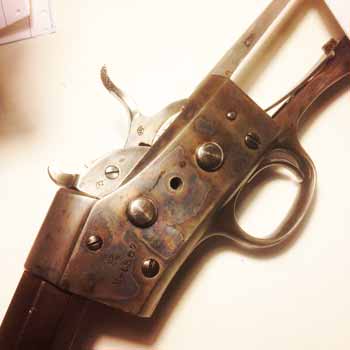
|
Other goodies included finding a complete set of the 1960\'s series, The Warplanes of the Second World War by William Green. Green is universally accepted as the go-to guy for warbird information. This actually made sense for me because I do a lot of fact scrounging. Besides, for $40 how could I leave them behind? This is exactly what I go to gun shows for: the out-of-context, non-gun stuff (saddles, antiques, etc.) and this was a real score!
Step five: find a decent burger
This time I took a gamble on a ½ pounder from the on-site Ptomaine Wagon. It was a frigging winner, with a capital"W"! What\'s the world coming to when usually terrible food turns out to be great! If you can\'t trust carnival food to twist your colon into knots, what can you trust?
The best thing about today was that none of the BS that\'s going on in the world crossed my mind even once. That was the biggest goody of all and the one I enjoyed the most. Sometimes ya\' just gotta escape, ya\' know? bd
28 Nov 2015 - The Population Bomb and Personal Miracles
This is going to be the shortest Thinking Out Loud on record. This is because I\'m going to give each of you a reading assignment (actually, mostly watching). These links will pass along some very basic, very non-political, very important information concerning the least understood, yet biggest threat to our country.
Essentially, what these links do is explain the math of population growth. There is no political agenda at all. They simply point out that any land mass can only support a given number of people and then show how our current regulations, none of them political in nature, will run head-on into that limitation. A solution is also shown, so don\'t get all gloomy faced. I may have talked about part of this before but can\'t find a record of it.
To redeem myself, there\'s a really heart warming link at the end. If you haven\'t seen it, I\'ll guarantee you\'ll be forwarding it. Incidentally, the reason I include the entire link, when I\'m passing them along is so if it doesn\'t work for you, you can cut and paste it in your browser.
Immigration By the Numbers
https://www.youtube.com/watch?v=muw22wTePqQ
World Poverty and Gumballs
https://www.youtube.com/embed/LPjzfGChGlE
The Islamic Concept of Hijrah
http://www.frontpagemag.com/fpm/260019/hijrah-europe-robert-spencer
Never Say Can\'t
https://docs.google.com/file/d/0ByFUzo9KwryWWkRwUEw4bmZNaVk/edit?pli=1
22 Nov 2015 - Wealth, Capitalism and Other Whipping Boys
Like everyone else today\'s middle class, I\'ve never worked so hard to make a buck in my life. Still, I have a serious bone to pick with those who are now screaming about income inequality and have made both"wealth" and"capitalism" bad words.
Let\'s not get into the silliness of people standing in welfare lines wearing high-dollar sneakers and killing time on their iPhones while bitching about those f**king millionaires and capitalists. Rather, let\'s focus on what I\'ve once again learned from a few recent encounters with serious money.
My little red airplane and the instruction I give in it attract a really wide variety of people income-wise. At one end are the barely-making-it bluecollar guys who are so in love with flying that they have mortgaged their souls to own a ragged little $15K single-place Pitts. At the other end are the folks who arrive in their own jets and pay for the instruction with pocket change. In terms of attitudes and personalities, I\'m pleased to report that I can\'t tell one group from the other. They are uniformly wonderful people who I\'m proud to instruct and lucky to call friends. They are also uniformly attracted to cars as much as they are airplanes and it\'s the cars that reminded me why I\'m happy that there are a bunch of really high rollers wandering around.
One of my students invited me over to see his"cars", which turned out to be this magnificent business building that had one purpose: it housed and supported his car collection. I\'m guessing there were 40-50 cars there, a few of them were high-end antiques, but most were high-dollar, absolutely perfect hot rods. We\'re talking well over a million bucks between cars and facility. Maybe two. He made his money in real estate, sold his company for many, many millions and is now living"the life" (and still running a huge real estate company). He\'s also a helluva nice guy, but the kind some love to single out as having too much money and not paying enough taxes. Which is, of course, BS, which I\'ll address in a minute.
Then, yesterday at the humungous (3,500 cars!) Good Guys rod and custom show I found myself in a long conversation with a guy who had a flawless, chopped \'34 Ford coupe that was obviously something special. I didn\'t know how special until he started describing the work done: it had won the fabled"Ridler Award" at the Detroit Autorama and had been selected as the America\'s Most Perfect Hotrod in other venues. He was quick to say,"I didn\'t touch it, which is why it is so perfect. I just wrote the checks." The legendary Boyd Coddington started it and the equally legendary Chip Foose finished it. I then knew approximately what the car had cost him, $400-$500,000 at the very least. But, now that he\'s won the awards, it\'s just his street car: he drove it in and parked it amongst the not-so-perfect \'57 Chevys and rusty rat rods owned by the proletariat, most of whom busted their knuckles building their rides.
Am I jealous of these rich guys? Not even slightly and no one else should be either. Yes, they are so wealthy that most of us can\'t even imagine the kind of financial security that is a part of their lives. However, in building their companies certain things had to happen: they had to employ a ton of people, all of whom shared in the building of that wealth in the form of wages, etc.
And their toys? I absolutely love the wealthy and their toys! There were at least three guys working full time to build and maintain the car collection I mentioned. Think how many hands were kept busy building the Ridler coupe. The big houses both of them live in employed dozens of craftsmen to build them. And you can bet their furniture didn\'t come from Pier One or Ikea, which means a bunch of other craftsmen were employed.
When the rich play, they are engaging in a healthy form of wealth distribution: yachts don\'t just happen. Neither do fancy cars or aerobatic biplanes or swimming pools or high-end resorts. Supporting the rich at play is a viable industry and untold millions, worldwide, are employed in that industry. A segment of every society is prospering because they are feeding on the elephant that is their employer. Do they get rich? Not usually, but there is nothing stopping them from starting their own real estate/manufacturing company, or whatever, and making their own millions.
I absolutely do not understand how Capitalism and wealth have become political whipping boys. Or are seen as being bad, when they\'re not. They\'re actually much less than bad. Capitalism is what has made this country what it is and much of that has benefited the world in general. Wealth is something to strive for. It\'s a goal that through hard work and a lot of luck, combined with intelligence and dedication is available to anyone. So, what\'s the big deal?
Wealth re-distribution is a sure way of developing a society where"average" is the goal. We have a hot room and a cold room and, when we open a door between, we wind up with a temperature that satisfies no one. This is NOT what has made this country great. Striving for mediocre is not a goal. It is settling. Standing amidst a startling collection of cars shouldn\'t make us dislike the person who owns it but should make us say,"Man, I\'m so glad someone had the luck, the vision and the day-to-day fortitude to make this happen. Maybe I\'ll drop what I\'m doing and build the same fortune."
Right now someone reading this is saying,"Davisson talks a good game, so why isn\'t he rich as he says anyone can be." I can answer that easily: I\'m not rich because I\'m not willing to totally dedicate my time and life to any given endeavor if making money is the only goal. Like most folks, I don\'t want to give up what is necessary to really succeed.
We\'re not rich. So what? A lot of us have had a good, very rich life doing what we love to do. Not everyone can say that. Including a lot of rich folks. bd
15 Nov 2015 - Celebrating a Good Year
Last night I was up until 12:30. It is now 0630 and I have a cupcake hang-over. I can\'t party like I used to, but the night was worth it: with about 50 of our closest friends and family, we celebrated a multitude of celebration-worthy events that have occurred in our household this year.
First, Marlene, AKA the Arizona Red Head (her license plate is AZRDHD), finally reached adulthood having out-grown post-adolescence by reaching 65 years of age last Thursday.
Second, she traded her maple leaf for the red-white-and blue by getting her citizenship, which we\'ve talked about here (6 June 15). The event itself was heart warming in the extreme. The party even more so.
Cake design (I forgot to photograph it)

|
Third, she became Grammy for the fourth time (see last week\'s Thinking Out Loud).
Fourth and final: we paid off the house! This is a cross between getting a load of cement blocks off your back and the exact moment you finally solve a week-long constipation problem.
The weather cooperated and the gathering that was milling around the pool in the coolish, but definitely livable, temps represented an diverse combination of friends and family. However, it wasn\'t until just this second that I realized something about my contribution to the goings-on: only about a half dozen of my flying buddies showed up, some from as far away as California, but every one of them was either building a serious hotrod or was driving one. These were as diverse as the people: a Studivette (41 Studebaker sitting on an 86 Corvette chassis and drive line), a \'48 Anglia with a double cam big block Ford, a \'31 Ford roadster with a Chrysler Hemi, etc. Plus half of them had built the aircraft they were flying. So, there was a tendency to drift to the garage. Not a bad thing.
Marlene\'s contribution, besides family, were lots of her ceramic friends, some of which seemed drawn to the conversations of my nuts-and-bolts friends. Plenty of cross pollinating of interests. However, the ceramic folks didn\'t have a chance against the sound of a hopped up flathead Ford idling in the garage, its dual pipes sticking out of the back door for all to enjoy the sound.
The participant that had the most fun was Shahn-deen, the Pomeranian. She immediately found that, if she pawed someone\'s leg while holding her ball in her mouth, they\'d take it and throw it. Then throw it again. And again. She worked the crowd like a pro, getting almost everyone in attendance to do the fetch thing. It was fun to watch.
I know this is a short Thinking Out Loud, but, in all honesty, I\'m dragging butt (in a pleasant sort of way). So, next week we\'ll get back to serious blogging. God knows we\'ve had enough national and global news recently to talk about.
See, ya\'! bd
7 Nov 2015 - A New Family Addition
A few months back I mentioned how inspiring Marlene\'s citizenship ceremony was. I had expected it to be an official paper-shuffling event, but I couldn\'t have been more wrong. I think everyone should attend one to remember what America is all about. A week or so ago The Redhead and I attended attended another ceremony that should be on every one\'s attendance list: the finalization of an adoption. Better yet, in this one we officially gained another Davisson.
First a little background: Jennifer The Movie Mogul already has the most incredible five-year-old you\'ve ever met: Alice Willa. A wonderfully bright, beautiful and entertaining little organism. Jennifer is the ultimate mother and, among other things, didn\'t want Alice to grow up without siblings. A single mother, she decided to adopt, which isn\'t as easy as it sounds. In fact, it\'s super complicated, expensive and riddled with potential for personal pain: she drove from CA to NC to pick up a little girl as it was born. She had it for a day or two and during the grace period the mother decided she wanted her back. A difficult time that Jennifer handled better than I would have thought possible. Then another baby popped up in Memphis.
The story of her driving through March ice storms in Texas to get there could be a novel (she\'s totally aerophobic and can\'t come close to flying). What a grind!
She\'s a hyper-Elvis fan (interesting considering she\'s not quite 40, hardly someone you\'d think would like Elvis), so I\'m not convinced the adoption was as important as her finally getting to tour Graceland. It was a near religious experience for both Jennifer and Alice, who is the tiniest Elvis freak.
So, the baby was born and Alice was given the honor of naming her: the newest addition to our family is Rosie Presley Davisson. I love it!
Rosie Presley Davisson
Kinda knocks you on your butt doesn\'t she? !

|
Incidentally, as if this whole thing wasn\'t quirky enough, the baby was supposed to be a boy and they didn\'t know it was a girl until delivered! Go figure!
This whole process was made all the more dramatic by two factors: they left TN on a Tuesday and Alice\'s 5th birthday was to be on Friday in CA, 1800 miles away. This is a factor because Jennifer would be damned if Alice\'s birthday was going to be spent on the road. This was further complicated by the fact that California had to give official permission for the baby to come into the state and Jen, Alice, and five-day-old Rosie were on our patio in AZ, 400 miles from LA late Thursday afternoon. The clock was ticking and Jen was on the phone with her attorney non-stop. The lady in the CA agency was getting ready to leave for the day and Jen still didn\'t have permission. Tensions were increasing as if we were waiting for a shuttle launch. Jen was covering it up as much as possible, but she was clearly distraught.
Then, with 10 minutes to go before the civil servant bolted for the door, the word came. Jen was on the other side of the bushes in the backyard and Alice was standing on our diving board when she saw her mother break into tears of joy while blurting"thank you, thank you" over and over. Alice jumped off the board, threw both hands in the air and yelled at the top of her voice,"Let\'s go home!" It was a beautiful moment!
California law says the adoption isn\'t final until she goes before a judge after a suitable period (I\'m guessing six months) and answers a few questions. That was the ceremony we attended last week.
I have no idea how the proceedings work with other judges, but this one made it into an absolutely joyous event, making those in attendance (I\'d guess about 15 family and friends) part of it. She instructed Alice to go to a bin full of teddy bears and select an"adoption bear" for both herself and Rosie. She asked the audience if they were behind the adoption and received a fairly vocal response, but it wasn\'t to her liking. So, she asked again, encouraging more enthusiasm, which she got in abundance.
It was a warm, personally full-filling experience in which Jennifer was asked if she understood that from this point on Rosie was be as if she was born to Jennifer. Jennifer was reminded that she would have sole responsibility for her health, happiness and education for the rest of their lives. Jen struggled to answer through tears and I\'ll guaran-damn-tee you that there was no one named Davisson in the room that didn\'t have tears running down their cheeks. We drove 14 hours round trip and I would have gladly driven for days to be part of that experience.
It\'s difficult to describe how those few minutes felt. Just as Marlene\'s citizenship thing made you feel closer to your country, seeing a tiny (6 months old) officially becoming part of your life somehow redefined"family" and drew us all closer. It was one human being given the duty of loving and caring for another and it was beautiful!
If you have a chance to witness one of these shindigs, do it. It\'ll make your month!
bd
19 Sept 15 - In Search of the Perfect Tamale
A while back Marlene and I went to a wedding being held in Sedona, which if you don\'t know it is a unique, vaguely frustrating little town. But not without its charm, which is enhanced by the area (high country of AZ) and the people it attracts. In fact, we ran across a couple of interesting folks in the course of the wedding and they represent something worth discussing.
We were at the after-wedding dinner thing (reception??) that was being held in a sort-of-funky-but-still civilized Mexican restaurant (can you still say"Mexican" and not be racist?). Their bar was just outside of the eating area and I noticed that Marlene was stopping to talk to a couple of guys there every time she went to the head (she has a bladder condition so head-trips are more often than usual). Finally, I got up and went to investigate and found that Marlene was doing things like explaining why they shouldn\'t be eating the clams that aren\'t open (or maybe don\'t eat the ones that are open, I forget).
I wound up sitting down at the bar with them and got their story which everyone reading this can identify with to one degree or another.
They were a couple of old friends, both in their early 50s (I\'m guessing) and they were driving around the country on their Harleys, each having different goals. Originally from somewhere on the East Coast one was"...looking for the America I\'d only heard about" and the other was"...searching for the world\'s best tamale."
These weren\'t a couple of biker dudes and they weren\'t a couple of office cubicle refugees out looking for a last fling before their perception of old age sets in. And they\'d both made a little headway in their respective searches: by the time you wind up in a bar in a small town in Arizona, you\'ve already covered a lot of country and you\'ve already had an opportunity to sample a lot of tamales. When they left the bar, they were going to continue another 30 miles to Jerome and stay in the Grand Hotel there, also known as the Asylum.
Jerome is a long-time ghost town that is little by little being gentrified, but it\'s still got a lot of funk left. The Asylum is about as unusual a hotel as you\'re going to find. It was originally the hospital for the copper mining town (which is built on a 50 degree grade and was totally abandon by the early ‘50\'s). Closed in 1950 then reopened in the mid ‘90\'s as a hotel it\'s a favorite stop for ghost hunters because of all the supposed strange goings on there. The hospital had a lot of deaths occur. As antiquey as the hotel may be, it also has a honest-to-God 4-star restaurant. It\'s small but super good.
So, our two adventurous bikers were going looking for good food surrounded by ghosts. We never heard from them again (not victims of the Asylum, I\'m sure) but we can guarantee they didn\'t find even one tamale on the menu. However, our meeting them had its effect on us. We asked ourselves,"Would we be willing to launch cross country like that with no particular goals or destinations in mind?"
That\'s a helluva good question that just about everyone I know has asked themselves. Especially lately. With all the BS we hear in the news and see the government doing, hardly a day goes by that most of us don\'t think about tossing some clothes in the back of our car and just taking off. No cell phones, no TV, nothing that connects us with our normal life, which at the moment seems to be under attack by the entire world. We can\'t get away from the bad news that leaves us with the impression that civilization, as we know it, is going to crumble by next Wednesday. Or maybe the Saturday after.
Marlene and I both agree, running away is super tempting, but, if we were to give in and leave the real world, it probably wouldn\'t be on Harleys (she would insist she have her own). Too many joints and vertebrae are already turning to dust. No reason to accelerate the process. But, a small, van-sized motor home would work well for us.
At the same time that we\'d be having these conversations we also be casting doubts on the entire concept. My late brother had to close down his psychology business because he\'d contracted Valley Fever (look it up) that, in his case had the possibility of being fatal. So, he spent six months driving round in his van practicing bio-feedback that eventually did arrest and cure the illness. He covered the entire US and spent a couple weeks with me while I lived in NJ. I remember him saying two things, and he was deadly serious."Don\'t ever hit the road without a destination. It gets old, really, really fast."
He also said,"If you have a choice, don\'t ever be alone. It\'s not healthy."
I can clearly see where he was coming from on both points.
In talking about us just cruising around the US, which is a popular activity (or non-activity, depending on how you look at it) for the age group we\'re moving into, I know for a fact it wouldn\'t work for us. I, for one, can\'t go a day without feeling as if I\'ve accomplished something. Once in a while I\'ll have a day that\'s just a waste of time and it puts me in a real funk, as if I\'ve stepped on, and killed, a kitten or something. But, I know that\'s not the way everyone is.
Every time we drive to California, which is quiet often, we pass through the little sorta-town of Quartzite, which is right on the California/Arizona border. During the winter Quartzite is a favorite destination for hundreds and hundreds of trailers and motor homes of all sizes and descriptions. Some are in the designated motorhome parks, but the vast majority are scattered round parked out in the desert in random arrangements. Some are close together, but you see lots that are barely visible by themselves surrounded by miles of desert.
This is an area where there is virtually nothing. There are only a few eating places, no movie (the closest is in Blythe, CA, 20 miles away) and miles and miles of desert. In January they have a big swap meet and five or six weeks of a fossil/gem show (out doors), but that\'s it! Every time we go through there I\'m always wondering out loud"What the hell do these people do all day?"
I LOVE prowling around, taking off on side roads, just to see where they go. In fact, one of my side fantasies is designing a four-wheel drive van just for that purpose. But, I know I\'ll never do it. Some folks just can\'t do-nothing and sight seeing gets old quick. I know, I\'m not alone in that. Even on vacation (we took a 12-day trip to England in 2008, our only pure vacation, although it did include two days of shooting tanks for a magazine.) and even though I was positively riveted by England\'s history, after about four days, part of me was ready to return to the grind.
So, could I go search for the perfect tamale? Yes, if it were a magazine assignment. Could I do it, just because I wanted to do it? No way, Jose! Never happen. And I\'m betting many reading this couldn\'t do it either. It sounds good in concept and makes good TV/Movie plot material, but in real life, most of us want to be doing something relevant. We know we only have so much time left and need to invest it wisely.
Besides, and please don\'t spread this round, I don\'t really like tamales. Enchiladas and burritos, yes. Tamales, no. bd
12 Sept 15 - The Day After and Cool Stuff
I\'m not going to dwell on 9/11 because I did it in some depth back on August 2nd, when I ran across the 9/11 Boat Lift video. I\'ll comment on it, but mostly I\'m going to pass on a ton of neat links to videos that I find interesting and some of you may also.
We can all tell minute by minute what we were doing when The Towers came down. It seems every generation is destined to have at least two moments like that. One that happens young, one that happens late. For my dad, it was Pearl Harbor and JFK\'s assassination. For me, it was JFK and 9/11. For my kids it\'ll be 9/11 and something that hasn\'t happened yet, which is a really somber thing to think. But, that seems to be the way it works. Two per lifetime.
One thing that was unique about my 9/11 experience was that my student who was staying in our B & B was from the Netherlands. One from England had just landed in Phoenix and another was airborne and a few hours out. He was from Luxumbourg, if I remember correctly. So, I lived The Day After with a bunch of Europeans who were as shocked as we were. NYC belongs to the world. All non-Muslim nations felt it almost as much as we did.
It\'s nearly impossible for the date to come and go without reliving those hours and days. We lost our national virginity that day. Unfortunately, our Administration hasn\'t learned a damn thing from it. I\'m afraid that terrorism, as the rest of he world knows it, is being imported to the US by executive fiat and my kids are going to have to deal with it.
Someday I\'ll tell all of the silly details having to do with me trying to get back in the air with those students. It culminated with me being the first VFR pilot into the air post-9/11 in AZ and almost certainly in the US.
Incidentally, I see where the Phoenix"sniper attacks" have made the national news. I don\'t know anyone here who thinks this is a terrorist act. It feels more like the actions of a whacko or irresponsible teen.
On to the links. See below. Lots of cool stuff.
Enjoy!
His Very Own Undeground City
City
Easter Island Bodies
Easter Island
Underwater Pyramids
Pyramid
Underwater Cities
Cities
2000-Year-Old Shipwreck
Roman Wreck
Inca Grass Bridge
Bridge
Michigan Shipwreck
Michigan Wreck
Abandoned Russian Hangar
Russia
American Indian DNA
Indian
6 Sept 15 - Visual Progress as a Mood Elevator
This past week or so has been a period during which I rediscovered a guaranteed method of making yourself feel better: do something that\'s been bugging you for a long time and get it out of the way. There\'s nothing like achievement, no matter how trivial, to make us feel as if we\'re getting ahead in the game.
First, it should be realized, that I, like what I prefer to believe is the majority of males, can let a mess lay around or watch something deteriorate for years, continually stepping over it or walking round it, but never doing anything about it. Stacks of books become part of the woodwork (the floor IS counted as shelf space, right?). Crap piled up in one area of the shop is ignored because"it\'s always been that way." A workbench slowly disappears as it\'s engulfed by the ever-growing heap of random stuff being tossed on it.
Every one of our lives (at least those of us who weren\'t born with a"tidy" chromosome.) has these little irritants around us that we\'ve managed to ignore until they reach the point that they finally drive us to do something about them. Unexpectedly, I reached that point last weekend. What had started out as moving the junk in front of the roadster around so I could finish installing the head studs (again), turned into a scratch-the-itch marathon in which, while walking around the garage working on the little car, in route I took care of dozens of things that had been bugging me forever.
I walked past the pile of steel scraps and said, to hell with it, and sorted them into appropriate bins. I took the formed plastic trunk liner for Marlene\'s Maxima that had been lying on top a big pile for about two years, since her accident and put it back in the car. Uncovered my wood lathe and turned it around to face the other way (and swept under it) so, if I ever wanted to use it, it would be facing the right direction. Restacked a bunch of ammo and got it out of the way. Moved some spare car parts up into the rafters.
All of the tasks I took care of were small. By themselves they were unnoticeable, but the net effect on my state of mind was stronger than if I\'d gotten the roadster running again. This was because it was visual progress on something that I see almost every day and had been on-going, pin-prick irritants.
The mantra I lived by that day was , if I walked past something that would benefit from a little attention, I\'d stop what I was doing and take care of it. I even dumped the big drawer of extension cords out on the floor, neatly coiled them all up and put them back. I liked the feeling so much that for the rest of the week, every time I touched or passed something that\'s been bugging me, I\'d take care of it. An itch scratched. Take my poor little Honda, for instance.
Arizona kills car speakers. Turns them to dust in a matter of years. Mine were in tatters and had been for at least five years and the terrible sound had become part of the audio woodwork that I totally ignore. Then, one day I took one of the speaker grills off with the intent of seeing what kind of speakers I needed, got side tracked by work, and for two years have been driving around with a ragged, gaping hole in the left door panel listening to a radio that at full volume is barely audible. This in a good-looking little car on which I had the body cherried out and painted. Tuesday, I said,"screw it", and dropped it off at Audio Express for new speakers and whatever else it needed.
The radio in that car (a 1990 Civic) had been in two previous Hondas of mine and, as near as I could tell, it was at least 35 years old. A low-end JVC with a cassette player (remember those?), it had been a birthday present from my kids as youngsters, so it followed me into every car after that. Yes, I am a sucker for nostalgic connections. But, when the speakers were replaced this week, the radio was found to be dead or dying. So, now I have a newer-but-still-cheap JVC with Bluetooth and more software than my trusty Mac has. Someday, I\'ll figure it out. Maybe.
The A/C in that same car had been in-op for over a year because some over-enthusiastic mechanic had pulled the threads out of the aluminum idler pulley bracket and it had been riding around in the trunk while I cooked in 105-plus temps. So, Monday, I buzzed down to a hotrod buddy of mine, he welded up the valley in the casting that the threads went through, installed a hi-tech helicoil (the kind with four locking pins) and I\'m now riding around in air conditioned splendor talking on my phone hands-free with great tunes. Life is good!
This is all little stuff. None of it terribly expensive or time consuming, but the psychological pay-off has been huge. It\'s disproportionate to the effort. I absolutely guarantee that every person reading this can turn their head and look around the room and find something they\'ve been putting off for too long. So, when done reading this, stand up and take care of whatever that is and your day is bound to be better.
Quite often it\'s the little stuff that contributes to visual progress that seems to count the most. bd
29 August 15 - The Link Between Discovering Fire and Inventing Computers
As I was sitting here waiting for the second cup to kick in, I was idly cruising through some random stuff I had in my Thinking Out Loud File and I ran across the below. It is an answer to an e-mail on the Bearhawk group that became a thread a mile long and got much more serious and philosophical than you\'d expect between a bunch of airplane bums. Which, by the way, is thoroughly typical for that group.
The thread was kicked off by Dr. Ben Carson\'s response to an Atheist who questioned his view of creation. He said"I believe I came from God, and you believe you came from a monkey. And you\'ve convinced me you\'re right."
This kicked off an in-depth discussion on the chat group about how man has evolved/progressed/etc. and the question was asked of why man appears to have gotten so smart in the last couple hundred years or so. The below was my answer. If you\'re not up for numbers and theories, it would be a good idea for you immediately hit the delete button and go on with your morning. I got off on a tangent (surprised right?). Re-reading it made my head hurt!
...-
Your question is "What caused what appears to be a sudden expansion in fairly recent times of our ability to comprehend?" You\'re hinting that it was God Given. What caused the sudden, exponential explosion of technology in the last 20 years? Are we so much smarter than those who came before? Was there a sudden, god-given change in our ability to think? Of course not. The answer to the question of increased comprehension is super complex, however, much of it, in my feeble mind anyway, is rooted in numbers, percentages and shared experience.
From the minute that man stood upright, discovered fire (apparently this happened with the first humanoids 1-1.6 million years ago) and the concept of tools, he has been in a technology race not unlike what we\'ve seen in the last couple of decades. The reason earlier technology phases (stone age, etc.) appear to have taken so long is partially explained by the small numbers of people involved. This means the way in which they gained experience in a given technology was slowed by the small amount of interaction between others. They were inventing in a vacuum.
With a small, slow moving population, we didn\'t have a lot of people watching what a lot of other people were doing so they weren\'t feeding off of others\' experience. We learn a lot from others\' experience, which, in effect, makes us not only smarter, but able to think better in terms of solving problems and coming up with ideas.
Oh yeah, in those days, survival meant that there was a daily push to find the next meal, which, in turn, meant there wasn\'t much spare time to be spent on expanding knowledge.
This could be looked at as a numbers-driven conversation. It\'s a given that within any population, regardless of how primitive it may be, there are always those individuals that are more intellectually gifted than the rest. Let\'s say 1 in 1000 is smarter than the rest (a number I just pulled out of my butt). It is generally assumed that man began to develop into humanoids 1-1.6 million years ago (yes, I verified all of this, although I wasn\'t there at the time). It is also estimated that the worldwide population at that time was only about 18,500 humanoids. So, by the 1:1000 ratio, there were only 18 people on the planet with a higher than normal intellect. Not enough to invent television, Hollywood or Starbucks.
Early populations didn\'t grow at the rate that we think of populations growing. It grew much slower than we\'re used to. In fact, from the time of Christ, when the world\'s population was around 250-300mm, to the mid 1700s, the population was pretty stable. Then, when "civilization" became more advanced and food supplies more available and easier to share, the population started skyrocketing in the early 1800s. The world population today is around 7 billion with 60% of that being in Asia. The net result is that, although the percentage of smart people has probably stayed exactly the same, the sheer numbers of them has literally exploded. This is why China will eat our lunch in a lot of areas: there are four times more of them than us, so they have four times the brainiacs to work with. Plus, their communal experience means so much is being shared by so many between such a wide variety of disciplines that they will grow their national intellect at an even higher rate. The numbers, not the individual capabilities, dictate that happening. And, of course, they steal a lot of good stuff from others, which accelerates the trend.
A classic example of making an individual "smarter" by feeding off of others\' experience and intellect is the Bearhawk group, which is populated by one of the most varied, most experienced, naturally-smart people I\'ve ever met. I know for a fact, that I\'ve learned far more out of this group than any other single source: we\'re building our abilities to comprehend because we\'re building on each other\'s experiences and thoughts.
You questioned: Are you speaking of physical evolution, cranial evolution, or spiritual evolution?
In my mind the brain developed right along with the body but got a major injection of the smarts when Cro-Magnon man replace Neanderthal, which was mostly an accident of evolution that happened about 40,000 years ago. His brain was apparently wired slightly differently. That\'s when"modern" man took the stage.
The spiritual aspect however happened long, long before Cro-magnon came on the scene. It\'s only logical that man has always had a difficult time coping with death and virtually every phase of man\'s development, from humanoids on, has had some form of spiritual development attached to it, but the very early humanoids left little physical evidence of it. In other words, in my opinion, man wasn\'t far from the discovery of fire when he invented religion because he couldn\'t cope the idea of being dead. He wanted more, so he invented it, as did every civilization from that point on.
So, has our brain suddenly gotten smarter? No, we\'re just using more of it and being more efficient in learning from others.
I didn\'t mean this to ramble on so long. Too much caffeine too early, so, I couldn\'t help myself. Sorry.
.........
...and you thought we just talked about airplanes, didn\'t you? :-) bd
22 August 2015 - More American Than America
I stumbled across a video this week that I can\'t begin to explain. Yeah, I can explain the event, but I can\'t explain why Swede\'s have such a love affair with the concept of the American big cars of the 50\'s, 60\'s. The video at the end will do that for me.
First, I should warn you: it\'s 0345 in the morning and I couldn\'t sleep, so here I am. I know a lot of folks who are habitually up this time of the morning because, when I roll into the office at 0530-0600, as I usually do, I always find a bunch of e-mails from them waiting. I also know some borderline insomniacs who do very creative, worthwhile things with their dark time. Not me. On mornings like this I feel like Dorothy\'s scarecrow"...if I only had a brain." The lights won\'t come on upstairs until the second cup kicks in and, even then, I\'ll be thinking through a layer of cotton. Or at least it feels like it.
After night-time peeing, I\'m usually sound asleep before my head hits the pillow. But this morning my brain was in full running mode and I couldn\'t shut it off. All sorts of major things were playing in my head: do I stick with my baby Glock 9mm, which is my habitual concealed carry piece and also use it as my open carry piece, or use my Sig 229 for that and convert it from .40 to 9mm so I only have one ammo type? Or, when I\'m too old to work, will I concentrate on making knives or rifles?
I obviously deal with world-shaking subjects when my brain is left to its own devices.
At some point the never ending problem I\'ve been trying to solve in my little hotrod\'s motor popped onto the scene (having to pull and reseal all the head studs), and then I found images of American ‘50\'s,\'60\'s chrome boat cars being projected on my mental screen. What the...? This is not a subject I\'m even interested in, so what\'s my brain doing? I guess it was the effect of the Swedish video. I\'m not talking about 55-57 Chevys (even as a teenager I thought a \'57 Nomad wagon with a tri-power 283 and four on the floor would be the perfect car). I\'m talking about the BIG cars: the Chryslers, Pontiacs, Cadillacs and such, all of which were dripping with chrome.
Today we forget how it felt to drive a car that could easily fit three people abreast in the front seat and four weren\'t too crowded in the back. Not long ago I drove a \'62 Pontiac two-door similar to what I had owned back in the day and I\'d forgotten what it felt like to be pushing a hood around in front of you that\'s the size of a picnic table."Ponderous" is the word that comes to mind. Because the change happened so gradually, we don\'t realize how much better even today\'s family sedans handle. Marlene\'s lowly Maxima would have been considered a sports car in the ‘50\'s.
And then there is Sweden, the country where major chrome wagons go to live again. Garden variety older American cars, the majority of which are FAR down the collector\'s scale on this side of the pond are eagerly sought-after over there. We\'re talking about original condition, sort-of-running, used cars here. Not exotic, totally restored gems. And we\'re not just talking about the higher grade, fully optioned versions. A Caddie doesn\'t have to be an Eldorado hardtop or a convertible to qualify. The four-door barges little old ladies are still seen trundling to the grocery at 10 mph are still hot tickets. Who\'d a thunk?
I\'m not sure if the Swedes see these monster cars as some sort of art decoish link to a simpler time or the bloated architecture each carries is a statement about an America that was. One thing is an absolute fact however: as much as America is, and always has been a car culture, the Swedes are reinventing that culture and keeping a time alive when cubic inches and pure fun mattered.
Go to https://vimeo.com/59718224. You\'ll dig it! If you\'re hip that is. (damn that sounds dumb doesn\'t it? Did we actually talk that way?). bd
17 August 2015 - It was Just Another Week...Sort of
For a week during which history was being made left and right, mostly in politics and shootings, my week was actually a fairly mundane week punctuated with moments of...oh, I don\'t know...oddly interesting personal happenings. Let\'s take the bird first.
I saw him only as a dark streak in front of us. We\'re on short final and this pretty good sized dark"something" darted out in front of us. It was obviously a bird, but don\'t ask what kind. At a closing speed of around 125mph, you don\'t spend much time trying to count the freckles on its breast to identify it. He swung out in front of us, changed his mind, and quickly rolled towards us completely reversing course. He disappeared just outboard of our wing tip. Or so I thought. It wasn\'t until we landed and were taxiing back that I saw parts of mister bird hanging from my flying wires just under the left wing. At that point, I knew only part of him had escaped. It actually looks as if he hit just below the nose of the leading edge and he was big enough that part of him hit the streamlined wire that split him like a knife. It didn\'t create much of a mess, but this wasn\'t my first time to the bird strike rodeo: years ago, I hit six Canadian geese on takeoff taking four of them through the prop. Now that was a mess!
Zigged when he should\'ve zagged. I\'ll bet that smarts!
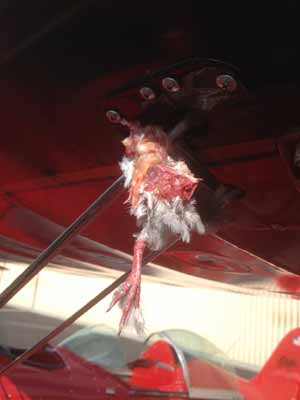
|
This week was also marked with a streak of real old fashioned Arizona-style summer heat. We topped 110 degrees four or five times and supposedly peaked at 117 on Thursday (!). I was flying super early every day, first hop at 0700, second, mid-morning, but I still got to see 109 degrees from the cockpit. This doesn\'t bother me at all, but it absolutely sucks the stuffing out of my little airplane\'s spirit. It made my little hotrod into a VW with only three cylinders working. ‘Didn\'t do much for my student either.
I tuned out this week\'s political scene because it had turned into National Trump Month. Not that I\'m totally against Trump, but I\'m tired of the circus. On the good side, however, his sometimes-idiotic behavior has brought a lot of people into the discussion especially about immigration. I ran into one of those totally unexpectedly.
I was at Burger King with my student cooling off when a Hispanic came up to the table next to us. As he pulled a chair back, he glanced at us and asked,"Is this the Republican section?"
Sensing some sort of pending confrontation, my student and I didn\'t know what to say. The guy grinned and said,"Yeah, you gotta give Trump credit. He\'s telling it like it is. Never thought I\'d see that in a politician. He\'s alright!"
I can\'t tell you how much that surprised me. He was obviously raised on this side of the border because he spoke with almost no accent of any kind. He just laughed and went up to pay for his order. I noticed when he pulled the trucker\'s wallet out of his back pocket that it was decorated with a Confederate flag. Talk about assimilating into our culture!! Yeehah!
There was one last discovery/happening this week that was probably not good, depending on how you look at it: I found that tool and hardware giant, McMaster-Carr (if you don\'t know them, you should...Google them), has one-click shopping just like Amazon does. Do you know how financially dangerous it is to a guy like me to be able to just click on a photo, then click a box and know that part/tool is on its way to me. Damn! I have fallen into mail order heaven.
Shhhhh! Please, don\'t tell Marlene about the hardware thing. bd
8 August 2015 - Presidential Debate Trumps the A-Bomb
Overshadowed by the Presidential Debates was the fact that 70 years ago that same day the Enola Gay ushered in the nuclear age over Hiroshima. Seven decades ago this weekend the most horrific episode in mankind\'s horrific past was unfolding as hundreds of thousands of Japanese tried to cope with what had just happened. 140,000 died. Many were painful beyond imagination. Survivors often wished they hadn\'t.
Today we hear many say the US was unnecessarily cruel in dropping the bombs. I suppose that depends on how one feels about the projected cost of an actual invasion. The projections of American casualties range from 1.2 million (500,000 fatalities) to the study done for Sec of War Henry Stimson that peaked at 800,000 US fatalities and five to ten million Japanese fatalities. The range was the result of not knowing for sure how much the civilian population was mobilized (which turned out to be close to 100%). If the main island invasion death rate had been only 10% of the US death rate in the Okinawa invasion (less than 500 square miles), which lasted only 82 days, the cost would have been 500,000 US fatalities. This makes the projections of millions of possible deaths, seem reasonable.
So, was it cruel to kill 140,000 and wound untold thousands, versus killing millions of the native population and hundreds of thousands of GI\'s? In my view I was a terrible trade off, but a good one for both sides.
We often hear,"They were ready to surrender and the bombs weren\'t necessary". Historical research proves this to be wrong. The only reason Emperor Hirohito surrendered, when he did, was because he ignored his advisors. He also survived an assassination attempt by those who wanted to keep on fighting. This was unheard of in Japanese culture. Hirohito was a diety to the Japanese and his word was law. Although Hediki Tojo\'s war council pushed for a fight to the last man, woman and child, Hirohito couldn\'t face another Hiroshima or Nagasaki. Even he had his limits. And so a horrible chapter in history was closed. And another opened. The nuclear threat is still with us and getting worse by the day. (A side note: I\'m going to be amazed if an outlaw nuke isn\'t detonated somewhere in the next decade)
If there is one thing that we civilians don\'t have the right to do, that is second guess the military\'s actions when in the middle of a war. And in this case, seven decades on, we can\'t second-guess Truman. It\'s well known that he didn\'t want to drop the bombs. Neither did anyone from the bombs\' creators to the men on the B-29\'s that dropped them. However, ask the opinion of any one of the Marines that were among the hundreds of thousands arrayed around the home island knowing that they were going to have to launch the most costly invasion in history. It would make D-Day look like a cakewalk. The Germans weren\'t suicidal. But after four years of war in the Pacific, every Marine/GI knew the Japanese preferred death over surrender and had been whipped into a frenzy. An invasion wasn\'t going to be pretty for either side. The cost of using The Bombs to force the surrender was high, but very necessary, when put against the realities of the situation.
One of the saddest part of the Hiroshima/Nagasaki events is that we haven\'t learned a damn thing from them. Forget the unbelievable destruction and focus on the human suffering. A conventional explosion of the same size (15-20 kilotons), which isn\'t possible, would have killed and maimed the same numbers. But the wounds would have been largely"mechanical" in nature. Burns, broken bones, concussion damage: stuff that doctors can deal with"easily." Radiation is something else. Its effects are long lasting and unpredictable. As part of the Iran Nuclear Agreement BHO is forcing on us, Iran will regain the ability to acquire long range ballistic missiles. This in addition to the huge strides they are making with missiles of their own design using North Korean guidance systems. Does anyone in their right mind think that if Iran gets the long-range ballistic missiles it\'s yearning for, it won\'t launch them into Israel (Iran\'s mantra is,"Israel must be removed from the map") with nukes right behind?
A Note On the Presidential Debates
About Trump: I like his maverick stance and I\'ve tried hard to line up behind him, but I just can\'t. While I like some of his views, we can\'t have someone with a mouth like that speaking for the most powerful nation on the planet. Had he made even the slightest attempt during the debate to say most of the same things but in a more civilized manner, I might feel different about him. But, DAMN!, there has to be at least a little respect for the dignity of the office. I think BHO and Michelle have dragged it down to the lowest level I can tolerate.
Also, my BS alarm goes off often with Trump. For him to deliver on the things he promises, he\'s going to have to compromise with Congress, etc., but he has always been the captain of his own ship. A dictatorship is his style and we\'ve had enough of that. After five minutes watching BHO, even before he announced he was running, my poser alarm pegged. With Trump, it\'s a different feeling but alarms go off nonetheless.
For me, right now, it\'s Cruz by a narrow margin over Walker with Fiorina and Carson as VPs. I did, however, like Rubio. Huckabee pleasantly surprised me with his rant about transgenders, etc. in the military. But, he doesn\'t have a chance.
We have a long year ahead of us,folks! bd
2 August 2015 - Boat Lift: a Tale Late in the Telling
It was early in the morning, too early, so, when the phone rang, I knew it was trouble: it was my daughter, Jennifer, in LA. She was frantic."Dad, Mom just called, have you been watching the news?" I flipped it on and, sitting on the floor in my underwear next to the bed, the phone to my ear, Marlene in the bed behind me, my dog in my lap, we watched the Towers come down together.
I so clearly remember the disbelief."Dad, the tower just collapsed!"
"No, honey, it couldn\'t have." Then I realized it had. I refused to believe it.
I seriously doubt if there\'s a single person reading this that doesn\'t remember exactly where they were and what they were doing when they saw, or learned, of the 9/11 attack. The images in our minds, just won\'t go away. For my parents, that moment was when they heard about Pearl Harbor, for me it had been when I heard about JFK\'s assassination. Now this.
Amazingly enough, even though 9/11 has been sliced and diced every way possible by the media, some images have, for whatever reason, never been seen. Or, if they have, the audience has been tiny. The reason I say that is because this week I was sent a link to a You-Tube video that made my month. Maybe my year. It showed a side of 9/11 that I didn\'t even know existed. The link is at the bottom of these words. PLEASE take the time to watch it. You\'ll be glad you did and you\'ll forward it to everyone you know because of what it means to us as a people.
I think this video is of particular importance today because, in a short ten-minute slice of life, it shows America as we like to think of her: selfless, bonded together by purpose, covering each other\'s six no matter what.
Also, when you put it in context against today, it shows how incredibly self-centered and petty we can be. The 14 years since the attacks started out with our national head held high. American flags festooned everything that would hold one. During my lifetime I can\'t remember a time when we were as patriotic or as united. Then politics and personal interests began to erode those proud moments and re-sculpt us right back into a familiar form. That trend has continued until we\'re now as factionalized and divided as I\'ve ever seen us. It\'s much, much worse now than it was even during the ‘60\'s. It\'s hard to believe things could deteriorate so quickly, especially considering the grievous wound we all suffered on that fateful day.
It\'s not worth going into how we wound up where we are today. We each have our own explaination of what I see as a decline, but others don\'t. Instead, take a few minutes out of your day at watch the below. You\'ll be glad you did and it may even re-ignite the flame that\'s necessary for us to reclaim the spirit that I personally believe is still within us straining to get out.
https://www.youtube.com/embed/MDOrzF7B2Kg?rel=0 bd
18 July 2015 - I Can\'t Say it Any Better
As I\'m typing this, I have one foot out the door headed for Oshkosh, which I desperately need. I need to get away from the Media and all the incredibly stupid/bad things going on.
I really don\'t want to leave on a negative note so I\'m not even going to mention the four Marines that a Jihadist just killed and ISIS being in our backyard. In fact, I\'m not going to write much at all because I ran into a You-Tube video I want everyone to watch. A young lady says it much better than I ever could and with much more credibility. The link will be at the end of this text
I\'m really upset about this whole Confederate thing and the horrifying things people are doing or getting ready to do in the name of political correctness, e.g. dig up Nathan Bedford Forrest and his wife and move them out of Memphis (research his post-civil war racial equality efforts, you\'ll be surprised). New Orleans is talking about renaming all the streets named for Confederate generals and removing all their statues. The NAACP is demanding that the Stone Mountain, Georgia monument be erased by sandblasting. We are doing to our own country\'s history exactly what ISIS is doing in every historic city they enter: destroy anything they disagree with. It\'s amazing the speed with which this whole thing peaked.
Eliminating a flag or a segment of history that\'s 150 years old isn\'t going to change today one damn bit. All it will do is build resentment where there is none and alienate a huge section of the country. Not to mention pissing off open-thinking people like me. I like the fact that Kid Rock and Ted Nugent are recording a record, "Kiss My Rebel A**". And both of them are from Detroit!
Wanna see an unexpected source of clear thinking? Go to http://chicksontheright.com/blog/item/29867-watch-young-black-woman-explains-the-confederate-flag-to-everyone-and-especially-sensitive-black-people.See you in ten days. bd
4 July 2015 - Independence Day Blues
Oh, man! It\'s mid-morning Phoenix time (same as CA) on the Fourth of July and I wish I were back in Seward Nebraska. Yeah, it\'s my hometown, but on Independence Day, it\'s also my touchstone for the Real America. I\'m not kidding even a little bit, when I say that everyone in our country should experience the Fourth of July as celebrated there.
Right now, amidst their 4th of July hoopla that has earned them fame nationwide, their parade is starting. It\'s just one of the many things I miss about that day. Seward is where I go to remember that America is NOT as the news channels or government would have us believe it is. Just as small business is at the heart of our economy, small towns like Seward (population, a shade over 7,000) are the central part of our soul. Those small towns are also where the Fourth of July is remembered for what it is: Independence Day.
A quiet form of self reliance permeates the atmosphere of every small town and they seem to subliminally identify with our founding fathers\' decision they\'d had enough of the Crown of England. Inasmuch as those pioneering colonialists had created this nation out of nothing, they didn\'t see why the fruits of their labors should go to support a foreign nation. Also, since their unique form of individualism was what had made them successful, they knew they didn\'t need someone else to tell them how to run what they had created. Small towns are on the forefront of self preservation as it was practiced on the frontier, a trait that comes in handy during hard financial times. Big government isn\'t something they aspire to, nor do they expect it to solve their problems. Personal and civic responsibility is a given.
Independence Day undoubtedly means different things to different folks, but in small towns, the overwhelming display of patriotism clearly shows where their heads and hearts are at.
I find the red, white and blue extravaganza to be refreshing. And reassuring. National news is dominated by the Beltway Buffoons and unbelievable news from overseas. The way we are absolutely pummeled by the worse type of news, it would be really easy to get depressed, and in some ways, I think the nation is depressed. But, as I look around at small towns, especially those in agrarian areas, I know that regardless of what happens nationally, when the dust settles, the small towns and their traditions will have survived. The big cities may be smoking piles of ash but small town America will still be up and kicking. That\'s where our nation got its start, and if it proves necessary, that will be where it gets a fresh start. Just knowing that makes me feel better.
So, here are a few photos that demonstrate what a small town Fourth is all about.
|
|
The quinessential small town square complete with Civil War statue. The plaques around the base thank those who have fought in every war since.
|
|
|
The plaques go from the Civil War to today. Iraq and Afghanistan are on order.
|

|
|
An area about six blocks on a side is shut down as every possible activity you can think of is in process. These are female highschool pole vaulters showing their stuff.
|

|
|
The parade has been known to last two hours. This in a town that is barely a mile wide, if that.
|

|
|
Every tiny town has a Czech queen and they all show up. I think the record is 13 (update: there were 11 this year).
|
|
|
Sometimes family reunions will be measured in the hundreds when all the generations show up, and they usually do. |
|
|
When was the last time you saw Boy Scouts in a parade? Makes we smile just to think of it.
|
|
|
Every politician worth his salt knows his future may depend on showing up in this specific parade. |
|
|
How can you have a parade without fire trucks? Makes we wonder who is protecting the surrounding towns.
|
|
|
Old cars, especially Model A Fords, are a big thing in the plains states. There will be many dozens chugging along.
|

|
|
If you can walk or ride, you can participate.
|
|
|
The rodeo queens are always a favorite.
|
Seward is about 30 miles west of Lincoln right on I-80. You should think about visiting next year. You\'ll be glad you did. We\'ll be there for sure. bd
28 June 2015 - A Bloodless Coup?
Holy...! What just happen? Did the Supreme Court just decide to redefine Separation of Powers and Checks and Balances and, in the process, take over the United States of America? Did"We the people..." just get replaced by"We the judges?"
I\'ve made an honest effort this year to keep Thinking Out Loud away from politics and anything like it. But, this week too much stuff happened to ignore it. I hope this is the last time I get forced into talking about this crap.
First there is the Supreme Court: The way the US government was purposely set up by the founding fathers, the Supreme Court of The US (SCOTUS) was there to judge whether laws met the exact letter of the Constitution. They are the final authority and are supposed to look at a law, lay it against the template of the Constitution and make a judgment as to whether it fits or not. THEY ARE NOT THERE TO TWIST THEIR INTEPRETATION OF EITHER THE CONSTITUTION OR A LAW TO MAKE THAT LAW MORE PALITABLE TO THEM. They absolutely cannot make or change laws. That\'s the job of Congress. Unfortunately, no other branch has overview as to whether SCOTUS is doing its job or not and the mechanism to censure them for questionable"behavior" is cumbersome and has seldom, if ever, been used.
This week dissenting judge Scalia summarized it best in his brief when he said, of the Obamacare ruling,"The Court\'s decision reflects the philosophy that judges should endure whatever interpretive distortions it takes in order to correct a supposed flaw in the statutory machinery. We must always remember, therefore, that our task is to apply the text, not to improve upon it.\'"
He further said that the legacy of the Roberts Court will be "...forever the discouraging truth that the Supreme Court of the United States favors some laws over others." Scalia explained that the Court engaged in "somersaults of statutory interpretation to save ObamaCare, rather than applying neutral and consistent rules to all laws equally."
In other words, SCOTUS not only didn\'t do their job, as spelled out in the Constitution, they redefined their job the way they saw fit. This is a scary situation because they\'re the check valve for the whole system. If they waiver in their responsibilities, the entire system is weakened to its core.
It\'s not so much the Obamacare decision I object to, as it is the manner in which they did it. However, I don\'t like the decision either.
The Gay Rights Decision. I suppose I could react the same way to their gay marriage decision as I do Obamacare, but, my objections to that are different. First, let it be known far and wide that I don\'t think anyone outside of the couple involved should have any say on the matter of gay marriage or anything similar. It\'s none of my business what they do. I know this is going to rankle some readers, but I really don\'t care if a guy wants to marry another guy, a pig or his pick-up. I have zero personal leanings in that area other than one very big one: I DON\'T THINK GOVERNMENT...STATE OR FEDERAL...HAS ANY DAMN BUSINESS LEGISLATING ANYTHING HAVING TO DO WITH GAY RIGHTS. Their rights should be the same as anyone else on the planet. Ditto for transgenders or anyone else regardless of color, creed or sexual orientation, assuming they don\'t present a physical threat to the population. Once you separate out any category or group of people for special legislation, which we do repeatedly, you\'re on a slippery slope.
By the same token, if a person\'s religious beliefs say they really don\'t want to bake a cake for a gay wedding, that\'s their business. The government should butt out. In my eyes, that\'s just a variation of the sign on the door,"no shirt, no shoes, no service."
Morality and Politics. The entire governmental system is screwed up for one very simple reason. The way the Constitution sets up the government is brilliant in the way, that, if it is followed, it keeps any given branch from becoming so powerful that it negates another branch. However, a flaw in the concept was spelled out by T. Jefferson at the very beginning, when he stated that this structure would only work if it was built around"moral men." The concept requires a high level of honesty, integrity and dedication to the Constitution and the people it serves, to keep the roles of each branch well defined so they can keep watch on the other branches. Judging from many of the actions this week, it would appear that Tom\'s concern is valid.
Moral leaders are the main ingredients of a republic. What we are seeing right now is that, if a person is in a governmental position for which there is little to no penalty for performing in a wrongful manner, there are only their own morals to keep them walking the line. I\'m afraid that\'s what we saw this week in so many areas of government, not just SCOTUS. In short, it appears the morality of government and their commitment to the Constitution has been compromised in the extreme.
This has been going on for a long time. Recently, we all screamed when the President unilaterally decided to give an immigration breaks to 5 million illegals. Clearly not within his power. The whole Benghazi thing smelled to high heaven, but we let it slide. The ultimate"how dumb do they think we are?" actions can be seen in the rash of beltway hard drive crashes, hard drive disappearances, e-mail trashings, etc. And then the SCOTUS rulings this week! On a national level, it seems as if we\'ve very much lost our way and are wandering in the wilderness.
About the Confederate flag thing: I have mixed emotions about that one. Because the stars and bars has been high jacked by so many racist groups, I can clearly see why some folks see it in that light. That reference is hard to escape and I understand and largely agree with their sentiment. Being from Nebraska, my roots are as a bluecoat (the Kansas-Nebraska act of 1854 helped start the Civil War.) Some part of me, however, strongly identifies with the anti-government, rebel aspect of the south but not the slavery. I\'m betting that was the case with 90% of Confederates. They weren\'t fighting for slavery as much as they were fighting simply because they were being invaded. When you shoot at someone, they have no choice but to shoot back. And that\'s what I see, when I see a Confederate flag: underdogs backed into a corner and being forced to fight. They did so as bravely as anyone ever has. And they were Americans. Make no mistake, however, I can clearly see why some folks want that flag removed and I won\'t argue that. But, why now all of a sudden?
We are seeing a tsunami of narrowly defined political correctness sweeping the land that may see warrior statues being removed and an attempt at re-writing history by omission ala Japan\'s treatment of WWII. Also you can count on the American flag eventually being targeted. Students at the Univ. of California Irvine campus have already said they want that symbol of oppression and imperialism removed. If we don\'t recognize the symbols of American pride, both national and regional, those regions will have every right to resent the PC-Nazi\'s intrusion and eventually, the whole thing will fester until it comes around to bite us in the butt. This thing goes much deeper than a flag.
I hope this is my last political, Thinking Out Loud. bd20 June 2015 - But, it\'s a Dry Heat
If you watch the news, some would say that it was hot this past week here in Phoenix. Others would say it was hot as hell. And, I would have to agree. It\'s important for those thinking about moving to Phoenix to realize that we have four months where the temps never get below 211 degrees. Celsius. So, don\'t move here. Please!
I can\'t count the number of times I\'ve told someone I\'m from Phoenix and automatically, they say,"Oh, man! How can you live down there? It\'s always 110 degrees! How can you stand it?" It\'s like it\'s a conditioned response. Just as my conditioned response to them is,"Let\'s have this same conversation in January."
Truth is, we had a really cool, and pleasant, spring, but June marks the start of serious summer for us where temps go over 100 and pretty much stay there until mid-September. June also, for some reason, always seems to have at least one week, like last week, where it stays above 110, which is well above normal, all week, then drops back to a more normal 105-108.
I know that even 105 sounds ridiculously hot to most folks, but that\'s because they\'ve never experienced those temperatures at the kind of humidity we have here. Last week we saw as high as 114 degrees (and yes, thank you, I was flying in it) with 111 being an average. But I never saw the humidity above 10 percent. Usually about eight percent. And that makes a HUGE difference. The"dry heat" thing everyone jokes about is very real. Super real, actually.
FYI- the historical record temp for Phoenix was 122 in 1990, which caused the main airport to shut down. This because airline performance charts didn\'t go that high.
I\'m always flying in these temps with students from out-of-state or out-of-the-country (I fly VERY few locals. I\'ll go a year or two without any.) and it\'s fun to hear their comments on our weather. They\'re usually here for a week and, regardless of the time of year, inevitably they say something like,"Man, this is like Ground Hog day. The sky almost never has any clouds!" That\'s not 100% true, but close enough.
They also say, when they see the hangar thermometer at 105,"I can\'t believe that\'s how hot it is. If I was back home in (insert your state), we\'d be dying, but I\'m perfectly comfortable." However, the instant the air stops moving, as in shutting off the fan in the hangar, you start sweating. Even if the humidity is low. Fortunately, there\'s usually a slight breeze and the front seat of my Pitts is open cockpit.
We do have higher humidity (as high as 25-30%) during August and we all bitch and moan about it. You only have to live here for a couple of weeks to become a certified weather wienie: we can\'t stand temps below 60 and humidity above 20-25%. And I\'m not kidding one bit. If it gets down into the 50\'s, which it will sometimes during the winter, you honest-to-God see folks walking around with gloves on. I always fly with gloves, when it\'s that cool.
The hottest I\'ve flown here was 118 degrees with a student from (are you ready for this?) northern Ontario, Canada. But he was a really game kid and didn\'t complain a bit. I made up a"Certificate of Incredibility" for him at the end of the week. He\'s now flying in the Red Bull races. Additionally, I\'ve flown enough in high temps that I can automatically convert the Celsius (when did it stop being Centigrade?) on ATIS to"real" degrees (Fahrenheit) in my head.
One thing I\'ve really noticed about myself in the last few years on this heat thing is how easily I get dehydrated. I mean, to the point that I can feel my brain shutting down and my body goes weak. So, I go through a minimum of two bottles a hop, which I never had to do in the past. I\'m guessing the miles I\'ve racked up on this old body have opened up some of the tolerances in my internal fittings so I just need more lubricating.
So, anyway, everybody\'s favorite season is here: summer and most folks will lament the day it passes. Not us. As soon as summer is over we can begin actually living, not just tolerating.
As Rudyard Kipling said (sort of ),"Only mad dogs and Englishmen (and turistas) go out in the mid-day sun. Zonies know better." bd
6 June 2015 - America: A View From the Outside
I\'ve started to write this blog at least six times and I can\'t believe I\'ve let two weeks go by in the process. Things just kept taking me away from it. But in some ways, it has worked out well because today is June 6th, a red, white and blue date that always chokes me up. It\'s also a date that dovetails with what was to be the original subject of this blog: I found that a good place to have a rebirth of patriotism is to attend the swearing in ceremony for new citizens. Especially a ceremony as special as this one was.
Two weeks ago last Tuesday, Marlene Elizabeth Davisson was sworn in as a US citizen! This was something she\'d had on her bucket list for a long time and sitting there, watching the ceremony, affected me more than I thought it would.
|
|
The smile of a new citizen
|
I had been told that it was to be a very cut and dried, repeat-after-me thing that took more time getting seated than it did to complete. Wrong on all scores. Very wrong and I have to give the Immigration Service credit for making sure that those who had decided to become US citizens and their families would remember the day.
There were 64 people to be sworn in and probably 200 people in the room: every family, us included, knew this was a very big deal. In looking around the room, I suddenly realized that I had walked in the door with some preconceived notions that were wrong. With all the hype about our southern borders and immigrants pouring in, I had assumed most of those in the room would be Hispanic. But of the 33 nations represented, Mexico didn\'t come close to dominating the room. There were less than ten Hispanics. In fact, as the administrator had people stand up as he called out their country, there were as many Iraqis as Mexicans and the rest was split every way you could imagine. A four-member family from England, a young couple for Nairobi and on and on.
They asked for volunteers to get up and tell their stories, which was what brought tears to my eyes. The AZ Redhead was amongst the speakers and, in as proud and as clear a voice as I\'ve ever heard from her, she let us all know that, she had been in Phoenix since 1958, when her family moved down from Vancouver, Canada and she considered herself as American as anyone in the room, but this would make it official.
Two other speakers were the ones who really got to me. One was another Canadian, a young man who struggled with his words and his emotions as he told his story. He had had surgery for brain cancer, which effected his speech, and he said that, as he went through the entire, painful experience, all he could think about was becoming a US citizen.
The other was a tiny, ancient, gray-haired woman, at least 85 years old, from some country I\'d never heard of in Africa. She told the tale of an America she had only seen in her dreams and on the TV she saw rarely. When she came to Phoenix, she said what surprised her most were the people. She hadn\'t expected them to be so warm and to reach out to her so readily. Their sincerity had touched her and she could hardly believe that she was about to become an American.
It was about that time that a wave of pride in my country rolled over me. Like so many others, I\'d forgotten what an incredible country this is. It took voices from the outside to remind me. From the inside we see only the squabbles, the politics and the problems. We forget that for all its warts and overt screw-ups, this is still the most fantastic country in the world. Tony Blair once said that you can judge the quality of a country by whether people are trying to get into it or out of it. And the very fact that immigration is one of our major subjects of discussion says that, as nasty as some groups would like to make us out to be, we are still the"go to" country worldwide.
As I think about all the young men who died 71 years ago on an Atlantic beach determined to bring freedom back to an oppressed land, and I think of the hopeful souls in the room with Marlene last week, I almost get angry at myself. And at the rest of our population. There\'s a very negative vibe throughout the country that shows we\'re losing our confidence in the principles upon which we as a nation have conducted our lives for 239 years. We\'re losing our faith in The Dream. But, as I sat there with 64 people from 33 countries, you could almost feel their dreams filling the room. In their minds they were taking a very large step toward becoming part The American dream. They still believed in us. And we should too.
16 May 2015 - Simplicity Trumps the Need for Speed...Maybe
The other day a shiny new Maserati Ghibli coupe pulled up along side me at a light. It was being driven by a millennial who sported the requisite unshaven look. He glanced over and, as our eyes met, I couldn\'t help but grin and chuckle, which perplexed him...me being in my ancient Civic and all. I guess I wasn\'t giving him the respect he imagined his ride deserved. That happens a lot with me.
First, I have to admit to being a car guy, which is no secret to any reader of Thinking Out Loud. However, I also have to admit that my four-wheel taste is a little eclectic (weird might be a better word). As I\'ve gotten older, it has gotten decidedly oddball and unexpected. Unexpected even to me.
First my students often find it strange that someone who spends an obscene amount of time falling out of the sky in a hotrod biplane drives a 25-year-old (1990) Honda Civic (I bought it new as I was getting divorced, 240,000 miles!). Much worse: I seem to enjoy it. And I\'ve lavished far more money than is sensible in returning it to, if not show room condition, at least to a state that it isn\'t totally embarrassing (dents removed, new paint, etc). The car doesn\'t match the personality the airplane would seem to indicate. And I\'m not sure why.
I have to admit that, while I dearly love performance cars and my taste runs to the slightly cruder machines than the Maserati, for some reason I just don\'t want them in my life. Again, I\'m not sure why.
My first new car right out of college was a \'65 GTO (Tri-power, four-on-the-floor, posi-traction, etc.). Before that it was a \'62 Pontiac Catalina hardtop from my younger brother that was set up with all the Grand National Stock Car options that were then available. For a lot of years the Goat shared my garage with a \'65 Shelby GT350 (Serial number 195). I\'d LOVE to have any one of those cars back, and, of course the Shelby is now worth a very pretty penny, but, for the life of me I can\'t see myself driving any of them. This isn\'t because I\'m technically a gray dog and too old for them: you\'re never too old for a boss ride and the majority of high dollar performance cars I see around here are driven by gray dogs. I think it\'s because my life just doesn\'t have room for them. No, let me rephrase that: I wouldn\'t have them because I don\'t want to invest the time necessary to effortlessly house them and enjoy them. I just don\'t want the complexity.
This is going to sound incredibly silly, but, some part of me seems to be seeking some sort of simplicity in life, this even though I\'m surrounded by tons of stuff that breeds complexity. ‘You want to complicate a life? Try owning an airplane in a big city. It\'s a major pain in the butt in every way possible.
Maybe part of aging is the realization that there really are only 24 hours in a day and we\'re not as good at compressing stuff into them as we used be.
It might also be the realization that for a lot of our lives, we would look at something and say,"Oh, I\'ll get at it eventually." Time was an intangible, gossamer concept that, while we valued it, we didn\'t conscious see it as having an end. There was always more of it out there.
Of all the things that moving into the last quarter of your existence changes, it is your concept of time. At some point the fact that time has a finite limit attached to it creeps into our consciousness and we begin looking at things differently. We finally realize that at some point there will be the last car, the last dog, the last hug, the last of everything. And, without thinking about it, some of us begin setting priorities as to how we\'re going to invest whatever time is left in our bank. And"invest" is the right word. We no longer think in terms of doing something just to be"passing the time." We want it to earn us something that\'s precious, but not necessarily tangible. Maybe it\'s paying more attention to old friends. Or maybe creating something that others will enjoy when we can no longer enjoy it. I don\'t know. Everyone does it differently.
Certainly one of the trends that\'s creeping into my thought patterns is coming up with dreams and goals that are more short term in nature: I select projects and goals that I can logically see where they\'ll end, rather than stretching out to some sort of vague, difficult to control,"sometime" conclusion.
I guess I\'m looking for a little simplification in everything because I then know I can handle what ever it is and do a better job of it. Would I like to be commuting to the airport in a \'65 GTO? Sure I would, but would I want to complicate my life? No way.
As I accelerated away from the light, hearing the Honda\'s modified exhaust tone building as I effortlessly snapped it into second gear, I looked at the Maserati pulling away from me and grinned again. I was having as much fun as he was with a whole lot less effort or worries. And that\'s worth a lot.
PS
The AZ Red Head just read this and said it\'s mostly BS. She said, if I had the money I\'d have another big block screamer. In truth, she\'s probably right. So much for profound thoughts and commonsense. :-)
7 May 2015 - A Ten Second Period of Grace
I just had a miracle happen to me. It could have just been a coincidence, but, miracle or not, I\'ll take it. This because, without it, there\'s the chance I would have been writing this propped up in a hospital bed hammering on my laptop. I wouldn\'t have been seriously hurt but would probably be banged up a little. Monday I had the luckiest, unlucky thing I\'ve ever had happen to me and I\'m hoping to learn from it.
We were cleared for takeoff and my student was in the process of taxiing from the crowded run-up area to the empty sanctity of the wide runway. Just as she curved onto the centerline, throttle at idle, the right rudder pedal fell to the floor, brake and all, and just that quickly, we had zero directional control of the airplane! Zero! Since we were barely moving at a walk, but already turning, the airplane\'s center of gravity took control of things and continued pulling our tail to the right until the tailwheel unlocked and we made a very tight, very lazy ground loop, eventually coming to a halt sitting crosswise on the centerline.
So, there we sat, on the approach end of an 8,000 foot runway, jets clearly in sight on final and others lined up on both sides of the runway ready to go. But, there was this little red biplane sitting in the middle of the runway. I felt incredibly exposed, obvious and just a hair confused.
It took about a second for me to realize that there was no way in hell that I could taxi clear of the runway. Any power at all just caused the airplane to turn tightly. So, we shut down and bailed out of the airplane as if it was on fire, pushing like crazy people to get it off the runway and across a taxiway to the ramp as quickly as possible. I\'d be go to hell, if I would be one of those idiots who shut down a runway and back up traffic. I\'ve seen them do that for nothing more than a flat tire. Not me.
As I was pushing, I had no idea what happened, but obviously something had broken. I suspected a cable or maybe a nicopress had slipped off. When I walked around to the other side of he airplane, I got my answer: the right rudder cable was dragging on the ground with half of the turnbuckle that connected it to the rudder attached. The other half of the turnbuckle was still attached to the rudder horn. It had actually broken! That\'s the first time in my life I had seen one break.

|
|
Some problems are easier to diagnose than others!
|
Incidentally, as I was inspecting the rudder cable I became conscious of how hard my heart was beating and the quickness of my breath. I hadn\'t realized I was in such sorry physical condition. That was a wake-up call.
A tow tractor with a dolly showed up and we started the slow motion towing trek back to the hangar, about ¾ mile away. During the ten or so minutes it took to make the trip, I sat on the tractor thinking about the episode and all the"what ifs" attached to it.
What if it had happened five seconds earlier, when we were taxiing past a Falcon in the run-up area? We would have been moving much faster and had quite a bit of power on it. The turn to the left would have been much more violent. I don\'t think we would have had enough room between me and the Falcon for me to hit the good brake and execute a tight ground loop before hitting it. In all likelihood we would have stopped with my prop chewing into the fuel filled wing of the Falcon and with more than a little speed behind me.
If it had happened five seconds later: we would have had full power on the airplane accelerating rapidly to a 70-80 mph lift off. If still on the ground, the airplane\'s P-factor would have yanked us off the left side of the runway at about the same time I would have chopped the throttle. It would probably have twisted us into a very high-speed ground loop as we left the runway. The normal scenario in a Pitts at that point is it folds the outside landing gear, catches the wingtip and flips the airplane on its back usually destroying it and ruining the occupant\'s underwear.
If it had happened 10 seconds later, while we were in the air, I would have been faced with the challenge of having to land the airplane with no directional control. I could have gotten it on the ground just fine, but immediately after touchdown, it would have taken off for the side of the runway at about 70 mph and the upside-down-in-the-gravel scenario was almost guaranteed.
The turnbuckle had decided to fail during the only ten-second window possible that there wouldn\'t have been dire results. I doubt if any of them would have resulted in serious injury, but who knows?
I was such a seriously lucky SOB I can\'t believe it! And it had some worthwhile effects on me. Among other things I immediately got more serious about my morning walks and started looking for hills to challenge me. I\'ve even tossed in some squats and push-ups. I\'m also making a very minor mod to the airplane that won\'t let the rudder pedals fall forward and take the brakes away from me. Most tailwheel airplanes are set up the same way and I\'d suggest a similar mod to all of them.
This wasn\'t a life-threatening event. In fact, what actually transpired was more entertaining than threatening. However, the what-ifs are another matter. They made me a little more aware of what else is going on in my life and, like someone who had escaped death (which I hadn\'t), made me appreciate the good things more and not let the bad ones bother me. I guess I\'m prioritizing a little better. The challenge now is make that effect last. bd
26 April 2015 - You just gotta love the coyote
One of the most hopeful signs that everything is still right in the world was on the news last night. The accompanying video was of the NYPD (as in New York City cops) chasing a coyote that was running around lower Manhattan. As usual, the Coyote was making the NYPD look silly. Just as they always do with everyone else. Now that\'s funny! Just shows no place is sacred to a Coyote, which I view as the overall leveling organism in the universe. Next to the cockroach.
I love coyotes. Yeah, like most westerners, I\'ve put my share of them in the ground, but I\'ve changed my ways. They, of course, haven\'t. Now, other than the fact that they have CAT (big cats) and dogs (small dogs), which are my closest family, on the top of their everyday menu, I find them entertaining. I find it flat out amusing that even a place that\'s as sophisticated (or so they\'d like us to believe) as NYC (which actually floats on a veritable cockroach haven) isn\'t safe from El Coyote\'. Old Mr. Coyote is the omnipresent reminder that we don\'t actually rule the world. That we\'re just passing through. Mr. C is the thread of continuity that ties yesterday, today, and tomorrow together.
I would have loved to be there when someone stepped out of a high-dollar NYC eatery only to have a coyote, being pursued by a herd of cops, flash past them. Okay, so it\'s not hilarious to most, but I think the image is pretty damn funny.
Frank Lloyd Wright said (although it could have been Buckminster Fuller...or Soupy Sales) that 10,000 years from now, all that anyone will find of our civilization will be toilet bowls: ceramics are forever. Nothing else manmade is. However, the cockroaches and coyotes, which were here long before we walked on two legs and will still be here long after we\'re gone, will probably have their thoughts about us. If they feel like talking they could talk about the tall, salty-tasting bipeds that used to beat their chests and stack rocks on top of rocks and live inside the result. Yeah, those funny looking, hairless bipeds were here. But, now they\'re gone.
It\'s kind of interesting to think about the coyote and how he has reacted to mankind taking over his living space. I was born and raised in eastern Nebraska, which doesn\'t mean much except for a couple of unusual facts. First, I know for a fact that I never saw a coyote in the wild unless we drove out into the Sand Hills on the other end of a pretty big state (430 miles across). Oddly enough, same thing holds for deer. It was farm country with lots of food, but we had to go out west to find deer. Today, of course, both species are nuisances in the area.
I doubt if we\'re going to see deer running down 3rd Avenue on the lower East side, but the funny, not-so-little, laughing dogs have somehow made the trip. But, I can\'t imagine how.
Manhattan Island is called an island because...well... because it\'s an island. That means it\'s surrounded by water. A lot of water. But there are good sized bridges across that water. However, I cannot, for the life of me, see a coyote getting up on the George Washington Bridge and trotting into the Big Apple. Ditto the Lincoln or Holland tunnels. So, how did that guy get into Manhattan? The video was the final proof that, if you leave a sandwich laying around, a coyote is going to find it. You can kill ‘em, but you can\'t run them out of a territory were they want to live.
As for coyote populations moving East, that makes perfect sense. Even though it would appear that we have taken their living spaces, just the opposite is true. They\'re the space thieves: they\'ll live any damn place they please. And it pleases them to live around the edges of mankind because mankind produces an endless stream of garbage. Which attracts rodents and rodents attract coyotes. And mankind raises things like cats and small dogs, which might as well be coyote bait. We lost a cat not long ago to a coyote. Now we keep them in at night.
I\'m certain everyone from farmers to suburbanites to 5th Avenue doormen are trying to get rid of coyotes. However, if there\'s one incontrovertible fact in life, when it comes to a fair fight (no firearms involved), always bet on the coyote.
And the cockroach, of course. bd11 April 2015 - Getting Our Lives Under Control (Good luck!)
The human animal is a curious one. We have reshaped an entire planet in what amounts to the blink of an eye, yet, when it comes to controlling some pretty basic, personal behavior patterns, most of us suck. Me especially. I\'m admitting this publicly in the hopes that it\'ll shame me into doing something about it. And may help others with the same challenges. I\'m talking about minor stuff like controlling our weight or where our life is going.
There\'s something about most of us that we\'ll put our heads down and charge into the unknown ready to take on any challenge. However, give us a little time and we seem to drift off course and forget where we were going. A classic example is how quickly the patriotic furor over 911 faded and degraded back down to the same divisive conservative/liberal way of thinking . Or, on a more personal level, how we go charging off determined to get in shape. Or, better yet, lose weight. Or clean the garage. Or whatever. We start off like a house afire, but in a fairly short period of time lose momentum and there we are...right back where we started. Granted, there are those amongst us who can pick a direction and maintain it, resisting all temptations to drift off course. But that\'s not most of us. In fact, I think I hate those people. You know who you are (kidding).
I, for one, get pretty damned disgusted with myself from time to time because I know I\'m not doing what I should be doing. And right now is one of those times. I look around at my life and ask myself,"What the hell are you doing? You\'re not even close to controlling your life, which is something you\'ve always prided yourself on."
I\'m absolutely positive others feel the same way periodically. That we\'re letting events set our course rather than controlling it ourselves We\'re letting the winds fly our airplane, when we should be controlling what\'s going on rather than just reacting to what\'s happening around us. Why is that?
I\'m not talking about the big things like politics and the madness in our nation\'s capital. I\'m talking about all of the smaller, day-to-day life-factors over which we have total control, but do nothing about. Sometimes we seem to let them overwhelm us, or they pick at us a little at a time causing us to lose our heading without our realizing it.
Wait....! For all I know, I\'m alone in this up and down, saw-tooth approach to life. Please don\'t tell me that the majority of you start on a project of some kind and keep fiddling with it until it\'s done. Please don\'t tell me you decided to lose 17 ½ pounds ten years ago, lost it and kept it off! That makes me think you\'re some sort of extraterrestrial because, in my experience, mere mortals can\'t do that. At least this one can\'t. I lost 33 pounds about five years ago and little by little have gained 20 of it back. And I\'m seriously pissed at myself. But it goes deeper than that and I was made aware of similar losses of control while I was messing with my taxes this morning.
Those of you who are in business for yourselves all have the same problem: since we don\'t actually know what we\'re going to make on a yearly basis we have to exercise a bit of self control and walk a razor blade path that lets us pay the bills, yet still have enough left to pay the taxes.
I said that backwards: we plan to pay the taxes and hope we have enough left to pay the bills.
Increasingly, taxes are the big wind that we have to control and, in the last few years that has become more difficult. But, this is just one of those control-challenged areas, like my weight, that I\'ve lightened my grip on so this tax year is going to be a tough one. This morning, I found myself brow beating myself because I\'m not doing the job of running my life as I\'m supposed to be doing. On every front I\'ve become lax. When that happens, what do we do about it?
It\'s obvious that"lax" is a chronic human condition that I think lurks around the corners of our personalities and is always waiting to catch us in a weakened condition so it can lead us off the correct path. In so many aspects of our lives, we say"screw it!" and pry the top off a fresh quart of chocolate-carmel ice cream (which should be illegal, by the way), at the same time saying"Just this once. I\'ll only eat an inch of it now. I\'ll diet it off tomorrow." That NEVER works! Worse...we know it doesn\'t work, but we do it anyway.
It is universally accepted that the human animal is a weak one. Yet, as a species, we manage to do some amazing things. Even more amazing, most of our accomplishments are for good. We\'re not the scourge of the universe some would have us believe that we are. Individually, however, we (more correctly"I") have difficulties controlling our own tiny universes. So, it\'s time for me to do something about that.
Our current B & B/flying student is leaving in a half hour. Shortly after that, I\'m rousting The AZ Red Head out of the sack with a hot cup of tea and we\'re going to sit on the patio, yellow pad in hand, and plot out a new course for us. How long the result will stay in effect is hard to tell, but one fact is absolutely true: if we don\'t make the effort, nothing is going to change. And I can\'t live life like that. Could you? bd
4 April 2015 - A Simple Life?
This morning, as I was brushing my teeth, a conversation I had on a plane a while back floated through my mind. I don\'t know if I\'ve recounted it before, but, if I have, I feel like talking about it this again this morning.
I don\'t remember where I was going, but when my seatmate made his way to his roost beside me, his uneasiness was palpable. His eyes had a lot of age behind them but, as he walked down the aisle, they never stopped moving around the airplane. He studied the overhead storage, the way the bins opened, he glanced down into each seat as he passed and a finger rode the overhead rail keeping track of the seat numbers: he even stopped to read the defibrillator placard on the appropriate bin. This was a true airline newby. Actually, it was more than that: he was a stranger in a strange land. And obviously from a different era.
I tried to guess his age, but couldn\'t. Everything about him said late 80\'s. Maybe even 90\'s. But, the quickness in his eyes made me think younger. His back was straight, his frame thin but wiry. His sun-darkened skin was the wrinkled texture of old, but well oiled, leather and he carried himself proud. He was old. There was no way to deny that. But he made old look good.
He wore a faded, but clean and perfectly pressed, flannel shirt, with matching jeans, a big buckle from a long-ago rodeo and pointy-toed boots that he\'d valiantly tried to polish, but their age and the miles showed through. He carried a small leather suitcase/bag like you\'d see in an antique store in one hand and his Sunday-go-to-meeting, high-crown Stetson in the other. The hat had obviously been his traveling companion for a long, long time. Everything about the old gentleman said"cowboy." Not the kind you see on the Country Music Awards, or climbing out of a Cadillac with horns on the hood. The kind that part of your mind hopes still inhabits far corners of the American Experience carrying on a tradition that we know is dying and we hate that. He was the real thing and had been since before I was born.
As he sat down, he fumbled with the seat belt and strained to see out the window. I introduced myself and stood up, insisting that he slide to the window seat so he could enjoy the entire experience. I helped strap him in and pointed out the overhead lights and the seatbelt signs. Initially, he was timid. Almost embarrassed that he needed help. I sensed an incredibly self-reliant man who was fighting old age as much as he could and didn\'t like the fact that he was so far out of his element that he needed help from a stranger. Still, he quietly expressed his gratitude and settled back for the take off, only slightly stiffened with well-hidden anxiety.
His nose against the window, the airplane raced down the runway and rotated into the air. At about 500 feet, his head snapped around with a big grin on his face, his eyes on fire."Damn!" Then he was back to the new world unfolding before him.
As the flight wore on, he relaxed and asked me where I was from. He called me"son", which I liked. Little by little, his story came out.
He was born, raised and lived his entire life on a smallish ranch in the mountains east of Phoenix. This is an area that still offers the open spaces and challenging life that the general public associates with"The West." Few, however, partake of that life because there are far, far easier ways to make a living. As he described his childhood and the times that followed, I could see the ranch in my mind so clearly it was as if I had been there. It was nestled into the back of the foothills on the eastern slope where the wooded mountains fade into high-country plains. Some of the pasture area could be mistaken for western Nebraska or the Dakotas except it was an easy 4,500 MSL with the mountains and hill country much higher than that. This meant their winters were tough and their summers hot.
Without even seeing them, I knew the simple house and barns all needed a coat of paint. Times had never been good, much less fat enough to allow regular painting and in many spots the wood had turned gray. His sons had moved to The City as soon as they were able. He was proud of them. One a mechanic, the other a physician\'s assistant. Oh, sure they visit as much as they can, but, you know...they have families. And business to take care of. His beloved Amanda is nearly a decade gone, but he\'s doing okay. The Gutierrez boys have acerage next door and they come over and help, when needed. He doesn\'t get TV, but the radio works real good. The telephone too. The big herd got to be too much, so he\'s only running about 50 head now. His immediate family is an old gray named George and a couple of dogs who love him dearly: Mable and Ernesto. His eyes lit up when mentioning the dogs and the lights stayed on, when he ran down the list of grand children, some of which had actually been out to the ranch. They seemed to enjoy it. At 92, he didn\'t think he\'d see them too many more times. If at all. Some of the light went out of his eyes, when he said that.
And, yes, this was the first time in an airplane. In fact, except for a few rodeos in Prescott and Texas, he\'d seldom left the county. Except during WWII. He\'d joined the Marines with a Navajo friend of his. He hated the Pacific and hadn\'t really known how to swim, when he stepped into the surf at Iwo. Dreadful place. Lost a lot of friends there. Some nights, when the light is low out on the back porch, he\'ll sit there smoking a cigar and see their faces. All of them are so young. So damn young!
As I said good by and looked him in the eyes, I hadn\'t realized, until that moment, how much I envied him. He\'d lived what most of us would judge as a simple life. But, it was his life, lived on his terms. And it was a good life. His years were guided only by the weather, the seasons, his health and that of his herd. And he\'d kept a dying tradition alive. I know I\'ve met lots of guys who think of themselves as cowboys. But, that day, I knew for a fact, I had actually met one. And I savor that memory. bd
2 March 2015 - Cities and Other Social Constructs
There\'s a truly interesting character, recently deceased at 93, Pablo Soleri, who is a part of AZ culture in an unexpected way: a student of Frank Lloyd Wright (the architect, in case you didn\'t know), he spent most of his long life trying to redefine the concept of"city" and this weekend, The Redhead and I finally understood what he meant. And that understanding made me stand back and re-evaluate the way I look at life, in general.
Trying to explain how Soleri looked at buildings and cities is difficult but I\'ll do my best (and I\'ll probably get it wrong). At the root of his design philosophy is the elimination of what he sees as waste: the waste of land, the waste of building materials, the waste of energy, the waste of the human experience. So his designs pivot around the concept of sustainability in which the key ingredient is low waste.
When designing his buildings he seeks to take advantage of everything natural, both in the support of those buildings (heating, cooling, etc.) and in his construction techniques. So, rather than strapping on a ton of solar panels, he orients his buildings to the sun, shapes them to absorb sun, when it\'s needed, and repel it, when it\'s not.
His construction is, for the most part, highly non-traditional. Rather than using conventional build-from-the-inside methods that result in a skeletal interior frame with a cosmetic covering, most of his structures have an exoskeleton, like a turtle or a beetle or a tilt slab building, in which all of the loads are carried by the exterior skin. The way in which he builds that skin is also about as non-traditional as you can get. He uses what some call the"earth casting" system: the basic shape of the building (usually some variation of dome) is sculpted in huge piles of dirt. The piles are dampened and tamped down so workers can sculpt designs and structural members into the dirt. This includes interior girders that appear as sculpted trenches in the dirt dome but appear as some form of artful arch inside the dome. Then the dirt dome is covered in concrete. Re-bar and steel screen run throughout the concrete, most of which is now sprayed in place (I\'m assuming some sort of gunnite). When the dirt is excavated (which can be used again for another building), you have a form of sometimes-huge igloo-like structures. I like that concept, if not the philosophy behind it.

|
|
Arcosanti workshop. The girders and inteior decoration is sculpted into the dirt mound before the concrete and re-bar is run over it.The orientation and arch is designed so sun reaches the work shops in the rear during winter but not summer. |
Soleri has two show cases for his architectural concepts here in AZ, one of which is Cosanti, a five acre tract about a mile from our house that was originally out in the desert but is now surrounded by some of the most expensive houses in Arizona. This was his student-supported architectural campus where he not only taught architecture, but based his bronze and ceramic bell business, which is also supported and operated by student labor. We love his bells/windchimes and anyone we know that\'s getting married can count on one being their wedding gift. Google them and you can buy them on-line. We highly recommend them.
Even though we\'d been exposed to Soleri for decades, we didn\'t really understand what he espoused until we finally stopped at his really major project, a utopian mini-city about 60 miles north of Phoenix, Arcosanti. We\'d been past it dozens of times, but never stopped. We finally stopped this weekend and that\'s when we not only understood his concepts, but came face to face with our own concepts of"city" and"living."

|
|
In Soleri\'s concept of a city, everything anyone needs would be built into a large rambling building, including entertainment. Arcosanti\'s ampitheater often hosts known artists, but the road in is two miles of rough dirt. |

|
|
All buildings, inside and out are raw, unplastered concrete that is tinted with dirt while being poured so they visually match the hillsides. They need zero up keep. Cast concrete slabs are integrated into the dome structures. |
In a nutshell, Soleri\'s concepts say that the major problem with cities is the car and the urban sprawl caused by the car. So, he thought we should all be in what amounts to huge apartment buildings that maximize energy conservation by not only using green systems but are within walking/bicycling distances of our jobs (he makes no provisions for manufacturing plants, etc). Cars wouldn\'t be allowed in the city-center. And that\'s what Arcosanti showcases: highly efficient use of space for large numbers of people who live in close proximity in a"harmonious way:" his concept also says people get along better if they share the same experiences and spaces.
He apparently never met me, or the vast majority of people I know.
My feeling about harmonious living can be summed up by a single experience, which I think I\'ve mentioned here before, but is again apropos: my garage/workshop has a garage door at both ends and my primary work area is against the back one that opens into the backyard. I had that door open during one of my rare workshop sessions. Suddenly a head popped up over the cement block wall that surrounds our backyard (typical for Phoenix). The Head, was eerily reminiscent of the guy in Tim Allen\'s TV show"Home Improvement" that was always talking to him over their fence. The Head said,"Hi, my name is Sam, I just moved in. I like building stuff too. Whatcha working on?"
At that instant, I suddenly realized I really don\'t like, or want, neighbors. I value my private time too much. And I\'m certain I\'m typical of a large segment of the population.
What Soleri\'s concepts don\'t recognize is that there are lots of folks who don\'t function well, when hemmed in. They aren\'t necessarily anti-social, but very much want to control their social interaction. If those folks want other people in their lives, they\'ll invite them in. Otherwise, stay away. In fact, those folks want to control everything about their existence and don\'t want anyone else involved. They don\'t need anyone to provide anything but the basics: electricity and water. In fact, given a choice, they\'d supply that too, if they could. That doesn\'t make them hermits. They just like things the way they like them, and aren\'t about to be pigeon holed. You won\'t find them sitting around a campfire singing Kumbaya and roasting marshmallows with the neighborhood.
Personally, I applaud the majority of Soleri\'s techniques and innovations. In fact, I\'d like to use some of them. But, his overall philosophy just ain\'t gonna work with a lot of folks.
I did, however spot a gorgeous desert valley less than a mile from Arcosanti where I\'d love to put a runway with a combination hangar/workshop/house snuggled into the cliff surrounding it. It would be a perfect application for Soleri\'s earth-casting building techniques. And it\'s far enough out in the boondocks that I wouldn\'t have talking heads popping up over my fence insisting I converse with them.
Bah-humbug! bd
15 March 2015 - Grandbaby Again
As I mentioned last week, my daughter braved her way through ice and snow to get to Memphis to await the arrival of her baby-to-be-adopted. It arrived, and yesterday, she came through with grandchild-four (granddaughter-three) and the granddad/Grammy thing became real again.
At 6 pounds 9, this one, is, to me frighteningly cute and frighteningly fragile, even though she\'s not. First, it\'s been a helluva long time since I\'ve been around a newborn (sitting on our patio, she was five days old!). Second, both of my kids were relative giants in the baby world: 9 pounds 6 and 9 pounds 3 respectively. So, I\'ve never been around a baby baby like this one. I find it hard to believe that every single member of the human race starts out that incapable of taking care of themselves. That says a lot for mothers. Less for fathers. I couldn\'t get over the tiny fingers and the eyes that roam around that you know are basically seeing nothing. It\'s all about impressions of bright and dark, warmth and closeness. And eating.
Her middle name is Presley, which I think is perfect and fits well. Mom is a hardcore Elvis fan (highly unusual for a 30\'s-something) and she and granddaughter-two had just been through Graceland a few days earlier. When mom asked her five-year-old what her new baby sister should be named,"Presley" popped out and, after some discussion, all agreed. Why the hell not? I love it!
So, now, my daughter is the single-mom of two. A hard row to hoe, but she\'s made hoeing hard rows a specialty, so there\'s no doubt she\'ll be fine and the new one will be the exemplary human being her older sister is. Not many kids are that lucky. Not many moms would take on the single-mom role a second time. But, my daughter couldn\'t NOT do it. She was driven. As she always is. So, all is good.
FYI - I was not aware of the incredible complexity of adopting children until my daughter went through it. I\'m not sure if her experience was typical, but it was certainly arduous. You don\'t just fill out an order form for a baby and wait to be called to the front of the line. The birth mother"auditions" perspective parents. My daughter actually made up promotional brochures on herself to present to birth mothers in an effort at selling herself.
And the process can be cruel: She was selected once, drove to the East Coast to do the adoption and, in the middle of the night, after spending a day with the new baby, the birth mother decided not to let it go. Nothing is firm until the forms are all signed. Like I said, it can be cruel.
Then there is the role of granddad and grammy: we have two grand kids in NJ and now two in CA. And all are too damn far away. I know lots of friends who are constantly on the road visiting their grand kids, and I\'m out and out jealous. But, those same friends are at least semi-retired. Most fully retired. We aren\'t. To say the least. I\'m not sure whether this is a good thing or a bad thing, but I know for a fact, it\'s not about to change unless some health event intrudes and makes us slow down. So, we have to work our far-spread family in around a daily schedule.
I\'m eternally grateful that we got that hour or so with the new little bundle because it\'ll be a month before we make another screaming-across-the-desert trip to grandbabies\' house. That\'ll give us a little time to wiggle ourselves back into new-grandparent mode. We can\'t wait.
27 Feb 2015 - Weather or Not
As this is being written, my daughter is threading her way through freezing fog in south Texas on her way from Hollywood, CA to Memphis to adopt a baby. I\'m sitting here flipping through weather maps and Interstate Weather sites trying to help her find the soft spots. But, I know full well that I can\'t do much more than advise. Frustrating!
The weather has come close to knocking everything else off the front page. And there\'s a good reason for that. When you can\'t find your car beneath an unbroken field of snow, even though you know about where it was parked, ISIS, politics and global warming get pushed off to the outer fringes of your consciousness. Ma Nature has a brutal way of continually reminding us that we actually don\'t control anything. She just allows us to exist in the calm periods between her calamitous fits of behavior. When she\'s in a bad mood, everything else is irrelevant. And the immediacy of the Net and media makes us totally aware of the seriousness of the weather even though we\'re not even remotely affected.
Being born and raised in flatland, blizzard country and then moving to lots-of-snow-and-too-many-people country (NJ), I\'ve paid my bad weather dues. Still there are times, when I not only remember what\'s going on in the rest of the country but very much appreciate what we have here in the Southwest. One of those days happened this week.
As I\'ve mentioned before that one of our favorite events is the Single Action Shooting Society\'s national extravaganza, Winter Range. That has run for the entire week and provided us with a weather-reminder.
For those not familiar with Cowboy Action Shooting, just picture the police tactical range training you see in the movies, where they are working their way through buildings and shooting through windows, etc. Now dress everyone in Western garb and take away the AR-15\'s and hand everyone a pair of single action handguns, a shotgun of some kind and a lever action Winchester or the equivalent. It\'s a bunch of guys playing cowboy with live ammo and steel plate targets. Also, there are tons of exhibitors purveying everything from firearms to Bowie knives, frilly dresses and hats for the ladies and all sorts of cowboy duds for the guys.
|
|
Guy in back is holding a timer. Note the shotgun laying on the bench. When finished with these targets, the shooter will grab the shotgun and dash to another stage |

|
|
Mounted shooting is a big deal at the meet with both men and women competing. They are shooting .45s loaded with crushed walnut shells. |
|
|
Some shooters really get into character.
|
This time around the weather was the typical AZ afternoon: high 70\'s, clear blue. We were sitting there with a couple of good friends enjoying a BBQ elk burger, the sounds of firing all around us and everyone in sight packing at least one single action. The sun cast kind of a warm glow over us, the conversation with those around us was engaging and mostly hilarious, and you could almost feel the relaxation settle over you like a blanket. However, I was acutely aware that we were part of a very small group of people in the entire Nation that wasn\'t cursing Ma Nature. In fact, we were falling more in love with her every minute.
The foregoing was definitely NOT being said to gloat. It was said to let those not as fortunate know that we very much appreciate what we have here. Actually, the break of getting out of the office and spending an afternoon in great weather, with good friends, doing something we really enjoy, was energizing. It was a long time coming and, as I now recognize, was necessary. We need to do it more often.
To those of you to whom weather is an unrelenting enemy, hang in there. Spring will eventually get here and just know that those of us who have been in your shoes feel your pain. Of course, it\'s easy to say that when the sun is almost always shining. Still, we\'re thinking of you. bd
21 Feb 2015 - Random Thoughts 2.0
This has been a very confusing week worldwide. It has been hard to concentrate on any one thing because of all the important and totally unimportant things that have popped up on my radar. So, if you don\'t mind, I\'m going to skip around and hit some random subjects, all of which include links that I think everyone needs to read. One is deadly serious, while others are amazing and fun.
First the Fun Stuff
There has been a You-tube thingie bouncing around the Web for a couple of weeks in which a young Dane takes the simple bow and arrow to new heights as a tactical weapon. His ability to put three arrows in three moving targets while he himself is running at full speed is barely matched by doing the same thing with an automatic handgun. And then there is the image of him splitting an arrow that is fired at him mid-flight. If you didn\'t see it on film, including slow motion, you wouldn\'t believe it. There\'s some good historical information included, as well. See below.
As a comparison/counter-point, I\'m including some links for the late Bob Munden, a six-gun speed shooter, which is also difficult to believe, but still not up to what the archer is doing. Ditto, Jerry Miculek, which some of you may know from TV. I have links below of him hitting a balloon from 1000 yards (yes, one thousand yards) with a 9mm handgun, doing some high speed shooting and hitting a target at 200 yards with a snub nose revolver while holding it upside down and firing it with his pinky finger.
This is all impossible stuff but it\'s really fun to see how good people can get at something, when that\'s their focus in life. I\'m including the full links so, just in case they don\'t work, you can cut and paste them into your browser.
Archer
https://www.youtube.com/watch?x-yt-ts=1421914688&v=BEG-ly9tQGk&x-yt-cl=84503534&feature=player_embedded
Bob Munden, speed shooter
https://www.youtube.com/watch?v=DcZHVspVIDs
https://www.youtube.com/watch?v=XsU5AMxvlKg
Jerry Miculek
https://www.youtube.com/watch?v=jJ3XwizTqDw
https://www.youtube.com/watch?x-yt-cl=85114404&x-yt-ts=1422579428&v=0FbUMqoyjDw
https://www.youtube.com/watch?v=HIwVK_FxGZk
A feel-good link
In case you haven\'t seen this, you\'ll understand why I\'ve included it, when you see it. I didn\'t want readers to miss it
http://swf.tubechop.com/tubechop.swf?vurl=8k9Si28k0Fk&start=0&end=438.55&cid
ISIS...again
They are dominating the news and increasingly, we\'re hearing people who have a good handle on things saying that we\'re seeing the beginning of WWIII. And it\'s easy to see why they say that. First, if you read the link, http://www.theblaze.com/stories/2015/02/18/former-libyan-dictator-made-ominous-prediction-about-islamist-militants-before-his-ouster-is-it-about-to-come-true/, which is just a news report of today\'s events over"there", skim it quickly on purpose. Don\'t slow down for the details. It\'s short and the impact is best noticed during a quick skimming: it reads like a newspaper front page that was printed in 1940, when the war in Europe was building on all fronts but we were still spectators. The running account of the various battles on the various fronts is essentially a template for what the news from overseas sounds like today. Country after country is being attacked with the battlefront stretching across North Africa with skirmishes throughout Europe in the form of terrorist attacks. Looked at in that way, we\'ve had some guerilla action taking place on our own shores.
The following link, http://www.theatlantic.com/features/archive/2015/02/what-isis-really-wants/384980/, is long, 32 pages, but it is hands-down the most important document people can read to put our current ISIS problem in context. Oddly enough, it is from the usually-liberal Atlantic Monthly, and the author did a superb job with the subject. Take your time with it: it\'ll give you a perspective on ISIS you won\'t get elsewhere.
Essentially what the long document says (it\'s exceedingly well written and readable) is that when we use the phrase"Fundamentalist Islam" that\'s exactly what they are. They are so"fundamental" that they are taking the original version of the Quran absolutely literally and everything they do and think on an hourly basis is driven by that document, a document that was compiled from prophet Mohammed\'s oral recitations circa 635 AD. So, they are essentially a modern army with the goals of a medieval religion that allows zero deviation from the script. Zero! If you don\'t live a Muslim life, as dictated by Mohammed in the original version, to the letter, you are lower than scum and to be eliminated. That\'s why they thought nothing of burning 45 Muslims alive this week: being a Muslim isn\'t enough. You have to be their kind of Muslim or it doesn\'t count and is to be punished. The reason for the beheadings and burnings is because that\'s what their version of the religion, as dictated by Quran 1.0, requires. Every single action they have taken can be found word for word in that document.
Their goal isn\'t really to convert the world to their way of thinking, although that IS their short-term goal. It\'s not their long view because according to their script, the"apocalypse" is coming and they want to facilitate it. And, to that end they will do what ever it takes to rid the world of those they consider unworthy. That\'s us, among others. And they\'ll take what ever time it takes."We will conquer your Rome, break your crosses, and enslave your women," Adnani, the ISIS spokesman, promised in one of his periodic valentines to the West."If we do not reach that time, then our children and grandchildren will reach it, and they will sell your sons as slaves at the slave market."
Slavery, BTW, is distinctly mentioned and allowed in the Quran. As are beheadings, burning and rape.
Think of the US, and the world in general, as a gigantic elephant. Now think of that elephant infected with fleas. He ignores them for a short time because initially they\'re underfoot and he only gets a bite here and there. The actual gestation of a flea from egg to full-fledged biting member of the flea clan is over a month. However, when several thousand fleas lay eggs, it\'s only a few short generations before you\'re seeing a new crop of fleas about every 10 seconds. In a short while, they are crawling all over him, biting everywhere. As soon as he snatches one off, another two or three are born and begin biting. Soon, even though they are tiny fleas and he\'s an elephant, he\'s totally covered and they\'re in every crevice and his eyes making it hard to see. They aren\'t going to kill him, but they are making his life miserable and become the focus of his existence.
Right now the fleas are threatening our ankles and it\'s time to get serious about using every possible means at our disposal to kill them and keep them from even getting on the soles of our feet. When it comes to ISIS fleas, zero tolerance right now will keep them from crawling up our national butt in the not too distant future. They are NOT going to go away on their own.
Enuff said? This really may be the beginning of WWIII. bd
7 Feb 2015 - ISIS/ISIL: a Global Threat
Let\'s think about two concepts for a just a second: the first is burning a man alive. The second is videoing that event with high level production values and then spreading it across the world as a sign of pride and achievement. It\'s difficult to say which is worse: the hyper-savage act or their making a public relations spectacle of it. We have definitely entered a new chapter in world history. Or have we?
If we look back through history we can find similarly savage acts. Shortly after the Vietnam debacle, Pol Pot and his Khmer Rouge wiped 1.5 million Cambodians, out of a total population of around 7 million, from the face of the Earth. The stories coming out of the various African countries like Rwanda and the brutal slaughter of Tutsi and moderate Hutu by the Hutu Majority where close to a million Rwandans were killed in barely three months. And then there were the Nazis. Nothing needs to be said there.
There is, however, a marked difference between the way in which ISIL has hacked their way into history and the actions of perpetrators of similar tragedies.
Seldom has any given group practiced their savagery for any reason other than brutalizing the population on which they were focused. Pol Pot was creating a classless, peasant society in Cambodia by eliminating anyone who didn\'t fit that category. Intellectuals, professionals, etc., were toast. The Hutus wanted anyone in their country who weren\'t radical Hutus gone. The Nazis sought to"purify" their nation by industrializing the slaughter of anyone who, under their definition, wasn\'t"pure." In the case of ISIS, however, their focus doesn\'t seem to be on a given group and they haven\'t limited their focus to Syria or Iraq. They seem focused on anyone worldwide who isn\'t hard core Sunni Muslim. Actually, even that isn\'t true.
Jordan is predominately Sunni, not Shia (ISIL\'s sworn enemy, although still Muslim) so it can be assumed that the Jordanian pilot they torched was also Sunni. So, they are absolutely not above killing their own in spectacular fashion. Ditto the unreal photos that come out of Iraq, like the one in which a soldier is surrounded by a wall of human heads, every one of them Muslim (probably Shia) or the videos of shooting hundreds of Iraqi soldiers in the back. Not only do these acts show that their brand of Islam is apparently unique to ISIL and their affiliates, but they have made their violent actions into specific public relations programs to promote their cause. Showcasing their brutality is meant to cow their enemies but, at the same time, the videos are designed to appeal to individuals world wide who share the same thoughts as ISIL. And this is what makes ISIL dangerous to the US.
If it weren\'t for social media and the Web, we really wouldn\'t know what ISIS/ISIL is doing except by watered down headlines in the papers that would appear long after the incidents. Technology, however, has given ISIL a world wide stage on which to display their brutality in real time and, in so doing, reach like-minded people on a global scale. Their on-line magazine, Dabiq, is as slick and as sophisticated as anything you\'ll find on any US newsstand http://www.clarionproject.org/news/islamic-state-isis-isil-propaganda-magazine-dabiq. It is VERY well written and most of the prose very persuasive. It makes ISIS look like a winner and a hero to be supported. Combine that with their use of every form of social media and you don\'t have a physical army doing battle in a far away land. You have an ideologically-driven, virtual force that is essentially a guerilla army that exists in every computer in every den/bedroom/basement in the world.
Their Web presence is what makes ISIL a real danger to the US, not the actual combat in the deserts.
ISIL doesn\'t need recruits that journey to Iraq to join them in their fight against the infidels. They can create ISIL soldiers right here in suburbia, in the inner city and even on seemingly placid farms. The subject matter in the magazine often explains how to carry out lone wolf attacks and it is so well produced that it can convince weaker, or more fanatical, minds that ISIL\'s goals are just. Videos of beheadings and the even more stomach wrenching episodes like burning the Jordanian pilot are recruitment tools as much as they are aimed at warning others what can happen if they continue the fight against them. Radicals worldwide, Muslim and otherwise, are cheering those videos. They are seeing blows struck for what they see as the downtrodden of the world. They see ISIL rubbing our noses in it.
Even though their videos have pretty much sickened the entire civilized world and turned that world against ISIS, has that really mattered? What has that world done to reverse the ISIL tide? At the same time, their propaganda machine has only to reach a few fanatics in each country for the terror that rages through out Iraq/Syria to reach right into our own neighborhoods via lone wolf fanatics. Because of the Web, no place is safe from ISIL. No place.
Even worse, there is no way that ISIL can be completely put out of business. Let\'s assume the good guys (that\'s us, just to clarify) totally chases ISIL out of Iraq and Syria. Lets say we kill every single one in sight. That won\'t change the threat to the US and the rest of the globe. Only a half dozen ISIL confederates working out of a garage in Yemen/Germany/Brooklyn/anywhere can keep a web presence going including beheading videos and such.
To those who think the ISIL threat is regional and exists only over"there" and we should let the locals fight it, you\'re wrong. This is a cancer in the process of metastising and the longer we wait, the worse it is going to get. As it is, this threat is going to be with us, in one form or another, for as long as the Web exists, which is another way of saying we\'ll be fighting it forever. ISIS has made terrorism a marketable product and has developed marketing programs to support it. This is the most sophisticated, devious, effective threat we\'ve ever faced.
We\'re entering a new chapter of American history. bd
PS-King Abdullah of Jordan came out swinging after the atrocity committed to one of his pilots and, in no uncertain terms, let ISIS know "I\'m coming after your a**!" (not his exact words, but close.). He\'s ex-Special Forces and a trained pilot. \'Never thought I\'d be willing to vote for a king. I couldn\'t resist posting the below.
He looks like he means business, doesn\'t he?

|
1 Feb 2015 - Spectator Sports and Me
It is the morning of Sunday, 1 Feb, 2015 and I know for a fact that a lot of you won\'t be reading this until tomorrow because the Super Bowl, or the Super Bowel, as I call it, is this afternoon. So, you\'re lost to the world until it\'s over. I know it\'s totally un-American for me to say this, but you couldn\'t pay me to sit and watch a ball game of any kind. And, if there were 100-dollar bills stacked on a free seat at the Super Bowl waiting for me, I couldn\'t force myself to fight through the crowds to get them. This, even though it\'s being played only about 15 miles from where I now sit.
I fully recognize that I must have a break in my DNA because my genes shouldn\'t give me that kind of outlook on sports. I was born and raised less than 25 miles from the U. of Nebraska and went to school at the U. of Oklahoma (which, by the way, is a near-capital offense in Nebraska). Logically. I should be a football super-fan: there is no way I can adequately explain how football is closer to a religion than a sport in those states. So, I guess that makes me a football atheist.
To put things in perspective: when my late brother was getting married, he and his bride had the bad sense to schedule it at the same time as a Nebraska football game. Throughout the ceremony, the Nebraska half of the clans in attendance, were clustered around a portable radio in the back of the room. They were not totally successful in muting their cheers and groans.
I can\'t explain my outlook on sports, but I\'m definitely sports-challenged. ‘Don\'t know why. Just is. Even though part of my college career was spent living in an apartment directly across the street from the OU stadium, I never once set foot in it, except to visit the architecture school that was built under it.
Given my point of view, you can understand why this weekend I\'m not even going to try to venture out to the airport. Among other things, to get to my hangar, I would have to fight my way through unreal traffic and then would have to have a special pass to get on the airport, even though I\'m paying a healthy chunk just to have a hangar there. And I totally understand their logic: The last time the Super Bowl was here in Phoenix, the airport was an unreal mess: 208 jets had to be parked on a fairly small (long but narrow) airport. They had 7 hours delays trying to get out the next day because the IFR traffic system couldn\'t absorb the traffic from all the Phoenix airports. So, this year every movement, coming and going, both VFR and IFR, is by reservation only.
The reservations sound like a good idea except they didn\'t count on Mother Nature giving them the shaft. Ceilings have been at, or below, minimums for a couple of days (very Un-Arizona-like) and right now, 0800 on Sunday, the day of the game, I\'m looking out the window at heavy ground fog, which doesn\'t happen once every couple of years out here. So, right now, their reservation system is going to go to hell in a hand basket: among other things, even though Scottsdale is supposedly in the top two airports in the country for corporate jet traffic, it doesn\'t have an ILS system. Mountains at the ends of the runway preclude it. Only the VOR/GPS systems let folks in with much higher minimums. Generally, that\'s no problem because true IFR weather happens seldom and usually lasts only a few hours. Not this week.
I can\'t imagine the back-ups that have been happening for the last couple of days or how nuts the airport is going to be when the fog burns off this morning. There\'s sun above it, but a lot of jets are desperate to get in before the TFR (Terminal Flight Restriction) sets in shortly after noon.
Oh, did I forgot to mention (visualize my big grin): while all the Super Bowl craziness is ramping up, the PGA Open Golf tournament is in full swing right at the end of Scottsdale\'s runway. The area is awash in sports nuts. We drove past a In ‘n Out burger last night (Saturday) in that part of town and the line went completely around the parking lot and attendants were standing out amongst the cars taking orders. Team jerseys were in abundance and this was the low buck crowd. The high-rollers were congregating in every major venue in town and circus tents abound. Every big open space has been turned into Party Central. Given the weather, I imagine a lot of folks awoke this morning with a severe hang-over.
Papillion Helicopters, normally serving the Grand Canyon, is down here operating a fleet of choppers ferrying folks from Scottsdale across town to the game. $600 per 12 minute (a guess) flight, which, given the current situation, sounds cheap. Even to me.
All of this because people want to watch other people chase or hit balls of various descriptions. One looks as if it was extruded through a sphincter, and the other is round with severe cystic acne.
Again, I know I\'m in a tiny minority here, but I just don\'t get it.
I\'m going to spend the day wiring the license plate light on The Roadster and putting a Timney, adjustable trigger, on a 98 Mauser.
When my day is over, I\'ll have something to show for it. Hmmmm! Maybe that\'s why I\'m not enamored by sports. Apparently, in my mind, there\'s a difference between investing my time and spending it. bd
25 Jan 15 --"Manspirin" to the Rescue
As I\'m writing this, a few miles east from where I sit the Barrett Jackson car auction is having its biggest day of the week. It\'s covered on Discovery Channel during the day and Velocity TV at night. However, if there\'s one thing that should be understood about the BJ car auction it\'s that it\'s not an auction. It\'s an"experience." Yes, a lot of high and low-buck cars cross the auction block, and a bazillion dollars changes hands but that\'s not a reason for attending in person.
First an apology: my main computer was down for three weeks, so this is late and this is a little out of date. Amazingly, although my start-up disc was a terrabyte in size, I filled it too full and it took major surgery to get me back on line. My total storage is now five terrabytes, three in the start-up disc. Amazing!
Now, back to Barrett-Jackson:
The last couple of years we haven\'t gone and, to be honest, I\'ve been in some sort of pressure-funk for the last couple of weeks courtesy of a newly overhauled, 80-hour airplane engine that had to go back to be rebuilt again. Although they found nothing wrong, it still needed to be flown a minimum of three hours a day, every day, to break it in again before inbound students show up tomorrow (Sunday). Plus, magazine deadline alligators were cruising the moat around the house. So, the thought of fighting our way through crowds versus making headway on stuff that absolutely had to be done, didn\'t appeal to me. Which, by the way, pissed me off. How dare the world allow making a living become an obstacle to having a little fun! Damn!
The Redhead, however, had other ideas. She got on my case and I soon found myself gritting my teeth as we pulled into the Barrett-Jackson parking lot. I was not a happy camper and was possibly the only person on the huge site with a tension headache (except for car sellers, you just know they were anxious).
Then the experience of being at a major event built around a much-loved interest began to work its magic.
Barrett Jackson covers a site that\'s about (this is a guess) two blocks by three blocks and that\'s not counting the really remote parking lots. At least half of the main area is under tent. It is frigging HUGE!! The atmosphere is a cross between carnival, circus and a car lover\'s wet dream. You name it and you\'ll find it in the five large storage/display tents where the cars to be sold are stored and then cycled across the stage in the huge arena where the actual auction takes place. How about a smallish, 1950\'s school bus restored to the smallest detail except that it sits about four feet off the ground on a four-wheel drive chassis pushed by a blown big block of some kind. Or how about the 1966 Super Snake, the 427 Cobra Carroll Shelby had built for himself. Phoenix uber-collector Ron Pratte paid $5.5mm (that\'s MILLION) for it a few years ago and this year he decided to dump his entire collection.
The 140 car Pratte Collection included stuff I didn\'t know he owned. This even though his hangar and museum is just across the runway from where the maintenance on my airplane is often done. Among other oddball items he had was the Beverly Hillbillies movie car that just sold for $275,000. A porcelain and neon Harley-D sign went for $86,000! Money came out of the woodworks by the truckload.
While the BJ cars are super interesting, after a while you get"car blind:" you\'ve seen so many you actually start to lose interest in them. They have to be something really out of the ordinary to catch your eye. You can only see so many $100,000 \'57 Chevy convertibles and sports cars so exotic you can\'t identify half of them. It\'s not long before you become overwhelmed.
I was drawn to an Austin Mini station wagon that was towing a finely finished mahogany hydroplane. Also liked some of the oddball trucks folks had restored and were hoping they\'d make money on, which, usually wasn\'t the case. I saw lots and lots of cars sell for prices that were about half of what it would cost to acquire and restore or modify the car. There were definitely some deals to be had on the field. If a guy had $20-$25k to burn, he could do quite well.
Truth is, we go to BJ as much for the exhibitors as we do for the cars. At least half the tented area is a swamp of exhibitors hoping to cash in on the herds of high rollers that were cruising the grounds. There was zero ticky-tacky stuff being sold, but there was more non-car stuff than there was automobilia. Want 40 acres of land so high in the Rockies that your only neighbors would be mountain goats? How about $10,000 adjustable beds? Lots and lots of folks were selling workshop benches that were chromed and painted so nicely, you\'d have a hard time not feeling guilty the first time you got them dirty.
I broke down and bought a fairly inexpensive throatless metal shear that I could probably get cheaper at Harbor Frieght, but it was there, I had the $120, and they\'d deliver it to the house for that, tax included.
The net result of rubbing shoulders (and everything else) with the sweaty masses who were attracted to the car spectacle was that I was in a great mood. Of course, it\'s impossible to feel funky, if you\'ve just bought a tool. That\'s a guaranteed"manspirin." bd
4 Jan 15 --2015: So far, so good
Here it is, the fourth day of the new year and so far nothing catastrophic has gone wrong. At least not in my world. I have, however, decided I\'m not sure I like having our two major holidays on Thursday. I found myself reacting strangely to four-day weekends.
Actually, looking back over the holiday weekends, here I am, just a few days after New Year\'s eve and I don\'t remember any of the holidays having happened. Somehow, everything being on Thursday left that uncomfortable Friday gap where I felt guilty, just as I did in highschool when I was ignoring my homework. I just knew a term paper was due and I wasn\'t working on it. Which definitely wasn\'t true.
With no kids in the house, Christmas comes very close to being just another day with a big dinner at the end of it. However, for some reason, knowing that most of the world is taking the day off and unlikely to call me, I seize on the morning and most of the early afternoon to do something that lets me know I\'m getting ahead. In this case it was writing an entire EAA article, a fairly complex one, in one sitting.
Being able to write something beginning to end is almost unheard of in our house because of constant interruptions in the form of phone calls and business e-mails. However, the only way that happened this time was by turning off my e-mail, because so many other gray dog friends were in the same boat. Dozens of them were sitting at their computers chatting back and forth because, it seems that after a certain age, Christmas morning is pure dead time. No ball games yet. No kids. Dinner isn\'t until mid afternoon. So, many default to the computer, as most of us do, when life slows down.
I had seen the two four-day weekends coming and I was determined to dedicate every available hour to making massive progress on The Roadster. So, with that in mind, I spent most of December getting all my articles done, getting Flight Journal finished and generally clearing the slate so I could indulge myself. However, as things slowed down on Christmas, and then New Years, eve, I quickly found I couldn\'t force myself out into the shop. I\'m apparently not very good at indulging myself. After nearly 45 years of self-employment, I, like most people in my position, feel as if free time has to be earned. And it is earned by TCB (taking care of business). So, at least four to six hours of every day of both holidays were spent cranking out future articles, pitching publishers for new articles and planning out 2015. That however put me out in the shop by around 11 o\'clock every day feeling as if I had earned it, so, yes, I did make, what to me, is huge progress on the little car. I\'m definitely closing in on putting it on the road.
New Years Eve here is always a traditional event: Marlene buys more clams, crab legs, shrimp and scallops than any ten people can possibly eat, fixes them and we spend the evening gorging ourselves. Then we struggle to stay awake long enough to watch the ball come down in NYC (2200 hours our time). We doze on and off in front of the TV for another half hour or so and then go to bed. Not terribly exciting but very comfortable and satisfying.
I think it\'s interesting that, once you give up going out on New Years Eve, eventually a lot of us wind up starting our year on New York time, not local time, and watching that silly ball come down. Every year it\'s almost painful watching people standing around Times Square freezing their butts off so full of enthusiasm and hope. It\'s also amusing watching 20-somethings in their ridiculously skimpy dresses with boobs overflowing while braving the temps in hopes of getting face time on national TV. Oh, well, you\'re only young once.
New Years day is a recovery period for most people, but it\'s a tradition with me to roll into the office no later than 0530. That\'s when I attack all the tiny, inconsequential stuff I\'ve let slide (answering e-mails I\'ve ignored, packing books for mailing that I have let pile up, clean my desk, etc.) and generally clear the decks for the new year. After about four hours of that, I\'m even with the World and a load of guilt is off my back. But, having a Friday after that is awkward. I tried working in the shop but it felt unnatural, so I gave up and made it into a normal workday and didn\'t hit the shop solidly until Saturday. That felt right.
Anyway, even though I barely remember the holidays, as we\'re standing here on the brink of a new year, I\'m painfully aware of the way time is running away from us all. We have to make it all count in every phase of our lives. This includes nurturing and rebuilding family relationships where it\'s needed. Then we need to keep a watchful eye on our futures and prepare and plan so we\'re not caught unaware. This includes keeping track of what our leaders are, and are not, doing on local, state and national levels. However, we need to do this in a way that doesn\'t include self-induced heartburn. In that area, we\'re often our own worse enemies.
The New Year in every life is a clean slate and it\'s up to us to write on it and make it read the way we want it to. bd
27 Dec 14 --An Honestly New Year
How was your Christmas? And how does the New Year look to you? Graydog Christmases don\'t have kids running around and being the focus of everything, so, the day is basically just a day. In some ways that sucks. But, not totally.
We\'ve pretty much stopped giving gifts to each other primarily because all of us, from my wife to my own kids, have pretty much anything any of us can ask for. My daughter, however, ignored that dictum and stole my day with two fairly simple gifts. One was a little 50-page photo book she created through Shutterfly.com in which four-year-old Alice acted out the 12 Days of Christmas in pictures. Besides being a major piece of production work, it showcased a granddaughter that we don\'t see nearly as often as we wish or should. It was absolutely killer and really showed The Alice personality and The Jennifer creativity. I love it so much I ordered two more. One for my office and one for my older sister.
The other gift gives me the ability to say something not too many fathers can say:"My daughter gave me a stuffed bat for Christmas."
I opened it (it has it\'s own glass, display bell) and start laughing immediately. Marlene summed it up perfectly with her first comment,"Well...she really knows her father." And, even though we have our differences, she does, indeed, know that aspect of me well. So, now I have two bats in my office. Doesn\'t everyone? I feel so blessed! J
As for the new year, it\'s so unpredictable, I don\'t even know what to say on the national/international level. Between Putin, ISIS, our Administration and the administrations of just about every other country, the possibilities are endless. However, for whatever reason, I don\'t see any of them having catastrophic results here. Probably the most dangerous thing here is the way OPEC is countering the Dakota\'s oil shale effect by dropping prices to the point that the US oil boom might go into the red. Yeah, we\'re getting cheaper gas but it may cost us much more in the long run. This, however, I\'m certain will sort itself out.
Incidentally, I think it\'s almost comical what appears to be happening over the Sony cyberattack: it now appears it may not have been N. Korea, as the FBI swore it was, but a pissed-off Sony employee. Oops!
Certainly one of the more upsetting trends is the anti-cop thing. The flames here are being fanned by the media and various organizations and........
Dammit! You know what? I don\'t want to talk about this kind of stuff any more! I\'m bone tired of it! There is so much BS floating around that it makes me feel as if I\'m wading through quicksand, unable to make any headway because of all the stuff that I\'m letting bog me down. That\'s simply not the way I want to start my year.
I don\'t know if you noticed or not, but Thinking Out Loud is now downloading much, much quicker than it has been in the last year or so. That\'s because I built a new, corruption-free file and have been slowly populating it with blogs from the last year. I\'m only a little way into that, but, in picking through the blogs to put up, I\'ve found they are overwhelmingly political and down beat. They\'re not fun to read. And they\'re sure as hell not fun to write. Some of them are basically depressing and reading them is hard work. And, as has been pointed out by my kids and friends, I appear angry. And I don\'t want to be that way. I don\'t want 2015 to be an angry year for me. And, it\'s going to be, if I continue on this track.
I need to start thinking about me, my life, my family and my friends and less about oh-my-God stuff that\'s over the horizon. I\'m wasting the years I have left worrying about stuff I shouldn\'t worry about and I\'m preaching to a choir that already knows every single thing I can possibly say in those areas. I want to go back to being happy, crazy and full of fun.
There are lots of good things happening in the world, but I\'m letting the politics and media blind me to them. And, if it\'s happening to me, it\'s happening to others. In fact, I think dwelling on the negatives has become an unhealthy national mindset and it\'s easy to see why: spend a few minutes surfing the news channels and see how many upbeat stories you see being covered.
I\'VE HAD IT and the resolution I\'m making for 2015 (being mindful that I never make resolutions) is to try to focus more on the good and less on the bad.
So...picture me smiling!
There, don\'t I look better and don\'t you feel better?
See, I knew it would work. Have a good one! bd
21 Dec 14 --Solstice Sensibilities
It\'s 0430 on December 21. Today the winter solstice occurs and I feel the need to sacrifice something to celebrate: ‘must be that my English heritage includes a little druid. So, as I\'m typing this, I\'m sacrificing an open face turkey sandwich. Does that count? Will the Gods look favorably on that? ‘Hope so because they\'ve been screwing with us of late.
We\'ve had a two-week run of semi-overcast days. Some barely getting above 60. Gloom in the desert is not becoming. My newly overhauled, and very expensive, airplane engine continues to exhibit varying degrees of sickness requiring a mechanical physician\'s attention about once a week. Both of my kids have essentially disowned me because of what I\'ve said in blogs. Marlene was standing on a plastic stool that died right at that moment, dropping her on to the driveway and chipping a bone in her foot, so she\'s hobbling around in a big boot thingie. Deadlines are eating me a live timewise so the Roadster no longer recognizes me.
Super minor things, when measured against the big picture, but aggravating nonetheless. So, I decided to dedicate this sandwich\'s life to the Gods of Nuisance on this, the winter solstice, in the hopes of getting some respite. Then, I made the mistake of Googling"winter solstice" and realized I knew even less about my world than I realized and my sacrifice was probably in naught.
Stonehenge, the Mayans and many other ancient civilizations that have miraculously constructed temples where two windows line up with the sun right at the moment of solstice, are basically full of crap. Winter Solstice in the northern hemisphere is when the sun is at its lowest point and, because of the Earth\'s 23.5 degree tilt and changing orbital speeds, it almost never happens at exactly the same time. Moreover, it doesn\'t even happen on the same day every time, which was real news to me. So, the ancients weren\'t holding a celebration and sacrificing turkey sandwiches at exactly the same time, same day every year. There were probably herds of them sitting around in the grass, playing poker or whatever, watching the sun creep up on their Windows 1.0 sundial thingie and, whenever they saw the sun line up in the windows, someone blew a rams horn or threw a spear into the air and everyone started drinking, screwing everything in sight, yelling and screaming and generally behaving like a frat house.
Considering that I\'m a pilot and an engineer, I\'m a little embarrassed that I assumed the solstices (summer and winter) always happen at the same time every year. I don\'t think I\'ve ever really thought about it, but, when you do, you realize it only makes sense that the exact time wanders around a little. Oh well, at least I\'m not too old to learn something that\'s obvious.
Just FYI, here in Phoenix, the solstice will happen this afternoon, Sunday 21, 2014 at 4:03 pm. Do I have to eat another turkey sandwich at that time to make the sacrifice count? FYI-you can forget about using those times as any kind of guideline because next year it\'ll happen at 9:48 pm. The real head wrecker is that in 2040, it\'ll happen a day earlier, on the 20th at 11:33 pm. Somehow, I don\'t think I\'ll be worrying about sandwich sacrifices for that one. Go to http://www.timeanddate.com/calendar/winter-solstice.html, so you know how to time your local sacrifices.
Incidentally, for those who have thought about sacrificing a politician to the Gods, don\'t bother. Those never count because"sacrifice" means you\'re giving up something you value. I value a turkey sandwich. Politicians, not so much.
So, while you\'re out there gleefully engaged in whatever pagan ritual befits your life style, just know you\'re probably doing it at the wrong time.
Also, even us heathens recognize Christmas on the 25th day of the 12th month and, although we may not buy into the religious aspects of it, I, for one, am very glad the religion and the celebration around it exists. Anything that gives mankind a code of exemplary conduct and brings the family together is worthwhile.
So, go to Merry Christmas for our best wishes to all of you. bd
14Dec 14 --Ashes to Ashes
I\'ve been sicker\'n crap and working my butt off for nearly two weeks. A miserable combination. There, that\'s my excuse for missing last week. In the midst of all this Marlene and I somehow started talking about what to do with our ashes, when this whole deal is done. That\'s a weird topic that brought up some unanswered questions that I\'m betting a lot of folks think about.
The first question for us was one you don\'t hear often in these kinds of conversations:"Do we include Meezer?" Meaning, do we include his ashes with ours, the way we will the rest of our furry kids? We both said,"sure", he finally came around.
Meezer is a big Siamese that we inherited from Marlene\'s oldest and was a first rate gangster initially. He would have nothing to do with anyone, showed a ton of attitude and absolutely brutalized Smoki Joe, the huge, soft-hearted, gray that has zero self confidence. Meezer was a Siamese through and through. However, the more he saw the love that blanketed the other cats, little by little he became more human and now is constantly begging for scratches, insists on sleeping on top of us and leaves Smoki pretty much alone. Just shows that enough love conquers even the most sinister of characters.
We\'ve always said that we want our ashes mixed together along with those of all the loving, canine/feline kids who have shared our life with us. I don\'t believe in heaven, but eternity is out there and we can\'t imagine spending eternity without all of those little characters that have made our life what it is. Each one of them has a corner of our collective heart and we want to hold them close forever.
There are, however, other thoughts that surround the above, the first being what do we have done with the ashes? Marlene and I don\'t see eye to eye on this one. She thinks everyone should leave something that marks their having been here. Specifically, a tombstone others can visit. I disagree.
Marlene\'s brother, Tom, has a tombstone here. He died in the most improbable form of accident you can imagine while in the Army (flew Snakes in VN, but died from peritonitis when a litter fell and pierced his fresh appendectomy incision here in the states). He has a widow and a kid or two locally, however, Marlene is the only one who ever visits him. It\'s a Memorial Day ritual with her.
My folks and brother are buried back in Nebraska and, whenever I\'m there I visit, but that\'s only about every five years.
I have no one locally who cares enough to visit and I absolutely guarantee that neither of my kids will visit even once. Grand kids neither. So, why spend the money on a tombstone or plot? As for leaving a mark that you\'ve been here, I figure my students and my words will have to be my legacy. A marble slab isn\'t needed.
I originally had high ideals about where my ashes would go, including a pinch being mixed with the smoke oil in a Pitts doing a show at Oshkosh. Seems fitting and I\'d still like to see it done. Otherwise, I\'d just as soon I was spread out over the Arizona high country, preferably over an Indian ruin. Spirits meeting spirits and all that.
Also, there\'s the thoroughly practical side of the combined-ashes thing: will a cemetery even let two people\'s ashes be buried in a single plot? Will they let animals be buried in their sacred, but very expensive, ground? I\'m betting they wouldn\'t be too crazy about a stone that reads:
The Davisson Family: Eternally United
Budd
Marlene
Nizhoni
Sha´hn-deen
Corki
Abigail
Smoki Jo
Meezer
And the list is bound to get longer.
I\'m fairly confident it\'s going to be a decade or so before anyone will have to make any of these decisions, but I\'m the king of worrying about things that don\'t need to be worried about. Just part of my wiring. I was also an Eagle Scout at a time, when that meant something, and our motto was"Be Prepared." So, just bear with me. bd
30 Nov 14 --Thanksgiving got the Crap Knocked Out of it
You know what? Just being alive in America is really tiring me out. It seems as if once a week (sometimes twice) we have a new crisis to deal with. It didn\'t used to be this way. Yes, we\'d have problems here and there but our news channels weren\'t delivering an almost daily offering of new stuff that to most of us makes no sense and can be pretty damn upsetting. This has been one of those weeks.
Between BHO\'s new immigration Executive Order (EO), also known as a monarch style mandate, and Ferguson, both of which appear to be specifically designed to further dismantle the USA, my brain is ready to explode. Thanksgiving came and went almost unnoticed. It is, however, so very American that news of Black Friday shopping (how did that get past without being branded racist?) knocked some of the other crap off the news channels...temporarily.
About Ferguson, let\'s get something absolutely straight: if a 6\'4", 290 pound, 18-year-old"kid" roughed up a cop while he was sitting in his car and then appeared to be charging him (according to the more valid witness statements), he\'d be dead regardless of what color he was. No one, cop or otherwise, would have behaved any differently. Ferguson-the-event wasn\'t about race. It was about dealing with a"perceived threat" that was the result of questionable physical behavior.
It\'s an absolute tragedy that a kid died, but, Brown had 80 pounds on the cop, who was also 6\'4", and, if he hadn\'t been stopped, it was going to end badly for the cop, I don\'t care how well trained he might have been. I\'m guessing that anyone reading this would have reacted the same way in the same situation. And the color of the assailant would have no bearing on the outcome.
Incidentally, reading the trial transcript you have to wonder why perjury charges weren\'t brought against some of the witnesses, some of whom changed their statements, because they were out-and-out lying. Especially the"shot him in the back while standing over him", type that forensics didn\'t even come close to verifying.
Regardless, this thing wouldn\'t have blown up the way it has were it not for 1) on-site aggravations in the form of professional race-baiters like Sharpton. He is doing the black community so much more harm than good that it\'s hard to believe. The input of the DOJ didn\'t help either. And 2) the presence of news cameras, which, in some cases changed the"protest" into violent kabuki theater where the attitude was,"You wanna see violent? Watch this!" Not once do I remember seeing footage of those protesting peacefully and, believe it or not, there were plenty of those.
Most of what went on wasn\'t protesting. You only have to watch the footage of the market/liquor store being trashed to know that those involved weren\'t protesting anything. They didn\'t even appear to be angry about anything. They were having a great running off with bottles of booze and anything else that wasn\'t nailed down. They weren\'t protesters. They were looters, criminals-at-large doing nothing more than taking advantage of the situation.
Incidentally, why weren\'t storeowners standing in front of their businesses with shotguns? I\'d heard rumors that the police had told them not to do that, but that was never verified. And a few business owners did mount a guard and it worked out well for them. Looters will always take the low hanging fruit and are never going to mix it up with even the most fragile form of guard detail.
And then there\'s BHO\'s immigration executive order and some unintended consequences hidden therein. At least I"think" they were unintended.
In essence, one of the things the new EO does is give business owners a $3,000 incentive to hire illegals who are being granted work permits over US citizens. This is because it will now be legal to hire an illegal immigrant, but, since they don\'t qualify for Obamacare, the business owner can\'t provide them health coverage AND the company won\'t be fined for not doing so. If they hire a US citizen and don\'t give them coverage, they pay a $3000 fine for each. If they hire an illegal that\'s carrying a nice, new work permit they avoid the $3,000 fine AND the cost of health car. THIS IS NUTS!!
Further, even though the EO supposedly applies only to those parents of legal permanent residents or citizens (their kids were born here) and have been in the country illegally for five years (this is a reward for being crafty enough to successfully avoid being caught for that long) it\'s not going to work out that way. There are already well-established underground businesses that produce difficult-to-spot phony rent receipts, utility bills, etc. So, as it stands now, someone has only to make it across the border to one of these document factories, waltz over to the INS and declare"Hey, I\'ve been here five years and can prove it. Give me my work permit." If you don\'t think that\'s going to be a HUGE magnet to future immigrants, you\'ve been drinking the Kool Aid too long.
And then there was Thanksgiving and just a little respite from reality. It was in the low-80s here in Phoenix (about 5 degrees above normal) and I had the back garage door open, a little breeze coming in and classic rock and roll coming out of the shop radio. I was whittling out little parts for the roadster (steel grommets for where the shoulder harness comes through the rear bulkhead). And I couldn\'t have been more relaxed and satisfied if I tried.
Regardless of the tons of BS coming down and an overall lack of trust in the government, we, as a nation and as a people, have a HUGE amount to be thankful for. So, I guess the best we can do is periodically turn off the news and glory in the lives we each have built, love our family and friends, and soldier on. One way or the other, we\'ll survive. bd
23 Nov 14 --On Surviving a President
Oh, Gee: I wonder what Budd\'s going to talk about this week? Could it be the weather? Could it be Syria and/or Iraq? Hmmmm! Do you think he\'ll touch on Obama\'s little Wednesday night message to the proletariat (us common folks) over which he rules? Damn straight Budd will. He/I can hardly ignore it.
First, let it be said that as much as I\'d like to be able to wave a magic wand and have every illegal person in the US magically transported to their homeland, that just ain\'t gonna happen. The reality is that the numbers are too big to be dealt with by deportation. It is logistically impossible. 11 Million people would be the equivalent of shipping the combined populations of 12 states (WY, VT, DC, ND, AK, SD, DE, MT, RI, NH, MN HI), out to a wide variety of destinations. If illegals wanted to really screw with our heads, they should all just show up in the Washington Mall agreeing to be deported. What a mess that would be!
At the same time, there\'s no way in hell we should be giving them a short cut to citizenship any more than we should be giving them benefits for just being here. Let\'s not forget: they broke our laws to be here and we are, if nothing else, a nation of laws. We don\'t reward people for breaking them. Further, we are a"republic" not a democracy, which means we have this do-not-disturb guidebook called the Constitution that pretty much spells out how everything should be done. Or at least it did until Wednesday night.
I have to admit something right up front: I was prepared to ignore the speech and not watch it because I figured it would be so much BS. But, it turned out to be so much more. At first, I was taken by BHO\'s ability to appear to speak from the heart and some of the content of the speech. Like providing a pathway for the parents of kids born here at least five years ago (citizens by birth...we\'re one of only two or three countries that allow that), to first get working papers and then work their way towards citizenship. Bring them out of the shadows, as he put it, and make them tax paying contributors. He stopped deportation on that class of individuals. An estimated 5 million people.
Then he said deportation would only be aimed at felons and other bad people. In fact, under his program people with skills that could contribute to the national well-being would NOT be deported, regardless of when they arrived. A theoretical mathematician could wade across the Rio Grande tomorrow and be guaranteed of staying. So we\'re going to have thousands of people streaming across the border claiming to be theoretical mathematicians. BHO had it pretty much worked out who he would deport and who he wouldn\'t.
As he talked I heard myself saying,"Hey, some of this makes sense. It\'s a beginning on sorting out the immigration mess."
Then, he droned on and on about how compassionate he was and how the country had a long history of compassion and how this affected a kid he knew, yada, yada, yada. If he had shut up right after making his points it would have taken longer for me, and so many others, to realize that we\'d just been had. He is so good in front of a teleprompter that we were taken in like every one else, when it was just more of his super-slick, condescending rhetoric.
It was during the rambling, sophomoric closing that a a brilliant neon sign lit up in the theater of my mind that said,"Just a damn minute! He can\'t do the things he just suggested! The Congress can, and, to one degree or another, probably should, but he can\'t." He was altering and making laws even as he stood there staring into the teleprompter that surrounded the camera. He was talking like a king making decrees that he was certain would please the most mentally challenged amongst us.
He was on camera less than 15 minutes, and, in the process. proceeded to absolutely shred the Constitution. He stood up in front of the American people and, in so many words, said that he wasn\'t going to follow the rules. He wasn\'t going to respect the governmental framework of checks and balances that insured no single branch had enough power that they could do what they wanted. Every branch (executive, judicial, legislative) could reach out and slow the others down. But, not him. He was going to write his own rules and run his own game.
Never mind what he said about immigration. The focus should be on the way in which he plans on putting those ideas into motion. People continually point out that both Reagan and Bush used executive orders (EOs) on immigration matters. What virtually none of them realize is that in both cases Congress had already voted on the issues and presented a law that the presidents were expected to put into action, which is the President\'s job (something BHO mentioned dozens of times in recent times). So, an EO put those versions of amnesty into action. BHO quite literally ignored the process and acted as if Congress had no say in the matter.
"They" also say that the Senate passed an immigration bill several years ago but the GOP House refused to vote on it. However, according to the Washington Times, Monday, Nov 17, that\'s not the whole story.
Senate Democrats keep own immigration bill from House, urge Obama executive action By Stephen Dinan -
Senate Democrats say Republicans could head off President Obama\'s immigration plans by passing the Senate\'s own immigration bill ... the only problem is the Democrats still haven\'t sent the measure to the House for a vote. Known as S.744, the 1,200-page bill has been bottled up by Majority Leader Harry Reid, Nevada Democrat, in a bit of legislative gamesmanship that has clouded much of the debate over the past two years. Now, that bill has become the centerpiece of last-minute chiding as Democrats say they have exhausted all alternatives except for having Mr. Obama go it alone.Again, ignoring what he says he\'s going to do, think of the motivation behind his actions. Why do it now? Why do it in such an arrogant, even petulant, manner? He looks as if he\'s spoiling for a fight and is sticking out his chin inviting us to swing the first blow, thereby becoming the bad guy. I pray that some of the GOP hotheads don\'t take the bait. We have an opportunity here to make our case stronger or destroy it completely and it\'s going to require balancing on a razor for two years to make it work. He is obviously going to go out of his way to make the GOP\'s life even more miserable than it is already and the challenge to the GOP big wigs is to prove to us that they are as smart as they think they are. And are smarter than BHO gives them credit for. Some serious blows need to be dealt but somehow they have to appear to be hugs and caresses aimed at making the Country better. BHO\'s speech was nothing more than the opening gun in what is going to be an unbelievably nasty, complex, drawn-out battle. The way in which it is handled is going to decide which party wins the golden apple in 2016. Unfortunately, I don\'t have a good feeling about any of this. I hope I\'m wrong.At the very least, it\'s going to be interesting and will provide a true WTF moment for future historians to ponder. bd
16 Nov 14 -The Hotrod Gene Yesterday was Good Guys car show day: a gathering of those individuals who, like me, see everything mechanical as something to be modified to our personal taste. In this case, the final result is rods and customs, vehicular genres totally unique to America. And, I think they are indicative of some kind of specific gene that exists in only some people.
First, let me say that much of what I\'m about to say is based on my own feelings about"stuff," especially mechanical stuff. Which is to say that there are very few things I can look at without seeing how I would change them. Or how I would build something similar from scratch that would better suit my specific tastes. This applies to firearms, guitars, knives, etc., etc., but especially cars and especially older ones. BTW-"Older" is defined as something from the ‘80\'s on back with pre-70\'s cars being of particular interest and pre-48\'s reigning supreme. But the same thing applies to just about anything I\'m associated with, not just cars.
Let\'s take rifles as an example: for $500 I can buy something new, like a Mossberg MVP that is reputed to be a tack-driver right out of the box (although some apparently aren\'t). But, as much as I admire highly accurate rifles, I can\'t just buy one. I have to start with something inferior and worn out. Generally it\'s something ex-military and old. I\'ll totally rebuilt and modify it and, even though I know it\'ll cost at least twice as much as something I can buy over the counter, will take several years to complete and it may not be as accurate as the store bought version (accuracy is often elusive no matter how much you spend), I\'ll do it anyway. I can\'t even begin to explain why I have a lifetime of the foregoing. It makes absolutely zero sense. But, right now I have about a dozen M98 Mausers of many varieties (WWI and WWII), all of them basically junk rifles (non-original) going all the way back to 1900, awaiting custom barrels, stocks and all the other hotrod goodies that will make them into rifles that reflect my taste.
Going to the Good Guys car meet is delving into another, but better recognized, orgy of modification. The Good Guys meets are held all over the country and each will attract over 3,000 cars, trucks and whatever. Every single one of those vehicles has had far more time and money invested in making it unique than is rational. Yet, not one of the tens of thousands of spectators on the grounds questions the rationale behind the cars they\'re viewing. Even though the majority of attendees wouldn\'t even dream of devoting so much of their lives to creating/re-creating a vehicle, they nonetheless admire the result. They understand the need to modify, to re-create something that matches the image someone has in their own mind.
What got me thinking about the modification gene was a comment my current Pitts student made. He\'s a car guy (and airplane guy, obviously) from England and he said,"...however, I really prefer to see cars restored to what they were when they came out of the factory." And I couldn\'t disagree: I very much admire fully restored cars. But, I can\'t do it myself. And I think I\'m typical of that part of the car culture, the hotrod/custom part, that seems uniquely American.
Lately, because my airplane was down for two months I\'ve had weekends off, so I\'ve gotten a HUGE amount done on the roadster. In fact, I thought I was going to have it ready to go to Good Guys in an unfinished form. Unfortunately, the pressures of making a living intervened, when the airplane came alive again. But, I\'m close. In the process of working on it, from time to time I literally grin, when I hit an snag, search around the shop for a piece of this or that, that I can cobble together and solve the problem. I love solving problems and I\'m free to do what I want to the car at any time in any way.
In restoring a vehicle to original, there are basically only two problems, both of them potentially huge: beating rust and finding original parts. Hotrodding, original hotrodding where you take something you\'ve found in a junkyard or ditch, not in a catalog or website, and make it perform a new function, shares the common enemy of rust. However, there is nothing that constrains us to use any specific part in any application. We can do it any damn way we please. There are no rules and few conventions.
These days, even the conventions that sometimes vaguely dictate the style of a given class of hotrods, e.g. highboy and low boy street roadsters, are being ignored courtesy of the rat rods and rat rigs (funky, modified big trucks). And I love it! While I could never bring myself to discard craftsmanship in favor of oddball creativity, as with rat rods, I enjoy the hell out of them. I enjoy that you just never know what a rat rodder is going to build.
As I typed that last sentence, I realized that some part of my rifle-building brain is that of a rat rodder. Years ago I bought a badly beat-up Mexican built 7mm Mauser (M98, small ring) that had a really long barrel and the much-abused stock was broken clean through right under the action. I glued it back together and shot it some because I admired its tenacity: it had obviously lived a hard life, which the barrel unfortunately showed. But it had survived. And I can\'t bring myself to destroy the patina and signs of struggle by restocking and refinishing it. So, right now I\'m getting ready to put a new, long barrel (26 inches) on it and leave the funky, I\'ve-been-there look alone. But, the new caliber 6.5 x 55 is a tackdriving round and I\'m installing a super accurate, but well worn, receiver peep sight on it and a finely tuned trigger that will be invisible from the outside. To complete the image, I\'m finishing the barrel to look old. My goal is to take a crappy looking rifle that will group at less than 1 inch at a hundred yards to the range and amaze people. It\'s kind of a rat rifle that will make absolutely zero sense and not be worth a dime to most people. This is okay with me. It\'s just something I\'ve built to match an image in my head. And that\'s all that matters.
Sometimes, when it comes to things mechanical, change for change\'s sake is impossible to avoid. It\'s in our genes. bd
7 Nov 14 --Let The Mouse Do it Other than handing the Democrats their asses, what else went on this week? Quite honestly, I can think of almost nothing because my life has been eaten up by watching political coverage (actually, I think I just like Meghan Kelly) and dealing with a newly overhauled airplane engine that refuses to behave. Oh, and one other thing: I discovered what I think is a way we can save our country.
Last Friday I worked and flew my butt off then jumped into my car and rocketed to LA. By 0700 the next morning I had met my daughter and granddaughter at our Disneyland hotel, checked in and was standing at the gates of Walt Disney\'s orgy of organization, creativity and fun. Because we were staying in a Disney hotel, we could get in at 0700, an hour ahead of the common folk, the sweaty, unwashed masses, which usually includes me. Looking through the gates at a totally empty, seemingly abandoned amusement park made me feel as if I was Clark Griswald and I\'d just arrived at Wally World not realizing it was closed. Eerie! What I didn\'t know was that I was about to become part of a mouse-driven machine that would impress me at every turn. This started right at the turnstile going in.
A sweet, middle-aged lady ask me for my hotel key and a photo ID. She ran the key through a card reader and clicked what looked like a cell phone in my face. From that point on, every time we changed parks or went through some sort of Disney-guest-only function, they\'d take a second (no longer) to scan the key and my face would pop up on their little handheld card reader verifying that I hadn\'t strong-armed some pink-haired old lady out of her room key. This process didn\'t come close to slowing anything down. It was totally seamless. The system would work perfectly for voter ID. If, of course, that wasn\'t racist. Same thing could be tied to credit cards to cut down credit card fraud.
From that point on, every time I turned around I saw overwhelming evidence of the Disney organization\'s ability to do things right and make monstrous amounts of money in the process.
First, my two-day pass was about $190 plus $40 (I think it was) so I could hop back and forth between the two parks. That was a choker for me, but, as I looked around there were tens of thousands of folks that just looked like normal working stiffs from the area. There were also a huge percentage of kids, 17-22, I\'m guessing, that were there having a helluva good time. I was astounded at how many normal-looking families were there with multitudes of kids, each of which cost a fortune to support for the day. Who knows? Maybe the economy actually is recovering. However, you couldn\'t prove that from my personal point of view. Of course, these could also be people either living up their foodstamp money or they\'d given up, said"screw it" and are having one last fling.
The quality of the parks, the quality of the thousands of employees staffing it, the overall complexity of the whole thing was nothing short of overwhelming.
Incidentally, I\'ve been to Disney World in Florida probably a dozen times, when I was still living in the East. However, I hadn\'t been to Disneyland since probably the 60\'s. I\'d forgotten how the entire thing is crammed into what amounts to a fairly small area so it took a lot of imagination and planning to squish everything together yet make it feel as if you actually had a lot of room. I couldn\'t stop myself from looking at details like how the hand rails were constructed and the massive amount of planning, engineering and manufacturing, it took to build just one ride or amphitheater and there were dozens and dozens of everything.
I should also make mention of the fact that Disney REALLY hires to a profile in a lot of their positions, but it\'s most obvious in picking the young ladies (and guys) who play some of their well known characters on the streets. They had to be some of the most beautiful, perfect behaving young ladies I\'ve ever seen in one place.
Little by little, as I wandered through the never ending, overarching quality of the experience, I couldn\'t help but think what a mess the country was in by comparison. Here was a massive, really huge, operation that was working like a well-oiled machine. However, virtually everything in which our government gets involved turns into an oversized, bloated, slow moving ox cart that continually breaks down and costs ten times what it should. It also almost always moseys aimlessly across the landscape and quite often winds-up moving in circles. But, I have a solution. Let\'s hire Disney run America.
Here is a company that really has its finger on the pulse of America. They make it their business to really know and understand the population and what it wants because, if it doesn\'t, it\'s not going to make a profit. This, of course, is true of every business of any kind, from the local cupcake vendor in Keokuk, Iowa, to giants like Microsoft. They can only survive if they make a profit and they can only turn a profit if they read their market correctly and satisfy its needs accordingly. This is not true of a government.
A government is a business but it runs on other people\'s money and doesn\'t have to worry about a balance sheet, much less a profit. And, of late, they\'ve apparently decided they don\'t have to operate on a budget either. They seem to think taxpayers are a bottomless piggy bank that will always be there for them to dip into. It\'s a mindset that would put them out of business in a heartbeat in the real world outside the beltway. If more politicians had come out of the private sector, rather than politics, the lawyer community or academia, they\'d understand how a government is nothing more than a special kind of business and would recognize how important efficiency is to stretch the supposedly limited resources they have. But, of course they don\'t.
The solution is to farm the country out to Disney. Let them run it and their pay would be a small percentage of any surplus created. They\'d be constrained in terms of being given an exacting list of services they have to provide. Also, I don\'t think we should let them put a mouse outline on top of either the capital building or the Washington Monument. Maybe put it on the five dollar bill or something. In my eyes, a Mouse is probably good for America.
So, now that the GOP is the temporary top dog in town and it looks as if BHO is going to dig his heels in and flaunt his power, what do we do? I think we\'re in for the craziest ride we\'ve ever seen in our history, in terms of a President running amuck while he still has a lame duck congress. And even more so for the next two years. TWO FRIGGING YEARS!! This is going to be nuts!
No matter what happens, it\'s going to be hard to maintain our emotional balance. So, I suggest we all take a couple of days off and hit Disneyworld or Disneyland. Hey, it can\'t hurt! If all the politicians were to go, they might learn a thing or two. However, neither BHO or Biden would be allowed to wear mouse ears. They\'d be redundant. bd
7 Nov 14 --AloneAs I\'m writing this, it\'s 0800 and Marlene\'s flight took off about 15 minutes ago. She\'ll be gone for a week visiting her sister and I already feel incredibly incomplete.
This is really a strange feeling, mostly because I don\'t think she\'s ever been gone for more than three days since we got together 22 years ago (married 16). It\'s even stranger considering that I usually hit the office around 0530 so on a normal day it\'s at least three or four hours before I even know she\'s in the house. Right now, however, I can sense her absence. Some part of me knows she\'s not there.
It\'s interesting how all mammals form some sort of psychic connection with another and often know when that connection is broken. How else do you explain the number of times a dog will sleep on his master\'s grave? Or a child will know when a parent has died thousands of miles away? A wife subliminally senses when her warrior husband has departed this life?
On a more positive side, I\'m guaranteed to choke up, or even have tears running down my cheeks, when I see some of the videos about men/women returning from overseas and surprising their mates at home or their kids at school. There is something so tangible about that connection that it touches us all.
However, I\'m not sure which touches me the most, the human connections or the unspoken, hard to explain connections between dogs and their owners. We can easily enough explain the family connections between kids and parents, husband and wife (well, no, we can\'t really explain that either), and between friends, but the bond between dogs and humans is simply unexplainable but so wonderful it adds a warmth to life that is unavailable from any other source. Even from a baby. Maybe it\'s the unquestioning love and devotion a dog will show.
So, this week, it\'s just me, Sháhn-deen and the cats. So, I won\'t be alone.
But, you know that\'s a lie, don\'t you?
Watch the below and if you don\'t get choked up at least a couple of times, drop me a line. I\'m pretty sure I won\'t get a single e-mail. bd
https://www.youtube.com/watch?v=lzCaA6IazFA
http://fox4kc.com/2014/07/25/dog-whines-with-joy-nearly-passes-out-when-owner-returns-home-after-2-years/
https://www.youtube.com/watch?v=JC5DXGIC8s8
https://www.youtube.com/watch?v=qzwJ70dYqKc
https://www.youtube.com/watch?v=RKBcs9tNWg8
PS
We were concerned enough about putting Marlene on an airplane, given the ebola situation, that she has surgical masks in her purse and, if she doesn\'t like the situation, I\'m certain she\'ll use them. She\'s already paranoid about everything she touches, thanks to the news coverage on the disease.